
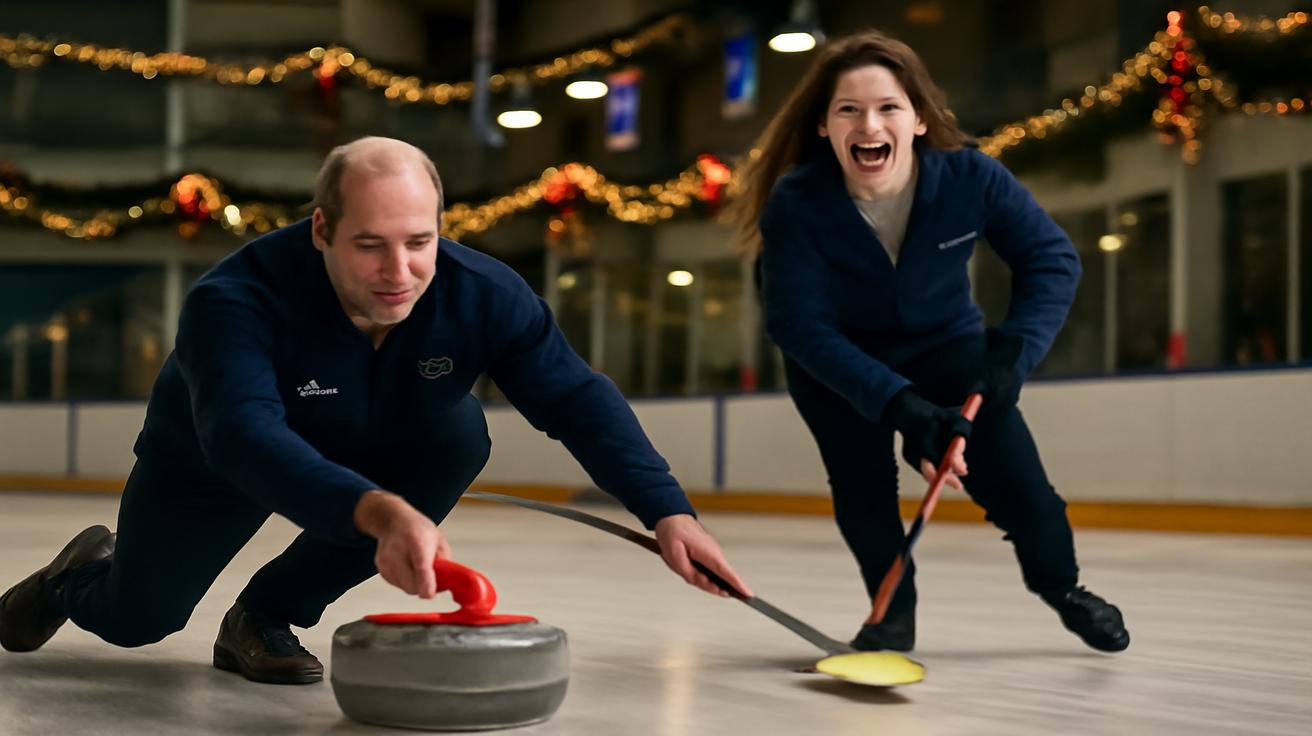
The ice catches the light like a frozen loch, all glittering shards and soft reflections, as a hush falls over the small arena in Scotland. Breath clouds the air in faint white puffs. Rows of local schoolchildren, bundled in puffer jackets and woolen scarves, lean forward from the stands, their whispers curling up like steam. At one end of the sheet, a man in a navy team jacket rolls his shoulders and grins. At the other, a woman in a pale, fitted coat plants her feet and bites her lip with mock determination. The Prince and Princess of Wales are about to face off in a curling challenge, and the air feels as charged as a Highland storm about to break.
A Royal Day on Scottish Ice
There is something almost storybook about the way the day has unfolded. Outside, the Scottish air carries the clean scent of damp earth and distant pine, the sky a shifting tapestry of pewter and silver. Inside the curling rink, though, it’s all about the ice—its careful grooming, its gently rippled sheen, its soft squeaks under rubber soles.
William, the Prince of Wales, looks right at home in this half-sporting, half-social space. His cheeks are slightly flushed from the cold, his smile easy and unguarded. Nearby, Catherine, Princess of Wales, laughs with a group of teenagers, her laugh bright enough that you can feel it, even before you hear it. There’s no stagey formality here, no stiff royal tableaux. Instead, there’s the gentle chaos of a community event: volunteers clutching clipboards, instructors explaining rules with wide hand gestures, parents craning their necks for a better view. The royal titles, for a moment, feel like a detail rather than the whole story.
The rink itself hums with layered sound: the subtle hum of refrigeration, the soft thud of curling stones being set down, the squeal of rubber soles, the murmur of Scottish accents—a melodic rise and fall, like birds over the Firth of Forth. A coach in a red jacket raises his voice over the mix to offer a last-minute reminder about safety and technique. “Remember: slow and steady, bend the knee, rock forward, and let the stone go. No heroics. Not yet.”
The Ancient Art of Sliding Stones
For many in the crowd, curling is part of the landscape, as familiar as wet leaves and low clouds. But for much of the world watching through news clips and photographs, the sport still feels like a whimsical curiosity—stones gliding in slow motion, people furiously sweeping in front of them as if sweeping were a matter of life or death. Here in Scotland, though, curling carries the weight of history.
Traced back to frozen ponds and lochs of the 16th century, curling once belonged to farmers and villagers looking for winter diversions, their footprints and laughter frozen into the ice along with the stones. The early games were played outdoors, on whatever frozen water could be trusted to hold a few brave souls and a heavy stone. Nowadays, climate-controlled arenas have replaced the uncertainty of winter weather, but the sport still has that earthy, communal feel—a kind of choreography of patience, skill, and strategy shared between friends and rivals.
On this particular day, the Prince and Princess are stepping into that lineage with a mix of curiosity and competitive spark. Their instructors keep it simple: a briefing on the basics, the difference between throwing too hard and too soft, the subtle twist of the handle that gives the stone its curl, that hypnotic, slow arc across the pebbled ice. “Think of it like chess,” one coach says. “Except you’re standing on a very slippery chessboard.”
Catherine’s eyes narrow with interest as she watches a demonstration stone slide gracefully into the house—the colored rings at the far end of the sheet. “It looks so calm,” she says. “Deceptively calm.” William, already rocking on his feet like a schoolboy about to be picked for a team, replies, “I’m not sure I can do calm.” A ripple of laughter passes through the group, loosening shoulders and breaking the last of the tension in the room.
The Face-Off: Prince vs. Princess
The challenge is simple, at least on paper: two small teams, one led by the Prince, one by the Princess. A handful of ends, a scattering of stones, and bragging rights at stake. But the energy feels anything but simple. The local children have chosen sides with a kind of organized chaos—some holding hand-drawn signs, others simply chanting names like a playground contest. The scoreboard, with its neat little numbers, suddenly feels like a big deal.
William takes to the hack first: that little foothold at the back of the sheet where the curler crouches before gliding out. He pauses, stone in hand, weighing it in his fingers as if expecting it to whisper advice. The stone is heavier than it looks, a solid, polished piece of granite with a handle that seems too small for all the drama it’s about to cause.
He lowers himself into a practiced-enough crouch, guided by his instructor. There’s an awkward wobble that draws a ripple of amusement from the stands—he recovers, grinning. Then, with a breath that fogs the air, he pushes off. His body extends, one knee bent, the other leg sliding behind in a long, careful line. The stone glides away with a quiet shush, handle turned to give it that slow, distinctive curve.
For a moment, there is only the sound of the stone on ice, the soft brushes of the sweepers’ brooms as they judge whether to coax it just a bit further. The crowd leans in. William’s mouth is half-open, like he’s willing the stone forward. It nestles just off-center in the house, close enough to count, perhaps, depending on what comes next. The instructor claps him on the shoulder. “Not bad for a first shot, Your Royal Highness.”
Then it’s Catherine’s turn. She kneels at the hack with a focus that makes the kids in the stands go completely silent. Her fingers adjust on the stone’s handle, testing its grip. There’s a quick exchange with her coach, a nod, a slightly mischievous smile thrown in William’s direction. Then she glides: smooth, controlled, her posture steady as she releases the stone with a movement that’s more ballet than brute force.
This time, the stone takes an almost poetic path—wide at first, then curling inward with that slow, predictable magic that makes curling so quietly gripping. The sweepers anticipate, scrubbing the ice with sharp, efficient motions, shoes squeaking. The stone drifts toward William’s, slows, and finally comes to rest just inside his, closer to the center of the house. There’s an instant roar from her side of the stands: triumph, delight, the thrill of an underdog moment even in a game that’s more friendly than fierce.
William claps, shaking his head. “That’s outrageous,” he says, but his grin betrays total enjoyment. “I think I’ve been hustled.” Catherine only shrugs, eyes sparkling. “Beginner’s luck,” she replies, not fooling anyone in the building.
Different Styles, Same Ice
As the ends stack up, a quiet pattern emerges. William tends toward bold shots, occasionally overthrowing the stone, sending it gliding through the house with a touch too much energy. When he misjudges, he reacts in exaggerated horror, hand to forehead, sending the kids into gales of laughter. When he nails it—dropping a stone into a tight gap with just enough weight—he accepts the cheers with mock aristocratic bows.
Catherine’s approach is different. She’s methodical, asking questions after each throw, adjusting her stance and release. By the second end, her throws have a new consistency, each stone gliding with a calm, steady pace, like a boat cutting through a still loch at dusk. Her stones begin to cluster near the button—the tiny center point—one after another, stacking points like pebbles on a cairn.
Between shots, they tease each other. “You realize this is being watched,” William calls down the sheet after one especially sharp shot from Catherine. “I’m never going to hear the end of this at home.” She arches an eyebrow and calls back, “You should have practiced more.” The crowd eats it up. For a moment, this modern royal couple are less symbols and more teammates on opposite sides of a community sports day: spouses ribbing each other, parents trying something new, two people learning the feel of the ice under their feet.
The Crowd, the Kids, and the Curling Stones
Beyond the bright focal point of the royal challenge, the rink pulses with quieter stories. A teenage girl on Catherine’s team keeps glancing shyly toward her, as if trying to memorize every word of advice. A boy on William’s side mimics his crouch in exaggerated slow motion, collapsing into giggles when his friends shove him playfully.
The coaches, local curlers who’ve spent countless hours on sheets like this, wear expressions of quiet pride. Today is not just about the royal visit; it’s about the sport they love, the icy geometry of it, the way it welcomes players of almost any age or athletic background. Curling is not a sport of towering physiques or explosive sprints. It’s about balance and strategy, small adjustments, steady breath. It rewards patience, conversation, teamwork—the sort of virtues that don’t always make highlight reels but build communities quietly from the inside out.
As the royal couple trade stones, a subtle rhythm emerges to the event: the liquid glide of each throw, a surge of cheering, a moment of commentary from the coaches, then the hush before the next turn. The arena becomes its own small world, bound together by chilled air and shared attention. Outside, the low Scottish clouds press close; inside, faces are lit by overhead lights and the occasional flash of a camera.
A Friendly Scoreline
By the final end, the game has taken on a playful urgency. The scoreboard—once an afterthought—is now a magnet for glances. Catherine’s team, with their clustering, careful shots, has edged ahead. William’s team, more dramatic and risk-taking, has pulled off a couple of stunning last-stone steals but still trails by a sliver.
For the deciding stones, everyone seems to hold their breath. William’s last throw is ambitious, an attempt to knock one of Catherine’s counters out of the house and carve out a narrow victory. The stone rockets forward, starts its curl, and clips its target—but at a slightly cruel angle. His stone rolls just a bit too far, sliding out of the scoring zone as the crowd groans in collective sympathy.
Catherine steps into the hack with that now-familiar steadiness. She doesn’t need anything spectacular—just a stone placed in a safe, scoring position to secure the win. Her release is smooth, almost serene. The stone glides down the sheet, curling gently to rest among her other counters, as if it’s been doing this for decades.
Applause rises, peppered with cheers and good-natured hollers. The final tally goes to the Princess’s team. She covers her mouth in a half-embarrassed, half-delighted laugh. William jogs down the sheet, hands spread in theatrical surrender.
| Team | Skip | Style of Play | Result |
|---|---|---|---|
| Team Wales – Blue Stones | Prince William | Bold shots, power plays, dramatic take-outs | Narrow Loss |
| Team Wales – Red Stones | Princess Catherine | Measured draws, patient placement, quiet precision | Win |
They shake hands with their teammates, the formality of the gesture softened by the laughter and shared glances. There are no stern faces, no fixed royal smiles; instead, there is the relaxed warmth of people who’ve just done something quietly challenging together, and done it well enough to feel proud.
Why This Little Game Matters
On the surface, it was a light-hearted moment: two well-known figures sliding stones across Scottish ice, trading jabs and smiles. But beneath the easy charm lies something more layered. The Prince and Princess of Wales didn’t just drop in for a quick photo; they crouched on the ice, slipped a little, listened intently, and put their reputations on the line in front of a crowd of discerning, and often unforgiving, young spectators.
There’s a subtle power in that. Curling, with its slow burn and emphasis on strategy, is a particularly democratic sport. It doesn’t lend itself to instant mastery. Even the experienced can misjudge a throw by a whisper of force or an inch of line. Watching two of the world’s most recognized faces wrestle with that learning curve connects the royal bubble with everyday experience. Every wobble, every overthrown stone, every small triumph lands somewhere close to home for anyone who’s ever tried something new in front of watchful eyes.
It also highlights something quintessentially Scottish. This is not a grand Highland hunt or a sweeping ceremony at a castle; it’s a community rink, the scent of rubber and ice, changing rooms with benches lined with coats and trainers. This is Scotland on an ordinary day—school groups, local coaches, volunteers handing out hot drinks—and the royals, for this brief stretch of time, moving within that ordinary rhythm.
Outside, the day has started to darken, that quick Scottish slide from afternoon to early dusk. The arena doors open now and then, letting in a gust of cold air carrying the smell of rain-soaked stone and distant traffic. Inside, the warmth persists in conversations: kids comparing autographs, coaches recounting the tightest shots, volunteers already replaying the best moments in their minds.
A Last Look at the Ice
Before they leave, William and Catherine walk back once more to the edge of the sheet. It’s quieter now, the formalities complete, the main crowd beginning to thin. The ice bears the faint scuffs and marks of the morning’s play—a constellation of stories frozen in its surface.
Catherine steps up to the barrier, fingertips just touching the cold, smooth edge. She smiles in that thoughtful way of someone replaying her own tentative first throw and the surprising success that followed. William, beside her, shakes his head with a good-natured groan. “I’ll be hearing about that scoreline for years,” he says softly. But there’s pride in his voice too—pride in her, in the event, in the shared experience they’ve just had with a slice of Scotland.
They turn away at last, their footsteps echoing across the concrete, and the rink begins its slow return to normal life. Soon, it will be local leagues and practice sessions again, teenage teams dreaming of championships, older players savoring the familiar ache in their knees and the gentle clink of stone on stone. The royal visit, with its friendly rivalry and newsworthy charm, will settle into local lore: the day the Prince and Princess of Wales took to the ice and discovered just how slippery, and how satisfying, a Scottish sheet of curling ice can be.
In that memory, the sport itself is the quiet winner: a centuries-old game that once danced across frozen lochs and now, for a few shining ends, brought royalty, children, and coaches together in the same breath-held silence as a stone curled toward its mark.
Frequently Asked Questions
Did the Princess of Wales actually win the curling challenge?
Yes, in the friendly face-off described here, the Princess of Wales’ team edged out the Prince’s team thanks to more consistent, carefully placed shots. The event was light-hearted, but her competitive streak and quick learning on the ice certainly showed.
Is this kind of royal sports challenge common during visits?
It has become increasingly common for members of the royal family to take part in local sports or activities during engagements. These moments help connect them with communities in a relaxed, relatable way, whether it’s sailing, rugby, or, in this case, curling on Scottish ice.
Why was curling chosen for this engagement in Scotland?
Curling has deep roots in Scotland, with a history stretching back several centuries. Including it in a royal visit highlights an authentic piece of Scottish culture and supports local clubs that promote physical activity, teamwork, and community ties.
Is curling difficult for beginners like the Prince and Princess?
Curling is accessible to beginners but has a steep curve for true mastery. New players can learn the basics of sliding a stone and sweeping in a short session, as the Prince and Princess did, but understanding weight, line, and strategy takes much longer. That mix of approachability and depth is part of its appeal.
Can anyone try curling at a local rink in Scotland?
Most Scottish curling clubs and rinks offer introductory sessions for newcomers, often called “try curling” or beginner days. They provide equipment and coaching, so participants only need warm, flexible clothing and a willingness to step onto the ice and learn.





Leave a Comment