
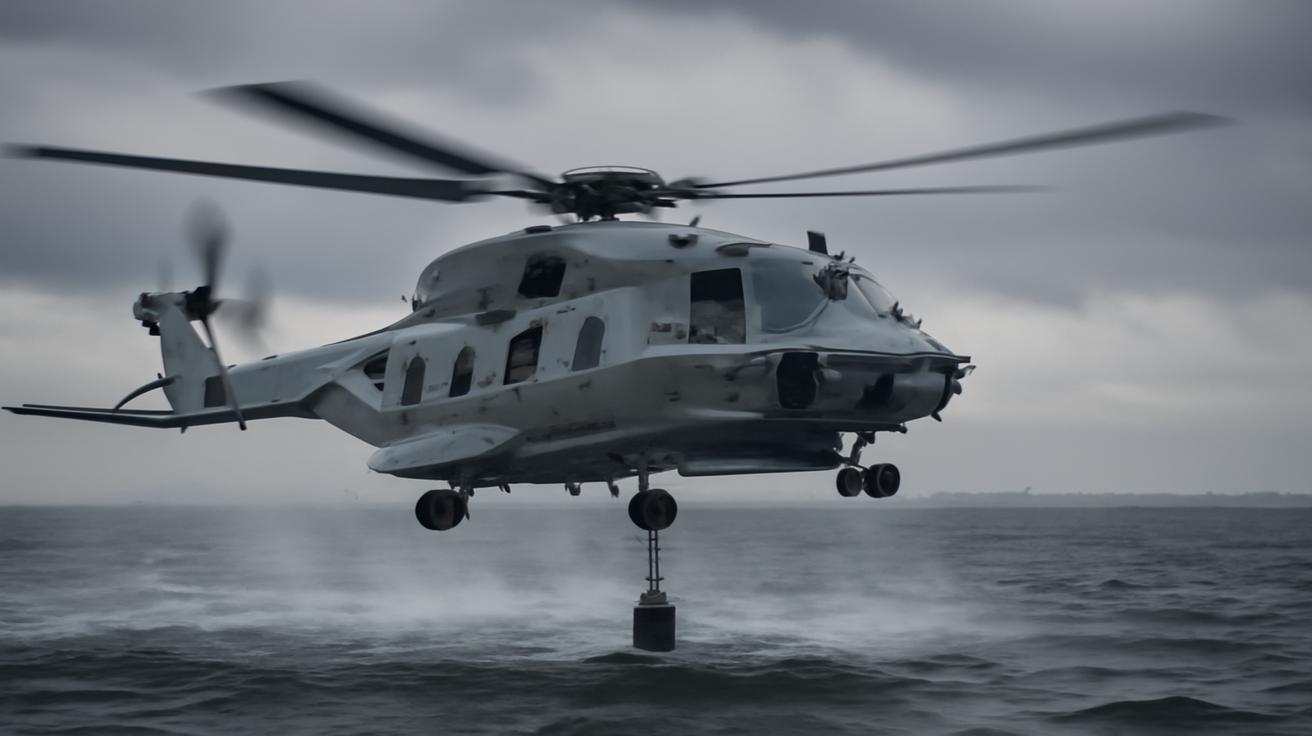
The North Sea was breathing. Long, slow swells rolled in the faint light, their backs silvered by an overcast sky. On the gray horizon, a Dutch frigate cut a quiet path through the water, its wake folding back into the restless sea. Above, a gull wheeled and cried once, lost in the wind, as a dark shape emerged from the haze—a helicopter, its rotors carving the mist into spirals. The familiar outline of the NH90 NFH hovered for a heartbeat over the deck before sinking gently toward the waiting crew. Steel, salt, and rotor wash. The Netherlands’ navy, meeting its most trusted airborne companion once more.
The Sea’s Changing Mood
The sea that once carried wooden ships now hums with advanced sensors, encrypted radios, and composite rotor blades. For the Royal Netherlands Navy, the North Sea is no longer just a maritime highway; it is a layered, contested space, where trade routes, energy fields, and security interests overlap like shifting tides. Beneath the waves, cables pulse with data, pipelines feed continents, and the muffled echoes of ships and submarines blend into a low, constant murmur.
It is in this intricate, invisible web that the NH90 NFH—NATO Frigate Helicopter—plays its part. When the Netherlands quietly decided to order three additional NH90 NFH helicopters, it was more than a simple expansion of a fleet. It was a tacit acknowledgment that the sea’s mood has changed, and that the tools needed to understand and protect it must change as well.
The NH90 NFH is not just an aircraft; it is a listener, a watcher, a translator of signals that human senses can never perceive. Its radar sweeps for shapes on restless horizons. Its sonar reaches into darkness, searching for the mechanical heartbeats of submarines. Its crew reads patterns in noise and distortion the way a seasoned mariner reads the sky.
For the Netherlands, a coastal nation whose history, economy, and identity are bound to water, these capabilities are no luxury. They are the modern equivalent of lighthouses and coastal forts, but now the beams are radar pulses, and the battlements ride on the wind.
What Makes the NH90 NFH Different?
Stand beneath an NH90 NFH on a quiet airfield—before the rotors spool up, before the smell of aviation fuel sharpens and the engines rise from a whisper to a roar—and you notice its balance. There is nothing ornamental. Every panel, sensor, and hatch has its place, designed to endure salt, wind, and the punishing flex of launch and recovery at sea.
Unlike helicopters built primarily for land operations and then modified for the ocean, the NFH variant was born for saltwater. Its airframe is treated and sealed against corrosion; its systems hardened to survive the harsh, damp, metallic air that eats into metal and wiring. When it lands on a frigate’s deck, it marries itself to the ship through harpoon and grid systems, locking down against the shifting tilt of the hull in heavy seas.
Inside, the cabin feels like a cross between a laboratory and a command center. Banks of screens glow softly. Data scrolls, blinks, and steadies into recognizable shapes for the operators hunched over them in dark flight suits. There is a quiet choreography in motion: pilots up front, eyes split between instruments and sky; tactical operators in the rear, fingers flicking across controls for radar, sonar, electronic support measures.
The NH90 NFH is a multirole machine by design, capable of moving between missions that seem, at first glance, utterly different. One day it might be dipping its sonar to search for a submarine threading silently along the continental shelf. The next, it could be hunting for a small, overloaded vessel carrying refugees or intercepting smugglers in choppy seas. Another day, it might be evacuating a sick sailor from a fishing boat, the downwash of its rotor whipping spray into the air as a rescue hoist rattles down toward outstretched hands.
Built for a Sea Full of Stories
The sea is not simply a battlespace for the Dutch navy; it is a place full of human stories—trawlers chasing dwindling fish, tankers pushing global commerce from horizon to horizon, families watching the tide from wind-scarred dunes. The NH90 NFH fits into all of these stories, sometimes loudly, sometimes as a distant shape against the clouds.
Its sensors are tuned not only to track threats, but to find people in trouble, to spot life rafts or heat signatures in darkness and storm. A thick bank of fog can erase visual landmarks in an instant, but the helicopter’s radar can still draw a skeletal coastline on its screens, marking out the spaces where help is needed.
To sailors who have watched one of these helicopters approach their ship in rough weather, it becomes a kind of reassuring myth made real: the bird that can find you in the gray, that brings medicine, spare parts, fresh faces—and sometimes the only way home.
Why Three More? Quiet Signals in a Noisy Ocean
On paper, the Netherlands’ decision to order three additional NH90 NFH helicopters can be captured in a few lines: fleet renewal, operational availability, enhanced mission coverage. But reality is always richer and more textured than the language of procurement documents.
Every helicopter has a rhythm of life: flying hours, meticulous maintenance, upgrades, inspections, the inevitable slow burn of wear and tear. For a small, highly capable fleet like that of the Royal Netherlands Navy, each additional aircraft is more than just a number added to a spreadsheet. It is breathing room. It is resilience in the face of the unexpected.
Imagine a week where one NH90 is deployed with a frigate on a NATO mission, tracking submarines in the North Atlantic. Another is flying maritime security patrols closer to home, watching the arteries of shipping lanes that keep Europe’s ports alive. A third is deep into scheduled maintenance. A fourth is assigned to search-and-rescue duty and cannot be spared. When a crisis unfolds—an unresponsive vessel, a suspicious contact, a storm-churned emergency—choices become tight, and the margin for error narrows.
By adding three more helicopters, the Netherlands is thickening the weave of its maritime safety net. More aircraft mean more flexible coverage, fewer gaps when one asset is grounded, and better support for allies who increasingly rely on each other to watch, patrol, and respond across shared seas.
The North Sea as a Living Map
Look at a modern maritime map of the North Sea, and it is crowded with symbols. Offshore wind farms sketch delicate constellations across the water. Shipping lanes form ribboned highways. Oil and gas platforms stand like small outposts at sea. Environmental protected zones, fisheries, training areas—they all jostle for room in a basin that once seemed endless.
In such a map, helicopters like the NH90 are moving, sensing nodes. Their presence helps stitch together a real-time understanding of activity across thousands of square kilometers. Through radar, AIS tracking, radio intercepts, and visual identification, they turn lines and symbols into stories: who is out here, doing what, going where, and why.
The additional three helicopters make it easier for the Netherlands to keep this living map continually updated—to fill in the blank spaces where uncertainty can grow, and where small problems can become big ones if left unnoticed.
Life Aboard: People Behind the Machines
It is easy to get lost in specifications: range, payload, sensor suites, top speed, endurance. But a helicopter, no matter how advanced, is only alive when people are moving inside it, strapping in, switching systems on, turning checklists into muscle memory.
Talk to a Dutch navy pilot about the NH90 NFH, and you might hear about that one night when the weather turned ugly over the North Sea. About the feel of the controls as crosswinds buffeted the aircraft during a deck landing. About the eerie green glow of night-vision goggles as they hovered over inky black water, trusting instruments more than their own senses.
A sensor operator might tell you about the strange intimacy of listening to the sea through sonar—the rising and falling of distant propellers, the subtle differences between merchant ships, fishing boats, and something that might be, just might be, a submarine. The slow sharpening of a contact on their screens. The rushed exchange of numbers, bearings, ranges. The crew’s silent awareness that they might be the first to notice something that was not meant to be seen.
The arrival of three additional helicopters is, for these crews, both promise and challenge. More machines mean more sorties, more missions, more opportunities for training and real-world experience. But it also means more young aviators to mentor, more technicians to train, more stories to pass down about what can go wrong in this demanding space between sky and sea—and how to handle it when it does.
From Hangar to Horizon
In the hangars where these helicopters are assembled, maintained, and upgraded, the air smells of oil and metal, with a faint sweetness of new paint. Technicians move in a precise dance around airframes perched on jacks. Panels are removed, wiring looms inspected, blades measured and balanced.
For them, the lives of crews depend on tiny details: a correctly torqued bolt, a carefully routed cable, a checklist performed at the end of a long shift when focus must not falter. They rarely see the sea from the cockpit; their horizon is the hangar door. Yet every safe landing, every mission flown, carries their unseen fingerprints.
The additional helicopters will flow through these spaces as well, passing from factory acceptance to naval integration, from testing to training, and finally to the decks of ships where salt and sun will start writing their own marks on paint and metal.
Technical Soul: Quiet Power Under the Skin
For those who like to understand the skeleton and sinew beneath a machine’s skin, the NH90 NFH is a study in compromises struck with care. It must be powerful but not wasteful, rugged yet light, heavily equipped yet nimble enough to slip into tight deck spaces in heavy seas.
The twin engines deliver the thrust needed to lift not just the helicopter itself, but also weapons, sensors, and sometimes rescued passengers or extra cargo. Fly-by-wire controls, unusual in many helicopters, mean its movements can be smoothed and assisted by computers, taking some burden off pilots during complex maneuvers like shipboard landings in rough weather.
Its radar can scan wide stretches of sea, locking onto contacts and tracking their course. Its sonar—whether towed or dipped into the water—sends out pulses that bounce off hulls hidden below, turning void into a three-dimensional soundscape. Electronic support measures quietly listen for emissions, trying to understand what is out there not by what can be seen, but by what can be heard across the electromagnetic spectrum.
Armed, it can carry torpedoes and sometimes anti-ship missiles, turning from observer to hunter if required. Unarmed, it can still change outcomes by the information it brings back, the people it rescues, or the message its presence sends: you are seen.
To understand at a glance how this helicopter fits into the Dutch maritime picture, it helps to see a simple comparison:
| Feature | NH90 NFH (Netherlands) | Typical Older Naval Helicopter |
|---|---|---|
| Primary Role | Anti-submarine & anti-surface warfare, SAR, maritime patrol | Limited anti-submarine and surface roles, basic SAR |
| Avionics | Fully integrated, digital, fly-by-wire | Analog or mixed, less integration |
| Sensors | Advanced radar, dipping sonar, ESM suite | Older radar, basic sonar, limited ESM |
| Shipboard Operations | Optimized for modern frigate decks, harpoon & grid systems | Less automated deck handling, more crew-intensive |
| Mission Flexibility | High—rapid role change between combat, patrol, and rescue | Moderate—often specialized for fewer roles |
A Tool for Today’s Subtle Pressures
It is tempting to imagine modern military decisions as responses only to dramatic events: a crisis, a standoff, a surge in visible tension. Yet much of what shapes a decision like ordering three more NH90s is quieter and slower—a gradual thickening of responsibilities, an accumulation of missions, a rising expectation from allies that the Netherlands will be there when called.
The helicopter’s technical strengths fit these subtle pressures. Modern conflicts and crises often unfold in the shadows: unmarked vessels, ambiguous incidents near critical infrastructure, unexplained disruptions in shipping. The answer is seldom a show of overwhelming force. It is persistent presence, precise awareness, and the ability to react quickly without making things worse.
By strengthening its NH90 fleet, the Netherlands is investing in precisely that sort of capability: the quiet, competent, day-in, day-out work of watching, responding, and reassuring in a sea that matters far beyond its visible surface.
Looking Ahead: A Sea That Never Sleeps
Stand again on that frigate’s deck, the North Sea heaving beneath your boots. The NH90’s engines begin to throttle back as the rotors slow, their thump fading into the wind. Crew members move in, guiding, chocking, securing. Within minutes, the sleek machine that had seemed so alive in the air becomes still, folded blades and clamshell doors making it look almost like a sleeping animal tucked into its steel den.
But even at rest, the presence of this helicopter means something. It means that the ship can reach further beyond the horizon, can see further into the gray, can act with more confidence in uncertain situations. It speaks of a nation that, despite its small size, understands the scale of its maritime responsibilities and has decided not to look away.
The three additional NH90 NFH helicopters the Netherlands is bringing into its fleet will spend their lives in this liminal zone—between air and sea, conflict and routine, crisis and calm. They will age in salt and sunlight, their paint dulled by countless missions that never make headlines: patrols where nothing happens, rescues where everything does.
And when, years from now, someone stands on a cold quay and watches one of them lift into a leaden sky, they might not know about procurement decisions or technical specifications. They will simply see a shape rising into the wind, carrying with it the quiet promise that, out there where the sea is deep and the weather turns without warning, someone is watching, listening, and ready to come.
Frequently Asked Questions
Why did the Netherlands order three additional NH90 NFH helicopters?
The Netherlands ordered three more NH90 NFH helicopters to increase operational availability, improve coverage for maritime missions, and provide more flexibility for deployments, maintenance cycles, and training. It strengthens the country’s ability to conduct anti-submarine warfare, surface surveillance, and search-and-rescue in its surrounding seas and beyond.
What does “NFH” stand for in NH90 NFH?
“NFH” stands for “NATO Frigate Helicopter.” This variant of the NH90 is optimized for operations from naval vessels, particularly frigates, and is equipped with specialized maritime sensors and systems for anti-submarine and anti-surface warfare.
How are these helicopters used by the Royal Netherlands Navy?
They are used for anti-submarine warfare, monitoring and tracking surface vessels, search-and-rescue missions, maritime security patrols, and support to international operations with NATO and European partners. They often deploy aboard Dutch frigates and other naval ships.
What makes the NH90 NFH suitable for operations at sea?
The NH90 NFH is designed from the outset for maritime use. It features corrosion protection for saltwater environments, advanced shipboard landing and securing systems, compact folding blades for hangar storage, and robust avionics and sensors that operate reliably in challenging weather and sea conditions.
Will these additional helicopters be used only for military missions?
No. While military roles such as anti-submarine and surface warfare are central, the helicopters are also used for non-combat tasks like search and rescue, medical evacuations, humanitarian support, and maritime safety missions that directly support civilians and commercial activity at sea.







Leave a Comment