
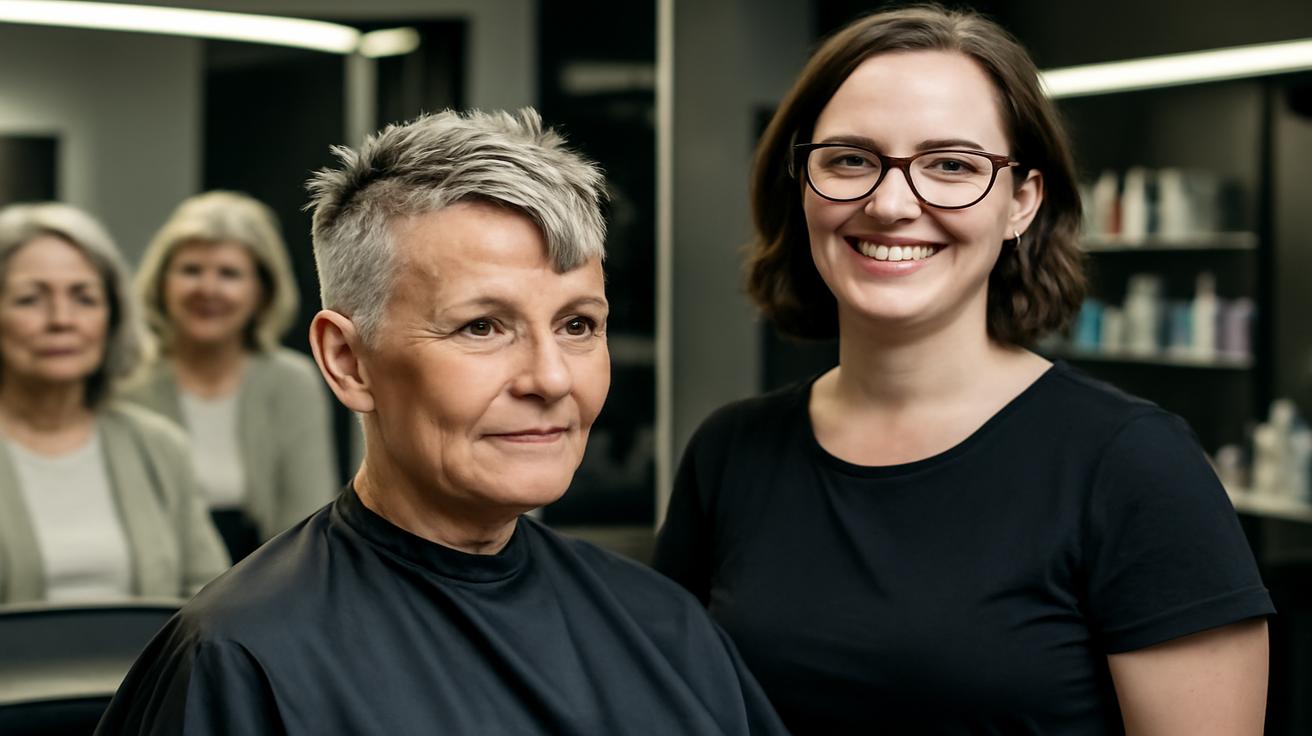
The first time Lila walked into the salon and asked for a spiky platinum pixie, the room went quiet in that small, almost audible way. You know the kind—when scissors pause mid-air, a blow dryer clicks off, and a few eyes flash up in the mirror, pretending not to stare. She was 67. Her hair was fine as spider silk, thinning at the crown, the kind that “should” be treated delicately and politely. A soft bob, maybe. A tidy crop. Something that whispered, “I’m aging gracefully,” in a voice no one would find threatening.
Instead, Lila wanted hair that shouted.
“I want to feel fast again,” she told her stylist, flipping through inspiration photos on her phone. “Not invisible. Fast.” The stylist, a woman in her thirties with cobalt-blue hair and forearms tattooed in curling wildflowers, studied her for a long second and smiled. “Then we’re going short. Really short.”
The cut that followed started as a practical solution for fine hair and became a small act of rebellion. Short hair on women over 60 is hardly new—but certain short cuts? On fine hair? At that age? Entire comment sections online combust over them. Words like “age appropriate” and “trying too hard” start flying around like gnats in summer. Meanwhile, stylists quietly keep doing what they’ve always done: matching the right cut with the right person, rules be damned.
The Pixie That Refuses to Behave
There’s a particular kind of pixie that has become almost notorious in stylist circles: short at the nape, textured on top, sometimes asymmetrical, often paired with bold color. On paper, it sounds simple. On an older woman with fine hair, it becomes a lightning rod.
“They say it’s too edgy for my age,” laughs Carmen, 72, as she runs her fingers through her soft, feather-light strands. Her pixie is cut close around the ears but explodes into messy volume on top, all choppy angles and deliberate chaos. Her hair is naturally fine and straight, but with a razor cut and a little paste, it suddenly has grit, attitude—even lift at the roots.
This cut works so well for fine hair because it doesn’t pretend there’s more density than there is. Instead, it uses every strand like it matters. Layers remove weight where hair tends to collapse, and shorter lengths make what remains look fuller. You don’t need thick, abundant hair to pull it off; in fact, fine hair often gives this pixie a soft, airy movement that thick hair can’t easily mimic.
So why the controversy? Partly, it’s because this style is unmistakably visible. There’s nothing “background” about it. It frames the face, emphasizes cheekbones, and showcases every line earned over six-plus decades of laughing and frowning and thinking. Critics mutter that it’s “too young,” yet the cut itself has nothing to do with youth. It’s about sharpness and clarity. It reveals rather than conceals.
Stylists, on the other hand, swear by this cut for women over 60 with fine hair who are ready to stop fighting limp mid-length layers and start working with what their hair naturally wants to do.
The Micro-Bob That Divides the Room
Then there’s the micro-bob—a razor-sharp line that hits somewhere between the cheekbone and mid-neck, sometimes with a slight angle, sometimes blunt, sometimes with a micro fringe that makes people gasp out loud. If the classic bob is a politely folded napkin, the micro-bob is a sleek little blade on the dinner table.
Jenna, 64, had worn a shoulder-length bob for most of her working life. It was… fine. A careful, corporate kind of fine. But her fine hair never quite filled it out. The ends always frayed into wispy transparency; the ponytails were thin and tired. After retiring, she walked into a downtown salon with floor-to-ceiling windows and said, “I’m bored with being sensible.”
Her stylist cut her hair to just under the jawline—shorter at the back, longer towards the front, using internal layers so subtle you couldn’t see them but you could feel the volume. On wash days, Jenna’s fine hair now fell into place with a gentle bend that made it look thicker than it had in decades.
Critics, however, had opinions. “Too severe.” “Too sharp.” “Too fashion-forward for her age.” As if the calendar on your phone also controls how many inches of hair you’re allowed to remove at each birthday.
Fine hair over 60 responds beautifully to this cut when done thoughtfully. The shorter length reduces the drag that weighs down fine strands. Precision cutting creates clean movement, and a well-placed angle can visually lift the jawline. It’s not the micro-bob that’s controversial, really—it’s the suggestion that at a certain age, you’re not supposed to look intentionally stylish anymore.
The “Shattered” Crop That Looks Like Freedom
Some cuts don’t care about neatness, and that’s exactly their power. The shattered crop—short, highly textured, with uneven, piecey ends—is the haircut equivalent of kicking off your shoes in the grass. It’s not a smooth helmet. It doesn’t say, “I spent an hour with a round brush this morning.” It says, “I have better things to do.”
This style makes particular magic on fine hair. Traditional layering can sometimes leave fine hair looking stringy, but a good shattered crop uses deliberate irregularity to create movement and volume. Short, flicked-out pieces around the crown and hairline give the illusion of fullness, while tapering at the nape keeps the overall silhouette light and modern.
But this cut also draws fire. It’s often described—usually by people who aren’t wearing it—as “messy,” “trying too hard to look young,” or “too rock-and-roll.” The unspoken expectation is that older women should aim for tidy, controlled, and softly rounded styles. Hair that behaves. Hair that stays in its lane.
Stylists see something else. They see a chance to give fine, thinning hair a new language. When a shattered crop is customized to face shape and natural texture, it can make hair feel incredibly alive with very little length. A bit of volumizing spray, a quick scrunch, and the hair looks intentionally disheveled in a way that feels liberating rather than chaotic.
It’s controversial because it challenges a quiet rule: that women should grow increasingly invisible with age. A shattered crop refuses to disappear. And that, more than the length, is what some people can’t handle.
The Bold Fringe That Steals the Show
Fringe on fine hair over 60 is its own battlefield. The truly divisive one? The bold, statement fringe: straight across, softly choppy, or curved like a crescent moon just brushing the brows. Pair that with short hair and you have a look that critics often label “too dramatic” or “too trendy.”
Listen to most advice aimed at women past 60 and you’ll hear a familiar refrain: “Avoid heavy bangs; they’ll drag your face down; they’ll emphasize lines.” But step into a modern salon and ask a stylist who loves working with fine hair, and you’ll get a much more nuanced story.
When done right, a bold fringe can actually lift the whole face. On fine hair, it’s typically cut using slicing or point-cutting techniques to keep the edges soft and feathered rather than blunt and blocky. The fringe draws attention to the eyes, balancing forehead lines and making cheekbones appear more defined. And because fine hair lies naturally close to the head, the fringe tends to fall in an easy, flattering curtain instead of sitting stiffly on the forehead.
The controversy comes from old ideas about who “deserves” to have a focal point on their face. A dramatic fringe doesn’t let you fade into the background. It announces your presence as soon as you walk into a room. Combined with a short cut—whether a pixie, crop, or mini-bob—it can completely reframe your profile.
Critics might call it desperate. But listen to the women wearing it and you hear something different: “I finally recognize myself again,” or “My face feels like art instead of an afterthought.” Those aren’t the words of desperation. They’re the language of reclamation.
The Silver Shock: Color as a Provocation
Color, of course, throws fuel on every one of these short cuts. Leave your hair its natural silver and some people will say, “At least that’s age appropriate, even if the cut isn’t.” Add icy highlights, a violet toner, or—scandal of scandals—a bright pastel or bold copper, and suddenly your hair is a conversation topic at family gatherings.
For fine hair, color is both a risk and an opportunity. Heavy bleaching can compromise already delicate strands, but subtle lightening, glaze, or tonal enhancements can add the illusion of thickness and luster. Stylists who specialize in mature hair talk about “optical volume”—creating depth and brightness in specific areas so that fine hair appears fuller without teasing or excessive styling.
Here’s the truth, though: the controversy isn’t really about what color looks “best” on fine hair over 60. It’s about what color is considered acceptable for that age group. There’s a quiet expectation that older women should choose restrained, muted tones, as if vibrancy is a privilege that expires with a certain birth year.
In practice, some of the most arresting short hairstyles for fine hair over 60 come alive not in spite of bold color, but because of it. A textured pixie in shimmering steel gray with icy highlights. A shattered crop with soft rose-gold accents shimmering through the top layers. A micro-bob with deep, shadowy roots fading into moonlit silver at the ends.
Stylists see color and cut as tools for expression, not age markers. Critics see a breach in the unspoken contract of “growing old gracefully,” where “graceful” often functions as code for “quiet” and “unobtrusive.”
Choosing Your “Controversial” on Purpose
Behind all this noise—the comments, the unsolicited feedback, the whispered “At her age?”—there’s a simple, grounding reality: hair is both wildly personal and completely renewable. Especially when it’s short. It grows. It changes. It can be redone. The risk is smaller than the cultural drama surrounding it would have you believe.
For women over 60 with fine hair, choosing a short, attention-grabbing cut isn’t really about trying to be younger. If anything, it’s often about stopping the performance of being younger—or older—and just being fully, unapologetically themselves.
The best stylists start not with a template, but with a conversation. What does your daily life look like? How much time do you really want to spend styling? Do you like your hair to feel soft to the touch, or do you prefer a bit of grit and hold? How do you feel about your neckline, your jawline, your forehead? Not in the judgmental sense, but in the deeply practical, “What do you want to highlight?” sense.
That’s where the so-called “controversial” cuts often emerge: when a stylist listens closely enough to hear the part of you that’s tired of compromise, and then shapes your fine hair to match that voice.
| Style | Why Stylists Love It for Fine Hair 60+ | Why Critics Call It “Age Inappropriate” |
|---|---|---|
| Textured Pixie | Adds lift at the roots, uses every strand for movement, easy to style with minimal product. | Seen as too edgy, too bold, or “too young” because it exposes the face and neck. |
| Micro-Bob | Shorter length makes fine hair look thicker; strong shape modernizes the face. | Considered too sharp or “fashiony” for traditional expectations of older women. |
| Shattered Crop | Textured ends create airy volume and freedom from heavy styling routines. | Viewed as messy or rebellious, challenging the idea of neat, controlled “mature” hair. |
| Bold Fringe with Short Cut | Draws focus to the eyes, softens forehead, adds personality to fine hair. | Criticized as dramatic or attention-seeking, especially with strong shapes. |
| Short Cut + Striking Color | Strategic color adds depth and the illusion of fullness to delicate strands. | Bold shades are often labeled “too much” or “trying to look younger.” |
Living Inside the Haircut
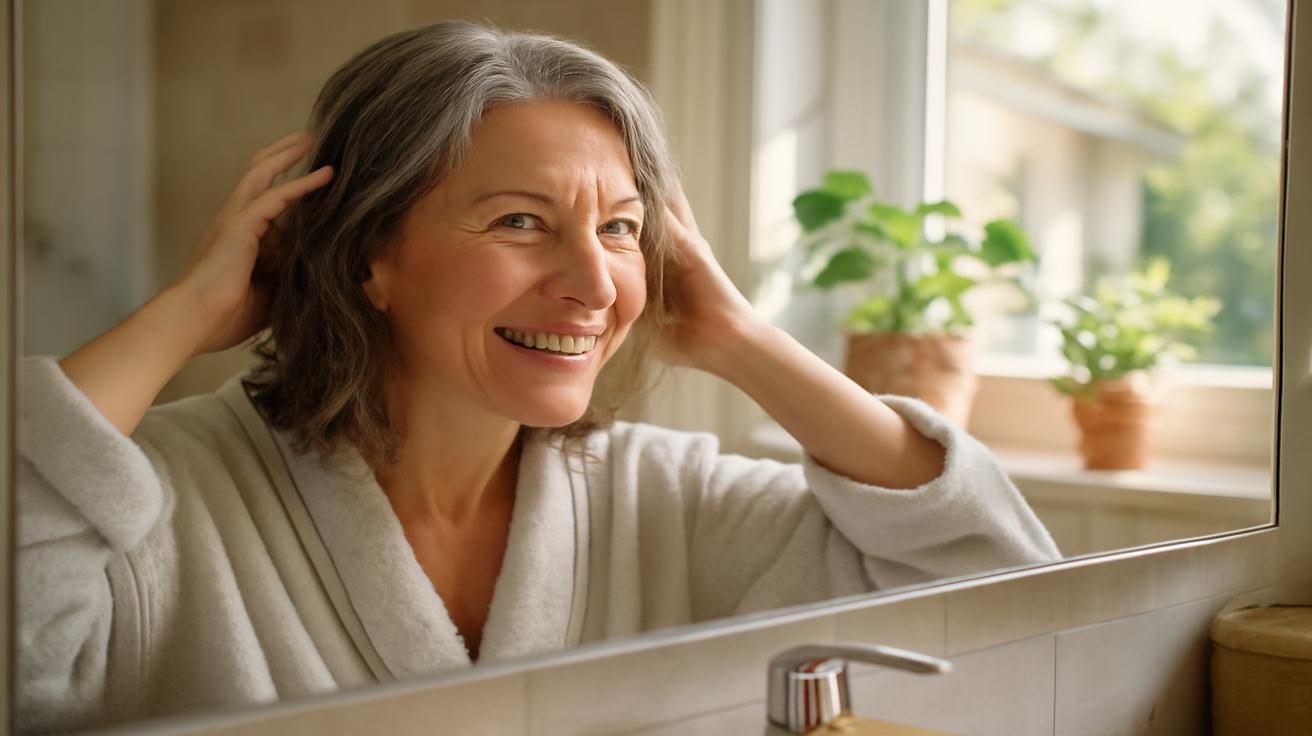
What makes a haircut controversial isn’t the inches on the floor. It’s the way you inhabit it once you leave the salon. The feel of cold air brushing the back of your neck for the first time in years. The freedom of washing and drying your fine hair in five minutes flat. The shock of seeing your whole face again in the mirror—lines, stories, everything—and realizing you don’t hate it.
There’s a quiet revolution in the way many women over 60 are approaching their hair now. Not as camouflage. Not as a performance of youth or a bow to age. But as a living, changing part of how they move through the world. Fine hair, once dismissed as “difficult,” becomes a playground for texturizing, strategic cutting, and sculpted shapes that float instead of flop.
You may still get the comments. A relative might tug at a piece of your new crop and say, “Interesting choice.” A stranger might tell you they liked your hair “better before.” A friend your age might whisper, half-tempted, half-terrified, “I could never pull that off.”
Your stylist will know better. They’ll see how your shoulders sit a little higher in the chair now. The way you tilt your head to admire your jawline or the angle of your fringe. The way your fine hair, at last, looks like it belongs to someone who is still very much here, not fading into the background of her own life.
So yes, these short hairstyles for fine hair over 60 are controversial. They’re talked about, judged, applauded, and side-eyed. But controversy is just another word for refusing to follow rules that were never written for you in the first place.
In the end, the most “age inappropriate” thing about them might be this: they don’t apologize.
FAQ
Are very short cuts really suitable for fine hair over 60?
Yes, when they’re well cut. Short styles often make fine hair look thicker because there’s less weight dragging it down. Precision layering, texturizing, and the right products can create lift and movement that longer styles often struggle to achieve on delicate hair.
Will a controversial short style make me look like I’m trying to be younger?
It depends on intent, not length. A cut chosen because it feels like you—not because you’re chasing someone else’s idea of youth—usually reads as confident, not desperate. Short styles can look modern and expressive at any age.
How much daily styling do these short cuts require?
Most of them are designed to be low-maintenance. Fine hair often responds well to a quick blow-dry or even air-drying with a lightweight mousse or texturizing spray. A good cut should do most of the work for you, with just a few minutes of styling.
Will a bold fringe work with my fine hair and wrinkles?
It can, if it’s tailored to your face. Softer, textured fringes usually flatter fine hair and lines more than heavy, blunt ones. A skilled stylist will adjust thickness, length, and shape to highlight your eyes and balance your features.
Is coloring my fine hair risky at my age?
Age isn’t the main issue—condition is. Fine hair can be more fragile, so gentle techniques, bond-protecting treatments, and less aggressive lightening are important. Subtle toners, glazes, and soft highlights can enhance volume and shine without over-stressing your hair.
What should I tell my stylist if I want one of these cuts but I’m nervous?
Be honest about your concerns and your lifestyle. Bring photos of cuts you like, explain what you’re drawn to (texture, length, fringe, color), and start with a slightly longer version if that feels safer. A good stylist will guide you, not push you.
How do I handle negative comments about my new short hairstyle?
Remember that hair is personal, and opinions are inevitable. You can simply say, “I love how easy it is,” or “This feels more like me,” and leave it at that. The person who needs to approve of your hair is the one who sees it in the mirror every morning—you.




Leave a Comment