
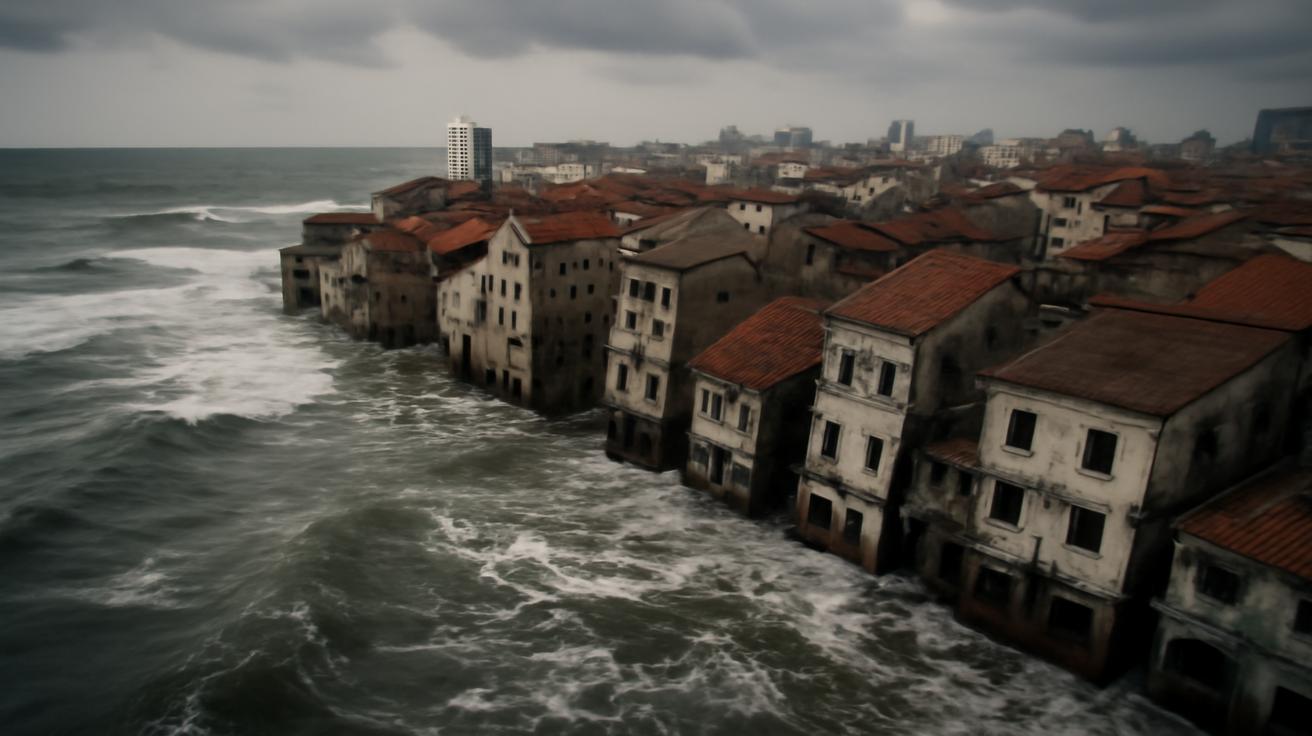
The first thing you notice is not the water, but the lean. A house in coastal Louisiana listing ever so slightly to one side. A telephone pole in Jakarta that no longer stands quite straight. A concrete pier along the Chesapeake that seems to crouch lower every year, as if exhausted. The sea, people say, is coming for us—and it is—but in places like these, something more unsettling is happening underfoot. The land itself is sinking, quietly, relentlessly, faster than the ocean is rising.
A World That Is Gently Falling
On a hot, breathless morning in Jakarta, Indonesia’s sprawling capital, the air smells of diesel fuel, fried shallots, and seawater. Motorbikes weave through ankle-deep puddles. The street vendors have moved their carts a little further inland than last year, away from a patch of road that now floods with every high tide.
A local shopkeeper points to a faded line on his front wall, about as high as his shoulder. “That was the flood in 2013,” he says. His finger drifts down to his hip. “Now the water reaches here, even with smaller storms. We didn’t move. The land went down.” He laughs, but it’s the kind of laugh people use when the truth feels too large to take in.
Subsidence—the technical term for land sinking—is rarely as dramatic as an earthquake or a hurricane. There is no single day the news cameras can circle on a calendar, no precise moment when the sky turns dark and the danger arrives. Instead, it is a slow unfurling loss. A millimeter here, a centimeter there. A front step that needs one more brick. A sea wall that no longer feels quite high enough.
Yet, across wide swaths of the planet, this quiet downward slide is now outpacing the upward creep of the ocean. We are living, in parts of the world, not on stable ground, but on a very slow escalator headed down into the sea.
The Hidden Forces Pulling Us Down
To understand why some coastlines seem to sink beneath their own reflections, you have to think of the Earth not as a solid marble, but as a living, shifting body. Inside, it flows. At the surface, it breathes. And sometimes, it settles.
Part of this settling is natural. Some deltas, like those of the Mississippi or the Mekong, are made of fine sediments that behave more like packed flour than rock. Over centuries, they compress under their own weight. In northern Europe and parts of Canada, the land is still slowly adjusting after the last Ice Age, rising where the glaciers once pushed it down—and sinking at the edges, like a seesaw finding its balance.
But the faster, more dangerous kind of subsidence is human-made. Picture enormous, invisible straws reaching down into the ground, sucking out the very things that hold the land up—water, oil, gas, even the tiny pockets of pressure within soil and rock. Without that internal support, the grains settle closer together. The surface drops.
In cities like Jakarta, Bangkok, and Mexico City, millions of people rely on groundwater pumped from beneath their feet. Wells bore down into soft sediments, drawing up the cool darkness that once filled invisible aquifers. As the water drains away, the ground can compact like a drying sponge. A building that once sat proudly above the tide line suddenly finds itself uncomfortably close to the water’s edge.
Adding to that weight is our own construction. High-rises, highways, ports, and airports concentrate mass on land that was never meant to carry such loads. In some coastal areas, extensive drainage of wetlands and peatlands triggers oxidation and shrinkage of soils that were stable only while waterlogged. The landscape changes, and the land sinks.
The Sea Is Rising, but the Land Is Racing to Meet It
Sea level, globally, is rising at roughly 3–4 millimeters per year on average, driven by melting ice and the expansion of warmer water. But in some of the world’s most vulnerable regions, the land itself is subsiding at equal or faster rates. What coastal residents experience is not just sea-level rise, but a combined effect—relative sea-level rise. To the human eye, water seems to be charging inland. In reality, two forces are moving toward each other.
In parts of Jakarta, measurements show land sinking by more than 10 centimeters per year—over 25 times the global mean rate of sea-level rise. In sections of coastal Louisiana, subsidence of several millimeters to over a centimeter per year stacks on top of the accelerating ocean. In low-lying neighborhoods, it feels like drowning in slow motion.
Where the World Is Sinking the Fastest
Walk the shorelines of certain regions, and you can feel the unnerving sense that the map is slowly going out of date. Here are a few of the places where the land is sinking faster than the sea is rising, and what it feels like to live there.
Jakarta, Indonesia: A City Below the Tide
Jakarta is a city of relentless motion: horns, engines, voices, a daily surge of nearly 11 million lives. But beneath this noisy churn, the ground itself is quietly sliding downward. Entire northern districts now sit below sea level, cradled behind seawalls that must be regularly raised.
Many of the city’s residents live in low-income, informal settlements near the coast, where piped water is unreliable or absent. Groundwater becomes the default. Small pumps hum in back alleys, every day lowering the invisible water table a little more. In some places, buildings that were once a short walk from the shore now stand trapped behind walls, looking out over water that laps tangibly higher.
On some streets, doorways seem unnervingly close to the waves. Stairs have been added, not to go up, but to go down to old entrances. Children play on rooftops because the ground floors have become too damp or flood-prone to use. When a king tide coincides with heavy rain, the sea pushes the city’s rivers backward. Drainage canals overflow. Water sneaks up through drains and cracks in the floor. The land, worn down by years of extraction, offers little resistance.
Coastal Louisiana, USA: A Vanishing Delta
Fly over southern Louisiana and the landscape beneath you looks like lacework: a delicate mesh of water and land. The Mississippi River has spent millennia building this delta, dropping sediments that formed marshes, barrier islands, and low-lying ridges. But in the last century, the balance has tipped dramatically.
Dams and levees upstream—vital for flood control and navigation—have trapped much of the river’s sediment before it reaches the delta plain. Canals, cut for oil and gas exploration, slice through fragile marshes, inviting saltwater further inland. As peat and mud dry and compact, starved of fresh sediment, the land sinks.
On a still morning in a Louisiana fishing village, you might hear the clink of boat rigging against masts, the hollow flap of flags in a weak breeze. Old photographs on café walls show yards where children played, oak trees shading front porches. Step outside today, and some of those same houses now perch on tall stilts, surrounded more by water than by earth. The oaks stand stranded, their roots often wet with brackish tides.
This isn’t just a story of flooding; it’s a story of disappearance. Maps that were hand-drawn generations ago, with careful outlines of bays and marshes, now describe places that no longer exist. Lessons in local schools sometimes include side-by-side comparisons of old and new coastline charts, allowing children to see, in blunt relief, how much of their inheritance has already slipped away.
Bangkok, Thailand: City of Shrinking Ground
Bangkok, with its high-rise hotels and gleaming malls, sits atop a swampy, clay-rich plain. For decades, the city pulled huge volumes of groundwater to fuel its rapid growth. The results can be felt in the subtle tilt of floors and the creeping rise of high-tide marks along the Chao Phraya River.
On a humid afternoon, tourists board boats to glide past gilded temples and riverside markets. The city, from the water, seems eternal—bright, crowded, self-assured. But if you talk to longtime residents, they’ll tell you the piers are lower than they used to be, the floodwaters deeper.
Government regulations have helped reduce groundwater pumping, slowing the rate of subsidence, but the legacy of past extraction remains. Even as Bangkok braces for future sea-level rise, some of its neighborhoods already sit lower than the river, shielded by walls that must be monitored with increasing vigilance.
The Mekong and Ganges–Brahmaputra Deltas: Soft Land, Hard Choices
Across the Mekong Delta in Vietnam, and in the Ganges–Brahmaputra–Meghna Delta of Bangladesh and eastern India, entire nations are built on river-born sediment. These deltas are among the most productive agricultural regions in the world, and also among the most vulnerable.
In the Mekong Delta, shrimp farms and expanding agriculture often rely on intensive groundwater extraction. Dams upstream reduce the flow of new sediment, starving the delta of the material it needs to rebuild. Villagers who once tended rice in fields near the river now watch as canals widen, banks slump, and saline water creeps ever further inland.
In Bangladesh, where the air tastes of salt and silt at the mouth of the great rivers, families track flood levels with notches on wooden posts. Some years bring water that lingers just a little longer, reaches just a little higher. Subsidence rates in certain areas compound the inexorable rise of the Bay of Bengal, rendering old flood expectations unreliable.
The Numbers Beneath Our Feet
It’s easy to talk about sinking land in metaphors—deltas dissolving, cities dropping. The reality is measured in patient, relentless numbers.
Scientists use satellites, GPS sensors, and ground-based instruments to track land elevation. What they find is sobering: in many densely populated coastal regions, the downward motion of land can equal or exceed the upward push of the sea.
| Region / City | Approx. Subsidence Rate | Context |
|---|---|---|
| Northern Jakarta, Indonesia | Up to >100 mm/year in hotspots | Driven mainly by groundwater extraction on soft sediments. |
| Coastal Louisiana, USA | ~5–15 mm/year (variable) | Delta compaction, reduced sediment, oil & gas activities. |
| Bangkok, Thailand | ~10–30 mm/year historically; slower now | Historical over‑pumping of groundwater; clay compression. |
| Mekong Delta, Vietnam | ~5–25 mm/year in many areas | Groundwater extraction; reduced river sediment. |
| Ganges–Brahmaputra Delta | Several mm/year (location‑dependent) | Sediment compaction, tectonics, human land use. |
By comparison, global average sea-level rise is on the order of 3–4 mm per year. In many of these places, from a resident’s perspective, the “sea-level rise” they see outside their front door is actually a combination of those millimeters of ocean plus many more millimeters of earth sinking beneath them.
Living on Soft Ground: Human Stories in a Sinking World
In all these regions, the science is threaded tightly with human lives. You can see it in the bricks stacked higher each year around doorways in a Manila slum, or the extra sandbags piled outside a shop in a Vietnamese riverside town. There is a particular kind of fatigue that sets in when your home seems to be ebbing away not in one dramatic event, but in an endless series of small adjustments.
In coastal Louisiana, an old fisherman steers his boat through what used to be forest. Cypress trunks stand ghostly pale and leafless, their roots permanently drowned in encroaching saltwater. He gestures toward a line of trees in the distance. “That was the shoreline when I was a kid,” he says. The shoreline is now several kilometers inland.
In Jakarta, a mother watches her children wade through knee-high water to reach school on days when high tide and heavy rain coincide. The route has always been low-lying, but the floods, she says, arrive more often and drain away more slowly. She has heard talk of a great sea wall, of moving the capital, of engineering solutions too large to fully imagine. For now, she focuses on keeping uniforms dry, books held high, patience intact.
In the Mekong Delta, a farmer runs rough fingers through soil that used to crumble easily, dark and sweet with organic matter. Now, the earth seems more brittle, and the water in his field has an unfamiliar tang. He has added another row of bricks to the base of his house. The riverbank where he sat as a boy, watching boats pass, has slumped into the muddy current.
Can We Stop the Sinking?
Unlike global sea-level rise, which is governed primarily by the planet’s climate system, a big slice of subsidence is under human control. This means that while we cannot simply turn it off, we can slow it down.
Reducing groundwater extraction is one of the most direct tools we have. Cities that invest in surface water supplies, rainwater harvesting, and more efficient use of existing sources can take some of the pressure off deep aquifers. When pumping slows, subsidence can lessen, though the compressed layers of soil or sediment rarely bounce back fully.
Protecting and restoring wetlands provides another buffer. Healthy marshes and mangroves can trap sediment, build land vertically, and cushion coastlines from waves and storm surges. In the Mississippi Delta, ambitious projects aim to reconnect parts of the river to its wetlands, letting sediment once again spill over and rebuild sinking landscapes.
Engineers can build sea walls, levees, and surge barriers, and in some places these will be essential to buy time. But hard infrastructure alone cannot hold back both a rising ocean and a sinking shore indefinitely. At some point, tough conversations begin: Which areas do we fortify, and which do we allow—or help—to retreat? How do we move people safely, fairly, and with dignity when their land is slowly abandoning them?
Urban planners increasingly talk about “adaptive pathways”: flexible plans that can change as new data emerge. A city might begin with improved drainage, then add tidal barriers, and eventually redesign entire neighborhoods to live with higher water or to relocate away from it. In all of these steps, acknowledging land subsidence is crucial. Ignoring it is like trying to repair a leaking roof while the foundation is slowly collapsing.
A New Map of the Future Coast
Picture a future map of the world’s coasts. Not the clean lines of current atlases, but a blurry, shifting zone where land and sea negotiate their boundaries year by year. In this future, some ports will be gone or heavily fortified, some deltas reshaped, some coastal neighborhoods remembered only in photographs and stories.
The question is not just how high the water will rise, but how fast the land will fall to meet it. Subsidence turns a slow-moving crisis into a faster, sharper one. It means that for many communities, climate adaptation timelines are compressed. What might have felt like a distant 2100 problem becomes a 2050, even a 2030, reality.
And yet, within this unsettling portrait, there is room for agency. Groundwater regulations can be enacted. Wetlands can be protected rather than drained. Buildings can be designed with future ground levels in mind. Long-term planning can finally catch up with what satellites and sensors have been quietly telling us for years: the ground beneath some of our most precious places is not as stable as we thought.
To walk along a sinking shore is to feel time in a different way. The land under your feet is not a given, but a temporary arrangement of sediment and water, weight and pressure, history and choice. Every well drilled, every river dammed, every forest cleared nudges that arrangement, sometimes imperceptibly, sometimes catastrophically.
Somewhere in northern Jakarta, a child marks the high-water line on a peeling wall with a stub of chalk. Somewhere in Louisiana, a grandmother points to the place where her father’s house once stood, now open water rippling with the afternoon breeze. The land is sinking, faster than the sea is rising, in places like these. The question that hangs in the humid air is not only how much more they will lose—but how quickly the rest of us will learn to see, and act, before the soft ground gives way beneath our own feet.
Frequently Asked Questions
What is land subsidence?
Land subsidence is the gradual sinking or settling of the Earth’s surface. It can occur naturally, due to processes like sediment compaction or tectonic movement, but is often accelerated by human activities such as groundwater pumping, oil and gas extraction, and drainage of wetlands.
How is land subsidence different from sea-level rise?
Sea-level rise refers to the increase in the average height of the ocean surface, mainly driven by climate change (melting ice and thermal expansion of water). Land subsidence, on the other hand, is the downward movement of the land itself. In many places, people experience a combination of both, which together create faster “relative sea-level rise.”
Which regions are sinking the fastest?
Some of the fastest-sinking regions include parts of Jakarta (Indonesia), Bangkok (Thailand), coastal Louisiana (USA), and large river deltas like the Mekong (Vietnam) and Ganges–Brahmaputra (Bangladesh and India). In these areas, local subsidence rates can match or exceed global sea-level rise.
Can subsidence be reversed?
In most cases, once soils and sediments have compacted, the lost elevation cannot be fully regained. However, subsidence rates can often be slowed or stabilized by reducing groundwater extraction, restoring wetlands, and allowing rivers to deliver fresh sediment to deltas.
What can communities do to adapt?
Adaptation options include regulating groundwater use, improving drainage systems, restoring natural buffers like marshes and mangroves, building or reinforcing protective infrastructure, and, in some cases, planning for the relocation of the most exposed communities. Integrating subsidence data into urban planning is critical for making long-term, resilient decisions.








Leave a Comment