
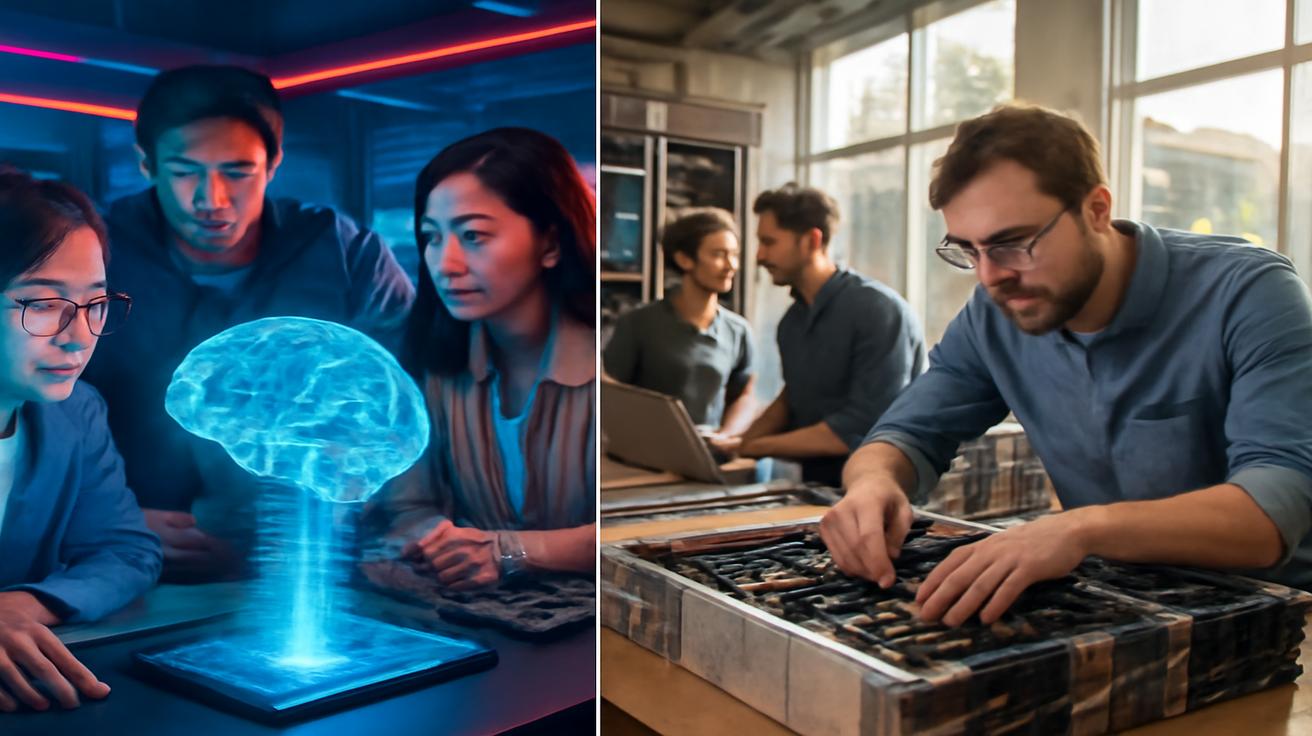
On a gray winter morning in San Francisco, the light that spills through the glass walls of a downtown office seems almost sentient. Rows of humming GPUs glow like embers, quietly transforming electricity into intelligence. On one of the screens, a multimodal AI model composes a short film script, designs its storyboard, and generates sample scenes—almost in real time. Across the Pacific, in Beijing and Shenzhen and Hangzhou, rooms that look eerily similar are humming just as loudly. The same glow. The same code-scrawled whiteboards. The same quiet sense that something enormous is in motion. And the distance between these worlds—once a vast, reassuring gap—is shrinking faster than anyone expected.
The Race You Can’t Quite See, But Can Definitely Feel
If you stand outside the conversation, “AI race” sounds like a cliché—another overused metaphor to dramatize what is basically just faster software. But sit for a while with the people building this stuff, and you realize it doesn’t feel like software at all; it feels like weather. It’s everywhere, invisible until it moves something big.
For years, Silicon Valley was the storm center. Google and OpenAI pulling in top researchers, NVIDIA selling the shovels in this new gold rush, and a halo of startups chasing the next foundation model. China, despite world-class talent and huge markets, seemed to be running a few steps behind—impressive, but not leading. Slow internet about their models. Fewer global users. Western press distracted or dismissive.
That’s over. Quietly, and then not so quietly, the gap has narrowed—dangerously so, if you’re sitting in Washington or Mountain View. The story is no longer “Silicon Valley vs the world.” It’s becoming a two-pole system: one anchored in the Valley and Seattle, the other stretched across Shenzhen, Beijing, Shanghai, and Hangzhou.
The signs are everywhere: Chinese chatbots holding their own in benchmarks, AI chips designed under sanctions constraints, robotaxi fleets gliding through cityscapes that make San Francisco’s test routes look quaint. What used to be “catch-up” now looks more like parallel evolution.
Model vs. Model: The New Great Comparison Game
The easiest way to tell this story is to zoom in on the models themselves—the large language models and multimodal systems that now write, code, reason, draw, diagnose, and increasingly, act. But the reality isn’t a simple scoreboard; it’s more like two ecosystems emerging in sync, shaped by different environments.
On the U.S. side, foundation models like GPT-4 class, Claude, Gemini, and a growing wave of open models sit at the center of a dense, venture-fed universe. These models are the public face of American AI: polished, widely used, deeply integrated into tools for work, creativity, and research.
In China, the ecosystem is more fragmented on the surface, yet no less intense. Baidu’s Ernie, Alibaba’s Qwen, Tencent’s Hunyuan, ByteDance’s models, and a constellation of startups—from Baichuan to Moonshot to Zhipu—are locked in what feels like a continuous launch cycle. A new model. A better benchmark. A faster training run. An improved “all-in-one” AI assistant.
The language barrier has hidden much of this from Western users, but in Chinese, the experience is strikingly similar: conversational assistants that can write contracts, generate lesson plans, summarize legal decisions, analyze code, and suggest product ideas. The user flows, the interface language, the cultural tone—everything feels native to their audience, tuned to daily life in Chinese cities rather than Silicon Valley’s mythology.
| Dimension | Silicon Valley / U.S. | China |
|---|---|---|
| Flagship Models | GPT, Claude, Gemini, open-source leaders | Ernie, Qwen, Hunyuan, Baichuan, etc. |
| Primary Strength | Global reach, research leadership, ecosystem depth | Mass deployment, tight app integration, rapid iteration |
| Data Advantage | Broad multilingual internet, strong English content | Huge domestic user base, dense behavioral data |
| Constraint | Regulatory uncertainty, open-source tensions | Export controls, access to cutting-edge chips |
| Deployment Style | Platform + API ecosystem, corporate productivity focus | Super-app integration, everyday consumer services |
In pure benchmark terms, U.S. models still often lead at the very frontier—especially in nuanced reasoning and complex, multi-step tasks in English. But China’s models aren’t far behind, and in specific domains—like Chinese language performance, educational tools, or integration into commerce and payments—they’re arguably ahead for their home users.
What’s more striking than any single metric is the tempo. A capability that appears in a U.S. model today often echoes in a Chinese equivalent in months, sometimes weeks. The feedback loop is tightening. The gap that once spanned years is now better measured in product cycles.
Hardware, Sand, and the Edges of What’s Possible
Beneath the shiny, conversational interfaces is a layer of reality that feels oddly primitive: sand, melted and etched into patterns measured in nanometers. The whole edifice of modern AI depends on this fragile base—semiconductor manufacturing—and it’s here that geopolitical friction is at its sharpest.
The United States, through export controls, has drawn a line in the sand—literally—around the most advanced AI chips. NVIDIA’s top-end GPUs, the silicon engines that power the training of frontier models, are heavily restricted for sale to Chinese companies. In theory, this should slow down China’s ability to train the largest, most compute-hungry models.
And yet, walk into a Chinese AI lab and you don’t feel a sense of paralysis; you feel improvisation. Workarounds. Model compression techniques. Custom chips built by domestic companies trying to fill the gap. Batch sizes tuned and re-tuned, training strategies adjusted, efficiency squeezed from every watt and every gate.
On the American side, the story leans into abundance: data centers planned like constellations, rivers of capital flowing into new GPU clusters, energy negotiations in forgotten industrial towns suddenly revived by the promise of “AI parks.” The Valley, for now, runs closer to the thermodynamic edge—pushing “bigger, deeper, more multimodal” simply because it can.
China, facing a ceiling on peak compute, is specializing in discipline: how far can you push a model with less? How much cleverness can make up for hardware constraints? There’s a quiet lesson there—that the future of AI may not belong only to the biggest models, but to the smartest training strategies and the most efficient chips. And in that future, the playing field looks far more level.
Everyday Life as a Testbed
The real shock comes when you step out of the lab and onto the street. AI is not just a research competition; it’s a lived experience. And in China’s megacities, the deployment is omnipresent, threaded through daily life like an invisible operating system.
In Chengdu, a delivery robot pauses at a crosswalk, its sensor head swiveling as it negotiates a shared space with cyclists and pedestrians. In Shanghai, a commuter pulls out her phone and asks an AI assistant, inside a super-app she already uses for payments and food delivery, to help her negotiate a lease. It drafts the email, explains her rights under local law, and suggests three alternative apartments based on her chat history and transaction patterns.
AI is nested into services: ride-hailing, logistics, short video platforms, e-commerce, customer support. Not as a bolt-on “AI feature,” but as a quiet assumption about how software behaves. It recognizes. It anticipates. It replies. In some malls, humanoid robots greet children and offer directions; in some hospitals, AI triage systems filter patients before they see a human doctor.
In the U.S., you feel AI most strongly in the knowledge economy and creative industries: code autocomplete in your IDE, writing assistants in your browser, copilots in office suites, generative design in your workflow. AI shows up in slides, documents, editor windows. It’s in the laptop, more than on the street.
China is running a different experiment: what happens when you saturate the physical world—transport, manufacturing, logistics, retail—with AI as aggressively as you saturate the digital one? Turn enough knobs at once, and you don’t just automate tasks; you reshape habits, expectations, and business models.
The gap here isn’t one of capability; it’s one of canvas. The American bet is that AI first transforms high-value knowledge and creative work, then spills outward. The Chinese bet is that AI seeps into everything at once, especially where large populations and dense cities create enough data to feed its appetite.
Different Rules, Different Risks
Behind the smooth voices and playful interfaces lies a thornier layer: rules. Alignment. Safety. Guardrails. And in this, Silicon Valley and China are not just racing; they’re playing by different playbooks entirely.
In the U.S., governance is an unsettled argument in motion. Tech CEOs testify before Congress, global safety frameworks are drafted, voluntary commitments are signed, and independent labs probe models for hidden failure modes—bias, hallucination, jailbreaks, emergent capabilities that feel eerie in their autonomy. The conversation is messy and often adversarial, but public, loud, and continuous.
China’s approach is more centralized and prescriptive. Regulations for generative AI arrived early and firmly: providers must ensure content aligns with “core socialist values,” restrict certain political outputs, and take responsibility for safety and traceability. Models are steered less by open debate and more by compliance with state-defined boundaries.
The result is a strange mirror-world. In the U.S., a model might refuse to answer a medical question or generate deepfakes, but argue with you gracefully about politics. In China, the same kind of model might help you write a business plan, plan your diet, and outline a marketing campaign—but quietly sidestep certain historical or political topics.
For global users, this duality matters. It means that as AI systems become more powerful, they will not converge into a single, universal assistant with one “worldview.” Instead, we’re likely to see multiple, geopolitically shaped intelligences—each fluent, capable, and bounded in ways that reflect not just engineering choices, but national interests and values.
And that deepens the danger of the narrowing gap. Once both poles can build highly capable systems, the question shifts from “who is ahead?” to “who controls the stories, the knowledge, the behavior embedded inside them?” The race is no longer only about performance. It’s about influence.
What a Two-Pole AI World Feels Like
Imagine a near-future morning, maybe only a few years from now. You wake up, reach for your phone, and your AI assistant has already reshaped your day. It has summarized overnight news, prioritized emails, suggested a time to call your parents, re-optimized your budget based on last night’s impulse purchase, and scheduled a workout adjusted to your sleep quality.
Nothing about this is science fiction; prototypes already exist on both sides of the Pacific. The difference is what isn’t visible. Under the hood, which news does it summarize? Which sources does it trust? How does it understand “a good life” when it suggests goals and nudges? Whose collective experience and norms are embedded in its defaults?
In a U.S.-centric AI ecosystem, your assistant might be tuned toward individual choice, entrepreneurial self-betterment, job mobility, privacy trade-offs negotiated by markets and lawsuits. In a China-centric one, it might be tuned toward social stability, group belonging, economic advancement through established platforms, and content that steers clear of certain controversies.
Now multiply that invisible tuning across billions of people, thousands of decisions per person per day, over decades. The AI race stops looking like a simple leaderboard and starts looking like a slow, pervasive reconfiguration of how societies think, plan, and coordinate themselves.
And this is why the narrowing gap feels “dangerous” to policymakers and industry leaders—not just because competition is intense, but because the outcome determines who sets the subtle defaults of the future. Whose optimization functions shape everything from how kids learn math to how companies allocate capital to how leaders interpret risk.
The comforting story used to be that one side was clearly ahead, and that its norms would simply dominate by inertia. That’s no longer a safe assumption. The more China’s AI ecosystem closes the technical distance to Silicon Valley, the more plausible a world of two centers becomes—two gravitational wells pulling smaller countries, companies, and researchers into their orbits.
FAQ
Is China really catching up to Silicon Valley in AI?
Yes. While U.S. companies still tend to lead at the absolute frontier of the largest and most capable models, Chinese labs and firms have rapidly closed the gap. In many applied domains—education, commerce, logistics, consumer apps—China’s integration of AI into daily life is as advanced as, or ahead of, what you see in the U.S., especially for Chinese-language users.
Do export controls on chips stop China from advancing in AI?
They slow, but do not stop, progress. Restrictions on cutting-edge GPUs make it harder for Chinese labs to train the very largest models, but they have pushed a shift toward efficiency: custom domestic chips, smarter training strategies, and more focus on getting more capability from less compute. The result is not a halt, but a different trajectory.
Which side has better AI models right now?
It depends on what you measure. U.S. models tend to perform better on English-heavy benchmarks and complex reasoning tasks, and they benefit from a deep ecosystem of tools and research. Chinese models often shine in Chinese language tasks, education, social and commerce integration, and mass deployment to huge user bases. The distance between them continues to shrink.
How are AI safety and regulation different in China and the U.S.?
The U.S. governance approach is fragmented and highly debated, involving companies, governments, academics, and civil society—leading to visible tension but also broad scrutiny. China’s regulation is more centralized and directive, with strict rules about politically sensitive content and platform responsibilities. Both aim for “safety,” but define and enforce it differently.
What does a “two-pole” AI world mean for ordinary people?
It means that the AI systems you use will increasingly reflect the norms, values, and strategic interests of the ecosystem they come from. Over time, that could shape what information you see, how your digital tools advise you, what choices feel “normal,” and even which opportunities open up to you. The race between China and Silicon Valley is not just about speed; it’s about whose assumptions get baked into the fabric of everyday intelligence.








Leave a Comment