
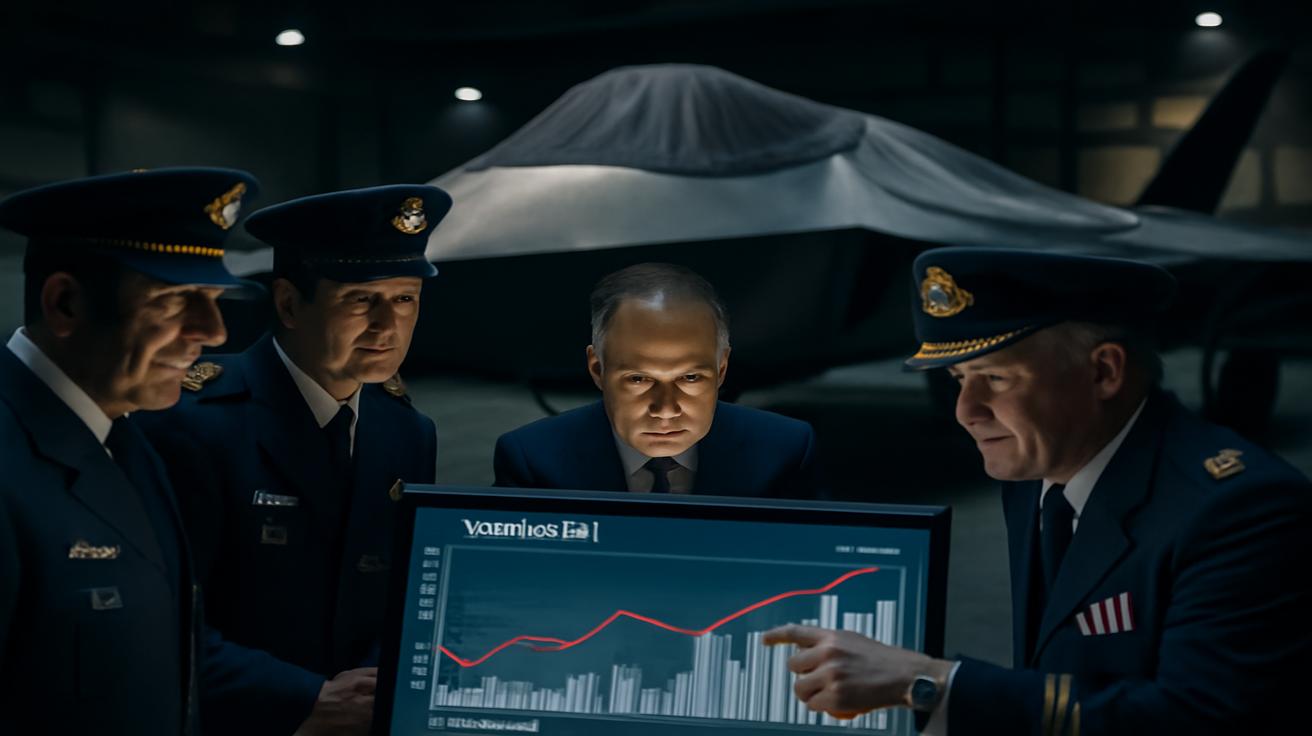
The jet doesn’t exist yet, but its shadow is already enormous. In a quiet hangar somewhere on an Italian air base, engineers huddle over screens filled with glowing blue renderings of an aircraft that could define the next half‑century of aerial combat. Thousands of kilometers away, in a Japanese lab where the air smells faintly of machine oil and coffee, a prototype cockpit mock‑up glows under harsh white lights. In the UK, in a secure design room ringed with soundproof walls, an artist’s impression of a sleek, predatory shape is pinned to a board. On paper, it is the future: a sixth‑generation fighter jet, bristling with sensors, invisible to radar, and woven into a digital web of drones and satellites. In the ledger, though, it is already something else: a warning about ambition, politics, and the spiraling arithmetic of modern warfare.
The Dream of a Sixth‑Generation Phantom
They’re calling it the Global Combat Air Programme, or GCAP, which sounds grand because it is. Italy, Japan, and the United Kingdom have joined forces to build what many imagine as the heir to the great fighter dynasties: Tornado, Typhoon, F‑2, F‑35. Their child will be something different. Not just a plane, but a flying node in a vast network of data and firepower.
Step into the story at sea level. Imagine standing near an air base on a cold, clear morning. You feel the faint tremor in your chest long before you hear the roar. A Typhoon slices overhead, grey against the sky, leaving a brief shiver in the air and a fading smell of jet fuel. It is still one of the most capable fighters on Earth, but it was born in a different age—before swarms of cheap drones, before hypersonic missiles became dinner‑table vocabulary, before every battlefield was a cloud of data.
GCAP is meant to leap far beyond that era. The new jet—often referred to as a sixth‑generation fighter—will theoretically be able to do things that today still sound like military science fiction: coordinate with unmanned wingmen that fly ahead as scouts or sacrificial shields; re‑route mid‑mission using AI that digests oceans of threat data in real time; merge its own radar, infrared, and electronic sensors with satellites and ground systems into a single shared picture of the battle space.
It will not just evade radar; it will bend the electromagnetic environment to its will, jamming and deceiving while whispering silently to allied forces. Its cockpit may feel less like a traditional fighter and more like a glass bubble of augmented reality, where the pilot’s visor becomes a gateway to overlapping layers of digital information: targets glowing on the horizon, friendly units pulsing in soft blue, invisible threats painted in ominous red.
It all sounds razor‑sharp, almost intoxicating. But woven through that vision is a quieter, more uneasy question: if this is the dream, what does it really cost to summon it from code and carbon fiber into the sky?
The Moment the Numbers Started to Swell
GCAP started as an attempt to do something sensible in a field famous for doing the opposite: share the burden. Instead of each country trying to build its own hyper‑complex fighter jet, they would combine forces, share technologies, divide manufacturing, and ultimately, lower the cost per aircraft.
On day one, it looked tidy on paper. Politicians spoke in smooth, confident tones about “cost‑effectiveness” and “efficiencies of scale.” The kind of phrases that make parliaments nod along and defense committees loosen their purse strings. Early estimates put the development price tag at a level that, while huge, felt manageable for three advanced economies.
But then came the familiar creep. Requests from air forces for extra capabilities—more stealth here, better sensors there, a larger weapons bay, more adaptable software, a higher level of autonomy. Each request came with justifiable arguments. After all, who wants to invest in a “future fighter” that is obsolete the moment it rolls out of the hangar?
The plane had not left the drawing board, and yet the cost curves were already bending upward. Before prototypes had even roared down a runway, the projected development costs had ballooned—tripled from some of the earliest informal expectations, according to people close to the program and defense analysts tracking the numbers. One planner, half joking, called it “the most expensive ghost we’ve ever built.”
Imagine a whiteboard in a secure conference room in Rome or Tokyo or London. At the top: “Unit Cost Target.” Underneath, in a different color, the latest projections. Each quarterly update stretches the ink a little higher. The faces in the room grow a little tighter. The air feels a bit heavier. Everyone has seen this movie before.
The Physics of Money and Ambition
There is a cold logic to why these costs swell, as relentless as gravity.
Modern fighter jets are no longer just planes; they are flying supercomputers fused with stealth geometry and powered by engines that must squeeze impossible thrust from constrained shapes. Every feature interlocks with every other. Change one tile in the mosaic—say, a new radar that draws more power—and the entire design shivers, from the nose sensor layout to the cooling systems buried deep in the fuselage.
When three nations collaborate, complexity doubles again. It’s not just engineering; it’s politics in aerodynamic form. Each country wants industrial participation that justifies the investment at home. Each wants to protect sensitive technologies. Each has its own air force culture: the way pilots fight, the kinds of missions they expect, the environments they train in.
Somewhere inside GCAP, there are tense conversations about how much autonomy to give the aircraft’s AI, about which country’s electronic warfare package gets priority, about how to spread manufacturing contracts among factories in northern England, central Italy, and across Japan’s industrial heartlands. Each compromise adds time. Time adds money. The spreadsheets stretch like a rubber band.
There’s a sensory element you can almost feel if you picture the process: the hot, recycled air of a midnight meeting in a contractor’s glass‑walled office; the gentle squeak of a marker circling figures on a projected slide; the dry taste of stale coffee; the long silence after someone says, carefully, “We’re going to need to revise our estimate.”
Below is a simplified snapshot that echoes what such programs often look like when ambition and reality collide:
| Aspect | Initial Expectation | Current Reality |
|---|---|---|
| Development Cost | Manageable, shared burden | Effectively tripled vs early hopes |
| Timeline | Operational by early 2030s | Under pressure; delays increasingly likely |
| Capabilities | Advanced but focused | Ever‑expanding “must‑have” features |
| Political Risk | High, but contained | Rising as budgets strain and elections loom |
Echoes of Earlier Skies
To truly understand GCAP’s cost surge, you have to listen to the echoes of other programs that came before it. The F‑35, for example, still hovers in the background of every modern fighter discussion like an uninvited elder sibling. It, too, was born under the promise of shared development, cost savings, and unified fleets. It, too, quickly found itself accused of being “the plane that ate the defense budget.”
Those who followed the F‑35 saga remember the headlines: delays, ballooning budgets, software turmoil, redesigns, and fierce debates over whether one aircraft could truly meet the wildly different needs of its diverse customers. The F‑35 eventually became a formidable platform, but at a cost that redrew entire defense landscapes.
GCAP’s architects know this history intimately. Many of them lived through it in their previous roles. They’re trying to avoid repeating the same mistakes while also pushing even further into technical unknowns. That tension—between caution and audacity—is written into every design review, every risk assessment, every late‑night strategy session.
Picture a Japanese engineer who once worked on indigenous stealth demonstrators, now sitting beside a British avionics specialist who cut his teeth on Typhoon upgrades, and an Italian systems architect who grew up watching Tornados thunder across low valleys. Over a shared screen, they argue gently—not over whether the new fighter should be exceptional, but over how far to lean into unproven technologies that might keep it relevant in 2050, rather than merely impressive in 2035.
They’re haunted by a simple paradox: play it safe, and the jet risks being outclassed before it’s fully rolled out. Reach too far, and the cost and complexity could spiral into something unaffordable, or undeliverable on time. Somewhere in the middle is the thin, swaying tightrope GCAP is trying to walk.
Who Ultimately Pays for the “Future”?
Somewhere far from the gleaming design labs, in a quiet government office in Rome, Tokyo, or London, a civil servant scrolls through a draft budget. The GCAP line appears like a mountain range on a flat horizon. It is impossible to miss. Around it, in smaller, more fragile lettering, are social programs, infrastructure projects, education, health care. Numbers rarely exist in isolation; they compete with other human needs.
As GCAP’s cost projections inflate, the trade‑offs grow sharper. Should a navy delay a new ship to free up funds? Should an air force retire aging aircraft earlier than planned? Should a government trim non‑defense spending—or risk political backlash by increasing the overall budget? Each country must answer those questions under the specific pressure of its own electorate, its own fears, its own alliances.
In the UK, there’s the lingering memory of past defense cuts and the proud, stubborn desire to remain an aviation heavyweight. In Japan, there’s a tense neighborhood, with rising military activity in nearby seas and skies and domestic debates about what kind of military posture is truly necessary. In Italy, there’s the balancing act between economic realities and a desire to be seen as a leading partner, not a junior participant.
Cost, in this context, is more than digits. It has a texture you can almost feel, like the weight of a ledger resting on a minister’s desk. It has a sound—the murmur of opposition lawmakers, the clipped questions of journalists, the rising hum of public skepticism once a figure with too many zeros is spoken aloud.
And yet, there is also the unseen cost of not building it. What happens if potential rivals field their own sixth‑generation fighters first? What if the future air battlespace is dominated by aircraft and drones designed in other capitals, flying under other flags? GCAP’s expense is justified, in part, by this anxiety: the fear of being left behind technologically, strategically, symbolically.
Imagining the First Flight Amid the Doubt
Set aside, for a moment, the gnawing anxiety of the budgets and imagine the day when the prototype finally takes to the air.
It’s an early morning at a test base guarded by high fences and watchful eyes. The sky is a flat blue, the kind that absorbs sound. On the tarmac, the aircraft looks simultaneously familiar and alien—low‑slung, stealth‑sharp, its surfaces matte and unsettlingly smooth, as if carved from a single block of shadow.
Technicians swarm around it like bees, disconnecting cables, removing bright red safety tags. The pilot climbs the ladder, helmet tucked under one arm, then lowers into the cockpit where the world shrinks to flight displays and the faint hum of powered systems. Outside, a small crowd of officials and engineers stand behind a security line, the smell of hot asphalt rising around them.
When the engines spool up, it’s less a roar and more a deep, enveloping thrum—you feel it in your ribs before you fully hear it. The aircraft creeps forward, gathers speed, and at a certain point, the boundary between ground and sky vanishes. The nose rises, the wheels lift, and suddenly, after years of arguments, committee hearings, political tensions, late‑night coding, design rethinks, and cost explosions, it is airborne.
For those who have dedicated years of their lives to the project, that moment will feel almost holy. For taxpayers and voters, who will only ever see the aircraft in carefully managed images or fleeting airshow displays, the feeling may be more ambiguous. Awe, yes—but threaded with skepticism. Was it worth triple the expected cost? Will it keep them safer in a way they can feel, or is it another symbol of distant geopolitical games?
The first flight does not answer those questions. It only sharpens them. It transforms the project from an abstract budget line into a physical thing that casts a shadow, eats fuel, and demands maintenance. As the jet wheels around the sky in a cautious arc, every turn whispers an uncomfortable truth: the real bill is only just beginning.
Can the Story Still End Well?
Programs like GCAP are not just about metal and money; they’re about identity and narrative. Each partner nation is trying to say something about itself with this aircraft: that it still has the industrial muscle and technological imagination to shape the future of warfare, rather than renting it wholesale from elsewhere.
So where does that leave us, standing on this uneven ground where the cost has already tripled but the plane has not yet crossed into operational reality?
One possible future is grim: further overruns, political fatigue, compromised capabilities, and a final product that arrives late and bruised into a world already moving on. Another future is more balanced: a difficult, expensive march ahead that nonetheless delivers a jet that does roughly what it promised, and perhaps more, alongside a network of drones, advanced sensors, and software that spills over into civilian industries.
The truth is likely to land somewhere between those two poles. The cost will not roll back. That toothpaste never squeezes itself neatly back into the tube. But how the program responds now—how ruthlessly it prioritizes, how honestly it manages scope, how transparently it reports progress—will decide whether GCAP becomes a cautionary tale or a hard‑won, imperfect success.
The next time a fighter shrieks across your sky—whether you recognize its silhouette or not—you might find yourself hearing more than just the thunder. Hidden in that sound is the echo of design choices made decades earlier, the murmur of parliamentary debates, the late‑night keystrokes of software engineers, and the quiet, stubborn human belief that, in a dangerous world, mastering the air still matters enough to justify the bill.
And somewhere, years from now, if an Italian, Japanese, or British pilot grips the controls of a GCAP fighter high above cold, thin clouds, they’ll be relying on that belief. The jet will feel alive around them—screens shimmering, sensors whispering, engines pushing against gravity’s pull. But trailing invisibly behind the contrail will be the true story: of a future that arrived flying on wings three times more expensive than anyone dared admit at the beginning.
Frequently Asked Questions
Why has the cost of the Italy–Japan–UK future fighter already tripled?
The cost has surged due to a combination of factors: expanding requirements from the partner air forces, integration of cutting‑edge but unproven technologies, the complexity of multinational industrial sharing, and inevitable schedule creep. Each new capability or delay adds layers of engineering work, testing, and coordination, all of which magnify the original estimates.
What is GCAP and how is it different from current fighter jets?
GCAP (Global Combat Air Programme) is a joint effort by Italy, Japan, and the UK to build a sixth‑generation fighter. Unlike current fighters, it is designed as part of a larger “system of systems,” working closely with drones, satellites, and ground networks. It emphasizes advanced stealth, AI‑assisted decision‑making, powerful sensor fusion, and deep connectivity rather than just speed and maneuverability.
When is the new fighter expected to enter service?
The partners aim for the early to mid‑2030s, but as with many complex defense programs, that timeline is under pressure. Rising costs often go hand in hand with delays, making the exact in‑service date uncertain and subject to future political and technical decisions.
Will the rising cost affect other military or civilian budgets?
Very likely, yes. Large defense projects inevitably compete with other priorities. Governments may redirect funds from other military programs, delay certain procurements, or adjust non‑defense spending to accommodate GCAP’s growing bill. The exact impact will depend on each country’s economic conditions and political choices in the years ahead.
Could GCAP still be canceled or significantly scaled back?
Major international projects are politically difficult to cancel once they gain momentum, but they can be reshaped. GCAP could be scaled back in capability, reduced in fleet size, or restructured in its industrial and technological ambitions if costs become politically or economically unsustainable. For now, all three countries remain committed, but the pressure will only increase as the numbers climb.








Leave a Comment