
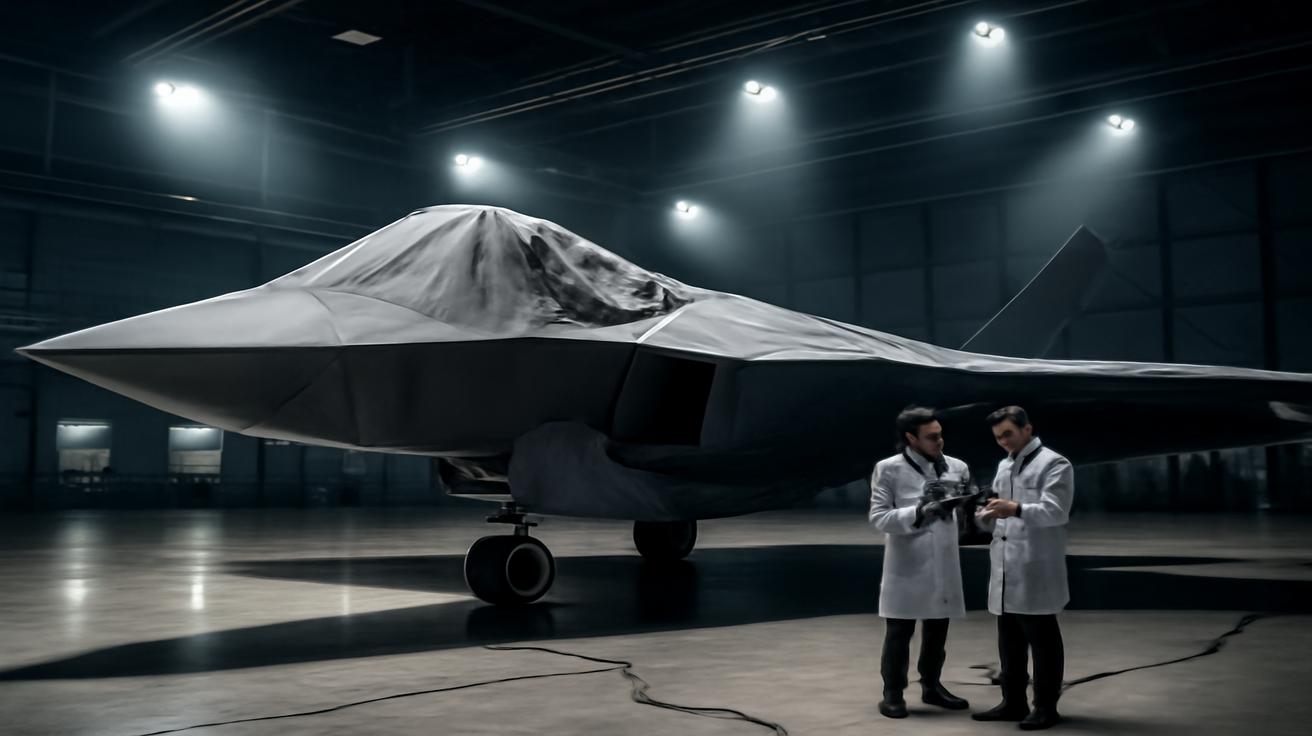
The news drifted out almost casually at first, like a rumor overheard in a crowded café: the sleek, futuristic fighter jet being developed by Italy, Japan, and the United Kingdom has already tripled in cost. A plane that hasn’t yet flown in the open sky, hasn’t roared over a single coastline in patrol, is quietly accumulating a price tag big enough to distort budgets and bend political promises. On paper, it’s called a sixth-generation combat aircraft, a marvel of stealth and sensors and data. In real life, it’s becoming something else too—an emblem of how we imagine security, how we spend on it, and how those dreams swell once steel and software begin to take shape.
The Jet That Exists Mostly in Imagination
Picture a hangar at dawn somewhere on a secure air base—its doors still shut, concrete slick with night condensation. Inside, perhaps, stands a full-scale mock-up of the future fighter: angular, predatory, all clean lines and matte surfaces. Engineers in reflective vests circle quietly, tablets in hand, taking notes on a body that doesn’t yet house a real engine or live avionics. This is where the future is being rehearsed, one digital model, one composite panel, one algorithm at a time.
The project, formally part of what’s called the Global Combat Air Programme (GCAP), aims to create a new generation of fighter jet to replace current Eurofighters and older fleets in the coming decades. Italy, Japan, and the UK are tying their industrial fortunes and military strategies together in a decades-long bet. On slides and briefing documents, the jet is a list of promises: enhanced stealth, AI-assisted piloting, swarming drones under its wing, seamless data-sharing across land, sea, air, space, and cyber domains.
But as those promises accumulate, so do the costs. Defence planners initially spoke about efficiency and shared burdens, about avoiding the spiraling bills that plagued earlier projects. Now, quietly, officials admit that the estimated costs have already tripled from early expectations. The plane is still mostly lines of code and conceptual drawings, yet the bill is already swelling like a storm bank on the horizon.
A Story Written in Numbers and Quiet Revisions
Cost changes in a program like this do not arrive with blaring sirens. They slip into revised spreadsheets, emerge in budget hearings, and appear as footnotes in parliamentary reports. One year, it’s a modest increase for “additional research”; the next, it’s a major re-baselining of the entire program. Suddenly, numbers that once sounded bold now seem quaint and small.
What’s tricky is that the jet doesn’t have a single price tag carved into stone. There’s development cost, procurement cost, life-cycle cost, upgrade cost; each figure feeds the next. And they all move. They’re projections layered on top of assumptions wrapped around uncertainties. When someone says the program has already tripled in cost, they mean that the early, optimistic sketches of the budget have been overtaken by the reality of building something that has never existed before.
But this is not just an accounting failure. It’s a human story as much as a financial one: about ambition outpacing caution, about national pride resisting compromise, about engineers wrestling with the limits of physics while politicians juggle short-term elections and long-term wars that may never come.
Why Future Jets Always Seem to Get More Expensive
Walk into any advanced aerospace facility and the first thing you notice is how quiet it is. Robots glide, machines hum, engineers murmur behind double-pane glass. Complexity is the real sound there. That complexity is what drives costs inexorably up.
To understand why this tri-national fighter is inflating before it’s even airborne, you have to step into that labyrinth. This won’t be just another fast aircraft—it’s meant to be a flying node in a web of sensors, satellites, missiles, drones, and data centers. It will talk to ships sailing hundreds of kilometers away and ground units hidden in forests, and to other aircraft that may be piloted, unmanned, or somewhere in between. It will juggle streams of data in real time, deciding what to show the pilot and what to delegate to AI.
Every one of those grand features is a separate engineering mountain. Making a jet stealthier often means pushing the materials to their limits, forcing changes in maintenance and production. Integrating AI means building systems that are not just smart, but certifiably safe under extreme conditions—sudden G-forces, radio jamming, sensor failures. Building a tri-national supply chain means bridging language, standards, and industrial cultures in three different countries, each with its own traditions and red tape.
And then there’s the simple, brutal math of inflation in a high-tech sector, where even a slight increase in requirement—say, better electronic warfare capability, or longer range—can cascade into heavier components, stronger engines, reworked structures, new tests, more delays. Delays themselves create more cost. Time, in aerospace, is not just money; it is compounding interest.
Three Countries, One Sky, Many Agendas
Now imagine three nations trying to shape the same aircraft. The jet isn’t just a machine; it’s a national symbol, a job creator, a bargaining chip. In Italy, Japan, and the UK, politicians talk about advanced manufacturing, strategic autonomy, and protecting their piece of the industrial pie. Each wants factories humming, high-paying engineering jobs secured, critical technologies developed at home instead of abroad.
Cooperation is supposed to save money. You split the costs; you share the risks. But cooperation also multiplies negotiation. Who builds the radar? Who owns the source code for the flight software? Which country gets final say on how the export controls are written? What happens if one partner wants to sell the jet to a controversial buyer and the others object?
These bargaining sessions are invisible to the public, but they leave fingerprints on the budget. Whenever consensus takes too long, timelines slide. Whenever a country insists on its own bespoke piece of technology, integration gets harder. Every new layer of political compromise has a technical price, and the plane that emerges is often heavier, more complex, and more expensive than anyone first imagined.
The Invisible Weight on National Budgets
Meanwhile, outside the secure gates of bases and ministries, budgets back home have their own emergencies. Hospitals stretch to cover aging populations. Schools need renovations. Infrastructure groans. Citizens hear that a fighter jet program has tripled in cost—and even if they support the military, something in the gut tightens. How much, exactly, is this future security worth right now?
It can help to see the numbers in some sort of relational scale. Even with careful estimates, they stagger. A program like this is not one big payment—it’s a river of money spread over decades. But even a river of money has to come from somewhere, and that “somewhere” often includes trade-offs that feel distant, but are very real.
| Perspective | Illustrative Scale of Cost |
|---|---|
| Early internal projections | Set as a baseline “1×” cost for research and development |
| Current rough projections | Around “3×” that initial baseline once full capabilities are added |
| Typical modern fighter life-cycle | Operating and maintenance costs often exceed procurement costs over decades |
| Budget implication | Requires long-term planning commitments by all three governments |
The precise figures are still shifting, and officials will argue over what counts as the “real” number. But even without exact digits, the direction is clear: up. For treasury officials, that means years of defending an invisible jet in hearings where questions grow sharper: Why this much? Why now? What if the security picture changes, or another technology—like swarming drones or space-based systems—makes part of this investment obsolete?
Security in an Uncertain Airspace
Yet, if you sit down with defence planners in any of the three countries, they paint a different landscape. They talk about a world in which airspace is no longer a simple matter of who has more planes. They describe hypersonic missiles that can outrun traditional interceptors, dense air defense networks hardened by decades of innovation, drones so cheap and numerous they become a kind of mechanical swarm of locusts in the sky.
In that world, old fighters—no matter how many upgrades you bolt onto them—begin to look like aging athletes. Still capable, still dangerous, but outpaced by the new game being played around them. The future jet, in this story, is not a luxury; it is the price of entry to a club of nations that can still operate freely in hostile skies.
Italy needs it to maintain relevance within NATO and to secure its defense industry. Japan sees it as a pillar of deterrence in a tense Indo-Pacific region. The UK views it as part of its ambitions to remain a major air power and a leader in advanced defense technologies. For all three, stepping out of such a project is politically risky; staying in is financially punishing. The cost spiral doesn’t just rise vertically; it wraps around them like a tightening ring.
When Technology Becomes a Moving Target
There’s another twist to this story, and it’s buried in the nature of technology itself: by the time a jet like this reaches operational service, the world it was designed for will have changed. The software we consider cutting-edge today will be quaint in fifteen years; cyber threats that don’t yet exist will be routine by the time the first squadrons are declared ready.
This forces designers into a gamble. They must overbuild flexibility into the jet—modular avionics, open software architectures, huge digital backbones that can be updated as easily as smartphones (or at least, that’s the hope). But designing in this kind of adaptability is itself expensive. It’s like constructing a city while also leaving space for a future subway system that hasn’t yet been invented.
So the requirements grow: more processing power, more cooling systems to handle the electronics, more redundancy to survive cyber attacks, more antennas and sensors that must still somehow remain nearly invisible to enemy radar. Each layer of future-proofing adds more cost today to avoid irrelevance tomorrow.
The Human Element in the Cockpit and Beyond
At the center of all this metal and code is still a human being—at least for now. A pilot, strapping in under a canopy, looking out over a runway and a big sky. The coalition behind the future fighter is not just building the plane; it’s building the ecosystem around that pilot: simulators that recreate battles in haunting detail, virtual co-pilots powered by algorithms, interfaces that decide how much information a human can handle at Mach speeds.
There’s a subtle psychological cost here too, one rarely priced into budgets. As jets grow more complex, training times extend. Pilots must not only master the aerodynamics of flight, but the orchestration of a networked battlefield, acting as both warrior and conductor. Ground crews need new skills to service stealth coatings and delicately calibrated sensors. Entire bases may need reworking to handle the digital infrastructure that comes bundled with “just one jet.”
The future fighter’s tripled cost is therefore not simply a case of “expensive airplane.” It’s the price of an ecosystem: data links, training, support, infrastructure, upgrades that will continue for decades. What’s tripling is the scale of what we now demand when we say we want “air superiority.”
What Happens When the Bill Comes Due?
In the end, the story of this tri-national fighter may not be written in test flights or glossy promotional videos, but in budgets and elections. There will come a moment when lawmakers in Rome, Tokyo, and London sit with the latest cost reports and ask the question in the plainest possible language: Is this still worth it?
By then, sunk costs will tug heavily in favor of yes. Thousands of workers will rely on the program for their livelihood. Defense strategies will have been built around the assumption that the jet is coming. Cancelling, or even significantly shrinking, the ambition would be both a political admission of failure and a strategic headache.
But staying the course also means owning the consequences. Every extra billion will be money not spent elsewhere. Every added year of development will be another year older for the jets this aircraft is meant to replace. The future, that vague justification for so many present-day decisions, will arrive with invoices attached.
And yet, the sky will look the same. Blue, mostly. Thin clouds, contrails drifting. Somewhere far above, one day, the new fighter will finally carve its first white line across that sky. For a moment, it will seem victorious—a dream made real, engines shaking the air, sensors sniffing the invisible. But all around it, even in that triumph, the quiet arithmetic of its cost will be rippling through economies, politics, and priorities on the ground.
Frequently Asked Questions
Why has the cost of the future fighter jet tripled already?
The cost has risen due to growing technical requirements, inflation in high-tech components, integration challenges across three national industries, and the need to future-proof the aircraft with advanced software and modular systems. Early estimates were based on simpler assumptions that did not fully capture the complexity now being built into the program.
Is cost growth normal for advanced fighter jet programs?
Yes, significant cost growth is common in cutting-edge fighter programs worldwide. Projects like previous fifth-generation jets have also experienced major overruns, often because they attempt to integrate multiple revolutionary technologies into a single platform under tight political and strategic pressure.
What are Italy, Japan, and the UK hoping to gain from this jet?
Each country wants to secure advanced airpower for the mid-21st century, protect or expand its defense-industrial base, and maintain strategic influence. The jet is also intended to deepen security ties and technological cooperation among the three nations.
Could the project be canceled if costs keep rising?
Cancellation is always a theoretical possibility, but the deeper each partner invests, the harder it becomes politically and strategically to walk away. More likely outcomes include redesigns, capability trade-offs, smaller fleet sizes, or stretched timelines rather than outright cancellation.
How will this fighter differ from current jets in service?
The future fighter is expected to feature enhanced stealth, powerful onboard computing, AI-assisted decision-making, extensive data-sharing with other platforms, and the ability to operate alongside or control unmanned systems. It’s designed less as a lone aircraft and more as a central node in a larger, networked combat environment.








Leave a Comment