
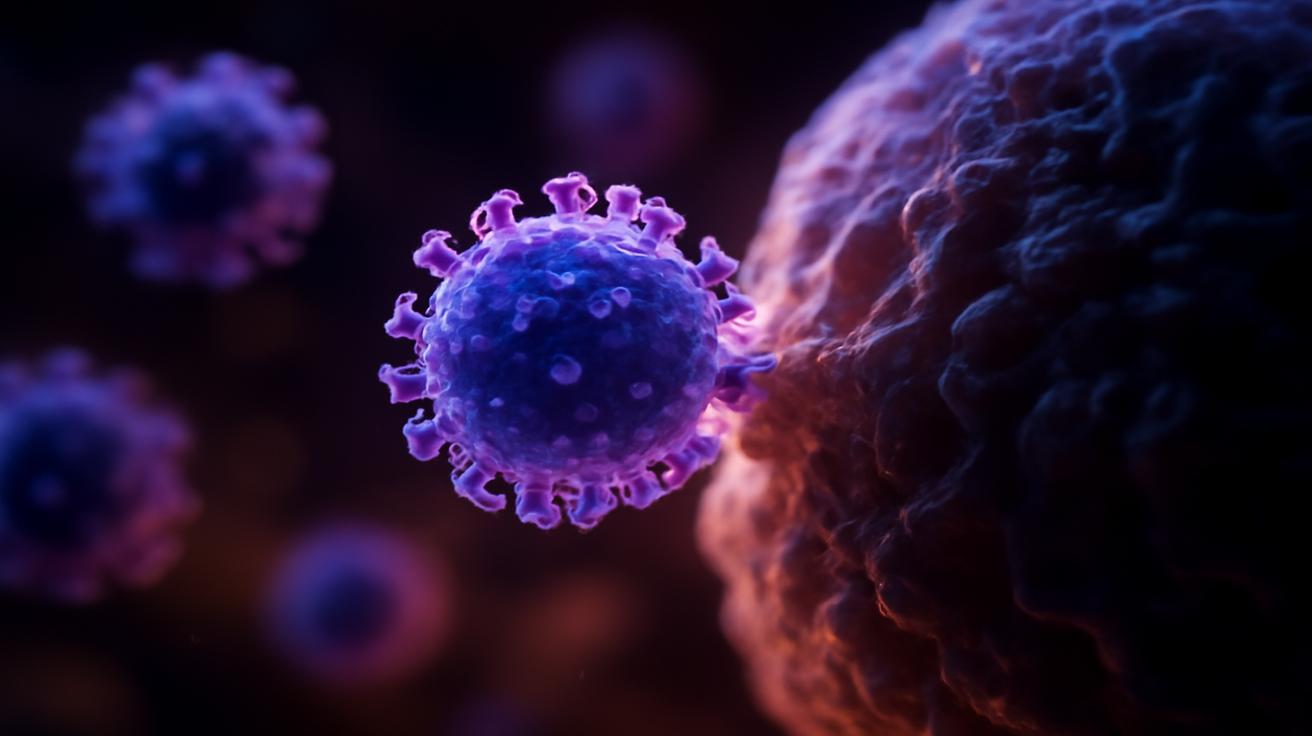
The first time I really noticed Epstein–Barr virus, it wasn’t under a microscope or in a lab report. It was in a waiting room. The air smelled faintly of antiseptic and overbrewed coffee, and the woman sitting across from me kept flexing her fingers as if she were turning an invisible key. Her joints were swollen, knuckles shiny and pink, but what caught my attention was the way she described her body: “It’s like my own cells don’t recognize me anymore,” she said. “Like I’ve become the enemy.”
She had rheumatoid arthritis, an autoimmune disease. She had also, like more than 90 percent of the global population, been infected with Epstein–Barr virus at some point in her life. And increasingly, scientists are whispering that these two facts might not be a coincidence.
The Silent Passenger We Almost All Carry
If Epstein–Barr virus, or EBV, were a character in a story, it would be that quiet passenger on the crowded bus that no one notices—until something goes terribly wrong.
EBV is a member of the herpesvirus family, but it doesn’t behave like the villains we typically picture. There’s no obvious blistering rash, no dramatic flare of symptoms you can point to in a mirror. Most people catch EBV in childhood or adolescence. For some, it becomes “mono,” the notorious kissing disease: fever, swollen glands, exhaustion like wet sand in your bones. For many others, it’s practically invisible—just a passing sore throat, or nothing at all that they can remember.
And then, almost without announcement, it goes quiet. EBV slides into our immune cells—especially B cells, the antibody factories of our defenses—and stays there. Not for weeks or months, but for life. Latent. Hidden. Waiting. Your immune system never fully forgets it; it just negotiates a tense truce, a kind of cellular cold war. The virus is not gone. It is managed.
This would be unsettling enough if EBV were simply a hitchhiker. But emerging research suggests it may be something more like an architect, subtly reshaping the landscape of our immune systems in ways we’re only just beginning to see.
The Strange Map Between a Common Virus and Rare Diseases
Autoimmune diseases often sound like plot twists in a story we didn’t sign up for. Multiple sclerosis, lupus, type 1 diabetes, rheumatoid arthritis, inflammatory bowel disease—labels that mean the immune system, designed to protect, starts misfiring at home. It mistakes myelin in the brain for invaders, or the joints, or the pancreas, or the skin, and attacks with precision and persistence.
For decades, the big question has hung over autoimmune research like mist in a valley: why? Why does one person’s immune system remain obedient while another’s goes rogue?
Genes are part of the story. Some people carry variations that tilt their immune system toward overreaction. But genes alone don’t explain the patterns. Identical twins, sharing the same DNA, don’t always share the same autoimmune disease. Something else is needed—some environmental spark to light the fuse.
EBV has hovered near that spark for a long time. Epidemiologists noticed that people who had infectious mononucleosis seemed more likely to develop certain autoimmune conditions later in life. Autoantibodies—rogue antibodies that target the self—kept turning up in people who had been infected. And in the nervous system of people with multiple sclerosis, fragments of the virus seemed to lurk like torn pieces of a lost map.
Then, in recent years, the evidence began to sharpen. Long-term studies following millions of people found that EBV infection often came before the onset of some autoimmune diseases, especially multiple sclerosis, by years. Not just coincidentally near in time, but consistently, stubbornly prior. It was as if the story of the disease could be traced back to the moment the virus arrived and took up residence.
How a Virus Teaches the Immune System the Wrong Lessons
To understand how EBV may help flip the immune system against us, imagine your body as a forest—and your immune cells as rangers trained to spot invasive species. EBV sneaks into that forest by targeting B cells, the rangers in charge of identifying threats and making antibodies against them. But once inside, EBV isn’t just hiding; it’s talking. It’s reprogramming.
The virus carries its own genetic instructions, which can turn certain B cells into something slightly off, slightly altered. These infected cells can live longer than they should, divide when they might normally rest, and show the immune system patterns that don’t belong.
Sometimes, those patterns look uncomfortably similar to our own tissues. This is the concept of “molecular mimicry”—when a viral protein looks like a twin to a human protein. The immune system, seeing the virus, mounts an attack. Antibodies are made, T cells are activated. But those same weapons can then mistake our own tissues for the virus itself. It’s like teaching a guard dog to bark at a stranger in a red coat, only to realize too late that your family wears red coats, too.
Researchers have found EBV proteins that closely resemble parts of our nervous system, our joints, even our gut. In some people, the match is close enough that the immune response spills over—a crossfire that becomes chronic. In multiple sclerosis, this might mean immune cells that were initially trained against EBV begin to attack the myelin sheath that insulates our nerve fibers. In lupus, the self-attack is broader, like a wildfire flung by sparks in all directions.
Another layer of intrigue: EBV doesn’t sit still. It nudges our immune system in other ways, changing how certain genes are read and how B cells behave over time. It’s as though the virus leaves fingerprints on the immune system’s control panel, gently adjusting knobs that regulate inflammation and tolerance. Some people’s systems compensate. Others begin a slow shift toward autoimmunity that may take years to reveal itself.
When Numbers Start Telling Stories
Data can feel cold compared to a person describing how their body turned against them. But when you zoom out and look at the patterns, a narrative emerges that’s hard to ignore.
Consider the contrast between how common EBV is and how rare some autoimmune diseases are. Nearly everyone carries EBV—like a shared secret at the cellular level. Yet only a fraction go on to develop diseases like multiple sclerosis or lupus. This tells us EBV is not the sole author of these illnesses. But it might be the co-writer, the one who hands the pen to the immune system at a critical moment.
To bring some of these associations into focus, here’s a simplified way to visualize what research has been suggesting:
| Condition | Role Suspected for EBV | Key Idea |
|---|---|---|
| Multiple sclerosis (MS) | Strong trigger or prerequisite in many cases | EBV infection often comes years before MS; antibodies may cross-react with nerve insulation (myelin). |
| Systemic lupus erythematosus (lupus) | Potential amplifier of autoantibodies | EBV-infected B cells may help create self-targeting antibodies that damage many organs. |
| Rheumatoid arthritis (RA) | Possible contributor to joint-targeting immune responses | Some EBV proteins resemble joint components, potentially confusing the immune system. |
| Autoimmune thyroid disease | Suspected environmental factor | Chronic immune activation from EBV may help unlock thyroid autoimmunity in susceptible people. |
These are not simple one-to-one relationships. They are more like overlapping circles in a Venn diagram: genes, hormones, environmental exposures, infections like EBV. Where those circles intersect, that’s where disease sometimes blooms.
Living with a Ghost in the Bloodstream
It can be unnerving to realize that a virus probably lives inside you right now—a quiet guest in your B cells, so common that it has woven itself into the fabric of humanity. But EBV’s ubiquity is also strangely comforting. It means that most of the time, in most people, the fragile balance between virus and immune system holds.
If EBV were a villain alone, we would all be sick. Instead, it sits in the background of our lives like a ghost in the bloodstream, occasionally flaring into activity but usually kept in line by layers of immune vigilance. For some, that vigilance may become excessive, the system tipped from watchful to warlike.
People living with autoimmune diseases often describe their condition in metaphors of betrayal and confusion. One person with multiple sclerosis might talk about her legs as if they were unreliable bridge planks: sometimes sturdy, sometimes giving way. Someone with lupus might describe the fatigue as a tide that drags everything under, no matter how fiercely they try to stand.
Behind these lived experiences, EBV may be playing a quiet, early role—a nudge, a trigger, a reprogramming of cells that eventually rewrites the body’s relationship with itself. But it is never the whole story. Social stress, other infections, diet, gut microbes, pollutants, hormones, and sheer biological chance all crowd into the same frame.
For those who carry a diagnosis—and for those who simply know they’ve had mono and feel the chill of these headlines—there is a temptation to ask: Is this my fault? Did kissing that person, sharing that drink, catching that virus change the rest of my life?
The more we learn, the clearer it becomes that blame has no rightful place here. EBV is part of the environment we are born into, like gravity or weather. Our choices matter, but they are never the sole authors of our biology. We are co-written by forces far larger and smaller than ourselves.
New Frontiers: Vaccines, Therapies, and a Different Future
The possibility that EBV may be a key that unlocks some autoimmune doors has sparked a quiet revolution in research halls. If a virus helps start the fire, what happens if you stop the spark?
One avenue scientists are exploring is vaccines against EBV. For decades, the idea of vaccinating against a virus that is usually mild, even invisible, felt like overreach. But if blocking EBV infection—or at least blunting its ability to linger and rewrite immune cells—could reduce the risk of multiple sclerosis or other autoimmune diseases, the calculus changes dramatically.
Imagine a generation that never has to negotiate a lifelong truce with EBV. Would their rates of certain autoimmune diseases drop? Would the landscape of chronic illness look different? These are not yet answered questions, but they are being asked with new urgency.
Another front lies in therapies targeting EBV-infected cells in people who already have autoimmune conditions. Some experimental treatments aim to selectively prune B cells carrying the virus, like gardeners removing diseased branches to save the tree. Others look at blocking specific antibodies or T cells trained by EBV that may be misfiring against the self.
None of these approaches are ready to declare victory. Science moves more like a careful hike through rugged terrain than a quick sprint: sideways sometimes, doubling back, checking the map twice. But for patients and clinicians, even the possibility of interrupting EBV’s influence on autoimmunity is a powerful kind of hope.
Listening to What the Body Has Been Trying to Tell Us
In some ways, the story of EBV and autoimmune disease is a story about listening more closely—to the body, to patterns across populations, to the molecular echoes inside our cells. For years, patients have reported feeling like something “set off” their illness: a severe infection, a period of overwhelming stress, a time when they just never seemed to recover.
As research catches up, those personal narratives are gaining scientific context. An infection like EBV may not be a simple before-and-after event but a pivot point, a reorientation of the immune system that unfolds over many seasons of a life. The onset of autoimmunity might be less like a sudden lightning strike and more like a slow misalignment, a quiet accumulation of cellular mistakes that eventually cross a threshold.
And yet, within this complexity, there is an invitation: to treat our immune systems less as isolated warriors and more as ecosystems. What we’re learning about EBV suggests that harmony and imbalance aren’t just poetic metaphors but biological realities, shaped by viral passengers, genetic terrain, microbial neighbors, and daily choices.
For individuals, this doesn’t translate into a simple checklist—no magical diet or lifestyle shield against a virus that spreads so easily and so widely. But it does whisper a reminder that tending to overall immune health, managing stress, caring for sleep, nurturing gut health, and respecting recovery from infections are not minor acts. They’re small alignments with the quiet labor our bodies perform every day to distinguish self from threat.
A Story Still Being Written
Back in that waiting room, the woman with the invisible key in her aching fingers eventually disappeared behind a clinic door. Somewhere in her blood, EBV likely sat, as it does in mine, as it probably does in yours. Her story and the virus’s story had intersected in a way that led to swollen joints and hard choices about medication and energy and pain.
We don’t yet know exactly how many such stories hinge on EBV. We don’t know whether, years from now, we’ll look back at this era as the moment we finally recognized the virus as a central player in autoimmunity—or as one crucial actor among many. What we do know is that the evidence keeps tightening around the idea that EBV is more than a benign passenger, more than a teenage rite of passage called mono.
The Epstein–Barr virus may be a key—one that fits into the lock of our immune system with unsettling ease. Turned on its own, it might cause little lasting harm. But turned in combination with genes, hormones, and the environments we inhabit, it may open doors we have spent decades struggling to close.
The work ahead—developing vaccines, refining treatments, decoding exactly how EBV teaches some immune systems to misfire—isn’t just about controlling a virus. It’s about rewriting a larger story of how we coexist with the microscopic world, and how sometimes, almost imperceptibly, that coexistence tips into conflict.
For now, we live in that tension: carrying EBV as a near-universal ghost, watching as science slowly illuminates its role in chronic illness, holding onto the possibility that understanding this hidden passenger may one day spare others from the harshest turns of the plot.
Frequently Asked Questions
Does everyone with Epstein–Barr virus develop an autoimmune disease?
No. The vast majority of people infected with EBV never develop an autoimmune condition. EBV appears to be one important factor among many—genes, other infections, environmental exposures, and chance all influence whether autoimmunity arises.
If I’ve had mono, does that mean I will get multiple sclerosis or another autoimmune disease?
Not necessarily. Having mono (a symptomatic EBV infection) may increase risk for certain diseases like multiple sclerosis, but the absolute risk is still low. Most people who have had mono never develop MS or other autoimmune illnesses.
Can we eliminate EBV from the body once we’re infected?
With current medical tools, we cannot completely remove EBV. The virus becomes latent, hiding inside certain immune cells. Treatments can reduce its activity and help manage diseases linked to it, but true eradication isn’t yet possible.
Is there a vaccine against Epstein–Barr virus?
There is no widely available EBV vaccine yet, but several candidates are in development and early testing. One major motivation for these vaccines is the hope that preventing EBV infection could lower the risk of some autoimmune diseases and certain cancers.
What can I do now to protect my immune health if I already carry EBV?
You can’t undo past infection, but you can support your immune system by prioritizing sufficient sleep, managing stress, avoiding smoking, staying physically active, and working with healthcare professionals to monitor and manage any emerging symptoms. These steps don’t specifically target EBV, but they help maintain overall immune balance.








Leave a Comment