
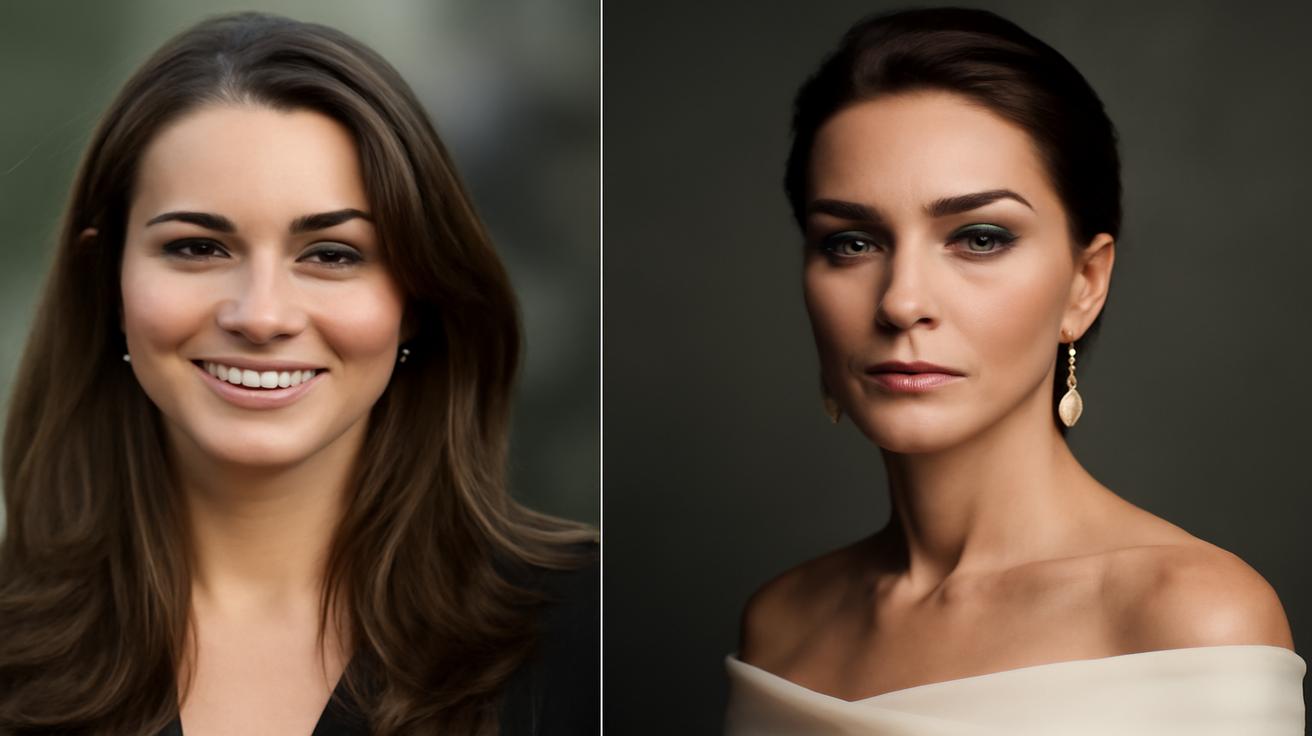
The photograph arrived the way all royal images do these days: not with trumpets and newspaper front pages, but with the cool glow of a smartphone screen. One moment you were scrolling past a friend’s vacation snap and a video of a cat in a cardboard castle, and then—there she was. Catherine, Princess of Wales. Serene, soft light on her face, eyes holding some blend of warmth and weathered wisdom. The comments poured in: “She’s aging like fine wine.” “Graceful.” “Regal.” But also, more pointed ones: “Why is this what ‘aging well’ has to look like?” “Is this real, filtered, edited?” And just like that, a single image of a woman in her early forties turned into a global debate about what it means to age, to be seen, and to be admired—or judged—for it.
The Princess, the Camera, and Our Hungry Eyes
We’ve watched Catherine for years now, in the unforgiving way we “watch” public women. Her story has unfolded in high-definition: from that college girl walking the runway in a daring dress, to the poised fiancée clutching a sapphire ring loaded with history, to the young mother with a newborn wrapped in white on hospital steps as the world zooms in, breath held, waiting for a glimpse.
In the early days, the fascination was about fairy-tale transformation. Could a middle-class woman really become a future queen? Cameras zoomed in on her hair, her dresses, the way she walked beside William, whether she curtsied too low or smiled enough. Then, slowly and almost imperceptibly, the story shifted. She turned 30, then 35, then 40. Lines deepened a little around her eyes, as they do on any human face lucky enough to accumulate days. Her posture, once just “elegant,” started getting described as “regal,” “assured,” “mature.”
That newer photograph—the one that poured gasoline on the phrase “aging like fine wine”—felt like a turning point. Her features were familiar, yet the mood was different: less ingenue, more grounded. Like someone who has learned that life can be both generous and merciless, and intends to meet it with a steady gaze. The image seemed to invite the world to say it out loud: Catherine is aging. And then to ask the more loaded follow-up: is she aging correctly?
The Seductive Myth of “Fine Wine” Aging
“Aging like fine wine” is one of those phrases that sounds loving on the surface, like a compliment wrapped in silk. People tossed it at the photo of the Princess of Wales like confetti. On social media, one comment sparked a thread that cascaded into tens of thousands of reactions in just hours. A woman in Brazil wrote: “She gives me hope that I can be forty and still feel beautiful.” A man in Canada added: “This is what real class looks like.” Underneath, another voice cut through: “Why is our ‘hope’ always tied to looking younger than we are?”
The comparison to wine is a neat, romantic metaphor. Wine matures in darkness, in barrels, in caves—out of sight. Then one day the cork pops, and the world discovers the reward of patience and time. But humans don’t age in darkness or silence, especially not public women. They age under a thousand lenses, in unforgiving sunlight, with screen captures and side-by-side “then and now” collages tracking every freckle.
So when we say the Princess of Wales is aging like fine wine, what do we really mean? That she has remained slender? That her skin, while no longer 25, still looks smooth from a distance? That her hair is thick, glossy, and still mostly brown? Or are we responding to something else—something in her presence, in the quiet steel she carries now, in the way she seems less eager to please and more anchored in herself?
Often, we don’t know. The language we have for aging is clumsy at best and cruel at worst. For men, “distinguished,” “seasoned,” “silver fox.” For women, the vocabulary is much more fragile: “still looks good for her age,” “has kept her figure,” “hasn’t let herself go.” The Princess’s image became a canvas where all those phrases, and the weight they carry, were projected and magnified.
The Feminine Face of Time Under a Global Microscope
What made this particular debate so heated wasn’t just the picture—it was the long shadow behind it. We’ve seen this movie before. Every time a high-profile woman crosses a threshold birthday—40, 50, 60—the world leans in with a measuring tape made of pixels and preconceptions.
Catherine, unlike many actresses or pop stars, is embedded in an institution that trades heavily on continuity and symbolism. The British monarchy presents itself as something outside of time, even as its members very much live inside it. The Princess of Wales isn’t just a person; she’s an emblem of “the future of the monarchy,” a living bridge between tradition and whatever comes next. That makes her aging both intensely personal and stubbornly political.
Some people saw the photo and felt comforted. Here was a woman who had visibly lived—three pregnancies, long days of public engagements, personal and public crises—and yet appeared composed, luminous even. For them, she embodied the possibility that you don’t disappear after 40, that you can accumulate years and still command a room or a frame.
Others bristled. They pointed out the careful lighting, the soft-focus style that blurs imperfections. They noted that very few women have the resources of a royal household: professional stylists, high-end skin care, access to private health care, perhaps the most flattering wardrobe on the planet. Was it fair, they asked, to use a princess—literally—as the benchmark for “aging well”? Was this just another impossible standard wrapped in the varnish of admiration?
In comment sections, the tone veered from admiring to accusatory, from tender to vicious. Debates about whether she had “work done” flared almost instantly, as if it were a moral question rather than a personal choice. A simple image of a woman in her forties became an X-ray of our tangled relationship with age, beauty, and power.
| Common Phrase | What We Think It Means | Hidden Message About Aging |
|---|---|---|
| “Aging like fine wine” | Getting better, more attractive with age | Aging is only acceptable if it enhances beauty |
| “Still looks good for her age” | Surprisingly attractive in later years | Looking good and aging are assumed to clash |
| “Hasn’t let herself go” | Maintains body and grooming standards | Aging is framed as negligence if not tightly managed |
| “Graceful aging” | Accepting age with dignity | Grace is often equated with invisibility and quietness |
| “Timeless beauty” | Not visibly affected by time | The ideal is to show as little age as possible |
Behind the Compliment: Who Gets to Age in Public?
Strip away the tiaras and official portraits, and a quieter question emerges: Who is allowed to age openly, and who must make aging look like an art form? When the world holds up Catherine as the definition of “aging like fine wine,” it’s often less about her specific face and more about a cultural script.
The script says: a woman should stay polished but not vain, natural but not “neglectful,” youthful but not desperately clinging to youth. She should move through her forties and fifties like a swan across a lake—effortless on the surface, invisible paddling underneath. The Princess of Wales is a particularly potent vessel for this script because we project so much onto her: composure, restraint, service, tradition. Her image reassures people who want to believe in a certain kind of order: that effort pays off, that discipline can hold back chaos, that you can control how the world reads your years.
But consider the people who don’t fit this mold. The single mother with two jobs and no time for facials. The woman navigating chronic illness whose body has changed swiftly in ways that cannot be dieted or serumed away. The trans woman whose late transition means she experiences aging under a microscope of a different kind. The grandmother whose wrinkles map decades of laughter and grief. Where do they fit in the language of “fine wine” aging?
The heated discourse around the Princess’s photo wasn’t just about her—it was about them. About us. Every compliment directed at her carried an implied comparison, an invisible measuring stick held against millions of anonymous faces. People felt that, even if they couldn’t always put it into words. Some admired and were inspired. Others felt the familiar sting of not measuring up to a standard they never agreed to in the first place.
Redefining “Fine Wine”: From Surface to Substance
Walk into an old wine cellar and you’ll notice something a camera can’t capture: the air feels thick, almost velvety. There is dust on the bottles, yes, but also a kind of quiet reverence. Time hasn’t just passed there; it has done work. Chemical transformations have taken place in the dark. The wine is physically different, structurally altered.
If we took that metaphor seriously, “aging like fine wine” wouldn’t be about how smooth the label looks. It would be about depth. Complexity. The way experiences have fermented into insight, compassion, boundary-setting, humor. It would be less about erasing the signs of time and more about honoring what time has built.
Viewed through that lens, the Princess of Wales does seem like an interesting case study. Over the years, there’s been a quiet shift in her public work—from fashion coverage to focus on early childhood development, mental health, and the subtle, often invisible factors that shape a life before it can even speak. In speeches and projects, there’s a sense of someone trying to use her position with increasing intention, as though the role has gone from costume to calling.
Maybe that’s the real definition of aging like fine wine: when your external story and your internal growth start to align. When the poise in a photograph isn’t just learned posture but the byproduct of weathering storms we may never fully see. When the light in your eyes owes more to what you’ve survived and chosen than to the ring light in front of you.
This doesn’t mean we should romanticize every image or ignore the layers of curation that go into royal photographs. But it suggests we might be able to hold two truths at once: that the picture is polished and that the woman inside it has likely grown more intricate with each passing year. The question is whether we’re willing to praise that intricacy, or whether we’ll stay fixated on the smoothness of the bottle.
Aging Beyond the Palace Gates: Our Own Reflection
The global argument sparked by one royal portrait says as much about the rest of us as it does about the Princess of Wales. Each time her image circulates with those familiar captions—“goals,” “perfection,” “this is how you age”—we are invited, almost compelled, to turn our gaze inward.
Maybe you think about the first time you noticed a streak of gray in your hair, how your fingers hesitated before pulling it out, then stopped, curious. Or the moment you saw your parent’s expression flash across your own face in the bathroom mirror—a wrinkle between the brows, a softness at the jawline. You remember the pang that came with it: was it fear? Sadness? Relief?
Sometimes aging feels like a slow unfurling; other times, like waking up to find an entirely new season outside the window. Social media compresses these seasons into swipeable before-and-after snapshots, erasing all the messy middle where most of life actually happens. That’s the part we rarely see with the Princess either: the late nights, the self-doubt, the unflattering angles, the health scares, the private negotiations with her own reflection.
But perhaps that’s where the most meaningful redefinition of “fine wine” aging lies—in accepting the middle, not just celebrating the polished reveal. In appreciating the days when you feel tired and puffy and still show up to your life. In admiring not just the woman who poses on a palace balcony, but also the woman who juggles school pick-ups, pays bills, cares for relatives, advocates for herself at the doctor’s office, or starts over after a loss.
What if we shifted the compliment? Instead of saying, “You’re aging like fine wine” while meaning “You don’t look your age,” we tried: “You’ve grown so much,” “You seem more yourself than ever,” “There’s a depth to you now that I really admire.” Compliments that attach worth to presence, not just presentation.
Frequently Asked Questions
Why did the Princess of Wales spark a debate about aging?
Her recent photographs circulated widely with comments about how she is “aging like fine wine.” This praise triggered intense discussions about beauty standards, the pressure on women to age in a specific way, and whether using a highly resourced royal as a model of “good aging” is fair or realistic.
Is saying someone “ages like fine wine” a compliment or a problem?
It can feel like a compliment, but it also carries hidden messages. Often it suggests that aging is only acceptable when it maintains or enhances conventional beauty, implying that visible signs of age are undesirable. The phrase ties value to appearance rather than to growth, character, or experience.
How does gender influence how we talk about aging?
Men are often described with positive terms like “distinguished” or “silver fox” as they age, which frame aging as adding value. Women, by contrast, are more likely to hear comments that compare them to younger standards—“still looks good,” “for her age”—which positions aging as something to resist or hide.
Does the Princess of Wales represent realistic aging for most people?
Not entirely. While she is a real person, her life comes with unique advantages: professional stylists, tailored clothing, curated photos, and access to high-level healthcare. Using her as the main reference point for “aging well” ignores the realities and constraints many people face in everyday life.
How can we talk about aging in a healthier way?
We can shift our language away from youth-obsessed compliments and toward recognition of depth and growth. Instead of focusing on how “young” someone looks, we can appreciate qualities like wisdom, confidence, resilience, humor, and authenticity—traits that often deepen with time and experience.







Leave a Comment