
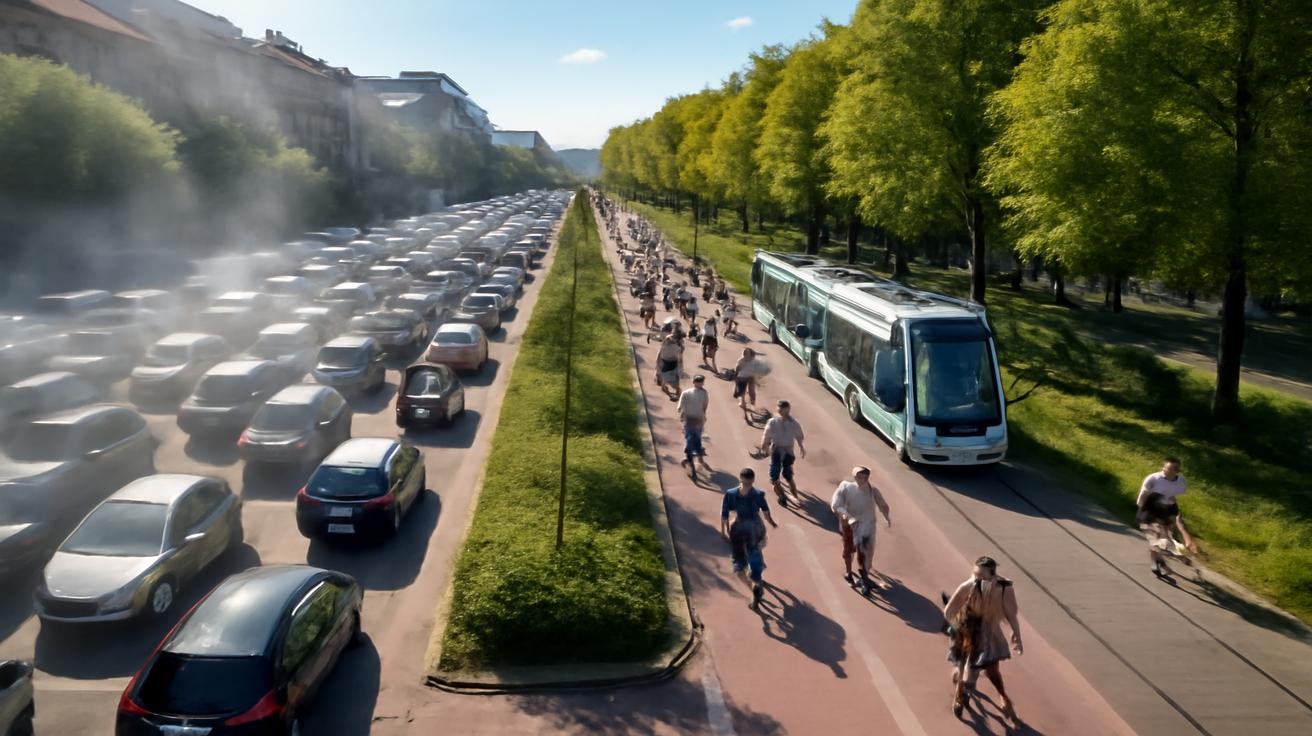
The bus sighs to a stop with a soft hiss, doors folding open like a book inviting you in. A rush of warm air, the scent of wet jackets and coffee, the low murmur of half-heard conversations. Outside, rain beads on the windows; inside, thirty strangers share the same humming engine, rolling through a city that would grind to a halt if each of them were sealed alone in a car. You tap your card, find a seat, and feel it—a tiny shift. Less traffic. Less noise. Less invisible exhaust slipping into the sky. You’re just getting to work. But somewhere, far above the clouds, the planet exhales with you.
The Hidden Story in the Air We Breathe
Most days, climate change feels distant—something happening to other people, in other places, on grainy news footage of floods and wildfires. Yet the story of the climate is written in the most ordinary parts of our lives: the 8:15 bus, the worn bike lane on the corner, the crosswalk where you wait with headphones on, watching the traffic ripple past.
Transportation is one of the biggest characters in this story. Globally, it accounts for roughly a quarter of energy-related carbon dioxide emissions, and in many cities it’s the single largest source. Each exhaust pipe is small. Together, they draw a thick, invisible line between the way we move and the warming of the planet.
The remarkable thing is how quietly that line can be erased. A bus replaces twenty, thirty, fifty cars in one sweep. A bike makes its journey on human power, the rider’s breath the only exhaust. A short walk to the grocery store instead of a short drive turns a mundane errand into a tiny act of climate repair. None of this looks radical. But scaled to a neighborhood, a city, a nation, these small choices begin to tilt the numbers in a very real way.
Why One Packed Bus Beats a Street Full of Cars
Close your eyes for a moment and picture the main street near your home twice over. First, imagine it in the usual way: cars stacked bumper to bumper, brake lights burning red, engines idling. Now wipe that scene away and restage it with the exact same number of people—only this time, they’re all in buses, on bikes, or on their feet.
The space changes. So does the sound. The air. Even the way you feel walking along the sidewalk.
From a climate perspective, that second scene is a small revolution. A full bus, train, or tram spreads its emissions across dozens of passengers. Measured per person, the carbon footprint of a bus ride is often a fraction of that of a car trip—especially when the bus is decently full and runs on cleaner fuels or electricity.
Here’s a simple way to picture it. The exact numbers vary by country and vehicle type, but the pattern is clear:
| Mode of travel | Typical passengers | Relative CO₂ per person-km* |
|---|---|---|
| Single-occupancy car | 1 | Baseline (100%) |
| Car with 3 people | 3 | About 35–40% |
| Urban bus (diesel, fairly full) | 25–40 | Around 25–40% |
| Electric bus or train (clean grid) | 40–100+ | As low as 5–20% |
| Bicycle | 1 | Near zero (food energy only) |
| Walking | 1 | Essentially zero (no fuel, just calories) |
*Illustrative comparison; actual emissions vary by location, technology, and electricity mix.
Behind those percentages are real, measurable climate benefits. Every time a bus fills up, the emissions “cost” of getting each person where they’re going drops sharply compared with separate car trips. Multiply that by tens of thousands of daily riders, and you start to see why public transportation is often called a backbone of climate solutions.
And there’s an added twist: public transport doesn’t just replace car trips; it reshapes cities so that fewer car trips are needed in the first place. Bus corridors, metro lines, and tram routes tend to attract homes, jobs, and shops around them. Over time, this density means shorter distances, fewer compulsory drives, and more chances to walk or ride instead.
The Quiet Power of Feet and Pedals
There’s a certain magic in the rhythm of walking. The soft slap of your shoes, the way a neighborhood reveals itself at human speed: a chipped garden gate, the bakery that smells like cinnamon, the side street you never noticed from behind a windshield. Cycling has its own soundtrack—the low whirr of the chain, the quick click of gears, the gust of air that lifts the day’s weight from your shoulders.
Active mobility—walking, cycling, using a scooter or wheelchair—feels personal and local, but its climate impact is surprisingly far-reaching. A bicycle produces virtually no emissions while it’s being used; a pair of walking shoes even less. The main climate costs are in making the bike or shoe and in the extra food energy you might eat. Even then, the numbers are tiny compared with a car’s lifetime fuel burn and manufacturing footprint.
Most of the trips we take are short. In many cities, a huge share of car journeys are under five kilometers. These are ideal distances for bikes and often walkable with decent sidewalks and safe crossings. When even a fraction of those short trips shift from car to foot or pedal, emissions fall in a way you can feel in your lungs as much as in a climate report.
There’s also a ripple effect. A street designed for walking and cycling tends to be narrower and calmer, with trees and benches instead of parking lots. People linger, chat, stop in at local shops. Drivers slow down. Parents feel safer letting their children ride to school. What began as a climate-friendly choice cascades into a healthier, more connected community—one where choosing the low-carbon option is also the most pleasant.
You can sense this when you enter a city that has taken active mobility seriously. The bike lanes are wide and separated. Crosswalks are frequent and well-marked. The air feels clearer. The noise has a softer edge. Climate benefits are not just numbers; they’re the texture of daily life.
Beyond Carbon: The Chain Reaction of Better Streets
At first glance, it’s all about greenhouse gases. Less fuel burned, less carbon dioxide in the atmosphere, fewer degrees of warming down the line. But public transportation, walking, and cycling trigger a whole chain reaction of side benefits that circle right back to the climate in ways we don’t always notice.
Start with congestion. A street full of single-occupancy cars wastes astonishing amounts of time and fuel. Engines idle in traffic, burning fossil fuel for no productive movement at all. Shifting even a slice of daily travel to buses, trains, and bikes frees up road space, smoothing the flow for the vehicles that do need to be there. Fewer traffic jams mean fewer pointless emissions.
Then there’s the question of space. Cars don’t just emit carbon; they also demand huge amounts of land—for roads, for parking lots, for garages and flyovers. Pave over enough land and you create “heat islands,” where concrete and asphalt trap the sun’s warmth, raising local temperatures. You lose trees that could store carbon and cool the streets. Public transportation and active mobility need far less space per person moved, allowing more room for parks, green strips, and shaded sidewalks that soak up rain, shelter wildlife, and store carbon in their roots and soil.
Health sneaks into the story too. People who walk or cycle regularly tend to be healthier, with lower risks of heart disease, diabetes, and some cancers. Healthier populations mean less pressure on medical systems and, surprisingly, less climate impact—healthcare itself is an energy-hungry sector. Fewer car crashes, less noise, lower stress: these all sound like social benefits, and they are, but they also gently support a world where sustainable choices become normal rather than noble.
Finally, consider resilience. A city that moves primarily by car is vulnerable: to fuel price spikes, to power outages at gas stations, to oil supply shocks. Well-designed public transport and robust walking and cycling infrastructure spread the risk. They give people more ways to get where they need to go during disruptions and disasters, which are becoming more common as the climate warms. In a subtle way, how we move can either magnify the climate crisis or help us weather it.
Designing Cities That Make the Green Choice Easy
There’s a popular myth that climate-friendly travel is mostly about individual virtue: the heroic cyclist pedaling through a snowstorm, the saintly commuter giving up their car for the greater good. But if you look more closely, you’ll notice something important. People walk, ride, and take transit most where cities make it easy, safe, and enjoyable to do so.
Think about how different your choices feel in two contrasting places. In one, the sidewalk is cracked or missing. The bus stop is a lonely sign stuck in a ditch, with no shelter or timetable. The bike lane ends abruptly at a tangle of fast-moving traffic. In the other, buses arrive frequently and reliably; they connect smoothly to metro or tram lines. The bike lanes are continuous and protected, with clear markings and lights. The streets are lined with trees, crosswalks are short and frequent, and everyday needs—groceries, schools, parks—are close by.
In the first city, choosing not to drive can feel like an obstacle course. In the second, it feels almost obvious to leave the car at home. The climate impact of these design choices is enormous, even though nobody talks about it in terms of carbon in their daily life. They just know that walking to the corner café or hopping on the tram is easier than wrestling for a parking space.
Land use planning plays a quiet yet decisive role here. When cities sprawl—stretching homes, jobs, and shops far apart—it becomes harder to serve them with efficient public transit, and distances grow beyond comfortable cycling or walking. When cities grow more compactly, mixing uses and building around bus or train corridors, the math flips: transit becomes more efficient, bike trips shorter, walking more natural. The climate follows those lines on the map.
Some of the world’s most beloved urban neighborhoods share the same formula: dense but human-scaled streets, frequent public transport, a safe weave of bike lanes and sidewalks. Climate policy documents might call this “transit-oriented development.” On the ground, it just feels like a place where life is close at hand and the car is optional.
What This Looks Like in Everyday Life
It’s one thing to talk about emissions and infrastructure; it’s another to see how it plays out in the quiet rituals of an ordinary week. The climate benefits of public transportation and active mobility are not abstract—they are stitched into the way mornings begin and evenings wind down.
Picture a commuter named Lina. A few years ago, she drove alone to work every day, forty minutes each way on a crowded ring road. She left home stressed, arrived more stressed, and joked about “living in traffic.” When a new bus rapid transit line opened along her route, with dedicated lanes and reliable schedules, she decided to try it “just for a week.”
Now she walks ten minutes to the stop, coffee in hand. She reads on the bus, or just watches the city slide past. She’s not burning fuel to sit still behind a steering wheel. Multiply her story by thousands of people along that corridor and you have fewer cars on the highway, lower emissions from each kilometer traveled, and cleaner air along the bus route itself.
Or imagine a teenager named Omar in a neighborhood that recently added protected bike lanes to the main roads. Before, his world was bounded by where his parents could drive him. Now he rides to school, to the library, to a friend’s apartment. Each of those trips replaces what would likely have been a car ride. Across a year, his small circle of freedom is a small circle of reduced emissions, one that may set patterns for a lifetime.
On a different street, an older neighbor, Maria, who had given up driving, finds that the new tram line and smoother sidewalks mean she can still shop, visit friends, and see her doctor without asking for rides. She’s maintaining her independence in a way that’s inherently low-carbon—and she’s not alone. Public transit and walkable streets knit together lives across ages and incomes, sharing the benefits of climate action rather than hoarding them for those who can afford new technologies.
These are the threads that, woven together, create a different kind of urban fabric—one where climate solutions look like easier mornings, calmer streets, and a city that feels more like a shared home than a battleground of machines.
Choosing the Next Step Forward
When people talk about climate action, they often leap to distant technologies: futuristic aircraft, vast carbon-sucking machines, new fuels distilled in hidden labs. There’s a place for those innovations. But some of the most powerful tools are already rolling past your doorstep on rubber tires and steel rails, or waiting in the hallway in the shape of a bike or a pair of shoes.
The beauty of public transportation and active mobility is that they work at many scales. National governments can fund rail networks and clean buses. Cities can redesign streets, tighten zoning around transit, and build connected networks of sidewalks and bike lanes. Neighborhoods can fight for safer crossings, better bus stops, and traffic calming. And individuals—you, reading this—can shift just one or two regular trips a week, then maybe a few more, and talk about why.
Not everyone can give up a car completely. Distances, disabilities, safety concerns, and work patterns all matter. But almost everywhere, there is some room for change: a park reached on foot instead of by car; a commute done by train once a week; errands combined into one trip on the bus. The climate benefits of these tweaks might feel small, but they add up, especially when they inspire or demand better infrastructure.
Think of it like tuning an instrument. Each choice—each ride, each walk, each policy that favors buses, bikes, and feet over endless lanes of traffic—brings the world a tiny step closer to harmony with the planet’s limits. The music of a low-carbon city isn’t silent; it’s just different. Less roaring engines, more overlapping conversations. Fewer fumes, more birdsong sneaking in between buildings.
Tomorrow morning, when you step outside and consider how you’ll get where you’re going, you’re not just choosing a route. You’re choosing which version of the future you’re walking, riding, or rolling toward. Somewhere, a bus is already sighing open its doors. A bike tire is waiting to meet the pavement. The climate, and your city, are listening.
Frequently Asked Questions
How much can I really help the climate by taking public transport instead of driving?
Shifting from a solo car trip to public transport often cuts your travel emissions by around half, and sometimes much more, especially on electric buses or trains. Over a year of commuting, that can add up to hundreds of kilograms of CO₂ avoided—comparable to the impact of major lifestyle changes like skipping several short-haul flights.
Is cycling or walking always better for the climate than taking the bus?
For short urban trips, walking and cycling are usually the lowest-carbon choices, since they burn no fuel and require little infrastructure. However, on longer routes or in bad weather, a full bus or train remains an excellent low-carbon option, particularly if it runs on cleaner fuels or electricity.
What if my city doesn’t have good public transportation yet?
You can still reduce your transport emissions by carpooling, combining errands into one trip, walking or cycling for the short journeys that are feasible, and supporting local campaigns for better transit and safer streets. Demand and public pressure often help push improvements forward.
Do electric cars make public transport and cycling less important?
Electric cars are cleaner than conventional cars, especially where electricity is generated from renewable sources. But they still require lots of energy and space, and they don’t solve congestion or land use issues. Public transport, walking, and cycling remain essential for creating cities that are not only low-carbon but also livable, safe, and inclusive.
How can I start using more active mobility in my daily life?
Begin with small, realistic steps. Choose one regular trip—like going to a café, the gym, or a friend’s house—and try walking or cycling instead of driving. Explore local bike routes or quiet streets, and consider combining modes, such as cycling to a train station. As it becomes more comfortable, add more trips until low-carbon travel feels like the default rather than the exception.








Leave a Comment