
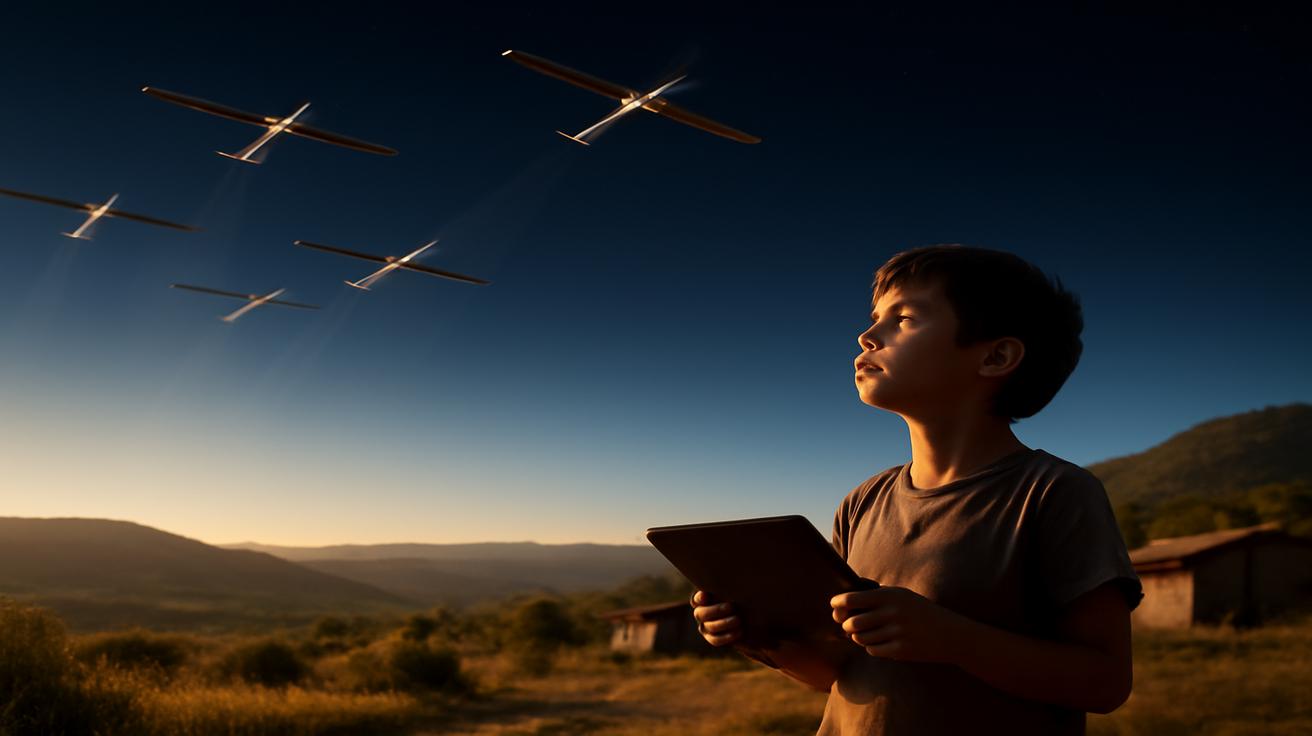
The first time you see one, you might not even notice it. Just a pale sliver of white against the deep blue, so high above the flight paths and contrails that it looks more like a wandering cloud than a machine. Yet somewhere inside that gently glowing curve of fabric, solar cells are drinking in the sun, batteries are quietly filling, and a cluster of electronics is listening, talking, and weaving invisible threads of connection. On the ground below, a child opens a tablet in a village that has never had a fiber line, never seen a cell tower, and a video call springs to life. No rocket launch. No dish the size of a small satellite bolted to a roof. Just the sky, repurposed as infrastructure.
The Internet, Suspended in Air
We’re used to thinking of the internet as something buried or distant. Cables snake across ocean floors like glassy sea serpents. Cell towers spike the horizon. Satellites orbit far beyond the clouds. If you want to put the world online, you either dig or you launch. Both are expensive, complex, and often shaped as much by geopolitics and geography as by engineering.
Stratospheric internet asks a different question: what if the easiest place to build a global network is not under our feet or hundreds of kilometers above our heads, but just thirty kilometers up, in a neglected slice of sky where almost nothing else lives?
The stratosphere, that calm, dry layer of atmosphere above the weather and below space, has quietly become one of the most promising frontiers for connectivity. Here, winds are more predictable, turbulence is minimal, and solar energy is abundant. In this thin, bright world, solar‑powered aircraft and high‑altitude platforms can linger in place for weeks or even months. From that vantage point, each platform can “see” an area the size of a small country and bathe it in high‑speed internet.
It’s a very different vision from the glittering ballet of low‑Earth‑orbit satellites like Starlink, where thousands of fast‑moving points zip across the sky, handing off connections in a constant orbital relay race. Those satellites are wonderful at reaching remote cabins in Alaska or boats at sea—but they are still limited by cost, coverage constraints, orbital dynamics, and the crowded reality of low Earth orbit.
Stratospheric systems, in contrast, hang almost motionless. They move with the upper winds, nudged back into position by quiet electric propellers. No rocket plumes, no reentry burn. Just aircraft that take off from ordinary runways, climb above the weather, and turn the sky into a service zone.
The Sky as a Cell Tower
Imagine standing on a dirt road in a remote highland valley. There is no cell signal. No fiber. Only the hush of wind and maybe the low murmur of a distant motorcycle. Then someone points up. Far above the clouds, a small gleam drifts against the sky, as unobtrusive as a wandering star in daylight. You can’t hear it. You can barely see it. But your phone buzzes as a message comes through. Suddenly, you are on the grid.
This is the central magic of stratospheric internet: each platform functions like an ultra‑tall cell tower—or a cluster of them. Because it operates at, say, 20 kilometers altitude instead of being bolted to a hill at 40 meters, its line of sight is immense. Rugged terrain that blocks ground‑based signals—mountains, canyons, dense forests—matters much less. One platform can reach thousands of square kilometers, covering scattered villages, winding highways, offshore rigs, and disaster zones in a single footprint.
Engineers call many of these vehicles HAPS—High Altitude Platform Stations. But the names are less important than their character. Picture a glider with the wingspan of an airliner but a body as slender as a canoe, its wings carpeted in solar panels. Or think of an oversized, helium‑filled airship, slow and stately, its envelope gleaming at dawn. They move just enough to hold position, sipping energy from the sun by day and from stored batteries by night. Onboard, radio equipment beams connectivity downward using familiar mobile standards like 4G, 5G, or Wi‑Fi, depending on what’s needed.
Because they float above national borders and rural back roads alike, these platforms can stitch together coverage where no traditional business case exists. The cost of stringing fiber across mountain ranges or rainforests is often prohibitive. Building towers in remote or politically unstable regions can be dangerous or simply unfeasible. Rockets and satellites demand major up‑front capital and complex regulatory coordination. But launching a solar aircraft from an airstrip and letting it climb into the stratosphere? That can be done for a fraction of the cost and with far more flexibility.
Stronger than Starlink? Where the Stratosphere Shines
“Stronger than Starlink” sounds like a challenge, but it’s really a matter of fit. Satellites are brilliant at certain things: maritime coverage, polar latitudes, and locations so remote that even a high‑flying aircraft would struggle to service them efficiently. Yet when we talk about connecting the entire planet—every school, every clinic, every farm cooperative, every roadside stand with a solar panel and a smartphone—the differences between space‑based constellations and stratospheric platforms become stark.
You feel the difference first in latency. A signal to a low‑Earth‑orbit satellite like those in a Starlink‑type constellation might travel hundreds or thousands of kilometers each way, bouncing through inter‑satellite links and ground stations. It’s fast by the standards of space, but there’s still a tangible delay. By contrast, a stratospheric platform might be just 20 kilometers above you. Data leaps up, back down, and onward to a nearby terrestrial backhaul point with astonishing quickness. For real‑time applications—telemedicine consultations, live language interpretation, remote drone piloting—that extra snappiness matters.
You feel it again in density. Satellites, especially at higher altitudes or with smaller constellations, struggle to serve extremely dense urban regions without capacity bottlenecks. They can cover broad swaths of rural land, but saturating a megacity of millions? That’s harder. A fleet of stratospheric platforms, on the other hand, can be stationed strategically, with multiple craft hovering over hotspots, dynamically adjusting coverage like a living mesh in the sky.
And perhaps most crucially, you see it in economics. A single rocket launch can cost tens of millions of dollars. Each satellite must survive the violence of launch, the harshness of space, and the difficulty of being essentially unreachable once it’s aloft. Maintenance means designed‑in redundancy and, eventually, replacement launches. Stratospheric platforms, though cutting‑edge, are fundamentally aircraft or airships. They can be serviced, upgraded, or retired by simply flying them back down. Their payloads can evolve quickly—new radios, new processors, new antennas—with far shorter design cycles than space hardware.
Consider this simple comparison of characteristics:
| Feature | Stratospheric Internet (HAPS) | LEO Satellite Constellations |
|---|---|---|
| Altitude | ~20 km (stratosphere) | ~550–1,200 km (low Earth orbit) |
| Latency | Very low, similar to ground networks | Low, but higher than HAPS |
| Coverage Footprint | Regional (country/region scale per platform) | Global, with many satellites |
| Deployment & Maintenance | Aircraft can land for upgrades or repair | Requires new launches and orbital maneuvers |
| Environmental Impact | Solar‑powered, low emissions; minimal debris | Rocket launches, re‑entry, orbital debris concerns |
In many ways, stratospheric systems offer a sweet spot: enough altitude to cover huge areas, close enough to Earth to minimize delay, accessible enough to maintain, and efficient enough to scale. For the billions of people who still live on the wrong side of the digital divide, that combination might matter more than the glamour of space hardware.
Stories from the Edge of Coverage
To understand what’s at stake, you have to leave the fiber‑lit cities and step into the margins. You have to sit in the back of a clinic in a coastal village where the only connection to the outside world is a shortwave radio that crackles and fades every time a storm rolls in. You have to share tea with a farmer who has to ride half a day to the nearest town just to check seed prices or find out if a buyer has reached the port. You have to walk into a school where the computer lab is a rumor, a dream in a cardboard box marked “donations,” because there’s no internet to make those machines more than lonely plastic.
Now imagine a quiet shift, not a sudden miracle. One dry season, a small team of engineers arrives with portable antennas and ruggedized equipment. They camp near the airstrip, where an unfamiliar aircraft waits at dawn. Long, narrow wings. No rows of jet engines. Just a faint whine from electric motors as it climbs into the cool morning air, growing smaller until it is only a white line against the sky.
Within hours, phones across the region light up with new icons. Bars of signal appear where there were none. The school’s dusty computers awaken. Doctors start using messaging apps to consult with specialists hundreds of kilometers away. A midwife in a mountain village begins downloading training videos that used to take all night, if they loaded at all. A fish seller near the estuary confirms prices in real time before she loads her boat.
Nothing about this feels like a tech demo. It feels like a door quietly opening.
Unlike satellite dishes that demand careful alignment and clear skies, the terminals for stratospheric internet can be simple—sometimes just upgraded mobile towers or small rooftop antennas that talk directly to the platform overhead. In some cases, ordinary smartphones connect without even realizing their signal is ending its journey tens of kilometers up instead of at a steel tower down the road.
Suddenly, weather data flows both ways. Farmers send observations; meteorologists send hyper‑local forecasts. Students upload projects, not just download worksheets. Local entrepreneurs launch online shops that serve not only their village but neighboring valleys linked by the same high‑altitude network. The stratosphere becomes less an abstract layer of atmosphere and more a shared, invisible commons.
The Engineering Ballet Above the Clouds
Of course, none of this happens by magic. Keeping an aircraft or airship aloft for weeks in the thin, cold air of the stratosphere demands relentless engineering. The sun there is fierce, the air frigid, and the margin for error small.
If you could ride along, the world below would curve away like a painted map. At midday, the wings would glitter, each solar cell orienting to capture photons that feel almost harsh. Temperatures outside might plunge well below freezing, yet inside the electronics bays, carefully managed thermal systems keep components warm. Batteries—some of the most energy‑dense ever installed in aircraft—quietly store surplus power for the long night.
The path of the platform isn’t a straight line. Winds at different layers of the stratosphere push and pull at different speeds and directions. Autopilot algorithms, guided by weather models, constantly decide when to climb, when to descend, when to angle the nose into the breeze to hold position over the service area. Down below, network engineers tune frequency allocations, beam patterns, and handoff strategies so that you can wander from one valley to the next without losing your call.
Yet for all the complexity, there’s a certain elegance in how stratospheric internet weaves into existing systems. It doesn’t demand that we replace every ground network or abandon satellites. Instead, it can fill the gaps between them. It can backstop fiber lines when floods wash out bridges. It can arrive first in disaster zones when cell towers topple, then hand over gracefully as temporary ground networks come online. It can connect relief workers, families seeking news, and small local radio stations broadcasting emergency updates.
Even security and resilience take on a different character. Stratospheric platforms can be repositioned when geopolitical tensions flare, moved away from contested airspace or toward regions suddenly in need. Redundancy comes from numbers: a fleet of craft, each with overlapping coverage, rather than a small number of large satellites whose loss or failure would leave wide dark spots.
Ethics, Sky Rights, and the Human Layer
With any new infrastructure, especially one that promises to wrap the entire planet in connectivity, hard questions follow closely behind. Who controls the platforms that hover silently above our borders? How is data governed when the radios that serve a rural province are technically flying above international airspace nearby? What happens when the same aircraft that can beam math lessons to a village can also host cameras or sensors?
It’s easy to fall in love with the technical grace of stratospheric internet and overlook the political, cultural, and ethical knots it tightens. A global stratospheric network touches on airspace law, spectrum allocation, surveillance concerns, and digital sovereignty. For some communities, especially those that have historically been exploited or over‑mapped without consent, another external system drifting overhead might feel less like liberation and more like intrusion.
That’s why the story of stratospheric connectivity cannot be told only through glossy renders of futuristic aircraft. It has to include town‑hall meetings under tin roofs where elders ask, quite reasonably, who reads the data that flows through the sky. It must include regulators debating how to license platforms that are not quite aircraft and not quite satellites. It must include local cooperatives that insist on a share of ownership or revenue from the networks that bind their markets and schools and clinics into the wider world.
The most powerful version of this technology may be the one that is not imposed from above but built through partnership. Regional operators who understand local languages and customs. Community networks that lease capacity on passing platforms rather than ceding total control. Open standards that make it easier for multiple providers to coexist, sharing the sky rather than fighting over it.
In other words, for the internet in the stratosphere to truly be stronger than Starlink—or any single constellation—it must be stronger socially as well as technically. It must be built with humility and flexibility, not just uplift and ambition.
A Patchwork Future of Networks
Walk outside some evening just after sunset, when the sky is still bright but the stars are beginning to prick through. You might see the faint dash of a satellite crossing overhead, its trajectory straight and unswerving. Somewhere far below that point of light, closer to the horizon, a stratospheric platform could be drifting unseen, almost motionless from your perspective, quietly feeding a web of connections spread out across farms, towns, and forests.
The future of connectivity isn’t a single all‑conquering system. It’s a patchwork: undersea cables, microwave links, city‑scale fiber, 5G towers, LEO satellites, and now solar‑powered aircraft floating in the blue. Each layer has its strengths. Each fills a different part of the world’s complex geography and economic reality.
From this perspective, “stronger than Starlink” stops sounding like a contest and starts sounding like a promise. Stronger because it reaches the people that orbital networks alone can’t serve affordably. Stronger because it can be maintained, evolved, and localized with less friction. Stronger because, if we choose to design it that way, it can belong more directly to the communities it uplifts.
Somewhere soon—or perhaps already today—another of those ghostly white wings is climbing above the cloud tops at dawn. On the ground, the air is full of small, ordinary sounds: the clatter of pots, the cough of a motorbike, the call of kids on their way to school. Somewhere in that mix, a new sound will join them: the quiet buzz of a phone connecting, for the first time, not to a distant orbit, not to a cable buried under an ocean, but to the sky itself, repurposed as a shared human commons.
Frequently Asked Questions
What is stratospheric internet in simple terms?
Stratospheric internet uses high‑altitude platforms—solar‑powered aircraft or airships flying around 20 km above Earth—to act like flying cell towers. They deliver internet connectivity over large regions without needing dense networks of ground towers or satellites in space.
How is it different from Starlink and other satellite systems?
Starlink uses thousands of satellites in low Earth orbit, hundreds of kilometers up. Stratospheric platforms fly much lower, in the stratosphere. That means lower latency, easier maintenance, and the ability to reposition or land them for upgrades. Satellites excel at truly global coverage, especially over oceans; stratospheric systems shine at regional, flexible coverage over land.
Will I need special equipment to connect?
In many designs, ordinary smartphones and existing mobile networks can connect with minimal changes, because the platform behaves like a very tall cell tower. In very remote areas, small rooftop or community antennas might be installed to link local users to the platform overhead.
Is stratospheric internet safe for the environment?
Most proposed systems are solar‑powered and use electric propulsion, so their operational emissions are very low. They also avoid contributing to orbital debris. There are still environmental questions about materials, manufacturing, and end‑of‑life disposal, but overall their footprint can be smaller than that of repeated rocket launches.
When will stratospheric internet be widely available?
Prototype flights and early commercial deployments are already happening in some regions. Widespread availability will depend on regulatory approval, investment, and partnerships with local telecom operators. Over the next decade, you can expect to see more countries experimenting with—and in some cases relying on—stratospheric platforms as part of their connectivity mix.








Leave a Comment