
The first thing you notice, standing on a quiet headland in northern Portugal, is not that the Earth is moving. You notice the Atlantic—its slow, heavy breaths against the cliffs, the salt on your lips, the gulls stitching white arcs across a washed‑out sky. The land feels rock‑solid under your boots. Old. Certain. This is a coast that has tasted shipwrecks and empires and a thousand storms. If anything in your life feels immovable, it is this: the stubborn granite ridge of the Iberian Peninsula, Spain and Portugal fused like a single stone at the edge of Europe.
And yet, far below your feet, the continent is quietly turning.
A Continent That Refuses to Sit Still
Geologists, who spend their time listening to the slow gossip of rocks, have been whispering a curious story about the Iberian Peninsula. Using GPS stations bolted into bedrock, satellite measurements, and a detective’s eye for tiny changes over long stretches of time, they’ve found that Spain and Portugal are not merely drifting along with the rest of Europe. They appear to be rotating—ever so slightly—like a massive, stone‑heavy wheel pivoting in slow motion.
This isn’t rotation as you or I would feel it, of course. You won’t wake up one morning to find Lisbon nudged closer to Morocco or Madrid spun noticeably eastward. We’re talking millimeters per year, summed over decades: the kind of motion that only reveals itself when you stack precise measurements on top of each other and squint. But to the scientists who track such things, the numbers are unmistakable. Iberia is not still; it is rehearsing a very, very slow dance step.
It’s a strange idea to hold in your head, especially when you’re physically there. Sit in a plaza in Seville with an espresso and a slice of orange light sliding down a whitewashed wall, and the last thing you’ll suspect is that the entire plaza is in motion—not just spinning with the planet and orbiting the sun, but shifting against the rest of a continent, very slightly twisting in place.
The Science Behind the Slow Turn
To understand what’s going on, geologists point to the restless choreography of tectonic plates. Europe, Africa, and the Atlantic floor all meet in complex ways around Iberia, like three dancers whose hands never quite line up. The African Plate is nudging northward, the Eurasian Plate is reacting in its own way, and the smaller microplates beneath the Atlantic are sliding and rotating. At the hinge between them—there sit Spain and Portugal, the Iberian microplate lodged like a shoulder in a crowded ballroom.
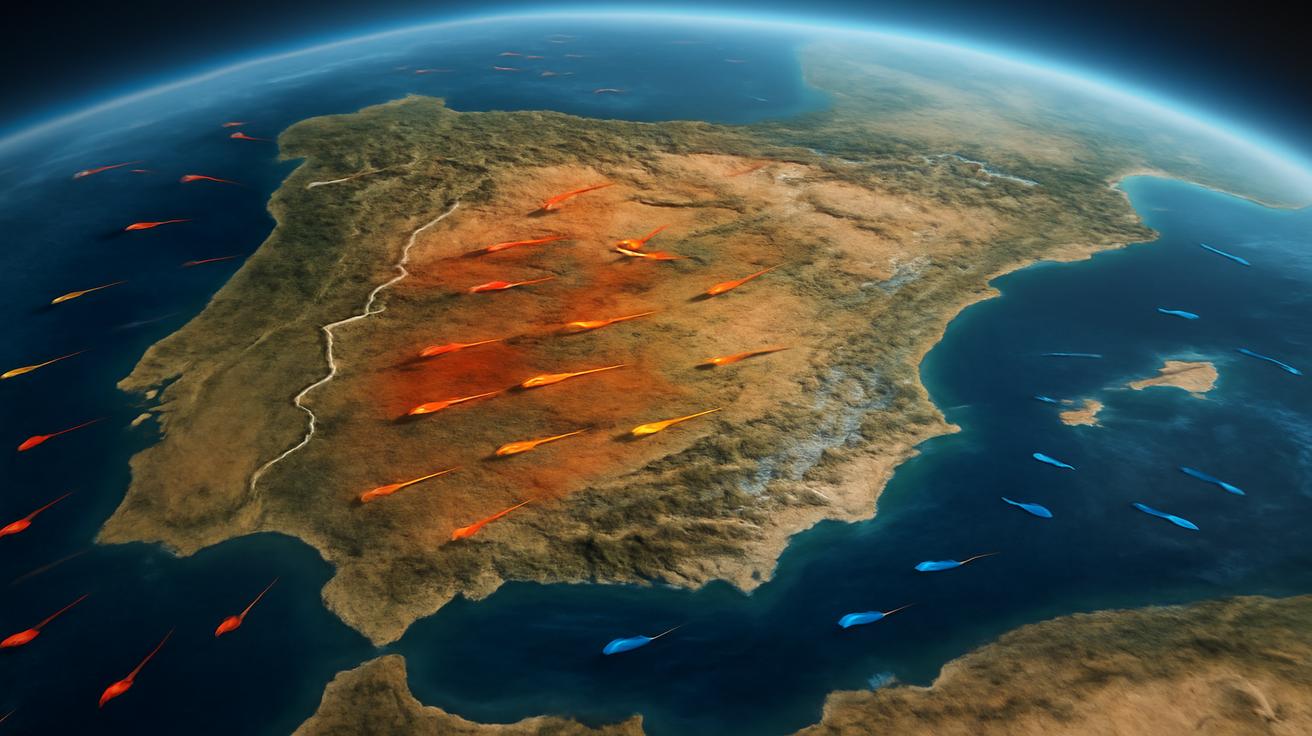
Modern GPS networks, anchored to solid rock with steel bolts, track positions down to a few millimeters. Over years, these instruments reveal slow, consistent movement. In Iberia, the pattern suggests a gentle rotation: the peninsula turning relative to the rest of Europe. Some models imagine a pivot roughly off its northeastern corner; others fine‑tune the axis differently. Either way, the idea is that this block of crust is not just drifting; it’s twisting.
In labs and research centers, maps flicker on screens: Iberia as a colored patch, tiny arrows radiating out from measurement stations in Cádiz, Porto, Barcelona, Salamanca. Each arrow is a whisper of motion. Alone, a single whisper is nothing; together, they tell a story. The story, at the moment, is that the western edge of Europe is slowly adjusting its stance, as if turning to face a slightly different part of the Atlantic.
Why Some Scientists Are Excited
For geologists and geophysicists, this is gold. It helps test models of how continents grow, how mountain belts form, and how stress travels through thick, stubborn slabs of crust. Iberia has already had a wild past: long ago it rotated dramatically during the formation of the Pyrenees, that rugged seam between Spain and France. Today’s subtle twist might be the faint echo of those ancient forces still playing out in the deep Earth.
It’s not merely a curiosity; it’s a key. This motion helps explain tiny but measurable deformation across Spain and Portugal: why some GPS stations creep one way while others creep another; where crust is being squeezed; where it might be stretching instead. Put all of that together and you get a more detailed picture of seismic risk, of how faults might behave, and of what the long‑term sculpting of the peninsula might look like.
Alarm, Indifference, and Everything In Between
Outside the world of rock nerds and satellite data, though, the reaction to “Spain and Portugal are rotating” is complicated. Say it over dinner in Barcelona or Lisbon and you’ll get a mix of raised eyebrows, skeptical shrugs, and half‑joking comments about needing seatbelts on bar stools.
Part of the problem is language. “Rotation” sounds dramatic, like the peninsula is spinning out of control, pirouetting towards disaster. For many people, it triggers images of maps tilting, coastlines swinging like doors, cities sliding sideways. If you already worry about climate change, rising seas, or more intense storms, the idea that the ground itself is turning can feel like one more thing to fear.
On the other end of the spectrum are those who hear the millimeters‑per‑year figure and mentally file it under Not My Problem. It sounds abstract, too slow to matter. Humans live by days and decades. Plates move by millennia and millions of years. Between those timescales yawns a gulf where indifference can easily settle.
The Media’s Role in the “Slow Crisis”
Whenever a new study or set of measurements comes out, headlines have a tough choice: make it sound exciting enough to click, or accurate enough to truly inform. “Iberian Peninsula Rotating!” has a very different flavor than “GPS shows subtle tectonic motion in southwest Europe.” One could trigger alarm; the other a yawn.
Yet both are trying to wrap words around the same delicate reality: the ground under Spain and Portugal is not quite as still as it looks. This is a challenge almost every slow‑burn planetary issue faces, from soil erosion to groundwater depletion. What moves in millimeters and decades can feel less urgent than what moves in meters and hours, even if the former quietly lays the foundation for the latter.
Living on a Turning Stone
Pause for a moment in a Spanish olive grove on a windless afternoon. The air is thick with the peppery scent of crushed leaves and dry soil. Cicadas buzz lazily, and in the distance a tractor growls. The trees have been here longer than most people in the nearby village; some may be older than the nation states that claim them. Beneath their roots, the crust has been shifting all along, unnoticed.
This disconnection between experience and reality may be the most unsettling part of the story. We expect danger to announce itself: a tremor, a roar, a crack in the wall. But tectonic rotation is the opposite of dramatic. It is a slow accumulation of tension, a barely perceptible rearrangement of stress in the rocks miles below your feet. The visible signs, when they do appear, are subtle: a fault line that creeps, a coastline that very gently warps, a GPS station that drifts the width of a fingernail over a year.
And yet, in a region with a long seismic history—Lisbon’s devastating earthquake of 1755 still echoes through European memory—these tiny motions matter. They don’t promise catastrophe; they don’t schedule the next big quake. But they are clues, hints in a puzzle that spans from the Azores to the Alps, from the deep Atlantic to the African margin.
What It Might Mean for Earthquakes
Here is where the debate sharpens. Some researchers argue that this rotation is tied to how stress is being transferred across Iberia, and therefore to where future earthquakes might strike. Others caution against drawing straight lines from millimeter‑scale motion to specific hazards. Earthquakes depend on messy local conditions—fault shape, rock type, accumulated strain—not just the broad sweep of continental movement.
What most agree on is this: understanding the rotation helps refine our maps of risk. If one part of the peninsula is turning slightly away from another, you can guess where compression and tension might be building. Those patterns can guide building codes, infrastructure planning, and long‑term preparedness in cities and coastal areas.
Still, it’s not the kind of revelation that sends people running into the street. No one can say, “Because Iberia is rotating, this town will shake on that date.” Instead, it folds into a broader conversation: How do we live responsibly on a planet that is always, quietly, rearranging itself?
How Fast Is “Fast” When You’re a Continent?
One of the reasons this whole discussion feels abstract is that our brains are not built for plate tectonic time. So it helps to put the Iberian rotation into a more human frame. Imagine sitting at a café terrace in Porto with a small notebook. Every year, you make a tiny dot marking where your chair sits relative to, say, a church tower down the street. After ten years, your dots would form a barely visible smear. After fifty? Still almost nothing… but geologists and satellites would be delighted with that “nothing.”
To give a sense of scale, consider this simplified comparison:
| Motion | Approximate Speed | Human Comparison |
|---|---|---|
| Iberian rotation / tectonic drift | A few mm per year | Fingernail growth rate |
| A walking person | 1–1.5 m per second | Millions of times faster than plates |
| Earth’s rotation at the equator | ~460 m per second | About 1,600 km/h beneath your feet |
| Continental collision (e.g., India–Asia) | 5–50 mm per year | Similar to how fast your hair grows |
Seen this way, Iberia’s motion is not exceptional; it’s part of the normal background hum of plate tectonics. Continents everywhere are drifting, rotating, colliding, stretching. The difference here is that we’ve caught this particular motion in the act with our modern instruments, and we’re sensitive enough now—scientifically and culturally—to wonder what it means.
From Millimeters to Meaning
The deeper question is not “How fast?” but “So what?” If your house very slowly moved a few centimeters in your lifetime, you’d never notice. But the infrastructure of a nation—bridges, tunnels, pipelines, ports—lives longer than any one person. Over decades and centuries, those millimeters can matter, especially when you add them to rising seas, more frequent storms, and growing populations along the coast.
Engineers already account for many kinds of motion: thermal expansion of steel in the sun, the flexing of bridges in wind, even the slight sway of tall buildings in earthquakes. Subtle tectonic rotation is another background factor. It nudges the baseline, shifts the zero point. If we understand it well, we can design with it quietly in mind. If we ignore it, we rely on luck and overbuilding.
The Emotional Geography of a Moving Land
There is also something more intimate at stake: our sense of belonging to a place. For many people, home is defined by the stability of the land itself. A village clinging to a hillside in Galicia, a fishing town in the Algarve, an apartment block in Madrid—all these lives are lived with an unspoken assumption that the Earth beneath them is a kind of promise.
Science has been eroding that promise for centuries. We learned that Earth is not the center of the universe, that continents are not fixed, that climates can swing wildly. To hear that Spain and Portugal are turning, however minutely, can feel like another small crack in the illusion of permanence. No wonder reactions range from joking denial to quiet unease to flat‑out dismissal.
Yet there’s another way to receive the news: as an invitation to see Iberia as part of a living planet, not a static map tile. The same tectonic restlessness that carved the Pyrenees, sculpted the Douro Valley, and pushed up the Sierra Nevada is still at work, invisible but present. When you walk a cobbled street in Porto or Granada, you’re walking on a story still being written in stone.
Between Alarm and Shrug
Maybe the most reasonable stance lies somewhere between fear and indifference. It would be foolish to panic every time a new GPS dataset suggests a slightly different rotational rate. It would be equally foolish to shrug and say, “Too slow to care,” when that data feeds into long‑term safety and planning.
Instead, we might treat the slow rotation of Spain and Portugal as a reminder: that we live on a restless Earth; that stability is a matter of timescale; that the land we love is not a stage set but a participant in its own story. Alarm is not helpful; neither is apathy. Curiosity, on the other hand, might be exactly what this continental dance is asking from us.
Looking Out from the Edge
Return, for a moment, to that headland in northern Portugal. The Atlantic is still breathing, the sky still wide, the cliffs still stubborn under your boots. If you close your eyes and really listen, you will not hear the grinding of plates or the creak of a rotating peninsula. You will hear only waves and wind, maybe the faint ring of a bell from far inland.
And yet, beneath that everyday music, the continent turns. Not in a way that steals sleep tonight, but in a way that shapes centuries. Iberia is adjusting its stance in the grand assembly of plates—leaning a fraction this way, a fraction that way, as Africa presses gently northward and the Atlantic continues its long conversation with Europe.
Some will meet this knowledge with a shrug, others with a knot of worry in the stomach. But perhaps the healthiest response is a simple, grounded awareness: we are travelers on moving ground, residents of a land that is itself in motion. Spain and Portugal are not slipping away; they are simply doing what continents do, at a pace that requires instruments and imagination to see.
In that sense, the strange, slow dance of Iberia is less a threat than a lesson in humility. Under the familiar tiles of Lisbon, the plazas of Madrid, the vineyards of La Rioja, the cliffs of Sagres, the Earth is turning its own page—quietly, inexorably, indifferent to our alarms and our indifference alike.
Frequently Asked Questions
Are Spain and Portugal really rotating, or is this just an idea?
Measurements from GPS stations and satellite data strongly suggest that the Iberian Peninsula is undergoing a very slow rotation relative to the rest of Europe. Different studies refine the exact rate and axis, but the basic pattern of subtle rotational motion is widely recognized by geoscientists.
Can people feel this rotation in everyday life?
No. The rotation happens at a rate of a few millimeters per year—far too slow for humans to feel. You won’t notice it in your home, your city, or even over your entire lifetime without precise instruments.
Does this increase the risk of big earthquakes in Iberia?
The rotation itself doesn’t automatically mean more or bigger earthquakes. However, it helps scientists understand how stress is being distributed across the region, which informs long‑term seismic hazard assessments. It’s a piece of the puzzle, not a direct prediction of specific quakes.
Should people in Spain and Portugal be worried right now?
There is no immediate reason for alarm. The slow rotation is part of normal plate tectonics. As with any region that has active faults, preparedness and good building practices are important, but the new findings do not indicate an urgent, sudden threat.
Will this rotation change the shape of Spain and Portugal in my lifetime?
Any changes would be far too small to see without scientific instruments. Over millions of years, tectonic motions can reshape coastlines and mountains, but within a single human lifetime, Iberia will look essentially the same on the map.
How do scientists measure such tiny movements?
Researchers use high‑precision GPS receivers anchored in bedrock, combined with satellite observations. By tracking these stations over years, they can detect shifts of just a few millimeters and build models of how the crust is moving.
Is Iberia the only region that rotates like this?
No. Many continental blocks and microplates around the world show some degree of rotational motion. What makes Iberia notable is the quality of the data available and the region’s complex tectonic setting at the meeting point of the Eurasian and African plates.






Leave a Comment