
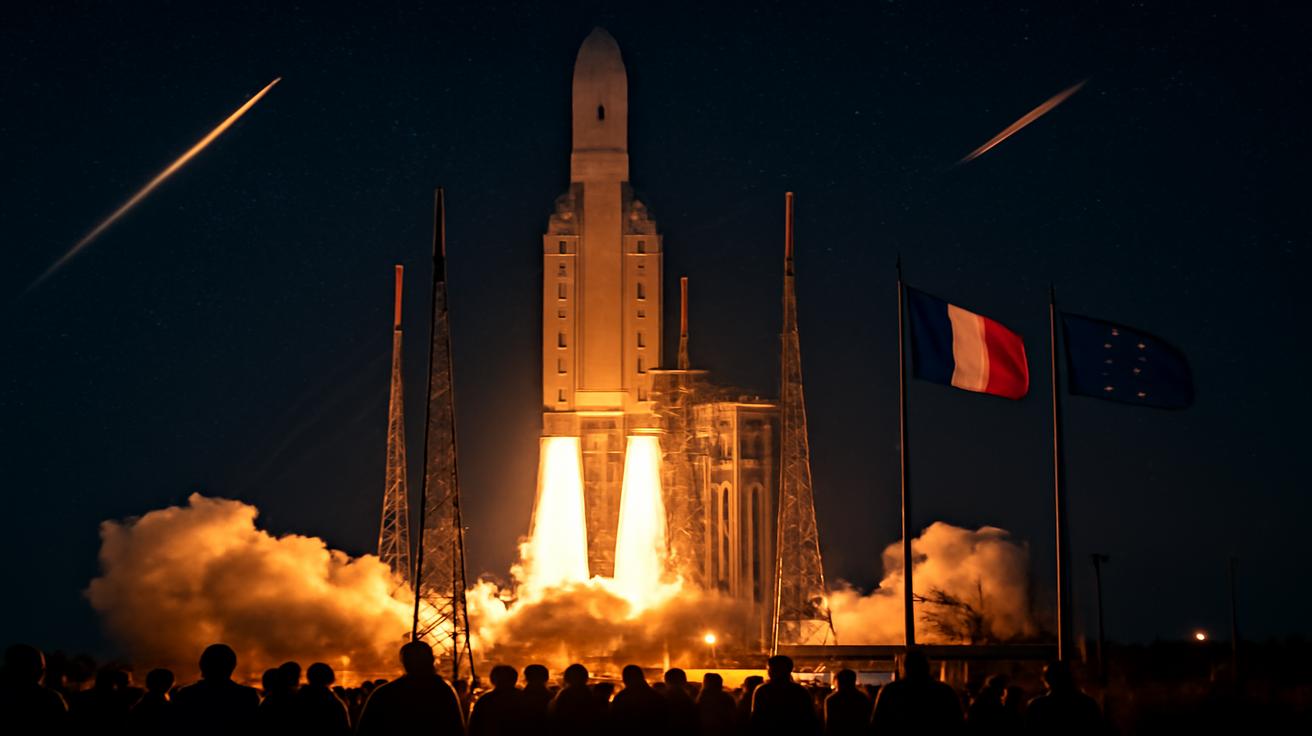
The clouds over Kourou look different when a rocket is on the pad. The air grows still, dense, as if the entire equatorial forest is holding its breath with you. There’s the distant whine of pumps, the chatter of technicians in a dozen accents, the chemical tang of fuel. And, above it all, the quiet pride: this is Europe’s spaceport, but it has always felt, in some deep, stubborn way, like France’s stake in the heavens.
For decades, Ariane rockets thundered into the sky from this slice of French Guiana, trailing not just fire but a simple story: Europe—and especially France—could stand tall in space. No American shuttle, no Russian Soyuz, no Chinese Long March could claim total dominance while Ariane kept her schedule. Telecom satellites, navigation birds, science probes: if you wanted a reliable ticket to orbit, you called Arianespace, and the French tricolor fluttered quietly in the slipstream of progress.
Today, that story feels more fragile. Not because rockets have failed—Ariane 5 retired with a remarkable safety record—but because the world around France has changed with terrifying speed. On one side is SpaceX, a private company that lands its boosters on drone ships like it’s a video game. On the other is China, building its own space station, launching at a furious pace, and talking openly about lunar bases and cislunar power. Between them, France has to decide: will it still shape the future of space, or simply rent seats on other people’s rockets?
The Old Order: When Ariane Ruled the Sky
Walk through the control center at Kourou, and you can still feel the echoes of an era when Ariane was the quiet champion of commercial spaceflight. In the 1990s and 2000s, long before “Falcon 9” became a household name, Ariane 4 and Ariane 5 were launching communications satellites two at a time, like a celestial carpool lane. Insurance companies loved them. Satellite operators trusted them. And for France, it was proof that technological sovereignty was not just a slogan but a countdown clock and a roaring engine.
This was never just about prestige. Space was—and is—about autonomy. If you can launch your own satellites, you can maintain your own secure communications, monitor your own borders from orbit, and deploy your own scientific instruments without asking anyone’s permission. For a country like France, with global territories, military commitments, and an outsized diplomatic presence, that autonomy was priceless.
But even in those “golden” days, something was shifting. Launchers were government-shaped: expensive, bespoke, slow to iterate. The competition—United Launch Alliance in the US, Russia’s Proton rockets—played by similar rules. Then a different kind of actor arrived.
The Disruption: SpaceX Redraws the Map
SpaceX didn’t just enter the market; it broke it. The first time a Falcon 9 booster turned around and landed on a barge, the video felt like science fiction. Then they did it again. And again. Suddenly, the thing that had been accepted as inevitable—that rockets are disposable, single-use, thrown away like burned-out fireworks—looked not just wasteful, but outdated.
The consequence hit Arianespace where it hurt: price. Reusability, aggressive engineering cycles, vertical integration—SpaceX used every tool in the modern tech playbook to drive launch costs down. And while European rockets remained reliable, they also remained expensive and slow to evolve. Customers, ever pragmatic, began to shift their payloads across the Atlantic.
Meanwhile, China was doing something quieter but just as consequential: launching more often, with more rockets, in more orbits. Long March vehicles began to appear on global launch statistics like a rising tide. Adding to that, Beijing’s space program never hid its dual nature—civil and military, strategic and symbolic. Space, for China, is a theater of power.
France, and Europe with it, suddenly found itself in a sky crowded not just with satellites, but with rivals. The old comfort—that Ariane would be one of a few major players—was gone. This is not a race between equals anymore; it is a race between ecosystems, industrial cultures, and political visions.
France’s Space DNA: More Than Rockets
To understand whether France can still hold its ground, you have to look beyond the launch pad. Space, in the French imagination, runs deeper than hardware. It is stitched into a long tradition of state-backed ambition and quiet technological excellence.
France’s space agency, CNES, is one of the world’s oldest. French engineers helped shape the foundations of satellite navigation, Earth observation, and planetary science missions. From the Spot and Pléiades imagery constellations, to the participation in missions like Rosetta and James Webb, French institutions have been in the room wherever the big, bold questions about space were asked.
Crucially, France also sits at the heart of Europe’s wider space architecture. It is the political muscle behind much of the European Space Agency’s launcher policy. It hosts major industry players: ArianeGroup, Airbus Defence & Space, Thales Alenia Space. And it has been the loudest European voice insisting that access to space is not just a market service but a strategic asset.
All of that still counts. But the landscape has changed so radically that even these structural advantages are starting to feel like anchors unless they adapt. The question is not “Does France have the expertise?”—it does. The question is whether it can turn that expertise into speed, affordability, and flexibility in a world shaped by SpaceX’s relentless iteration and China’s state-driven intensity.
Ariane 6: The Bridge or the Last Stand?
On the pad, Ariane 6 looks every bit the part: tall, clean lines, the quiet menace of stored energy. It is designed to be more modular and cheaper than its predecessor, reacting to the commercial pressure of SpaceX. But it is also, in many ways, still a child of the old world: expendable stages, long development cycles, complex governance spread across several nations and companies.
Every Ariane 6 launch will be a test, not just of hardware but of a model. Can Europe, led by France, remain a key launch provider with a rocket that is cheaper, but not reusable? Can reliability, political alignment, and a tradition of service offset the sheer gravitational pull of SpaceX’s low prices and high cadence?
All the while, China keeps building. Long March rockets, the Tiangong space station, a growing lunar program. The scale of its investment dwarfs any one European country. For Paris, the reality is sobering: France no longer measures itself only against familiar Western partners but against a rising superpower that sees space as integral to military deterrence and technological prestige.
What Space Sovereignty Really Means Now
In quiet conversations in Parisian ministries and ESA conference rooms, the language is shifting. Space “sovereignty” used to mean: we build our own launchers, operate our own satellites, and make our own decisions. Today, it’s becoming more nuanced, more layered, and also more urgent.
Launchers are one layer, but they are not the only one. There is data sovereignty: who owns the Earth observation images, the navigation services, the secure communications that modern states rely on? There is industrial sovereignty: can Europe (and France in particular) design, build, and maintain critical space infrastructure without relying on supply chains that run through geopolitical rivals?
And then there is orbital sovereignty—the least discussed, but perhaps the most explosive. As mega-constellations like Starlink fill low Earth orbit with thousands of satellites, the simple act of placing a new spacecraft becomes a negotiation with other powers’ infrastructure. Space is becoming congested, contested, and commercialized in ways that challenge traditional notions of freedom of action.
France’s answer to this complexity is a blend of strategy and stubbornness. It pushes for European-level programs like Galileo (navigation) and Copernicus (Earth observation), where France’s industry takes a leading role. It invests in military space capabilities, including surveillance of other nations’ satellites. And it has begun to talk more openly about “active defense” in orbit—monitoring, maneuvering, and, if necessary, interfering.
Against SpaceX and China, this isn’t just a matter of catching up on cost per kilogram. It’s about ensuring that Europe—and France as its driving force—can still make sovereign decisions about how it uses and protects space, even if the launch market is dominated by others.
The Rise of French NewSpace: A Different Kind of Rocket Fuel
Step away from the polished halls of legacy aerospace, and you find another France: scrappy, experimental, crowd-funded, and optimistic. In Toulouse, Paris, and along the Atlantic coast, a new generation of French space startups is quietly rewriting the rules.
Micro-launchers using 3D-printed engines. Constellations of small satellites designed to track climate variables or maritime traffic in near real time. In-orbit servicing concepts that promise to refuel or even recycle aging hardware. And, importantly, business models that don’t wait for slow, top-down public procurement cycles to green-light innovation.
To make sense of the shifting balance, it helps to see the players side by side.
| Actor | Key Strength | Main Weakness | Strategic Focus |
|---|---|---|---|
| France / Europe (Ariane ecosystem) | High reliability, strong institutional support, advanced satellite tech | Higher costs, slower innovation cycles, complex governance | Sovereign access to space, secure services, strategic autonomy |
| SpaceX | Reusability, low launch prices, rapid iteration, Starlink constellation | Regulatory tensions, dependence on US policy, market dominance concerns | Cheap and frequent access to orbit, global broadband, Mars ambitions |
| China | Scale of investment, integrated civil-military strategy, growing launcher fleet | Limited transparency, restricted international collaboration, geopolitical suspicion | Strategic dominance in orbit, lunar presence, independent global positioning |
| French NewSpace startups | Agility, niche innovation, lower development costs | Limited scale, funding constraints, dependence on policy clarity | Specialized services, micro-launch, in-orbit data and logistics |
This emerging ecosystem is France’s wild card. If nurtured with the right regulations and funding, it could give the country a way to compete not as a clone of SpaceX or China, but as something distinct: a web of smaller, faster-moving companies that exploit niches the giants overlook. Imagine a France where Ariane 6 is not the lone pillar of sovereignty, but one tower in a broader, flexible architecture that includes micro-launchers, responsive military space assets, and high-value satellite constellations.
Can France Still Hold Its Ground?
So, back to the core question: in a sky dominated by SpaceX’s reusability and China’s state power, can France still hold its ground in space? The honest answer is: yes—but only if it accepts that “ground” no longer means what it used to.
France is unlikely to beat SpaceX on raw launch price anytime soon; the industrial and regulatory DNA is too different. Nor can it match China’s top-down, long-horizon investment scale. But it doesn’t have to. Space sovereignty in this new era is less about winning a single race and more about controlling enough of the track to keep your freedom of action.
That means a few tough but necessary moves:
- Speeding up decisions at the European level so that launcher evolution doesn’t take a decade.
- Backing reusability and green propulsion seriously, not just in PowerPoint presentations.
- Giving NewSpace startups predictable access to public contracts and test facilities.
- Doubling down on the high-value layers of space: secure communications, defense applications, climate monitoring, and science missions that no private firm would fund alone.
It also means embracing a new kind of partnership with the very actors that threaten to overshadow it. There will be satellites launched on SpaceX rockets that still serve European strategic interests. There will be Chinese missions that generate scientific data France wants to study. Navigating this messy interdependence without surrendering autonomy is the subtle art of 21st-century space policy.
Standing in the Guyanese heat, watching a rocket light the night, sovereignty feels like something you can touch: a vibration in your chest, a man-made star clawing for altitude. In reality, it is becoming less visible and more complex—a web of contracts, code, regulations, and orbits.
France can still be one of the weavers of that web. But the age when a single launcher could symbolize a nation’s place in space is over. The new measure of power is not just how high your rockets fly, but how deeply your choices about space are truly your own.
FAQs
Why is space sovereignty so important for France?
Space sovereignty matters because it underpins national security, economic resilience, and political independence. If France can launch its own satellites, operate its own navigation and imaging systems, and protect its orbital assets, it can act globally without being forced to rely on foreign providers who may have conflicting interests.
Is Ariane 6 enough to compete with SpaceX?
Ariane 6 is a necessary step but not sufficient on its own. It improves costs and flexibility compared to Ariane 5, but without reusability it will struggle to match Falcon 9’s prices. Ariane 6 should be seen as a bridge to a more innovative generation of European launchers, not the final answer.
How does China’s space program threaten European interests?
China’s space program accelerates competition for strategic orbits, resources, and influence. Its growing constellation of satellites and lunar ambitions can shift the balance of power in communications, navigation, and military surveillance. For Europe, this raises the stakes of maintaining independent capabilities.
What role do French startups play in space sovereignty?
French NewSpace startups bring agility, new technologies, and alternative business models. They can offer micro-launch services, niche satellite constellations, and in-orbit services that complement large institutional programs. This diversity makes the overall ecosystem more resilient and less dependent on any single launcher.
Could France simply rely on SpaceX for launches and focus on satellites only?
Relying heavily on any foreign launcher, even a friendly one, creates strategic vulnerability. In times of political tension or export restrictions, access could be limited. For that reason, France sees independent launch capability as a core pillar of sovereignty, even as it pragmatically uses foreign rockets when convenient.
What might French and European space policy look like in ten years?
If current trends continue and reforms succeed, France and Europe could have a mixed ecosystem: a more advanced, possibly partially reusable heavy launcher; several active micro-launchers; robust sovereign constellations for navigation, climate, and defense; and a thriving private sector plugging into global markets. The goal is not dominance, but durable autonomy in a crowded and contested orbit.








Leave a Comment