
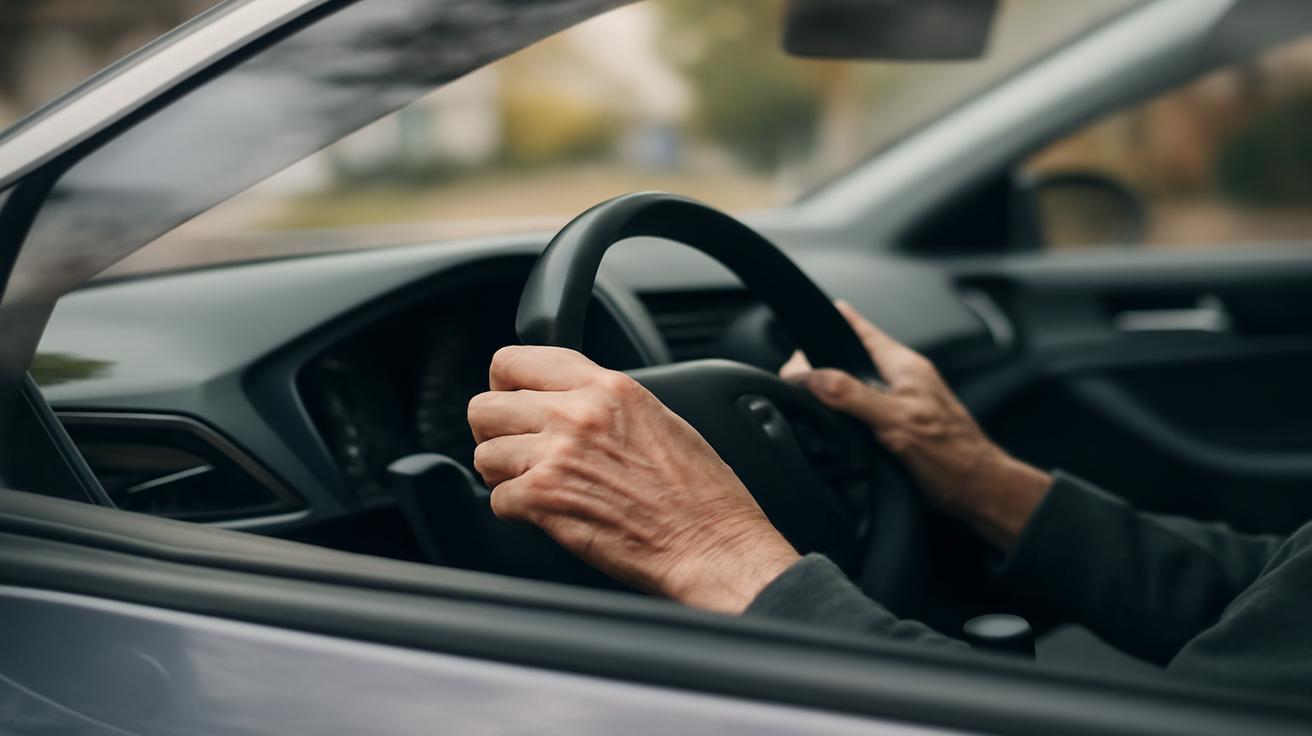
The old red hatchback hesitates at the intersection, its left blinker ticking like a nervous heartbeat in the morning mist. Behind the wheel, a man with snow-white hair leans closer to the windshield, squinting past a streak of sunlight. The light turns green. Cars behind him inch forward, a short impatient honk shatters the fragile calm. He flinches, presses the gas a little too hard, and the car jerks into the intersection. A cyclist, who thought he had time to cross, throws up his hands and swerves, breath coming fast, heart pounding. For a moment, all that fills the air is the smell of exhaust and adrenaline.
Was that just another close call in city traffic—or a warning sign that at a certain age, no one should be behind the wheel anymore?
The Road, the Years, and the Question Nobody Wants to Ask
Driving is not just a way to get from one place to another. For many older adults, especially retirees, it is independence in motion. The car keys on the hallway hook are more than metal and plastic—they’re a passport to the grocery store, the doctor’s office, a friend’s house, a last-minute trip to the lake. They’re freedom, dignity, spontaneity.
Now imagine those keys quietly taken away—not because of something you did, but because of your birthdate.
“Soon a driving licence withdrawal for senior motorists after a certain age”—the phrase itself lands like a stone in the chest. For some, it sounds like common sense, a straightforward safety measure. For others, it rings of prejudice, a blunt instrument that punishes the responsible along with the reckless. Somewhere between those viewpoints, on a stretch of road lined with years of lived experience, moves the real story: fragile, complicated, deeply human.
Walk into any café on a weekday morning, and you’ll hear it. At the table by the window, two retirees lean over their coffee cups. One insists that any driver over a certain age is a ticking time bomb. The other, who still logs hundreds of safe kilometers each month, bristles at the suggestion.
Both of them, in their own way, are afraid. Not just of accidents—but of losing control over their own lives.
An Age Limit or a Lifeline? What the Numbers Whisper
We like clear answers. A simple rule—“No driving after 75” or “licence automatically withdrawn at 80”—seems, on the surface, easy and fair. It doesn’t require judgment calls, medical reports, or awkward conversations. It draws a line, and everyone on one side is safe, and everyone on the other side is presumed dangerous.
Reality is not so tidy.
When you peel back the layers of accident statistics, the picture becomes less like a billboard and more like a mosaic. Yes, older drivers are more likely to be seriously injured or killed when accidents happen—fragile bones, slower recovery, more pre-existing conditions. Yes, some reflexes slow down with age; vision changes, especially at night; hearing dulls, joints stiffen.
But numbers also tell a quieter truth: many seniors compensate. They avoid night driving, rush hour, and complicated intersections. They drive shorter distances, at lower speeds, and often with far more caution than drivers in their twenties, who may be glancing at their phones or testing the limits of their cars—and luck.
In some regions, data shows that the most dangerous group on the road isn’t always the oldest, but often the youngest: inexperienced drivers who blend bravado with distraction. So the question shifts. Is age itself the problem, or is it specific impairments—cognitive decline, badly managed medication, untreated eye disease—that can strike at many ages, but become more common later in life?
Imagine two drivers stopped at a traffic light. One is 82, alert, clear-eyed, steady hands on the wheel, familiar with every curve of the road home. The other is 45, exhausted after a night shift, reading a text at 70 km/h. A blunt age rule would target only one of them. Does that feel like justice? Does it feel like safety?
Beyond the Birthday: The Invisible Variables
What doesn’t show up on a licence is the invisible weight each driver carries into the car. The 82-year-old may have just left a cardiologist who monitors every medication. The 45-year-old may be taking a cocktail of pills that warn, in faint letters, “may cause drowsiness.”
Older drivers are often hyper-aware of their vulnerabilities. They know when dusk turns the windshield into a mirror and the road into a blur. They feel the effort of turning their head more fully, the ache in their neck when they check blind spots. Many quietly, bravely, self-regulate: shorter routes, daytime driving, familiar streets. Others, however, cling fiercely to the wheel long after relatives have grown worry lines from riding in the passenger seat.
And then there’s the invisible part no doctor measures: fear. Fear of slipping into irrelevance, of asking for rides like a child, of becoming an obligation instead of an equal. Taking away a licence at an arbitrary age does not just remove a plastic card. It can cut through identity itself.
Discrimination or Protection? The Emotional Crash Site
Close your eyes for a moment and picture this scene.
It’s a bright afternoon. A letter lies open on the kitchen table of a small suburban home. The lamplight throws a pale circle on the paper. At the counter, a woman in her late seventies, who once drove her children to school and piano lessons and muddy soccer fields, stands with her hands wrapped too tightly around a glass of water. Her daughter has just read the letter aloud: new regulations, compulsory licence withdrawal at a fixed age. No exceptions mentioned. No personal assessment. Just a quiet, official line in the sand.
“So that’s it?” the older woman asks. “I’m dangerous now, because I had another birthday?”
In that moment, the policy feels like a betrayal. Not a neutral safety measure, but a judgment: you are your age, and your age is a risk.
Age-based withdrawal comes dangerously close to saying that the number on the calendar is more important than who you are, what your reflexes are like, how your mind works, how steadily you still handle a steering wheel. It lumps the careful and the careless together, and calls it fairness.
For many retirees, this is where safety talk starts to taste like discrimination. We tolerate regular eye tests and stricter penalties for drunk driving. These things look at behavior and health, not birthdays. But a rule that says, “At 80 you’re out,” no matter how fit you are? That can feel like being quietly moved from the driver’s seat to the far end of the back row, without being asked whether you can still see the road.
The Subtle Wounds of Being “Too Old”
Discrimination is not always loud. It doesn’t always shout insults or slam doors. Sometimes it comes as a polite letter, written in formal language, signed by anonymous officials. It sits beside your coffee mug and tells you: We have decided, without seeing you, that you can no longer be trusted.
This wound is especially deep because for many older adults, driving is the last big area where they still feel in complete control. Work might be over. Children have their own lives. Bodies change, doctors loom large. But behind the wheel, for a while, it is still you deciding the route, the speed, the destination.
When a society says that this control ends not with your abilities, but with your birthday, something fragile cracks. It tells older people that their individuality no longer counts. They become, simply, part of a high-risk group—statistics, not stories.
Of course, this sits in painful tension with another kind of pain: the grief of families whose loved ones were injured or killed by a driver who clearly should no longer have had a licence. Somewhere in that gap—in that canyon between fear of discrimination and fear of disaster—is where we must dare to look more closely.
The Middle Lane: Testing, Training, and Tailored Rules
If blanket age limits are too crude, and doing nothing is too dangerous, what remains? Perhaps the answer lies not at the extremes, but in the middle lane: a road where ability matters more than birthdays.
Imagine a system that treats driving like any other demanding skill. Pilots undergo regular health and performance checks; professionals in safety-critical jobs are monitored and retrained. We do this not to humiliate, but to make sure they and those around them are safe.
What if, after a certain age—say, 70 or 75—licences were no longer permanent passports, but time-limited permits, renewed through gentle, respectful checks? Not interrogations under fluorescent lights, but thoughtful assessments of vision, reaction time, cognitive flexibility. Not a single test on a rainy Tuesday morning that decides your fate forever, but a process that can be repeated, refined, adjusted.
Instead of an age wall, imagine a gradual ramp: more frequent check-ups, personalized advice, perhaps restricted licences that limit driving to daytime, certain speed zones, or familiar local areas. In this world, the question is no longer “How old are you?” but “How are you driving?”
| Approach | What It Does | Pros | Cons |
|---|---|---|---|
| Fixed Age Ban | Withdraws licences automatically at a set age. | Simple to administer; clear rule. | Ignores individual ability; risks discrimination; may not target actual unsafe drivers. |
| Regular Medical & Driving Checks | Evaluates health, cognition, and driving skills after a certain age. | Focuses on real capability; fairer; can catch issues early. | Requires resources; can feel stressful or invasive if poorly designed. |
| Restricted Licences | Allows driving under certain conditions (e.g., daytime only, local area). | Preserves independence while reducing risk; flexible. | More complex to monitor; may limit spontaneity. |
| No Extra Rules | Treats senior drivers like everyone else, with no added checks. | Avoids stigma; simple. | Misses real age-related risks; depends entirely on self-regulation. |
Now picture a driving instructor, not as a gatekeeper, but as a coach. A retired teacher, 78, who has been driving since the days of carburetors, joins a “refresher drive.” For an hour, she practices complex junctions, roundabouts, quick decisions. At the end, she receives not a pass/fail stamp, but a realistic evaluation: here is where you’re strong, here is where you’re vulnerable, here’s how to adapt—or when to consider stepping away.
Such an approach does something subtle but vital: it treats older adults as partners in safety, not suspects. It recognizes both their experience and their limitations, and invites them into the conversation.
When Families Become Mirrors
Of course, no testing system will catch everything. Often, it’s family members and close friends who first see that something has changed. The dent that “came out of nowhere” in the garage wall. The story of getting lost on a route driven for decades. The hesitation at green lights, the missed stop signs.
Conversations about giving up driving are some of the hardest a family can have. They carry echoes of role reversal—children worrying about parents, urging caution, suggesting limits. In cultures that prize independence, this can feel like disloyalty.
A policy of fixed-age licence withdrawal might seem to remove some of this emotional burden, but it also removes choice, nuance, and trust. A system centered on ability, on supported transitions, on involving seniors in the planning of their own mobility, respects the fact that the people we’re talking about are not problems to be managed, but human beings with deep roots, memories, and pride.
Life After the Keys: Rethinking Mobility and Dignity
Beneath the argument about licences lies a quieter, more expansive question: What does a good life look like when the car stays parked?
Right now, in many places, giving up driving feels like stepping off a cliff. Public transport may be patchy or inaccessible. Sidewalks are cracked or nonexistent. Buses are rare; stops are far away. Friends live across town. The weekly shopping trip becomes a logistical puzzle that depends on the kindness—or the schedules—of children, neighbors, volunteers.
In this landscape, of course losing a licence feels like exile. Of course any talk of automatic withdrawal sounds cruel.
But what if the world around us were different?
Imagine compact neighborhoods where pharmacies, small supermarkets, parks, and clinics all lie within a comfortable walking or scooter distance. Safe, well-lit sidewalks. Benches to rest on. Buses that kneel low, tram doors that open at level, drivers trained to wait a little longer for the older passenger with the slow but determined stride.
Imagine affordable ride services specifically designed for seniors: patient drivers, help with shopping bags, flexible routes. Not pity in the rearview mirror, but companionship, conversation, time.
In such a world, giving up a licence—whether voluntarily, or through a fair, ability-based assessment—would still be painful, but not catastrophic. It would be a transition, not a fall.
Redefining Independence
We often confuse independence with self-sufficiency. Driving your own car, alone, becomes the gold standard. But perhaps independence, reimagined, might include knowing that you can move freely without always being the one with your hands on the wheel.
The real goal is not cars, but connection: being able to reach the people and places that make life worth living. When societies invest in that, for everyone—young parents with strollers, workers without cars, retirees who no longer drive—the argument over senior licences becomes less panicked, less absolute.
Because then, taking the keys away does not mean locking someone inside their home. It means gently shifting them to a different seat in the great moving system of the city or village. Still present. Still valued. Still going somewhere.
Necessary Measure or Shocking Discrimination? Holding Two Truths at Once
So where does this leave the original question: is a driving licence withdrawal for senior motorists after a certain age a necessary safety measure, or a shocking discrimination against retirees?
Listen closely, and you can hear two truths humming like parallel engines under the hood.
One truth: as bodies and minds age, the risk of driving can increase. Ignoring this is not kindness but carelessness. Lives—of older drivers, their passengers, and strangers on crosswalks—are at stake. It is reasonable, even responsible, to say that past a certain point, we need extra safeguards.
The other truth: chronological age, alone, is a poor, blunt tool. It slices through nuance, capability, character. It can humiliate those who are still perfectly able, and it can let younger but impaired drivers slide by unchecked. To treat all retirees as unfit simply because they are retirees is indeed a form of discrimination, however politely worded.
The path forward is not a hard line, but something more intricate—a network of support, assessment, and redesign.
- Regular, respectful checks of health and driving ability after a certain age.
- Options for restricted licences that match real capacities, not stereotypes.
- Investment in transport alternatives that make life without a car still full and connected.
- Honest, compassionate conversations within families about risk, responsibility, and dignity.
- And, above all, a cultural shift that stops treating older adults as a problem to solve, and starts seeing them as partners in shaping a safer, more humane mobility landscape.
On that misty morning at the intersection, the white-haired driver and the swerving cyclist both carried their own stories, their own fears, their own reasons for being there. Any rule we write in the name of safety must try, somehow, to honor all of them.
Perhaps the real measure of a society is not simply how fast its traffic flows, but how gently it helps its elders step, with dignity, from the driver’s seat into the next chapter of their journey—still moving, still seen, still on the road of life.
FAQ: Senior Drivers and Licence Withdrawal
Is it fair to set a fixed age at which seniors must give up their driving licence?
A fixed age may seem simple, but it ignores individual differences. Some people are unsafe at 65, others are capable at 85. Age-related rules are often perceived as discriminatory because they treat everyone the same regardless of their actual ability. More nuanced systems focus on health and driving performance rather than birthdays.
Are older drivers really more dangerous than younger ones?
Older drivers are more vulnerable to serious injury in crashes, and certain age-related conditions can increase risk. However, they often drive more cautiously, avoid difficult conditions, and self-regulate. Younger drivers, especially inexperienced ones, may have more crashes due to speed, distraction, or risk-taking. Risk varies by individual, not just age group.
What alternatives exist to an automatic licence withdrawal at a certain age?
Alternatives include regular medical and vision checks, on-road driving assessments, shorter licence renewal periods for seniors, and restricted licences (e.g., daytime-only driving). These approaches aim to balance safety with fairness and independence.
How can families talk to an older relative about giving up driving?
It helps to focus on safety and care rather than blame. Share specific observations kindly, listen to fears about losing independence, and explore concrete alternatives together—such as community transport, ride services, or help from relatives. Involving a doctor or driving assessor can provide an objective perspective.
What can communities do to support seniors who no longer drive?
Communities can invest in reliable public transport, accessible stops, safe sidewalks, and senior-friendly ride services. Locating essential services—shops, clinics, pharmacies—within easy reach helps too. When non-drivers can still move freely and participate in daily life, giving up a licence becomes less of a loss and more of a transition.






Leave a Comment