
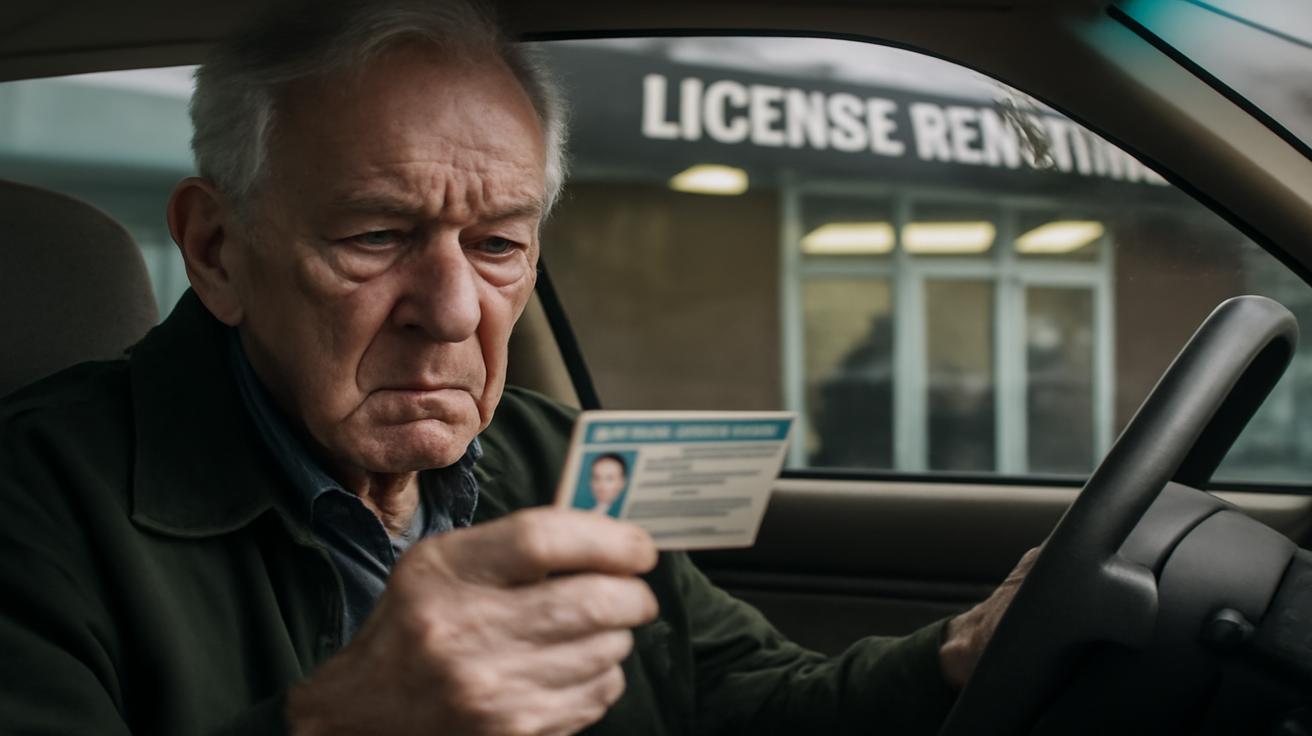
The old man in the blue wool cap grips the steering wheel the way some people hold on to railings in a storm. It’s 7:15 a.m., the frost is still clinging to the hedges along the country road, and the sky is the pale, tentative grey that comes before winter sunlight decides if it will show up. In the passenger seat, his granddaughter watches the world slide past—bare oaks, a distant tractor, a patch of mist lying low over the fields—while the car hums steadily along at 45 km/h in a 70 zone. There’s no rush. They left early on purpose. He always leaves early now.
He blinks a little longer at the oncoming lights than he used to. He turns his whole upper body to check the mirrors. At roundabouts, he hesitates, sometimes too long, sometimes not quite long enough. He knows this, feels it like a stone in his pocket. He also knows something else: this road is his last thread of independence. Without this car, he’s not a grandfather who can pick up his granddaughter from school, or drive to the lake at dawn to see the swans. He’s a man stranded in a village with two buses a day.
In the background of his life—and in newspapers, policy documents, and late-night talk shows—a question is getting louder: should there be an age at which that key, that licence, is taken away automatically? A fixed birthday when the state says, “Enough. Hand it over.”
When a Birthday Starts to Look Like a Deadline
If you listen to the way people talk in cafés, on park benches, and under the buzzing lights of supermarkets, you can hear two very different stories about older drivers.
In one, seniors are fragile dangers on the road. There’s the uncle who confused the brake with the accelerator. The neighbour who drove the wrong way up a highway slip road. The parking-lot incident that “could have ended so much worse.” These tales grow each time they’re told, picked up and passed around like cautionary myths: “They shouldn’t be allowed to drive after 75. Or 80. Or at least there should be a test.”
In the other story, seniors are careful, experienced, and—crucially—aware of their own limits. There’s the retired teacher who only drives in daylight and avoids the city. The widow who keeps to familiar routes and won’t touch the car when the weather turns bad. The grandfather who decided on his own to stop driving at night. No law made them do it. No licence was taken away. They adjusted, adjusted again, and kept adjusting, like river water flowing around new stones.
Between these two stories lies something sharper: fear. Younger drivers fear the unpredictable slowness, the late braking, the unexplained drifting between lanes. Older drivers fear losing more than just a plastic card. They fear losing their last easy access to the world beyond their front door.
The Numbers in the Rear-View Mirror
Behind the emotions, there is data, and it doesn’t always say what we expect. Seniors are, statistically, not the most reckless group on the road. Young, inexperienced drivers—often male—tend to cause more high-speed, high-impact crashes. Older drivers, by contrast, usually drive fewer kilometers, at slower speeds, and on more familiar roads.
Yet as people age, their vulnerability increases. An impact that a 30-year-old might walk away from can be devastating for an 80-year-old. Bones are more brittle, recovery is slower, and frailty turns moderate collisions into tragedies. Reaction times lengthen, peripheral vision narrows, and complex junctions become cognitive puzzles rather than simple routines.
So when policymakers look at crash statistics, hospital entries, and insurance claims, an uncomfortable pattern emerges: older drivers may not always cause more accidents, but when they are involved, the consequences are often more serious—for themselves in particular.
And this is where the debate sharpens into a single, controversial question: is a fixed age-based licence withdrawal the answer, or is it a blunt instrument in a world that needs nuance?
A Birthday, a Letter, a Line in the Sand
Imagine this: on your 80th birthday—after the flowers, the cake, the politely awkward speeches—you open your mail and find a cold, official envelope. Inside is a notice: your driving licence will expire in six months and will not be renewed unless you pass a new mandatory test. Or worse: it simply will not be renewed. Full stop.
For people living in dense cities with buses at every corner and a subway deep beneath their feet, this might be an inconvenience, even a relief. “I’ll just use public transport,” they say. “Or ride a bike. Call a taxi. Share a car.”
But the older you are, the more likely it is that your life has quietly reorganised itself around the car. It’s not only about commuting; retirement has ended that chapter. It’s about everything else: the pharmacy 6 km away, the GP in the next town, the weekly bridge club, the friend you’ve known since school who lives across the valley, the wild raspberries on the roadside that nobody else knows about.
A fixed age limit might look, on a spreadsheet, like clarity. It gives administrators a simple rule, easy to implement and easy to measure. But on the ground, in the everyday landscapes of people’s lives, it can feel like a guillotine—efficient, yes, but brutally indifferent to the unique abilities and circumstances of each driver.
Not All Eighty-Year-Olds Are the Same
Step into any swimming pool at opening time and you’ll find them: older people slicing through the water with a steady, silent front crawl that would exhaust someone half their age. Look up from your park bench and you might see an elderly cyclist coasting past, posture straight, gaze alert, legs turning the pedals with unhurried confidence.
Age, as a number, is a poor storyteller. It doesn’t tell you about the 82-year-old who still hikes in the mountains, or the 69-year-old whose diabetes, eyesight issues, and medication interactions already make driving risky. It doesn’t capture the subtle, early fog of dementia in a 74-year-old, nor the surprising sharpness of a 90-year-old whose mind is still as quick as morning light.
So basing driving rights purely on age is like banning everyone from climbing a hill just because some people slip on the path. The problem isn’t the date on a birth certificate; it’s the combination of health, reflexes, judgment, and insight into one’s own limitations.
Yet this is where things get humanly, painfully complicated. Because insight is exactly what can begin to fail in some ageing brains. The very people whose declining abilities make them unsafe may be the ones least able to realise it.
Testing, Not Tearing Up: A Different Kind of Roadmap
In some countries, the solution under discussion—or already implemented—is not an automatic withdrawal, but a series of regular assessments after a certain age. At 70, for example, your licence doesn’t vanish, but it comes with conditions: you must renew it more frequently, perhaps every three years, and each time you must prove that you are still fit to drive.
This shift in focus—from age to ability—can take different forms: vision tests, reaction-time assessments, medical evaluations, even practical on-road examinations. The goal is not to shame or punish, but to filter out dangerous situations before they happen.
Done well, such testing can feel like a safety net, not a trap. A thoughtful examiner can suggest changes instead of confiscation: “You’re fine in good light, but your night vision is weak. How would you feel about a licence that only allows you to drive in daylight?” Or, “Your cognitive test results are borderline. Let’s reassess in six months and talk about reducing how and where you drive.”
Done poorly, though, it can feel like a cold bureaucratic contest, with trick questions and no room for nerves or context. An otherwise safe, cautious driver might panic and fail a test that doesn’t reflect their actual habits, like keeping to familiar local routes at low speeds.
| Approach | Potential Benefits | Main Concerns |
|---|---|---|
| Automatic licence withdrawal after a set age | Simple to administer; easy to communicate; may reduce some high‑risk cases | Unfair to healthy seniors; ignores individual ability; risks isolation and loss of independence |
| Age-based regular testing and medical checks | Focuses on health and fitness; can allow conditional driving; more nuanced decisions | Can be stressful; depends on test quality; may burden healthcare systems |
| Voluntary self-regulation and family involvement | Respects autonomy; encourages open conversation; adapts to real life patterns | Relies on insight and honesty; families may avoid difficult discussions |
| Better public transport and alternative mobility options | Reduces need to drive; benefits all ages; supports climate goals | Expensive to build; slow to implement; often limited in rural areas |
The Quiet Negotiations Inside Families
Long before any government letter arrives, another, quieter process often begins around kitchen tables. It starts with a sentence nobody wants to say: “I’m not sure you should be driving anymore.”
For adult children, this conversation can feel like betrayal. The same hands that once led them across busy streets are now the ones they are asking to let go of the steering wheel. For parents or grandparents, it can feel like being demoted in their own life. The car has always been an emblem of adulthood, of competence, of freedom. Losing it can feel like stepping backwards into dependence, as if the years were unspooling in reverse.
Families improvise. Some gradually take over more driving: “Let me drive tonight, it’s dark and raining.” Others agree on conditions: “Only local roads. No more highways.” The keys are not ripped away; they loosen, visit by visit, until one day they stay on the hook by the door more often than they leave it.
When official rules or tests enter this delicate ecosystem, they can be helpful allies—“Mum, the doctor thinks it’s time to stop”—or blunt intruders that shatter fragile trust. The way societies choose to regulate senior driving doesn’t play out in abstract; it lands in these intimate negotiations, these kitchen-table treaties.
Rural Roads, Urban Choices
It is easy, in theory, to argue for stricter rules. It is harder when you stand at a bus stop in the rain in a village where the next bus is in three hours and the nearest supermarket is a 20-minute drive away.
In many rural regions, the car is not a luxury; it is a prosthetic limb bolted onto the landscape itself. Roads are built for cars, not pedestrians. Pavements vanish at the edge of the last house. Bus routes have been trimmed to lines so thin they almost disappear. Taxis exist, but not in the casual way they do in cities; they are expensive, must be booked, and are often scarce.
So when we talk about withdrawing licences from seniors after a certain age, we must ask: what are we offering in return? Are we building community transport schemes with flexible, door-to-door services? Are we subsidising taxis for elderly people in remote areas? Are we designing towns where basic needs can be reached on foot or by a small, slow shuttle bus?
Without such alternatives, a hard age limit on driving becomes a kind of quiet exile. It doesn’t just protect older people from the dangers of the road; it also walls them off from life beyond their mailbox. Loneliness rises. Doctor’s appointments are missed. Small, mundane joys—choosing your own apples at the market, stopping spontaneously at a scenic lay-by—quietly evaporate.
Technology at the Wheel
At the same time, cars themselves are changing. Driver-assistance systems now blink and beep and gently tug at the steering wheel when lanes are crossed. They slam on the brakes if a pedestrian steps out. They watch the blind spots that our ageing necks struggle to check.
These systems are often advertised as futuristic conveniences, but for older drivers, they can be lifelines. A well-designed car, with clear displays, good headlights, wide mirrors, and intelligent safety technology, can stretch the years of safe driving a little further, like stitching a few more strong threads into a fraying rope.
There is a danger, of course, in relying too much on this mechanical guardian angel. No beep or flashing icon can compensate for severe cognitive decline, for disorientation on familiar roads, for moments when green lights no longer quite mean what they used to. But technology can shift the balance point, buying time and nuance, helping some seniors drive safely for longer before that final, wrenching decision must be made.
So, Will There Be an Automatic Cut-Off Age?
The honest answer is that in many places, the trend is not toward a simple, universal age at which all seniors lose their licences overnight. That kind of rule, while tempting for its clarity, collides with two stubborn realities: the vast differences between individual older drivers, and the stark inequality between people who live in cities and those who live far from them.
Instead, the more likely future is a patchwork made up of several threads:
- More frequent medical and vision checks after a certain age.
- Shorter licence renewal periods for older drivers.
- Conditional licences—daylight only, local area only, no highways.
- Increased involvement of doctors in evaluating driving fitness.
- Gradual expansion of alternative transport, especially in urban areas.
In this scenario, very few people will experience a dramatic, single “withdrawal day.” Instead, the road will narrow gradually. For some, it will be a conscious, voluntary choice: “I’ve had enough. It’s time.” For others, it will be a joint decision between doctors, families, and authorities, supported by tests and gentle but firm conversations.
In the middle of all this policy and planning, there will always be real stories like that of the man in the blue wool cap, driving gently along the winter road. One day—maybe in five years, maybe in ten—his granddaughter will sit in that car for the last time. Perhaps she will be the one driving. Perhaps he will say, with a mix of pride and grief, “You take the wheel from now on.”
How we choose to shape the rules today will decide whether that moment, repeating in thousands of families, feels like an act of care or an act of dispossession.
Frequently Asked Questions
Will seniors automatically lose their driving licence after a specific age in the near future?
In most countries, an automatic, universal licence withdrawal at a fixed age is not currently planned. Instead, governments are leaning toward more frequent renewals, health checks, and ability-based assessments rather than a strict age cut-off.
Why is there so much debate about older drivers?
Because the issue sits at the intersection of safety and independence. Ageing can bring slower reactions, poorer vision, and health problems, which may increase risk on the road. At the same time, driving is often essential for seniors to stay independent, especially outside cities. Balancing these realities is emotionally and politically sensitive.
Are older drivers really more dangerous than younger ones?
Not always. Younger, inexperienced drivers tend to cause more high-speed and risky crashes. Older drivers usually drive less, more slowly, and more carefully. However, they are physically more vulnerable, so when accidents happen, injuries are often more serious for them.
What kind of tests might seniors face in the future?
Possible measures include regular eye exams, medical evaluations, reaction-time tests, and, in some cases, practical driving assessments. Some countries also use conditional licences that limit driving to certain times of day or types of roads, depending on health and ability.
What can families do if they are worried about an older relative’s driving?
Start with gentle, respectful conversations focused on safety, not blame. Offer alternatives—rides to appointments, help with shopping, information about local transport services. Involving a trusted doctor can also help, especially if medical issues are affecting driving.
How can societies reduce the need for seniors to drive?
By improving public transport, creating community shuttle services, supporting on-demand ride services for elderly people, and designing towns where basic services are closer and safer to reach on foot or by bicycle. These changes help not only seniors but everyone who cannot or does not want to drive.
What role does car technology play in this discussion?
Modern driver-assistance systems—such as emergency braking, lane-keeping support, and blind-spot monitoring—can help older drivers stay safer for longer. They are not a substitute for basic fitness to drive, but they can extend the period during which some seniors can drive responsibly and confidently.






Leave a Comment