
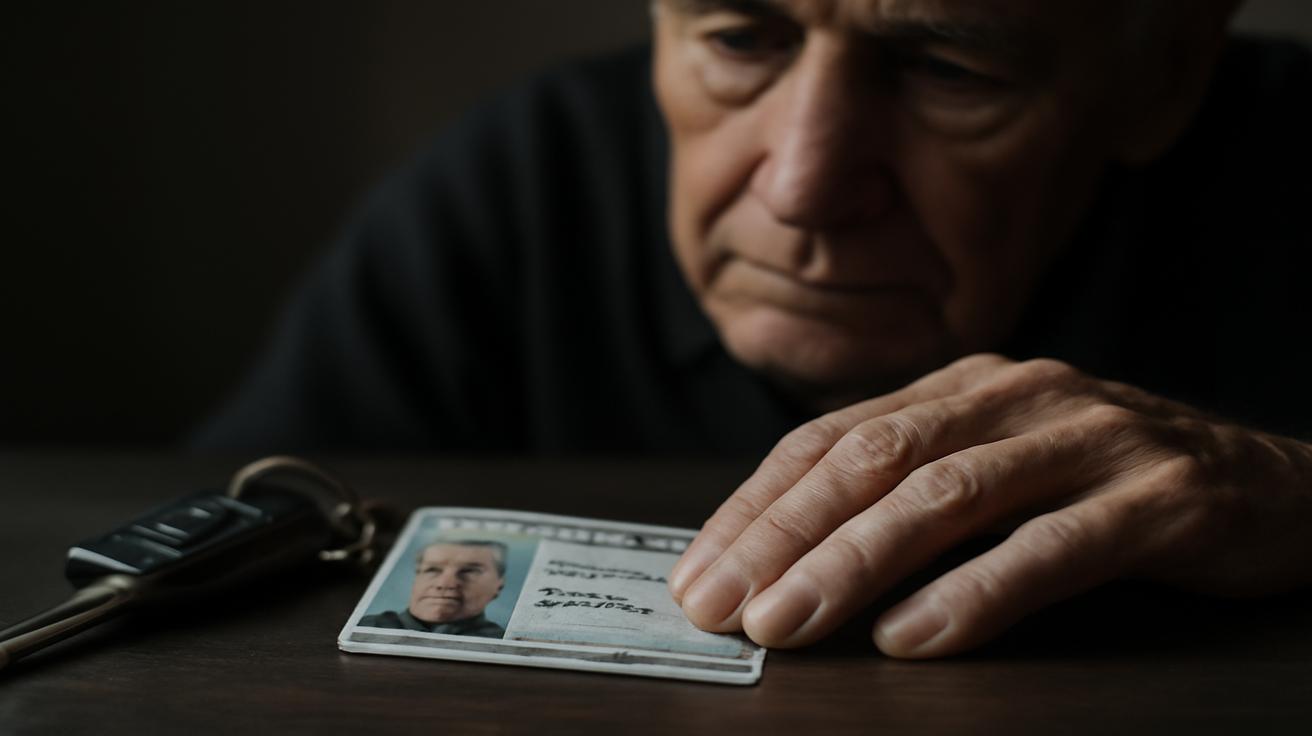
The old man stood at the edge of the village road, keys in one hand, shopping bag in the other, watching his dusty blue hatchback glint in the late afternoon sun. The air smelled of warm tarmac and freshly cut grass. He’d driven this road for forty years – to work, to the market, to the hospital the night his daughter was born. The curves, the potholes, the tricky junction near the church: they all sat inside his muscles like a second language. Yet as he fumbled to unlock the car, a thought he’d heard on the radio that morning kept tugging at him, sharp and insistent.
“Soon they’ll take licences away automatically once you’re ‘too old to drive’. For everyone. One birthday and poof – no more driving.”
He’d laughed at first. Another sensational headline. But now, standing there with the late light slanting over the hedges, he felt something colder: what if the world really was turning toward that kind of rule? What if one day, a form in the post, a number on a calendar, would weigh more than all his years of careful driving?
When age becomes a number on the dashboard
It’s an unsettling idea, isn’t it – that a day will come when your birthday could matter more than your braking distance, your reflexes, your common sense. We don’t mind age limits on some things. We accept that you can’t drive at fourteen, rent a car at eighteen in many places, or run for certain public offices without a minimum age. Somehow it feels orderly, tidy, almost mathematical.
But what about the other side of life? What about the age when the system gently – or not so gently – nudges you off the road?
Across many countries, the conversation is heating like an idling engine on a summer day: should there be a mandatory driving licence withdrawal for senior motorists after a certain age? No questions asked. No tests. Just: “You’ve turned X. It’s over.”
The arguments sound simple at first. Roads are crowded, population is aging, cars are faster, distractions are everywhere. Older drivers can have poorer eyesight, slower reaction times, cognitive decline. For some, the equation feels obvious: fewer older drivers, fewer accidents. Problem solved.
But step into that twilight space between policy and real life – the car parks at supermarkets, the rural roads where buses come twice a day, the cul-de-sacs where grandparents collect grandchildren from school – and the picture becomes messier, more human, less obedient to simple formulas.
The numbers behind the nervousness
Imagine representing the debate in a simple little table, the kind scribbled on the back of a café receipt while the rain taps on the window and traffic hisses outside. It might look something like this:
| Aspect | Younger Drivers | Senior Drivers |
|---|---|---|
| Crash risk per kilometre | Higher, especially under 25 | Rises again after ~75 |
| Typical behaviour | More speeding, risk-taking | More cautious, slower driving |
| Injury severity | Often lower (more resilience) | Higher (fragile bones, health) |
| Main safety concern | Impulsivity, inexperience | Health, reaction time, vision |
| Policy tools often used | Graduated licences, curfews | Medical checks, shorter renewals |
The numbers that underpin tables like this usually tell a nuanced story. Statistically, young inexperienced drivers often cause more crashes, especially severe ones, than careful seniors who have decades of practice and a horror of speeding fines. Yet older drivers are more likely to be badly injured or killed when crashes happen, simply because the human body at 80 does not absorb impact the way it did at 25.
So the picture is complex. On paper, the risk curve dips in middle age, then climbs gently upward as eyesight, flexibility and cognition change. But policy is rarely crafted on paper alone. It is shaped by fear: news stories of an elderly driver pressing the accelerator instead of the brake in a supermarket car park, or driving the wrong way on a motorway. Each incident becomes a flashpoint, a symbol, a rallying cry.
The road is more than asphalt: it’s independence
Numbers, however, can’t capture the texture of what a driving licence really is for many older people. It’s not only plastic in a wallet; it’s a key to a life that still feels self-directed.
Picture a winter dawn in a small village. The bus timetable pinned near the postbox is a relic, its ink fading. A woman in her late seventies pulls on a thick coat, breathing out little clouds in the cold kitchen, then drives herself to the early clinic appointment in the city because her arthritis has been particularly cruel this month. Without that modest silver hatchback, she’d have to beg a lift, pay for a taxi she can’t afford, or grit her teeth and hope the pain holds until a more convenient time.
A car carries independence: the ability to decide when to visit a friend, when to buy fresh fruit, when to attend the evening choir practice, when to see a doctor now, not next week. Remove that sudden freedom with a blanket age rule, and you are not just changing traffic statistics; you are rearranging the intimate architecture of someone’s daily life.
Psychologists talk of “mobility” not only as movement through space, but as a sense of possibility in time. Being able to get from A to B on your own terms is stitched into our sense of dignity. When we imagine ourselves at eighty, we don’t picture a date stamped “mobility expires here.” We picture something softer, more adaptive: perhaps fewer night drives, no more motorways, but still that cherished loop to the seaside, the weekly visit to the grandchildren, the garden centre with its rows of bright petunias.
So the question becomes more haunting: how do we honour safety on the roads without stripping people, in one bureaucratic swoop, of this web of invisible freedoms?
Blanket bans versus living, breathing assessments
One proposal some people float is seductively simple: choose an age – 75, 80, 85 – and say that from that birthday onwards, your driving licence is gone. No exceptions. The appeal is obvious. It’s clean. It’s easy to administer. It feels decisive.
But real lives are not that neat. Think of two people on their eightieth birthdays.
One still hikes the local hills once a week, reads fine print without glasses, remembers every neighbour’s name and phone number by heart. She drives gently, avoids rush hour, and has not had an accident since the 1970s – and that one was a low-speed bump in a car park.
The other has had minor strokes, struggles to remember where he was going, and sometimes confuses the gas pedal and the brake. His family is quietly terrified when he announces another solo drive into the city.
Same age. Vastly different risk. A rigid age-based rule would treat them as identical.
That’s where the idea of individual assessment comes in. Instead of using age as a blunt instrument, some countries already require more frequent licence renewals after a certain birthday, paired with vision checks, medical reports, and sometimes on-road tests. Rather than saying “eighty equals unsafe,” the system asks: “You, specifically – with your particular body, mind, and habits – are you still okay to drive?”
This approach respects diversity in aging. Bodies and brains do not read policy papers. They adapt, decline, surprise us on their own timetables. Some seventy-year-olds are frailer than some ninety-year-olds. Any serious attempt to balance safety and autonomy must start there.
The emotional crossroads: when to hang up the keys
Yet even nuanced systems don’t dissolve the emotional weight of this question. If you’ve ever been in the passenger seat while an older relative drifts too close to the centre line, misses a red light, or struggles to park, you’ll know the quiet, stomach-clenching dread. You grip the door handle a little harder, then later, around the kitchen table, you fumble for words that won’t sound like betrayal.
For many families, the moment “We need to talk about your driving” is as loaded as any conversation about wills or health. It’s not just about safety; it’s about identity. You’re not merely suggesting they stop a habit; you’re questioning their competence, their autonomy, perhaps even their place in the world.
On the other side of that conversation, older drivers often carry their own tangled feelings. Some genuinely don’t notice their abilities slipping, the way we don’t feel our hair slowly turning grey. Others notice – the missed turn, the new nervousness at junctions – but cling to the wheel because they fear what comes after. A life where every movement must be negotiated or requested can feel like a rehearsal for some smaller, narrower existence.
In such a landscape, a blunt legal rule that snatches licences automatically at a certain age can feel both a relief and a cruelty. A relief, because it shifts the burden from family argument to impersonal law: “It’s not me saying you should stop; it’s the system.” A cruelty, because it leaves no room for pride, for gradual adjustment, for that deeply human desire to choose.
Could technology become the gentle co-pilot?
There is another character slipping quietly into this story: technology. Modern cars already mutter warnings when you drift over lane markings, when you reverse too close to a wall, when you brake too late. Some slam on the brakes for you. Some read speed signs; some park themselves. In the near future, cars might do much more: monitor your alertness, notice patterns of confusion, or restrict certain manoeuvres unless you confirm twice.
Now imagine pairing that with policy. Instead of an all-or-nothing licence, you might have a graduated licence for older drivers, just as some countries do for teenagers. Your car – or an app connected to it – could support this more gently:
- No driving after dark if your night vision has deteriorated.
- Speed automatically limited to safer levels in built-up areas.
- Navigation that avoids motorways or complex junctions by default.
- Subtle alerts if your driving suddenly changes: more swerving, more harsh braking.
In this vision, the question changes from “Should we snatch away licences on a certain birthday?” to “How can we use tools, tests, and clever design to let people drive safely for as long as they reasonably can – and know when it’s time to stop?”
Technology, of course, is no magic fix. Not everyone can afford a brand-new car bristling with sensors. Many find such systems distracting or confusing. And nothing can erase the physical fragility that makes older drivers more likely to be injured in a crash. But used wisely, these tools might soften the edges of the ageing curve, smoothing that sharp cliff edge into more of a slope.
Rethinking the end of the road
There is, however, a deeper layer to all this, one that goes beyond dashboards and regulations. The debate about removing driving licences from seniors after a certain age is also a mirror held up to how societies treat ageing itself.
When we talk about older drivers as a “problem to be solved,” we risk shrinking complex, skilled, experienced human beings into mere risk factors. The same hands that once learned to drive in cars without power steering, that navigated snowstorms with no GPS, are now treated as ticking time bombs the moment a certain birthday arrives.
What if, instead, we framed the conversation around support and transition rather than exclusion?
That might mean investing seriously in public transport that actually serves the times and places older people need – early morning appointments, Sunday visits, evening community events. Rural buses that don’t vanish with every budget cut. Safe, comfortable, accessible taxis that don’t feel like luxuries.
It might mean designing communities where basic needs – shops, doctors, friends – are within easier reach without a car. It might mean normalising car-sharing schemes in which younger neighbours routinely offer lifts, not as charity but as part of how the community breathes.
Then, when the time does come to hang up the keys, the step might feel more like moving from one kind of mobility to another, and less like being locked out of the world.
So: will there soon be an automatic driving licence withdrawal for senior motorists after a certain age? Policies may tighten; renewals may become more rigorous; some countries might experiment with age-linked rules. But the more we listen – truly listen – to both the statistics and the stories, the less persuasive a one-size-fits-all age cut-off becomes.
In the end, the road ahead may not be a single thick line between “allowed” and “forbidden,” but a tangle of smaller paths: targeted tests, medical judgement, adaptive technologies, family conversations, and social changes that make not driving feel survivable, even acceptable.
Back on that village road, the old man finally climbs into his hatchback. He adjusts his mirror, checks his blind spot, eases out with a patience born from decades. One day, he knows, he probably will stop driving. Maybe because his knees give out, or his eyes blur, or simply because it feels right.
He hopes that day will be his to recognise, or at least to negotiate – not something that arrives like a traffic fine in the post just because the calendar says he’s had enough summers.
As we debate the future of senior motorists, perhaps that’s the quiet question humming beneath all the noise: in a world of limits and risks, how much room can we still make for trust, for nuance, and for the slow, dignified art of letting go at the right time, in the right way?
Frequently Asked Questions
Will seniors definitely lose their driving licence automatically at a certain age?
In most countries today, there is no universal rule that automatically cancels licences solely based on age. Instead, there are often more frequent renewals, medical checks, or vision tests after a certain birthday. Some policymakers do suggest age-based cut-offs, but these remain controversial and are not yet the global norm.
Are older drivers really more dangerous on the road?
The reality is mixed. Per kilometre driven, crash risk does rise again at higher ages, especially after around 75–80. However, older drivers are often more cautious, speed less, and avoid risky situations like night driving. Young, inexperienced drivers typically have higher crash rates, but older drivers tend to suffer more serious injuries when crashes occur.
What alternatives exist to automatic licence withdrawal by age?
Alternatives include regular medical and vision checks, shorter licence renewal periods, on-road driving assessments, restricted licences (for example, no night or motorway driving), and use of in-car safety technologies. These aim to tailor decisions to individual ability instead of using age alone as the deciding factor.
How can families talk to an older relative about unsafe driving?
Approach the conversation calmly and respectfully, focusing on specific observations (“I noticed you missed that red light”) rather than accusations. Emphasise safety for them and others, and be ready with practical alternatives: offering lifts, exploring community transport, or suggesting a professional driving assessment. It’s often more productive as an ongoing dialogue than a single confrontation.
What can societies do to make giving up driving less painful for seniors?
Key steps include improving public transport reliability and accessibility, especially in rural areas; planning communities with essential services close by; supporting affordable taxi or ride services; and encouraging neighbourly car-sharing or volunteer driver programmes. The easier it is to live well without a car, the less abrupt and isolating the end of driving feels for older people.






Leave a Comment