
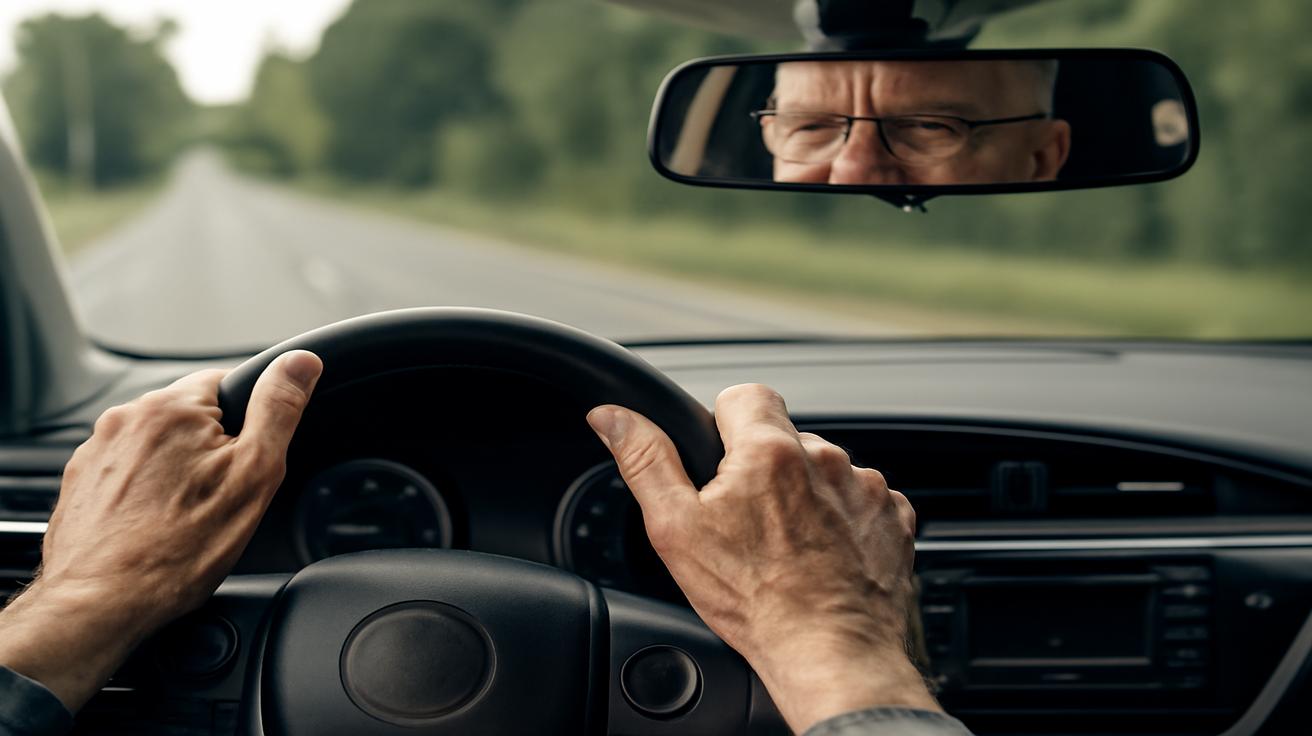
The old man in the silver hatchback doesn’t see the deer until it’s already there—sudden, spectral, suspended in his headlights. His hands tighten, his heart stutters, and for the briefest moment, time pools thick and slow around him. He brakes, not as sharply as he once might have, and the car shudders to a stop on the damp country lane. The deer vanishes into the darkness, soundless as fog. Inside the car, it’s just the faint ticking of the cooling engine and the deep, uneven rasp of his breathing.
He sits there, fifty kilometers from the town where he raised his children, ten kilometers from the nearest village, and only a few hundred meters from the cottage he now lives in alone. His palms are damp against the steering wheel. “Maybe I shouldn’t be driving anymore,” he whispers to no one. Then, more quietly: “But how else would I live?”
When the Road Becomes a Question
The debate over whether there should be a mandatory driving licence withdrawal—or at least an automatic review—after a certain age is no longer a distant policy conversation held in polished conference rooms. It’s playing out in kitchens where the clock ticks too loudly, in clinics smelling faintly of disinfectant, and in cars idling at twilight on narrow village lanes.
We are all, in one way or another, passengers in this story. If you are not yet old enough to be asked to surrender your licence, you likely love someone who is inching toward that fragile threshold. A parent. A neighbor. A quiet widower who still brings apples from his garden to the local school.
On paper, the issue looks deceptively simple: older drivers are statistically more fragile. Reaction times slow, vision narrows, hearing fades. The body becomes a fraction of a second slower, and on a highway, a fraction of a second can be everything. Yet real life has a way of blurring clean lines. That same older driver might be the one who has never had an accident, who drives gently, who avoids rush hour and bad weather, and whose car is their last thin line to freedom.
The question is not just, “Are older drivers safe enough?” It’s also, “What happens to a life when you take the keys away?”
The Numbers, the Fears, and the Faces Behind Them
When policymakers talk about this topic, their language turns to rates, risks, and curves on a graph. They point out that, per kilometer driven, some studies show drivers over a certain age may be involved in more serious crashes than middle‑aged drivers. They talk about intersections where left turns become perilous, about night driving and glare from headlights, about mistaking the gas pedal for the brake.
But statistics are a blunt instrument. They don’t tell you about the grandmother who carefully plans her route to avoid complex junctions, leaving early to miss traffic and never driving in the rain. They don’t show the widowed man who gave up highways voluntarily, who drives only to the supermarket, the doctor, and the graveyard where wildflowers lean against his wife’s name in the stone.
As our populations age, the proportion of senior motorists on the road is rising. In many regions, you can see it in supermarket parking lots: small, sensible hatchbacks, cautiously angled across two lines, parked a little too far from the curb. Each one belongs to someone who has survived wars, depressions, pandemics, and the loss of friends. They have spent a lifetime obeying rules, paying taxes, and stopping at red lights. Now, new conversations whisper through talk shows, town halls, and policy drafts: Should there be a firm age at which their right to drive simply ends?
The Silent Negotiations of Everyday Driving
Inside the car, aging is not just a number; it is lived in tiny, unspoken adjustments. A senior driver might notice that reversing is harder—neck stiff, mirrors never quite enough. They drive a little slower, perhaps too slowly for the impatience of the morning commute. When headlights dazzle them at night, a faint halo spreads around every bulb like mist; the road edges go soft, less certain.
They plan more. They avoid left turns across busy roads. They skip evening events because night driving is no longer welcome, the darkness too merciless. Still, the rituals of the car remain: the key’s familiar weight, the satisfying click of the indicator, the soft smell of old upholstery and hand cream. The car radio hums softly with news, weather, and the voices that make them feel less alone. To an outsider, these might look like small things. To the person behind the wheel, they are the scaffolding holding up entire days.
In this quiet space, the idea of mandatory licence withdrawal isn’t an abstract policy. It is a looming shadow. It is the suggestion that one day, perhaps soon, someone else will decide that your hands no longer belong on the wheel—even if your mind still does.
Should Age Alone Decide? The Problem with a Number
At first glance, choosing a cutoff age for driving appears neat: seventy‑five, eighty, eighty‑five. After that, no more licence—no debates, no lingering questions. But line up a row of eighty‑year‑olds, and the illusion of simplicity collapses.
One might stride toward you with the easy assurance of middle age, a briskness in their step and a clarity in their gaze. Another, the same age, might shuffle forward, slowed by illness or frailty. Age is a poor shorthand for capability. Just as there are reckless twenty-year-olds weaving through traffic with phones in their hands, there are careful eighty-year-olds whose greatest rebellion is driving ten kilometers under the speed limit on a sunny day.
And yet, there is a tension here that cannot be denied. While some older drivers are exceptionally safe, others may not recognize their own decline. Memory stutters. Medication fogs the mind. A moment’s confusion at a junction could change the trajectory of not just one life, but many.
So how do we respect the individuality of aging while honoring our shared responsibility for safety? Maybe the answer is not a single number, but something more subtle, more humane—regular assessments of vision, reaction time, and cognitive function, balanced with a recognition of history and habits.
After all, a licence is more than a plastic card. It is an acknowledgment: “We trust you here, on this shared asphalt river where our stories meet at sixty kilometers per hour.” Taking it away should demand more thought than simply counting birthdays.
Lives in the Balance: Independence vs. Safety
Imagine a rural village where the bus only comes twice a day, if at all. The nearest doctor’s office is twelve kilometers away. The supermarket, fifteen. Your children live hours off, your neighbors are kind but busy, and taxis are a luxury you cannot afford each week. What does “public transport” mean here? Often, it means nothing at all.
In this world, your driving licence isn’t just convenience—it is existence. It is the ability to choose fresh vegetables over canned goods, to attend a choir rehearsal, to visit a spouse in a nursing home, to say yes when a friend invites you to coffee instead of apologizing and staying home. It is the thin line between a life that still expands outward and one that shrinks, room by quiet room, into isolation.
Now place this life on the other side of the equation: a young family on the same road, children in booster seats, someone’s newborn bundled in soft blankets. Their safety matters too. Their right to come home in one piece is non‑negotiable. When discussions turn heated about senior drivers, it is often because these two truths—independence and safety—are colliding head-on in the public imagination.
In the end, neither side fully “wins.” We are one community sharing the same roads. The challenge is whether we can build systems that protect the vulnerable without quietly abandoning the elderly to the quiet cruelty of enforced immobility.
Rethinking the Rules: Assessments, Not Automatic Exile
Some countries already require regular medical exams or driving tests beyond a certain age—vision checks, reaction tests, medical declarations. Others simply let licences roll on unless an incident forces a review. The heart of the current debate isn’t just whether older drivers should be watched more closely; it’s whether their licences should come with an expiration date linked to age alone.
There is another path, one that many gerontologists, traffic experts, and ethicists quietly suggest: individual assessment over blanket bans. Picture a system where, say, every two or three years after a certain age, drivers must:
- Pass a vision test sensitive to night glare and contrast.
- Complete a simple reaction-time or cognitive screening.
- Have their medications reviewed for side effects such as drowsiness or dizziness.
- Discuss their driving habits honestly with a trained professional.
This isn’t about punishment; it’s about calibration. Perhaps a driver who struggles with night vision keeps their licence but is advised, or even restricted, to daytime driving. Someone with mild cognitive impairment might be steered away from highways and complex interchanges, encouraged to stick to familiar routes.
Such tailored restrictions can feel paternalistic, yes—but they can also be merciful. Better a carefully limited independence than an abrupt, total ban. Better a car used wisely and cautiously than a quiet apartment in which the keys hang uselessly on a hook, every day a little smaller.
| Approach | Pros | Cons |
|---|---|---|
| Fixed age-based licence withdrawal | Simple to manage; clear rules; easy to enforce | Ignores individual abilities; risks deep isolation; feels discriminatory |
| Regular medical and driving assessments | More precise; respects individual differences; can catch problems early | Costs time and resources; may be stressful or confusing for seniors |
| Voluntary self‑regulation by seniors | Honors autonomy; encourages reflection and responsibility | Relies on insight that may not always be present; can fail when denial or fear steps in |
Between these imperfect options, we are challenged to choose not what is cleanest on paper, but what is fairest in practice. Automatic exile from the driver’s seat may be simple. It is not always just.
The Quiet Courage of Letting Go
Of course, there is another part of this story that is harder to talk about: the day when, whatever the system in place, a senior driver truly must stop driving. Not because a rule says so, but because the risks, honestly faced, are too great. This can be a deeply human act of courage—to look your own limits in the eye and choose to step back from the wheel.
Sometimes, families step in. A son rides in the passenger seat, watching a father drift too wide on corners. A granddaughter sees her grandmother hesitate too long at a busy intersection, eyes flickering with uncertainty. The conversation that follows often begins in a whisper: “Maybe it’s time we talked about your driving.” It can end in tears, anger, or an exhausted silence.
The fear that haunts this conversation is rarely spoken outright: “If I give up driving, will I still matter? Or will I just… disappear?” To the person losing their licence, it can feel like a preview of every other loss that aging promises—the body, the sharpness, the sliding away of roles that once defined them.
Supporting someone through this transition demands patience and tenderness. It might mean helping them explore taxi vouchers, community shuttles, ride-sharing with neighbors, or family visit schedules. It might mean rearranging shopping routines, inviting them out more often, or simply acknowledging the grief without rushing to patch it over with cheerful platitudes.
Letting go of the keys is not just a logistical shift. It is a re‑writing of identity. We owe our elders the grace of understanding that, and the commitment not to leave them alone on the other side of that decision.
Designing a Future Where We Don’t Have to Choose
Somewhere between the trembling hands on the steering wheel and the urgent voices demanding safer roads lies a future that could ease this tension—if we choose to build it.
Imagine rural bus networks that actually match real lives, not office schedules: shuttles that swing past small villages, on-demand minibuses that you can book with a simple phone call rather than a complicated app. Picture streets re‑designed not just for speed but for clarity—bigger, clearer signage; slower zones around busy pedestrian areas; more roundabouts and fewer confusing multi-lane intersections.
Then there is the quiet revolution humming inside prototype cars and labs: advanced driver assistance systems that gently correct drifting lanes, warn of crossing pedestrians, or brake in emergencies faster than any human. Fully self‑driving cars may still be wrestling with ethical and technical hurdles, but partial autonomy already exists—if we choose to prioritize making it accessible and understandable to seniors rather than designing only for the tech-savvy and wealthy.
In such a world, the question of a hard age cutoff for driving might soften. Instead of debating an invisible line at eighty or eighty‑five, we could be asking: “How can we design transport so that nobody’s world collapses just because they can’t, or shouldn’t, drive anymore?”
And maybe then, when an old man in a silver hatchback has a near miss with a deer at dusk, he can choose to retire his licence not out of fear or shame, but because he knows the rest of his life won’t shrink to the size of a living room armchair. He will still go into town. Still see friends. Still feel the wind.
So, Will There Be a Licence Cutoff for Seniors?
The honest answer is that many societies are standing at this crossroads right now, their hands hovering over new rules. Some will move toward stricter age-based policies; others will resist, clinging to the ideal of individual assessment. None of these paths will be perfect.
But as citizens, neighbors, and future old people ourselves, we can nudge the conversation toward empathy. We can demand both safer roads and kinder systems. When we hear the phrase “driving licence withdrawal for seniors after a certain age,” we can remember that behind those words are faces: wrinkled, laughing, worried, stubborn, wise. People who once taught us how to cross the street safely are now being told they may be too dangerous to drive on it.
Maybe, instead of asking only, “At what age should we take away the licence?” we should also be asking, “What structures, options, and support must be in place before we even consider it?” Because in the end, this is not merely a question of traffic policy.
It’s a question of what kind of society we are building for the day when we are the ones sitting in the cooling car, heart pounding after a narrow escape, wondering quietly to ourselves in the dim light: “Is it time to let go?”
FAQ: Driving Licences and Senior Motorists
Is there a specific age when seniors must give up their driving licence?
In many countries, there is no universal age at which a licence is automatically withdrawn. Instead, there may be age-related requirements, such as more frequent renewals or medical checks. The exact rules depend on local laws, which can vary widely from one region to another.
Are older drivers really more dangerous than younger ones?
The picture is mixed. Per kilometer driven, some data suggest that very old drivers are involved in more serious crashes than middle‑aged drivers, largely because they are more physically vulnerable. However, older drivers often self‑regulate—avoiding night driving, bad weather, and busy roads—which can reduce risk. Young, inexperienced drivers can also be high‑risk, especially when speeding or distracted.
What alternatives exist to a strict age-based driving ban?
Alternatives include regular medical and vision checks, on-road driving assessments, licence restrictions (such as daylight-only driving), and closer review of medications. These approaches focus on individual ability rather than age alone, aiming to balance safety and independence.
How can families talk to an older relative about stopping driving?
Gently, honestly, and with respect. It helps to focus on safety for everyone, including the older driver, and to acknowledge the emotional impact of losing a licence. Offering practical alternatives—help with shopping, shared rides, exploring transport options—can ease the transition and show that the person is not being abandoned.
What can communities do to support seniors who no longer drive?
Communities can improve public and community transport, offer subsidized taxi or shuttle services, organize volunteer driver programs, and design neighborhoods where essential services are within easier reach. Social clubs, delivery options, and digital support can also help prevent isolation when driving is no longer possible.








Leave a Comment