
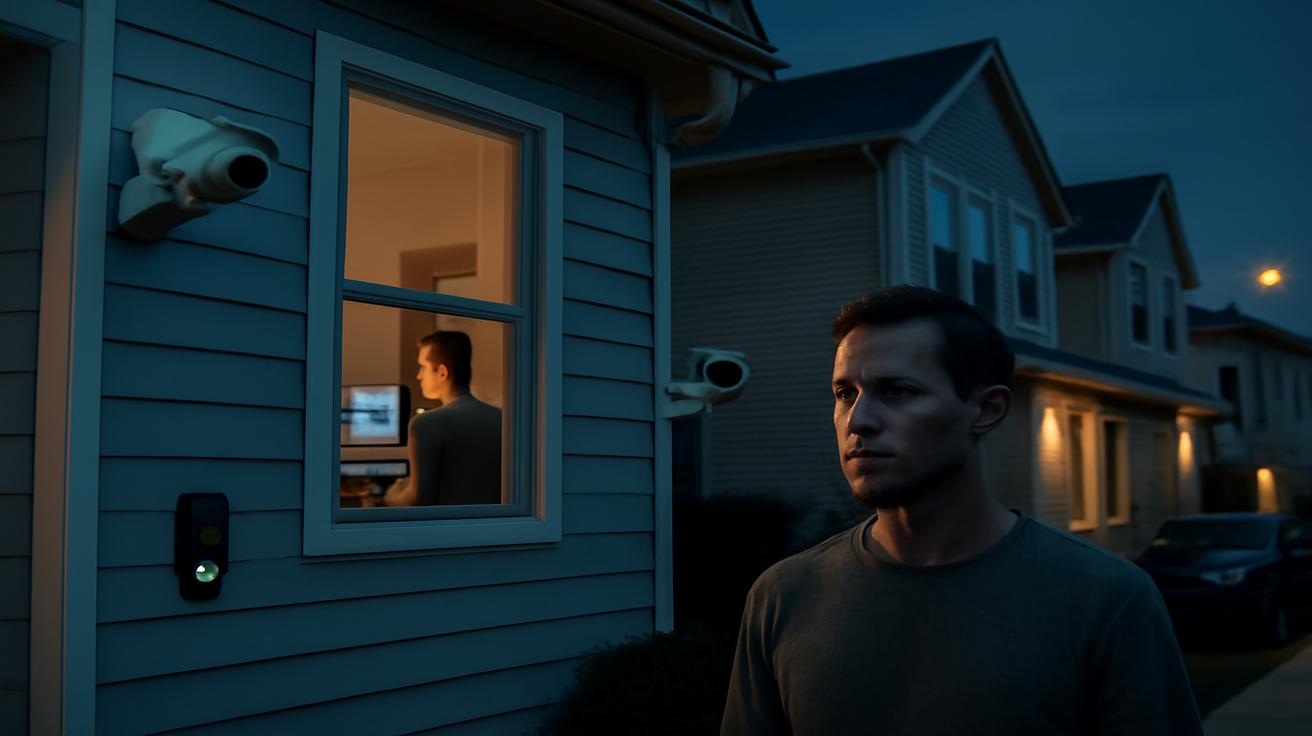
The first thing you notice is the tiny red light. It blinks politely from the porch across the street, like a neighbor giving you a friendly nod. Harmless. Almost reassuring. You walk past with your dog, keys in one hand, phone in the other, and the device follows you with a glassy, unblinking attention. Later that night, you’ll see yourself again—only this time, it might be on a stranger’s screen, replayed, paused, maybe even laughed at. Welcome to the age of smarthomesurveillance, where your neighbor’s sense of security might quietly turn your daily life into their content.
When Comfort Turns into a Camera
It started slowly, the way technological shifts often do. A doorbell that could show you who was outside. A motion-activated porch camera “for packages.” A smart floodlight that talked to an app. Each gadget arrived with a promise: more safety, more control, more peace of mind. The sales videos were full of soft light and smiling families, front doors opening to friends, burglars caught in pixel-perfect clarity.
But the camera doesn’t know your intentions. It only knows what it sees. And pretty soon, what it sees is everything that moves in its field of view. That includes you—taking your evening walk, arguing quietly on the sidewalk, juggling groceries, trying to coax a fussy toddler out of a stroller, kissing someone goodbye at the curb when you really hope no one is watching.
Someone might be watching.
Many of these devices don’t just record; they upload. They back up and sync. They organize clips by time, by motion, by “suspicious activity,” whatever that may mean. They make it easy—seductively easy—to scroll through the day like a highlight reel of the neighborhood. There’s the postal worker. The dog walker. The kid from down the street on his bike. The couple you sometimes see holding hands in the dark. And just like that, your neighborhood is no longer just a place. It’s a feed.
Neighborhood Watch or Neighborhood Reality Show?
In the old days, “neighborhood watch” meant a laminated sign with a cartoon burglar and a few retired folks peeking through curtains. It was analog, human, imperfect. You might be seen, but not saved, not stored, not shared in high definition. Today, those watchful eyes have been replaced or amplified by lenses—doorbells, floodlight cams, peephole cameras, garage cams, window cams. Many of them are networked, connected to apps that allow neighbors to share clips with a tap.
And they do share.
Some uploads are earnest: “Does anyone recognize this person stealing packages?” Others drift toward something stranger: “Who is this guy walking past my house at 5 a.m.?” A video clip appears: a man in a hoodie, hands in pockets, walking down a public sidewalk. Nothing illegal. Nothing particularly odd. But in the flood of comments that follows, suspicion blooms like mold in a damp corner.
The line between vigilance and voyeurism blurs fast. That same platform where people ask about coyotes or lost cats becomes a stage. Some neighbors grow addicted to their feeds, scrolling through motion alerts like they would social media. They begin to recognize regulars: the woman who always jogs at dusk, the teen who cuts across lawns, the gig worker who delivers takeout. They learn their rhythms, their habits, the tilt of their shoulders when they’re tired.
Except these aren’t characters. They’re your neighbors. They’re you.
Smarthome Devices and the New “Neighborhood Map”
Imagine a map of your block, not with streets and house numbers, but with cones of vision—overlapping camera fields, each one a silent, unblinking gaze. Anywhere you walk, you’re likely crossing several of these invisible beams. They might not be obvious in daylight, but at night, you can sometimes see the faint glow of infrared, like fireflies pinned to doorframes.
Here’s the part that often goes unspoken: many people don’t fully understand how much they are recording, how long they’re keeping it, or how easily it can be shared. And they almost never think about the experience on the other side of the lens—the passerby, the neighbor’s teenager, the dog walker, the person in crisis stopping for a moment on the curb, the friend who visits late at night and doesn’t want to be broadcast.
In this quietly expanding web of vision, your privacy isn’t exactly taken from you—it melts away, day by day, alert by alert, upload by upload. Not in big dramatic moments, but in the tiny ordinary ones that make up a life.
Why Your Privacy Might Be Someone Else’s Entertainment
Surveillance isn’t new. Security cameras have watched over stores, parking lots, and banks for decades. But those cameras were mostly owned by businesses, subject to rules, often grainy and utilitarian. What is new is how intimate and casual this watching has become—and how easily it slips from “safety tool” to “something to look at when I’m bored.”
Picture someone on their couch, phone in hand. Their doorbell camera app sends an alert: “Motion detected.” They tap. A delivery driver struggles with a huge package. It’s mildly amusing. They take a screenshot, send it to a friend, maybe post it for a few more laughs. The driver never knows. The moment, for them, was just a job. For someone else, it became content.
Now widen that lens: a messy breakup on the sidewalk, captured in crisp audio. A drunken stumble after a party. A wardrobe malfunction, a private phone call, a person crying quietly in the dark outside their car. These are real pieces of people’s lives. But they risk becoming little internet curiosities, stripped of context, served up as “crazy thing I saw on my camera last night.”
All of this happens because smarthome cameras sit at a powerful intersection of human impulses: the desire to feel safe, the urge to watch, and the endless hunger for things to share.
| Feature | Comfort & Convenience | Privacy & Social Impact |
|---|---|---|
| Doorbell Cameras | See visitors, track deliveries, talk remotely to people at your door. | Record everyone who walks by, create clips that can be shared without consent. |
| Smart Floodlights | Light up driveways and yards when motion is detected, deter intruders. | Capture neighbors in their own yards or cars, increase feelings of being constantly watched. |
| Cloud Storage | Access recordings anytime from anywhere, review earlier events. | Creates long-term archives of other people’s movements and routines. |
| Sharing & Community Apps | Helps locate suspects, find lost pets, document incidents. | Turns neighbors into “suspects,” encourages public shaming and misinterpretation. |
| Smart Integrations | Link with alarms, lights, and voice assistants for seamless control. | Expands surveillance reach; more data is collected about home and neighborhood life. |
When you zoom in on this everyday surveillance, you discover something unsettling: your privacy is increasingly dependent on other people’s self-restraint. The camera owner has the power. You have only the hope they won’t abuse it.
The Uneven Weight of the Lens
Not everyone is watched in the same way, or with the same level of suspicion. The story of smarthomesurveillance is also a story about bias—who is seen as “out of place,” who is labeled “suspicious,” who is turned into a clip, a warning, a villain in fifteen seconds of shaky video.
In many neighborhoods, people of color, teenagers, unhoused individuals, and gig workers carry a heavier surveillance burden. A delivery driver taking a short break in their car becomes a potential threat. A teen cutting across a lawn is suddenly “evidence.” A woman knocking on doors to hand out flyers is discussed as “sketchy” in a group chat made up of videos and whispers.
Cameras don’t discriminate, but the people behind them do, often unconsciously. The devices intensify whatever stories we already tell ourselves about who belongs and who doesn’t. They can harden fear into certainty and turn a vague unease into a public accusation.
This has consequences far beyond awkwardness. A shared clip can lead to police encounters, job loss, online harassment. A simple, context-free moment becomes something else in the hands of dozens—or thousands—of viewers who don’t know the person on-screen, but feel entitled to judge them.
From Security to Subtle Control
There’s a quieter side to all this, too, one that rarely makes headlines but hums beneath the surface of suburban streets and apartment hallways: the way cameras shape how people behave, how they feel, and what they dare to do in shared spaces.
Maybe you’ve felt it. That brief, awkward awareness when you remember the doorbell cam is recording as you wait for your friend to answer. You shift your weight. You adjust your face. You avoid muttering to yourself. You feel, suddenly, like you’re on stage—even if the audience is just one person behind a screen, miles away.
Over time, that awareness starts to change things. Maybe you don’t linger on the sidewalk anymore. Maybe you don’t pace outside while on a tense phone call. Maybe you think twice about visiting a particular house late at night, worried your presence will be captured, misread, or shared with strangers. The watchful eye doesn’t need to punish you; it only needs to exist for you to adjust yourself around it.
That is a kind of control—not overt, not announced, but deep and quiet. It seeps into the culture of a neighborhood. People begin to police not only one another but themselves. They behave for the camera, whether they agree with its presence or not.
In apartment buildings and condos, this effect can be even sharper. Residents install cameras in hallways, outside their doors, or via peephole lenses. Now, the threshold between private and public erodes further. Your late-night snack run, your visitor carrying an overnight bag, your messy sprint to catch an elevator—they all become data points in someone else’s archive.
Drawing a Line Without Building a Wall
So what do we do, standing here at this three-way collision of comfort, cameras, and control?
For most people, the answer isn’t as simple as “get rid of them.” Many smarthome devices really do provide value. They catch package thieves, deter would-be intruders, and help settle disputes about property damage or vandalism. They allow people who live alone or travel often to feel less vulnerable. There’s nothing trivial about that sense of safety.
The question is less about whether these tools should exist, and more about how we choose to use them—and who bears the cost.
One starting point is consent, or at least consideration. If you own cameras, ask yourself: What do they really need to see? Could you angle them to focus on your doorway rather than the entire sidewalk? Do you need audio recording, or is video enough? How long do you keep the footage? Do you routinely scroll through it out of habit, or only when you’re looking for something specific?
Another starting point is conversation. Talk to your neighbors. Let them know where your cameras are pointed and why. Be willing to adjust if your device is capturing more of their life than you’d want of yours. In a culture of silent watching, a simple conversation about boundaries can feel surprisingly radical.
And then there’s the matter of sharing. Before you upload a clip, ask what story you’re telling about the person in it—and whether you’d want that story told about you. Is this truly about safety, or is it about curiosity and entertainment? Are you labeling someone “suspicious” because of what they’ve done, or because of who they are, how they look, or when they dared to exist near your home?
Reclaiming the Space Between Safety and Spectacle
Walk down a residential street at dusk and listen. You’ll hear sprinklers ticking, TVs murmuring behind walls, a dog barking a few houses over, a car door closing softly. You’ll also hear the soft mechanical whir of cameras shifting focus, the almost inaudible click of a sensor picking up motion. It’s a soundscape of a new kind of neighborhood—one woven not just with fences and hedges, but with invisible grids of observation.
But even here, under this web of lenses, there is room for choice.
We can decide that not every surprising, strange, or imperfect human moment belongs in a group chat or on a public feed. We can treat smarthomesurveillance not as a toy or a content generator, but as a tool we wield with care—and sometimes choose not to wield at all. We can become more curious about the lives behind the pixels, and less eager to turn strangers into characters in an impromptu drama.
Most of all, we can remember that privacy is not just an individual preference; it’s a shared resource. Your decision to point a camera outward doesn’t only affect you. It reshapes how your entire block feels, moves, and breathes. It can either expand or contract the sense of trust that makes a place truly feel like home.
As more houses glow with the discreet red dots of recording devices, the question quietly shifts from “Are we being watched?” to “What kind of watchers will we be?” The answer, as always, won’t come from the technology, but from us—from the stories we choose to tell, the lines we refuse to cross, and the way we balance our hunger for security with a gentler respect for each other’s unscripted, unedited lives.
Frequently Asked Questions
Are smarthome cameras legal if they record public sidewalks?
In many places, it is legal to record areas that are visible from your property, including public sidewalks. However, laws vary, and some regions restrict audio recording or require notice. Even if it’s legal, there are ethical questions about constantly recording people who haven’t consented.
Can my neighbor record my yard or front door?
Generally, cameras should be focused on the owner’s property. If a neighbor’s camera is clearly aimed into your windows, yard, or entrance in a way that feels invasive, you may have grounds to complain to building management, a homeowners’ association, or in some cases, local authorities. Starting with a calm conversation is often the most effective first step.
What can I do if I find a video of myself shared online from a home camera?
First, ask the person who posted it to remove it, explaining your concerns clearly. If it’s on a social platform, you may be able to report it for privacy or harassment. Your legal options depend on local privacy and recording laws, and sometimes on whether your image was captured in a public or private space.
How can I use smarthome surveillance more responsibly?
Limit what you capture to what you truly need for security, adjust camera angles away from neighbors’ property, avoid unnecessary audio recording, set shorter storage times, and think carefully before sharing clips. Use cameras as tools for protection, not as sources of entertainment.
Does surveillance really make neighborhoods safer?
Cameras can help solve some crimes, especially theft and vandalism, and may deter certain behavior. But they don’t address root causes of crime and can create new problems, like mistrust, harassment, or biased reporting of “suspicious” people. Safety also depends on social ties, communication, and shared responsibility—not just technology.







Leave a Comment