
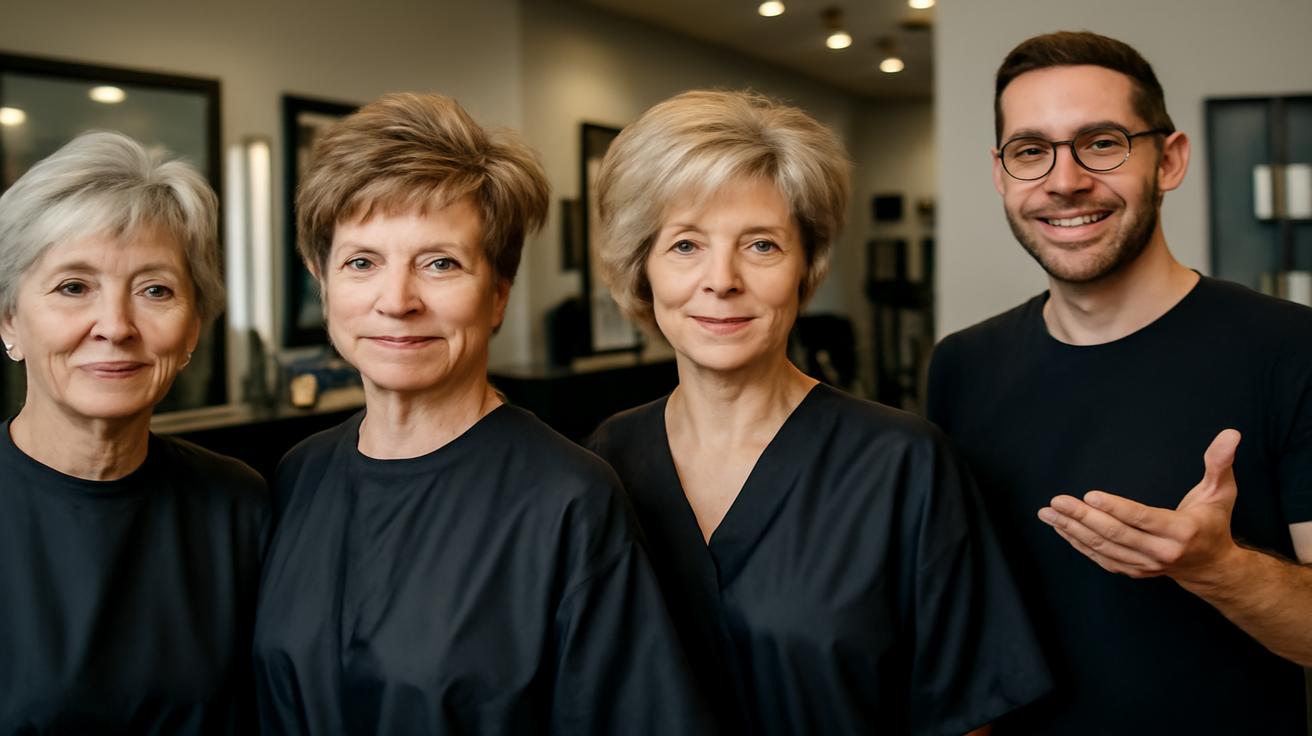
The first time you cut your hair short, you don’t walk out of the salon. You float. Your neck feels impossibly light, like you’ve set down something you’ve been carrying for years without realizing it. The wind finds your skin again. You run your fingers through what’s left and think, Oh. This is me. And then, if you have fine hair, the mirror starts whispering its familiar doubts: Will it lie flat? Will every gust of air expose your scalp? Will it look thin instead of chic? If that sounds like you, you’re not alone—and your hair is nowhere near as “difficult” as it’s been made to feel.
The Secret Life of Fine Hair (And Why Short Cuts Are Your Best Friend)
Fine hair has its own quiet personality. Each strand is smaller in diameter, softer, sometimes silkier. It can be shiny and delicate, and it often falls straight down, clinging to the shape of your head like a silk scarf instead of lifting and holding like wool. It’s not that there isn’t enough hair; it’s that each piece of hair doesn’t take up much space.
When it’s long, fine hair is weighed down. Gravity wins, and whatever volume you coax at the roots sighs and slips away before lunch. This is why short hair, when it’s cut well, is a secret superpower for fine hair. A good short haircut for fine hair removes weight, builds shape, and uses illusion to your advantage, turning scattered strands into something that looks fuller, denser, and intentional.
Picture it like architecture. Long hair is like a tall, narrow building—every extra floor puts more strain on the structure. Short hair is a low, thoughtful design: carefully angled walls, clever lighting, and an emphasis on the foundation. With fine hair, the right short cut creates that same kind of optical magic. The eye reads volume, even when the hair itself hasn’t changed.
We’re going to wander through four of the best short hairstyles for fine hair—cuts that add lift, create movement, and make your hair look thicker and livelier. Think of this not as a rulebook, but as a walk through possibilities. You’ll feel which one is yours.
1. The Airy Textured Bob: Light, Effortless, Bigger Than It Looks
Imagine waking up and your hair already looks like you’ve done something with it. Not perfectly styled, but softly intentional, with ends that kick and curve just enough to look alive. That’s the promise of a textured bob on fine hair: loose, airy, and fuller than it has any right to be.
A textured bob usually sits somewhere between the cheekbones and just above the shoulders. For fine hair, the magic is in the internal layers—the kind you don’t always see, but you feel. Your stylist removes weight in hidden sections, so the hair doesn’t cling flat to your face. Instead, it lifts, fans, and falls in gentle, imperfect pieces that mimic density.
There’s often a barely-there bend involved. Not tight waves, just a soft S-shape, especially around the mid-lengths. This movement makes each strand catch the light differently, giving the impression of more hair in the same space. A blunt perimeter (the line where your hair ends) adds thickness visually, while the subtle texturizing inside keeps it from becoming a limp curtain.
It’s the haircut that moves with you. When you tuck it behind one ear, there’s still volume at the crown. When you shake it out at the end of the day, the pieces separate instead of matting together. You can air-dry with a light mousse, crunch with your fingers, and call it a style. For fine hair that hates being fussed over, this bob feels like a truce.
| Short Style | Best For | Volume Trick |
|---|---|---|
| Textured Bob | Fine, straight to slightly wavy hair | Invisible layers + blunt ends |
| Layered Pixie | Fine hair that styles quickly | Stacked layers at the crown |
| French Crop Bob | Fine hair wanting classic shape | Soft shaping around face + neck |
| Shag-Inspired Cut | Fine, slightly messy, carefree styles | Choppy layers + face-framing pieces |
2. The Layered Pixie: Tiny Cut, Big Personality
There’s a specific kind of freedom that comes with a pixie cut when you have fine hair. Suddenly, your hair is no longer something you’re trying to disguise or thicken; it’s a sharp, deliberate choice. Your face appears, fully. Your neck is all lines and grace. And those light, fine strands you’ve fought with for years? They become an advantage.
A layered pixie works with the natural softness of fine hair. Instead of fighting for heavy structure, it leans into lightness. The back and sides are usually shorter, skimming the head, while the top is left longer, layered, and a little disobedient. That extra length at the crown and fringe area is where the volume lives.
Think of the top as a series of stacked cards. Each layer supports the next, creating vertical height. Because fine hair doesn’t bulk up easily, you can layer generously without the cut feeling thick or helmet-like. A bit of root-lifting spray and a pea-sized dab of mousse can turn your hair into something that lifts when you touch it, instead of collapsing.
Texture is key here. A layered pixie loves dry styling. Rough it up with your fingertips as it dries, push the fringe to one side, or mess it forward slightly over your forehead. Fine hair takes on a feathery, almost weightless texture in this cut—delicate, yes, but not fragile. The trick is to avoid heavy creams and oils; they drag those feathery layers down. Instead, think of mists, foams, and airy pastes.
If you’ve always suspected that your features are hiding under your hair, this is the cut that brings them out. Cheekbones become more pronounced. Eyes look bigger. The haircut itself becomes a statement, and the narrative of “thin hair” gives way to “bold cut.”
3. The French-Inspired Crop Bob: Clean Lines, Quiet Volume
Not everyone wants their hair to shout. Maybe your idea of a perfect short haircut is something simple: elegant, a little romantic, and not trying too hard. Enter the French-inspired crop bob, the haircut that looks like it belongs in a café window reflection: soft bangs, clean edges, and a shape that makes fine hair look deliberate rather than sparse.
This bob usually sits at jawline level or brushing just below, with the back slightly shorter than the front. There’s a subtle graduation that makes the hair hug the nape while skimming forward toward the face. The result is a gentle, almost cinematic silhouette: volume at the back, softness around the eyes, and enough structure to keep everything from going flat.
For fine hair, the genius is in its restraint. There are fewer layers than a shag or a textured bob; instead, it uses shape and line to create fullness. A soft, wispy fringe can be cut to blur the forehead without looking heavy, which is ideal when you don’t have a ton of bulk to work with. The ends are often slightly blunt to fake density, while the underlayers are thinned just enough to prevent the cut from collapsing into the face.
Styled with a round brush or a small blow-dry brush, the French crop bob lifts at the roots and folds under at the edges, like a page gently turning. It requires a bit more intention than a wash-and-go pixie, but the payoff is a shape that holds its own all day without a helmet of spray.
On fine hair, this cut feels like a beautifully tailored shirt: nothing extra, everything precise, designed to flatter what you already have. It invites subtle movement—tucking, untucking, smoothing, tousling—without ever looking messy.
4. The Soft Shag-Inspired Cut: Controlled Chaos for More Volume
If your soul is a little wilder, if you love the look of hair that seems to have a story, the shag-inspired short cut might be your home. People often think shags are only for thick, unruly hair, but fine hair wears this style with a different kind of charm: lighter, fluffier, more whisper than roar—but just as expressive.
A short shag for fine hair lives somewhere between a bob and a long pixie, with lots of piece-y layers and movement. The hair is cut in varying lengths that radiate from the crown, traveling forward into soft, face-framing tendrils and backward into tapered layers at the nape. The goal is not blunt perfection, but artful irregularity.
On fine hair, those choppy layers create air pockets between strands. Instead of lying flat against one another, they separate, stack, and lift. The result is a halo of movement that looks fuller because there are more visible edges and shadows. Think of it like ripples on water: the more ripples, the more alive the surface appears.
This cut pairs beautifully with a soft fringe—curtain bangs that fall just over the brows, or shorter, sketchy bangs that look like they grew that way. Styling can be as low-key as scrunching in a volumizing foam and letting your hair air-dry. Imperfection is the goal. A bit of dry texturizing spray at the roots and mid-lengths can transform “flat” into “deliberately undone.”
The shag-inspired cut is about personality as much as practicality. For fine hair, it sends a quiet but firm message: this hair doesn’t need to be thick to be interesting. It just needs movement, intention, and room to breathe.
5. Everyday Volume Rituals: How to Treat Fine Short Hair Like It Matters
The best short haircut for fine hair is only half of the story. The other half lives in your daily rituals—the way you wash, dry, sleep on, and touch your hair. Fine hair responds quickly to generosity and just as quickly to neglect.
First, there’s the matter of cleansing. Heavy conditioners and rich masks, especially near the roots, are the sworn enemies of volume. They coat the strand so thoroughly that it loses its ability to lift. With short fine hair, think of conditioning from mid-length to ends only, and choose formulas labeled “lightweight,” “volumizing,” or “for fine hair.” Your scalp prefers clarity over suffocation.
Drying is a quiet art. Flip your head upside down while you rough-dry with your fingers, focusing on lifting the roots away from the scalp. If you use a brush, keep it small and mobile, lifting sections up and away as you dry rather than dragging them down. Heat-protectant sprays are your allies: choose ones that promise volume, not sleekness.
Products should feel barely there. A golf-ball-sized puff of mousse can be enough for an entire head of short fine hair. A spritz or two of root-lifting spray at the crown before drying can create a soft cushion of height. Dry shampoo isn’t just for saving second-day hair; used on clean hair at the roots, it can add friction and body, making fine strands easier to shape.
And then there’s touch. The more you run your fingers through fine hair during the day, the quicker it oils and flattens. Instead, learn a few small gestures that revive volume without overhandling: a gentle lift at the crown with your fingertips, a quick shake at the roots, a flip of the part to the opposite side for instant height.
Fine hair, in its way, is honest. Treat it with lightness and a bit of strategy, and it reflects that care. Pair those rituals with one of these four cuts, and you stop fighting your hair into submission. Instead, it starts working with you.
FAQs on Short Haircuts for Fine Hair
Will cutting my fine hair short really make it look thicker?
Yes—when it’s cut well. Short cuts remove the weight that pulls fine hair flat and use shape, line, and layering to create the illusion of density. Blunt edges, clever internal layers, and volume focused at the crown or around the face all help your hair appear fuller.
Which short haircut is best if my fine hair is also thinning?
A textured bob or French-inspired crop bob is often the most forgiving. They allow for a slightly heavier perimeter, which disguises see-through ends, and they can be styled to cover thinner areas at the crown or part. Avoid overly choppy or extreme layering on very thin sections, as this can expose the scalp.
How often should I trim a short cut on fine hair?
Every 5–8 weeks is ideal. Fine hair loses its shape faster than thicker hair, especially in short styles where a few millimeters can change the overall silhouette. Regular trims keep the lines clean and the volume structure intact.
Are bangs a good idea on fine hair?
They can be, as long as they’re tailored to your density. Soft, wispy or curtain bangs often work better than very thick, blunt ones for fine hair. They add interest and can create the impression of more volume around the face without stealing too much hair from the rest of your head.
What styling products should I avoid with fine short hair?
Avoid heavy oils, thick creams, and strong waxes designed for coarse hair. These weigh fine strands down and erase volume. Instead, look for lightweight mousses, volumizing sprays, soft dry texturizing sprays, and light pastes used sparingly.
Can I wear a shag-style cut if my hair is very straight and fine?
Yes, but it should be a softer, more controlled version of a shag. Too many aggressive layers can make very fine straight hair look stringy. Ask your stylist for gentle, graduated layers and styling tips to add movement—like using a small curling iron to create random bends that mimic natural texture.
How do I talk to my stylist about the right short cut for my fine hair?
Bring clear photos of styles you like, and be honest about how much time you’ll spend styling. Tell them what you struggle with (flat crown, see-through ends, limp fringe) and what you love about your hair (softness, shine, ease). A good stylist will adapt one of these four cuts—the textured bob, layered pixie, French crop bob, or soft shag—to your hair type, face shape, and daily routine.






Leave a Comment