
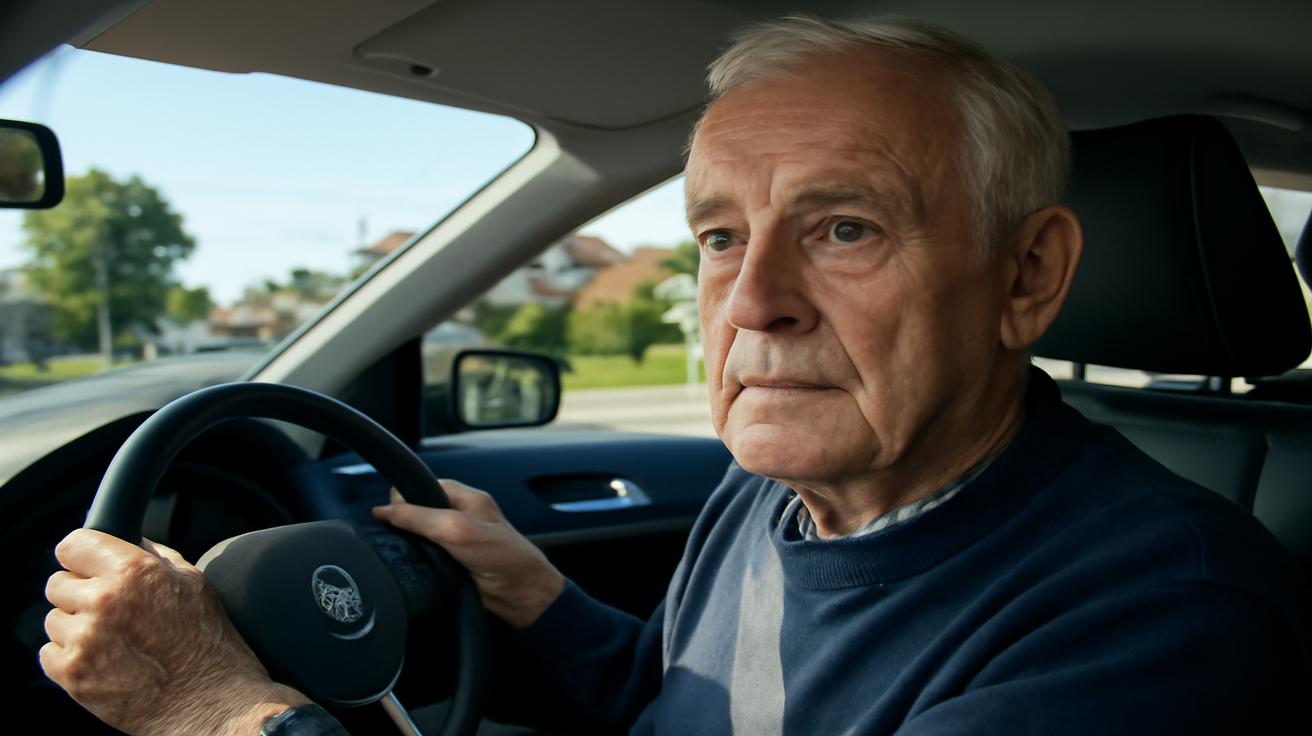
The first thing you notice is the slowness. Not the impatient kind that makes you tap the steering wheel, but a careful, almost reverent way of moving through the world. The little silver hatchback edges into the roundabout, indicator blinking a fraction too early, a white-haired driver peering over the wheel. A delivery van behind him flares its headlights in frustration. Someone honks. The old man doesn’t seem to hear. Or maybe he does, and pretends not to. Either way, he rolls on, steady, like he has all the time in the world. Because for him, driving isn’t just getting from A to B. It’s independence, memory, and the last solid border between “still myself” and “being looked after.”
A rumor at the breakfast table
The story usually starts in a kitchen like any other. The kettle whistles, the radio murmurs, spoons clink in mugs. Then someone drops it: “Have you heard? From 2025, they’re taking everyone’s license away automatically once you turn 70.” The room goes quiet. A fork pauses half-way to a plate. Eyes flick to the calendar on the wall, to the circled birthdays creeping closer.
In many countries, the idea has been floating around for years: older drivers are unsafe, their reflexes are slow, their eyes are bad, their medications confusing. It seems so simple on paper. Pick a number — 70, say — and declare that the road now belongs to the younger and the faster. No need for messy individual evaluations, no awkward conversations at the doctor’s office, no heart-wrenching arguments in the driveway about who is “still okay to drive.” Just a clean rule.
But life, of course, is never that clean. The rumor of automatic license withdrawal at 70, supposedly coming in 2025, has spread faster than facts, pushed along by half-heard talk show debates, provocative headlines, and the casual cruelty of social media comments. “If you can’t see properly, stay off the road.” “Old people should be banned from driving altogether.”
If you sit quietly in a café on a weekday morning, you’ll hear the other side. “I only drive to the supermarket.” “Without my car, I can’t visit my sister.” “I don’t want to be a burden.” For many seniors, 2025 has become a date not on a calendar, but on a cliff.
What the law actually says (and doesn’t say)
To understand what might really change for older drivers, it helps to separate myth from policy. The talk of licenses being “pulled automatically after 70 from 2025” is rarely as straightforward as it sounds. In practice, most governments face a delicate balancing act: protecting road safety without turning aging itself into an offense.
In many places, there is no law that says, “On your 70th birthday, your license is gone.” Instead, what exists — or is being discussed — are systems of checks. Periodic medical exams, shorter license renewal periods, eyesight tests, cognitive assessments, or mandatory refresher courses. Policymakers, haunted by tragic headlines of crashes involving confused or frail elderly drivers, reach for tools that feel measurable and fair.
From 2025 onward, a number of countries and regions are planning adjustments to how senior drivers are monitored, but that doesn’t equal one universal, blanket rule. In some jurisdictions, renewal intervals may shorten once a driver turns 70. In others, a doctor’s certificate might be required, or a behind-the-wheel test after a certain age. Elsewhere, proposals are still under debate, stirring anxiety long before the ink is dry.
That distinction matters. An automatic revocation paints everyone with the same brush, from the 70-year-old who still hikes in the mountains and reads small print without glasses, to the 70-year-old who struggles with early dementia. A system of checks, on the other hand, at least tries to see the individual behind the date of birth — however imperfectly.
The power of a plastic card
For many of us, a driver’s license is just another card in the wallet, handy but replaceable. For someone in their seventies or eighties, it can be the last thread tying them to the life they recognize. The day that card disappears, the world shrinks dramatically. A fifteen-minute drive to the shop becomes three bus changes and an hour in the cold. A spontaneous visit to a friend becomes a logistical operation.
Listen closely to older drivers when they talk about their licenses, and you’ll hear less about convenience than about identity: “I’ve been driving since I was eighteen.” “I taught my kids to drive.” “I drove across the country once.” The car becomes a vessel for all of that history. To revoke the license is, in a way, to redraw the border of their life story without their consent.
And yet, the other stories are real too. The ones where someone gets lost on the way home from a familiar supermarket. Where a confused driver goes the wrong way down an exit ramp. Where the car that has always been a symbol of freedom suddenly becomes a weapon no one intended to wield. Behind every abstract debate, there are families trying to weigh the terror of a possible accident against the quiet, aching loss of autonomy.
Age, risk, and the uneasy truth
Let’s set sentiment aside for a moment and look at the uncomfortable question: are older drivers actually more dangerous? The answer, like most truths, is complicated.
Statistically, crash rates can rise again at very advanced ages, especially from mid-70s onward. Slower reaction times, poorer vision — particularly at night — and medication side effects all play a part. When older drivers do get into serious accidents, they are also more likely to be badly hurt, because their bodies are more fragile. This vulnerability sometimes colors the perception of how “dangerous” they are, because the consequences are more visible and severe.
But it’s equally true that many seniors self-regulate. They avoid driving after dark, in heavy rain, during rush hour, or in unfamiliar cities. They tend to drive fewer miles overall and often at lower speeds. Some studies have shown that, per mile driven, young inexperienced drivers, not seniors, are the riskiest group on the road. The stereotype of the reckless teenager weaving through lanes isn’t entirely unfair.
What age does, almost inevitably, is narrow the margin for error. A confusing intersection, a sudden detour, or a fast-approaching motorbike can overwhelm an older brain more easily. The question for society then becomes: do we respond with a scalpel or with an axe?
Automatic bans vs. nuanced checks
Supporters of automatic license withdrawal after a certain age argue that it’s clear, easy to enforce, and saves lives. They note that individual medical checks can be subjective, patchy, or influenced by families who beg doctors not to report problems. From this point of view, a hard line at 70 or 75 seems like the only honest solution.
Critics counter that age is a blunt instrument. Some people in their late seventies remain sharp, healthy, and fully capable behind the wheel; others struggle much earlier. Good regulation, they argue, should measure ability, not the candles on a birthday cake. Mandatory, regular driving assessments from a certain age, combined with medical screening, can arguably achieve the same safety goals without equating “old” with “unsafe.”
Here, 2025 looms as a symbolic date. Not because every country will suddenly flip the same switch, but because more and more lawmakers are being pushed to decide: do we trust nuanced systems enough, or do we pick an age and design the law around it?
A closer look: what might change for seniors in practice?
In the noise of ideological debates, it helps to translate policy into everyday life. For a typical senior driver, “stricter rules from 2025” rarely mean a uniform, immediate ban. More often, they mean that renewing a license after a certain birthday will feel less like a formality and more like an exam.
Imagine you’re turning 70 or 75 in a world with tightened rules. Instead of mailing in a form and a new photo, you might need to schedule a health check. An optometrist measures your field of vision. Your family doctor runs through questions about medications, dizziness, forgetfulness. In some regions, you might even be asked to drive with an examiner for half an hour through town, navigating roundabouts, lane changes, and a parking maneuver.
For many, this will be a relief: passing the test is tangible proof that the quietly whispered doubts — “Am I still safe?” — haven’t yet caught up with reality. For others, it will be an ordeal, a spotlight on every small lapse that aging has brought. Jittery hands on the steering wheel, a heart beating faster than the engine.
| Aspect | Before 70 | After 70 (in stricter systems) |
|---|---|---|
| License duration | Long validity (often 5–15 years) | Shorter validity (e.g., 1–3 years) |
| Renewal process | Mostly administrative | Medical / vision checks required |
| Driving test | Rare, usually only after serious incidents | May be required at set age intervals |
| Self-regulation | Voluntary (avoid night, bad weather, etc.) | Sometimes formal (restrictions on night or highway driving) |
In some systems, licenses can be renewed with conditions: driving only during daylight, within a certain radius of home, or at lower speed limits. It’s an attempt to tailor the right to drive to the reality of a person’s abilities. Not all seniors welcome these compromises, but for some, they offer a gentler slope down from full freedom rather than a sudden drop.
The emotional crossroads
Beyond regulations and test forms lies something harder to legislate: dignity. Picture a son standing in a dim garage, trying to find the words. “Dad, maybe it’s time to stop driving.” Picture the father stiffening, hand on the old steering wheel, the smell of oil and leather and years of family holidays embedded in the seats.
Conversations like these are happening every day, in every country. 2025’s rumored changes give them a new urgency but not a new shape. Where the law draws a line, families are often the ones who must enforce it — or choose to look away.
Many seniors admit, in quieter moments, that they feel less confident behind the wheel. They notice the way traffic seems faster, how signs appear out of nowhere, how other drivers honk more readily than they used to. But handing over the keys voluntarily can feel like walking into a smaller life. It’s not just about “no more driving”; it’s “no more deciding when to go.”
This is where nuanced policies can either soften or harden the blow. A system that invites older drivers to regular assessments and honest conversations with doctors can make it easier for them to retire from driving with some agency left intact. A system that simply cuts the cord at 70 risks turning them from participants into patients overnight.
Designing roads for all ages
There’s a quiet irony in how the debate around older drivers often plays out. We talk as though the only two options are “allow them to drive” or “keep them off the road.” Rarely do we ask: could the road itself be kinder?
Clearer signage, larger fonts, better lighting at intersections, simpler lane markings, longer yellow lights at traffic signals — these changes help elderly drivers, yes, but they also reduce confusion and accidents for everyone. Intuitive roundabout designs, protected left turns, traffic calming in busy areas: each is a small mercy for a slower brain and a body with less room for error.
Public transport that actually works — frequent, accessible, safe — can take some pressure off seniors who cling to their cars because every alternative feels like an ordeal. Community ride services, volunteer driver networks, and on-demand shuttle systems can transform the prospect of “no license” from a sentence of isolation into a manageable adjustment.
And then there’s technology: modern cars with automatic emergency braking, lane-keeping assistance, blind-spot warnings, and fatigue alerts can be powerful allies for older drivers, if they’re taught to use them without fear. In a way, that little chime when you drift too close to the lane line is a quiet promise from the car: You don’t have to do this alone.
Preparing for the moment before it comes
For anyone approaching 70, or with aging parents who still drive, the most compassionate thing we can do may be to start the conversation early — before a letter from a licensing authority or a scary incident on the road forces the issue.
That can mean scheduling a voluntary driving refresher course, just to see how things feel. Going for a drive together, observing gently rather than judging. Asking doctors not only whether the heart is okay, but whether the new pills might blur the line between safe and risky behind the wheel.
It can also mean mapping out alternatives in advance. Where’s the nearest bus stop? Which neighbor might be happy to share rides to the supermarket once a week? Is there a local taxi voucher program or community shuttle? These practicalities, sorted before they become urgent, can turn “losing the license” from a free fall into a planned landing.
So, will licenses really be pulled automatically after 70 from 2025?
When someone leans across the breakfast table and whispers, “They’re going to take them all away at 70, starting in 2025,” what they’re really expressing is fear: fear of change, fear of aging, fear of a world designed for the quick and the young.
The reality is more layered. Some regions are tightening rules. More will likely follow, under pressure to reduce accidents and respond to an aging population. For many seniors, renewing a license after 70 will become more demanding, more medical, more conditional. But a universal, automatic ban at 70 — a sudden, blanket revocation on a specific birthday — remains, in most places, more rumor than rule.
What is almost certain, however, is that the question of older drivers will not fade. As life expectancy increases and generations insist, rightly, on staying active and mobile longer, the roads will be shared by more and more silver-haired drivers. The challenge is not to push them off those roads, but to make sure that everyone using them — old, young, confident, anxious — can do so without turning each other into statistics.
Somewhere this afternoon, that same silver hatchback will pull into a supermarket parking space, a little crooked, a little slow. The driver will sit for a moment, hands resting on the wheel, listening to the tick of the cooling engine. Maybe he’s heard the rumors about 2025. Maybe he hasn’t. Either way, he knows the day will come when someone else will drive him here. The only real question is whether we, as a society, will meet that day with blunt rules and fear — or with nuance, empathy, and roads that welcome every age.
Frequently Asked Questions
Will my driver’s license automatically be revoked when I turn 70 from 2025?
In most places, no. While some regions are planning stricter checks and shorter renewal periods for older drivers, a universal automatic revocation at 70 on a specific date is largely a rumor. It’s important to check the specific rules where you live, as they can vary widely.
What kinds of changes can seniors expect around 2025?
Many proposed changes focus on safety checks rather than outright bans. These may include mandatory vision tests, medical certificates from a doctor, shorter license validity periods after a certain age, and in some cases, on-road driving assessments at renewal.
Are older drivers really more dangerous than younger ones?
The picture is mixed. Very elderly drivers can have higher crash rates and are more likely to be seriously injured in accidents. However, they also tend to self-limit their driving and generally drive more cautiously. Young, inexperienced drivers are often statistically riskier per mile driven. Age alone doesn’t tell the whole story; health, experience, and driving habits all matter.
Can a license be renewed with conditions instead of being taken away?
Yes, in some systems. Depending on the results of medical or driving assessments, seniors may receive licenses with restrictions, such as daytime-only driving, no highway driving, or staying within a certain distance of home. These tailored conditions aim to match driving privileges to actual abilities.
How can families support an older relative who might not be safe to drive anymore?
Start with open, respectful conversations well before a crisis. Offer to ride along and gently observe, suggest a professional driving assessment, and talk to their doctor about any relevant health issues. At the same time, help map out alternatives — public transport, ride-sharing with neighbors, community services — so that giving up the car doesn’t mean giving up independence completely.








Leave a Comment