
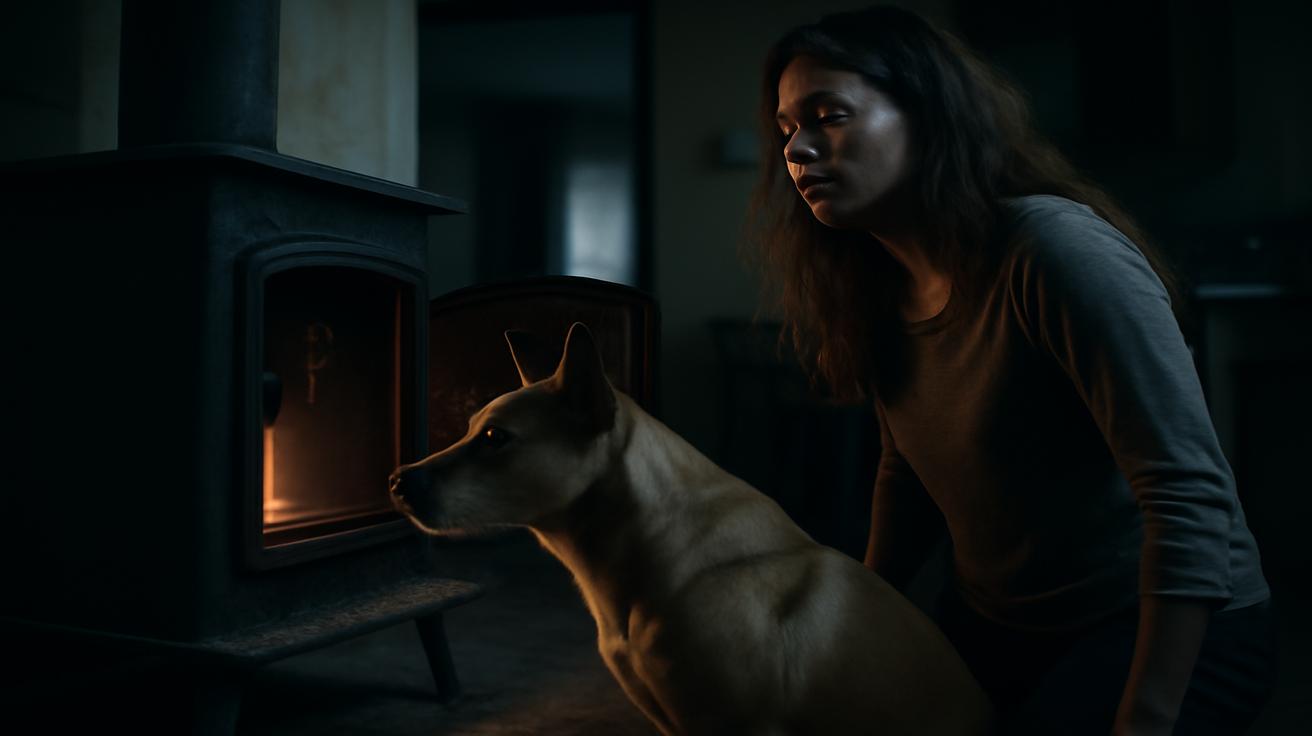
The dog noticed first, of course. Long before she did, before the kettle boiled or the wind changed or the night decided what it wanted to be, the dog knew. He sat on the braided rug in front of the wood stove, muscles tight beneath his fur, eyes fixed on the cast-iron door as though it might suddenly open and speak to him.
At first, she thought he was just waiting for the fire to bloom. It was early December, the kind of cold that moved like a quiet rumor through the trees and under your clothes. The cabin was still shaking off the chill from the day, walls ticking and popping as they adjusted. In the kitchen, she wrapped her fingers around a mug, listened to the kettle hum, and watched her dog—Finn—hold his silent, unblinking vigil in front of the stove.
“Give it a minute, drama king,” she called softly. “I’m getting there.”
Finn did not turn his head. His ears, sharp and triangular, leaned forward. His tail, usually a slow, easy metronome of contentment, hung low and still. The hair along his spine stood up like frost-tipped grass. That was the first moment something inside her stirred—the faint, instinctive recognition that whatever had Finn’s attention, it was not the promise of warmth.
The Night the Woods Held Their Breath
Outside the cabin, the forest was already dark, the sky pressed low and heavy with snow that hadn’t quite committed. The tall spruce and stunted birch were silhouettes against a sky the color of old slate. Somewhere in the distance, a barred owl called with that familiar, echoing who-cooks-for-you, and the sound folded into the night like it had been rehearsed a thousand times.
She moved to the window above the sink, shifting her mug from one hand to the other. Her breath dimmed the glass, smearing the view into smudged shadows and faint stars. Nothing moved. No headlights on the narrow road. No crunch of tires over frozen earth. The neighbors—if you could call people who lived a mile down a rutted track “neighbors”—were settled in their own pockets of light and warmth by now.
Behind her, Finn let out a low, rolling growl that she felt more than heard, like a tremor under her feet.
That sound rooted her. She inhaled, slow and deliberate, the way you do when your body warns you that things may be about to change. The kettle clicked itself off with a faint metallic sigh. The refrigerator hummed. The baseboard heater in the bedroom ticked. All the usual domestic sounds of small living.
But under it all, there was something else. A new ingredient in the air: a faint, acrid tang that did not belong to coffee or pine or woodsmoke. Something metallic. Oily. Wrong.
When a Dog’s Eyes Become a Compass
She set the mug down and stepped into the living room. Finn didn’t look at her. His whole body was angled toward the wood stove, his attention pinned to the iron door and the dark, hollow throat of the chimney above it. His nose twitched, taking in drafts she couldn’t yet feel. His growl sounded again, a warning running along the ground like thunder.
She knelt beside him and placed a hand on his back. His muscles fluttered beneath her palm, hot and tense. His heart thudded fast, too fast for a dog lounging in his favorite warm spot. She followed his gaze to the stove.
The fire had burned low. Only a few embers glowed at the back, pulsing orange like sleepy eyes half-shuttered. The cast-iron door radiated a gentle heat, but the cabin as a whole still felt cooler than it should, as if the warmth couldn’t quite grip the room.
“Finn,” she whispered, as much to herself as to him. “What are you seeing?”
He didn’t blink. Didn’t move. Just stared, his nose tilting upward, toward the dark circle of the chimney pipe that disappeared into the ceiling. There was a faint sound there—she realized slowly—a soft, irregular tap-tap, like fingernails on the inside of a tin can. Not the rustle of squirrels skittering across the roof, not the scuttle of mice. Something closer. Inside, not outside.
For a moment, memory surged: the stories locals told at the feed store, over coffee and cold mornings. The talk about people cutting through empty seasonal cabins, slipping in and out when no one was around. Always through the easy places. The forgotten windows. The unsecured sheds. Even, once, someone swore, through an old, crumbling chimney.
Back then, she had laughed, slipped the story into the same drawer as ghost tales and mountain legends. But now her dog was ready to fight the wood stove, and there was a sound inside the chimney no bird or squirrel could possibly make.
The Chimney That Breathed
She stood slowly, careful not to break whatever fragile understanding Finn had with the darkness in front of him. The room seemed to sharpen around the edges: the weave of the rug under her bare feet, the faint soot smell that always clung to the air in winter, the way the lamplight painted gentle gold on the ceiling beams.
Another sound from inside the chimney. A deliberate scrape. Then a pause. Then the soft rustle of…fabric?
Her fingers went instinctively to her pocket, where her phone waited like a lifeline. She didn’t pull it out yet. Instead, she stepped closer to the stove, stopping a good two feet away. Finn cast her a brief glance, a quick flick of his eye as if to say, You see it now? Then his attention snapped back to the source.
The chimney pipe was old, riveted metal, blackened from years of smoke. It ran straight up through the ceiling to the roof, its route a simple geometric line in an otherwise imperfect, hand-built cabin. She had cleaned it herself in early autumn, a ritual she’d come to enjoy: the brushing, the soot, the satisfaction of watching flakes of last winter’s fires fall away. She knew every bolt and bend.
That was why she saw it. A shift. Not big, not dramatic, but enough. The faintest wobble in the collar where the pipe met the stove. The way a shadow inside it deepened, dark on dark.
Her throat went dry. “Who’s there?” she said, hating how small her voice sounded in her own home.
For a beat, there was nothing. The cabin listened with her. Even the refrigerator seemed to hold its breath.
Then, out of the chimney’s black mouth, a voice came down—ragged, muffled, edged with strain.
“Don’t… don’t freak out.”
The Intruder from the Dark Throat of the House
Her first thought was not profound. It was, simply: People do not come out of chimneys. That was a fairy tale rule, a Santa Claus clause written into the childhood code of wonder. Chimneys were for smoke, birds, the occasional disoriented bat. Not for human words spilling out like smoke gone wrong.
Finn erupted. He lunged at the stove, claws scraping on cast iron, teeth flashing in the lamplight as a snarl ripped free. His bark exploded in the small room, loud enough that she flinched.
“Easy, easy!” the voice above coughed, edged with panic. “I’m stuck, okay? I’m—I didn’t mean—just get the dog—”
She moved faster than she thought she could, grabbing Finn by the collar and dragging him back, muscle against muscle. He resisted, but years of obedience training kicked in; he yielded in inches, then feet, though his whole body vibrated with unwillingness. He barked again, deep and hoarse, as if he could shake whoever was in the chimney loose just by sound.
“What are you doing in my chimney?” she called, now with more steel in her voice. Her pulse hammered in her ears. The cabin felt too small, her walls suddenly permeable, the world inside and outside tangled in a way that made her skin prickle.
There was a scraping noise, metal on metal, like a boot twisting for leverage. A puff of soot drifted down into the stove, blooming black against the orange embers.
“I was trying to get in,” the voice said, matter-of-fact, like he was explaining how he’d come in through an unlocked door. “I thought the place was empty. Then I… misjudged the angle. Look, I’m kind of wedged. Can we just—can you calm the dog down and, I don’t know, call someone? Fire department? Police? A really strong neighbor?”
Her mind did a quick, ragged inventory: distance to the nearest town, patchy cell signal, the narrow, unplowed drive. The nearest “really strong neighbor” was an older man with arthritic knees and a bad back. The volunteer fire department took at least twenty minutes to get anywhere in good weather.
But under all that was something simpler: someone had crawled into her chimney trying to break in. Chosen that route because they thought no one would notice. Slipped down the throat of her house like smoke, assuming it was empty. Her home hadn’t just been a dot on a map tonight; it had been a target.
She felt suddenly both small and very, very awake.
| Sign | What It Might Mean |
|---|---|
| Dog staring fixedly at one spot | Scent or sound you can’t perceive yet |
| Raised hackles and low growl | Perceived threat, not curiosity |
| Unusual sounds in chimney or walls | Animal intrusion or, rarely, human entry |
| New, unfamiliar smells indoors | Strangers, fuel, or disturbed soot/insulation |
Listening to the Animal in the Room
She pulled Finn further back until his shoulder brushed the arm of the couch. He stood like a statue, every fiber of him oriented toward the stove, a living compass pointing to danger. But he obeyed, sitting when she told him, though his sit was more a coiled spring than a resting posture.
The voice in the chimney coughed again, the sound edged with dryness and humiliation. Whoever he was, he hadn’t expected his evening to end in a metal throat above a stranger’s fire.
“You picked the wrong cabin,” she said, not because she felt powerful, but because the words steadied her. She slipped her hand into her pocket and thumbed her phone awake, the cool rectangle anchoring her to the present.
“Yeah,” he said. “Starting to see that.”
His tone—half-sheepish, half-irritated—brushed against a strange chord in her. This was no shadow monster, no faceless danger. This was a very real, very stuck person whose breathing she could hear over her own. And yet, the violation of it tensed every muscle she had. The chimney, once just another piece of this cobbled-together life in the woods, now felt like a wound. One someone had pressed their body into.
She stepped into the kitchen, keeping one eye on Finn, who kept both eyes on the stove. The dim beam of her phone’s screen painted the room in a cold glow. One bar of service flickered at the top. It was enough.
She called 911.
The dispatcher’s voice arrived thin and tinny, threaded with the late-night calm of someone used to emergencies. As she spoke—explaining the address, the woods, the chimney, the intruder stuck inside—she heard herself from a small distance, as if she were telling a story someone else had lived.
“You’re certain he can’t get out on his own?” the dispatcher asked.
She glanced back at the stove, where another small shower of soot drifted down. “From the sound of it, yes. He’s jammed up there.”
“Are you safe where you are right now?”
She looked at Finn, at the dog who had long since crossed the line from pet to partner, whose entire being was currently arranged around keeping her safe. “I am,” she said, and believed it.
Waiting with the Wild Things
The dispatcher promised to send both a sheriff’s deputy and a fire engine, for the extraction. It would take time. They were, after all, at the frayed edge of the county, where the pavement gave up and the forest pressed in and every GPS signal hesitated.
“Stay on the line if you can,” the dispatcher said. “But if you feel unsafe, put distance between you and the chimney. Do you have a way out?”
Her eyes flicked to the back door, to the boots lined up on the mat, half-filled with the day’s dried mud. Yes, she could leave. She could call Finn to her side and step out into the cold, waiting dark. But the thought of stepping outside, turning her back on the small circle of light and heat, leaving a stranger wedged inside the bone structure of her house—that felt like its own kind of exposure.
“I’ll stay here,” she said. “We’re okay.”
She hung up and turned off the overhead light, leaving only the lamp by the couch and the beating heart of the embers in the stove. Shadows gathered in the corners like old friends. Finn shifted closer to her leg but never, not once, shifted his gaze from the chimney.
“You still there?” she called.
“Yeah,” the voice came down, a little hoarser now. “Hard to go anywhere. Your dog—uh—sounds… serious.”
“He is serious,” she said. “That’s why I’m not closer to you.”
A short, humorless laugh trickled down like dust. “Fair.”
Silence settled between them, awkward and thick. The kind that only grows when two strangers share too much of a moment and not enough of a life. She became acutely aware of everything: the sting of woodsmoke in her nose, the faint taste of cooling coffee on her tongue, the way the wind traced itself around the corners of the cabin, inspecting it for weaknesses.
Outside, branches brushed against the roof, soft as fingers. Somewhere in the woods, something small moved through the undergrowth with the staccato urgency of prey—rabbit, maybe, or vole—puncturing the quiet and then vanishing again.
“You always do this?” she asked abruptly. “Break into people’s homes through the chimney?”
A sigh. “No. First time, actually. Learned my lesson.”
“You picked a place with a dog,” she said. “Not a great strategy.”
“Didn’t see a dog,” he replied. “Didn’t see a truck, either. Just a quiet house in the trees. Looked… empty.”
The words landed on her like snow—light, but insistent. That was how her home looked from the outside, then: a quiet prize in a dark forest. She had chosen this place for its solitude, its buffer of silence. The way the trees gathered around it like allies. She hadn’t thought of how it might look to someone else, someone scanning for dark windows and easy access.
What We Learn When the Walls Talk Back
They waited. The minutes stretched out, elastic and strange. Finn’s breathing slowed slightly, though his ears remained pitched forward, his whole body angled toward the stove. Every so often, the man in the chimney shifted, and the pipe creaked, and Finn’s growl rumbled back up from his chest like a warning drum.
It struck her then—sudden and clean—that Finn had given her time. If he hadn’t noticed, if he had simply snoozed by the window or begged for dinner, what then? Would the stranger have managed to lower himself quietly into her living room, shaking off soot and cold, stepping into her space with pockets full of unknown intentions? Would she have been in the shower? Asleep? Bent over the sink, humming to herself, unaware that a shape was unfolding from the dark just behind her?
The thought slid through her like ice water.
“You know,” she said softly, mostly to Finn, “you’re impossible when the mailman shows up, but I’ll take it.”
He flicked one ear back in her direction, acknowledging the sound of her voice without giving an inch of his watch.
As they sat, she took stock in a way she hadn’t before. The stovepipe’s single latch. The lack of a chimney cap—a thing she’d been meaning to install for seasons, always bumped down the list by more pressing projects. The way the back door’s lock sometimes stuck when the temperature dropped. The habit she had of leaving her truck parked down the road when the drive got too icy, making the cabin look uninhabited from certain angles.
Living close to nature, she had always thought, meant accepting a certain vulnerability. Winds would pry at the roof. Mice would test the corners. Bears might wander by the compost. But this? A human being moving through the same entry points as smoke and wild creatures? It was a different sort of wildness entirely.
The Night Opens, Then Closes Again
The first sign of help was the far-off wail of a siren, thin and swallowed quickly by trees. Then the softer crunch of tires on frozen dirt. Lights swept briefly across the front windows, striping the walls in bands of red and white, like some strange heartbeat passing through the cabin.
Finn’s tail thumped once, twice, conflicted between the familiar sound of visitors and the unresolved threat in the chimney.
“It’s over,” she murmured to him, though they both knew it wasn’t, not really. Not in the way that mattered most.
There was a knock on the door, brisk and authoritative. She opened it to a wash of cold air and the shapes of uniformed figures, breath clouding the space between them. A deputy stepped in first, scanning the room, his gaze lingering just a beat longer on Finn before lifting to the stove.
“Everybody okay in here?” he asked.
“We’re fine,” she said. “He’s in there.”
The firefighter who followed carried tools that looked both familiar and alien in her small living room—a Halligan bar, a flashlight beam strong enough to carve new edges into the air. They circled the stove with the practiced choreography of people who had seen houses surprised in all sorts of ways.
“Sir,” the firefighter called up into the pipe, voice steady. “We’re going to get you out. Just hang tight.”
From above, a noise resembling both relief and embarrassment floated down. Finn’s lip curled slightly, but he stayed by her side, the badge and the gear convincing him, perhaps, that this was now someone else’s problem to solve.
She watched as they worked: bolts loosened, panels unseated, the familiar shape of her stove taken partially apart in front of her eyes. The cabin smelled suddenly of cold metal and disturbed soot, layers of winters past shaken loose. Then, finally, a leg appeared, then a torso, then a face—pale under streaks of black, eyes squinting in the lamplight like some awkward, soot-covered creature dragged out of the underworld.
He was younger than she’d expected. Late twenties, maybe. Slim, with the kind of wiry build that fits into spaces it shouldn’t. His clothes were dark, now uniformly gray with ash, his expression wavering between defiance and something softer, more human.
The deputy moved forward, cuffs ready. “You’re under arrest for attempted burglary,” he said, the words landing solid and practiced in the warm air of the room.
The man’s eyes flicked around the cabin, taking in the details now from the inside: the boots by the door, the chipped mug on the counter, the dog whose gaze never quite left him. For a flicker of a second, they met her eyes. There was something like regret there. Or maybe that was just what she needed to see.
As they escorted him out into the cold, Finn stepped forward just enough to let one last, low growl roll through the floorboards. The man flinched, then was gone, swallowed by the night and the waiting vehicles.
After the Smoke Clears
The firefighters stayed long enough to reassemble the stove, to check for damage, to recommend—with professional calm—that she consider installing a chimney cap and updating her locks. The deputy took her statement slowly, his notebook scratching quietly as she recounted the evening from kettle whistle to siren.
When the last truck finally backed down the drive, its taillights shrinking to distant jewels between the trees, the cabin settled again. The silence returned, but it was a different silence now. One with a hairline crack running through it.
She added a fresh log to the stove, nudging it into place with the metal poker. Flames licked up, lazy at first, then hungry. The familiar rush of heat spread outward, chasing shadows into the corners. The chimney, now proven both vulnerable and resilient, exhaled smoke into the night where it belonged.
Finn circled his spot by the hearth once, twice, then finally lay down, his body unfolding into something softer. His head, though, remained up, ears still tasting the air.
She lowered herself to the rug beside him, fingers sinking into the thick fur at his neck. The adrenaline had ebbed, leaving in its place a bone-deep weariness and a strange, sharp gratitude.
“Guess you earned that fancy grain-free food,” she murmured. Her voice cracked on the edges, but there was a smile caught in it, too.
He sighed—a whole-body exhale—and rested his chin on her knee. His eyes, finally, drifted from the stove to her face.
In the days that followed, she would buy a chimney cap and schedule a locksmith, would move a motion sensor light closer to the drive and hang a bell on the back door. She would talk to her neighbors, comparing notes and phone numbers, stitching a small human web through the woods.
But that night, the lesson was quieter and older than any home improvement list: sometimes, the first line of defense between you and the unknown is four-legged, furred, and wordless. Sometimes, the wild creature you’ve let into your home is the one who keeps the rest of the wild—human and otherwise—on the other side of the wall.
Outside, snow finally began to fall—soft, insistent, erasing tracks and tire marks, resetting the forest’s memory. Inside, the fire whispered up the chimney, and the dog slept with one ear open, just in case the house ever tried to breathe wrong again.
FAQ
How did the dog know something was wrong before the owner did?
Dogs rely on scent and hearing far more than humans. Finn likely picked up the smell of an unfamiliar person and the subtle sounds of movement inside the chimney long before those cues were strong enough for his owner to notice. His fixed stare, raised hackles, and low growl were early warning signs.
Can someone really enter a home through a chimney?
In rare cases, yes. Older cabins or houses without chimney caps and with wider flues can be vulnerable, especially if the stove or fireplace is not in use. More often, people who try this route misjudge the space and become stuck, turning a break-in attempt into a rescue operation.
What safety measures help prevent chimney intrusions?
Installing a sturdy chimney cap, using proper stovepipe dampers, and keeping stoves and fireplaces closed when not in use are key steps. Good exterior lighting, visible signs of occupancy, and secure doors and windows all add layers of protection, especially in remote areas.
What should you do if you suspect someone is trying to enter your home like this?
Prioritize your safety: move to a secure location, call emergency services, and avoid direct confrontation if possible. If you have a dog, keep them close but under control. Provide clear information about noises, entry points, and your address to responders.
Why is it important to pay attention to a dog’s unusual behavior at home?
Sudden, intense changes in a dog’s focus—like staring at one spot, growling at walls, or fixating on chimneys or doors—often mean they’re sensing something new or concerning. While it might be a small animal or harmless noise, taking those signals seriously can sometimes give you precious time to respond to a real threat or emergency.








Leave a Comment