
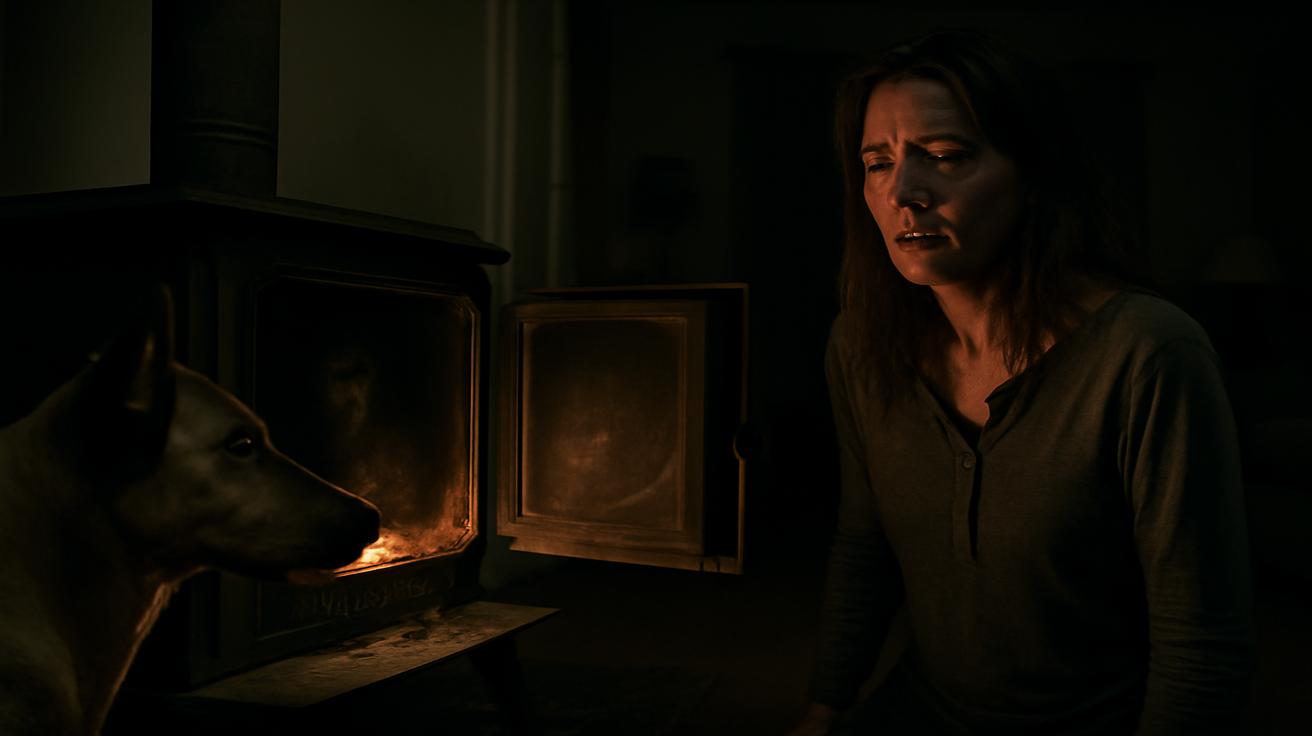
The night it happened, the snow had the last word. It hushed the fields, blotted out the road, and turned the old farmhouse into an island of creaks and lamplight. I remember the dry hiss of the wood stove, the way the heat rolled through the room in slow, generous waves, and my dog, Willow, stretched on the rug like a fallen log. There was nothing to fear, I told myself. Just the storm, the stove, the deep, animal quiet of winter. Then Willow lifted her head and began to stare at the iron door of the stove as if it had whispered her name.
The Dog Who Wouldn’t Look Away
At first, I thought she was tracking an ember’s glow or some imagined flicker. The cast‑iron door reflected the fire in a dull, reddish smear, and sometimes Willow would watch it the way you’d watch a campfire—idly, dreamily. But this felt different. Her body went still, the kind of still that erases every soft, silly thing about a dog and leaves only the wolf underneath.
I sat cross‑legged on the couch, mug cupped in both hands, steam curling into the lamplight. The storm grumbled against the windows. Willow didn’t blink. It was like something inside the stove had suddenly become more interesting than the promise of sleep or the leftover roast chicken cooling on the counter.
“What are you doing, bug?” I asked her.
Her only answer was a small, pinched whine deep in her throat, almost swallowed back as quickly as it came. Her ears lifted. Nose quivering. Every inch of her attuned to that squat, red‑bellied beast in the corner of the room.
I knew my dog well enough to know her catalog of stares: the hopeful stare at the pantry; the wistful stare at the door; the sharp, electric stare at a squirrel skittering across the yard. This was none of those. This was the stare of a creature that has just felt the world tilt an inch to the left and is trying to decide whether to run or stay perfectly, perfectly still.
When the Ordinary Turns Strange
The wood stove had been my winter companion for three years, and I trusted it the way you trust worn slippers and old friends. It clicked and ticked as metal does when it expands in heat, but those sounds were the background music of my Januarys. I could tell from three rooms away when a log had settled or when the fire was sighing down to coals.
That night, though, the sounds changed. Beneath the familiar crackle, there was a muffled scuffle—something soft, something alive, something not quite belonging.
“Probably a bird,” I muttered, to myself as much as to Willow. The word felt flimsy in my mouth.
Willow shifted her weight forward, toes spread, nails clicking lightly on the worn oak boards. Her entire body seemed to say: no, not a bird.
The air in the room thickened. I turned down the lamp until the light dropped to a warmer, softer pool. The rest of the house receded into shadow. The stove’s orange glow licked through the small glass window in the door, throwing darting reflections across Willow’s eyes. Her breathing went shallow.
Outside, the snow hit the roof in wet, sliding thumps. Somewhere in the walls, the baseboard pipes sighed as hot water made its slow circuit. The house was full of sounds I knew, but threaded through them was a new rhythm—a hushed shuffling, then stillness, then the smallest scritch of something on metal.
Willow’s gaze did not waver. It burned a straight, invisible line between her and the stove door.
Chimney Whispers and Quiet Footsteps
The first time I heard a noise in that chimney, it was August. A raccoon had tried to set up an apartment midway down, and the flue had turned into a summer echo chamber for midnight rasps and little complaining growls. I’d called a chimney sweep who’d removed a nest and installed a cap, promising no more “drop‑in visitors.”
Snow ticked against the window like fingers. I set my mug down on the coffee table, the ceramic clink too loud in the expectant room. The sounds inside the stove hushed, as if whatever was in there had also heard it.
“Okay,” I whispered, for no one’s benefit.
I eased myself off the couch and the floorboards responded with their usual groans, each one a confession of age. Willow didn’t take her eyes off the stove, but her gaze flickered briefly to me, asking, Do you see this too?
I did.
The fire inside had quieted, more glow than flame now, a bed of coals pulsing gently like the heartbeat of some large, slumbering animal. But behind that, in the dark guts of the stove, there was movement. Subtle, but there.
Something thumped delicately against the inside of the metal belly. Not falling ash. Not shifting logs.
My mind did a quick parade of possibilities. Squirrel. Bird. Bat. A trapped, soot‑dusted something that had lost its grip on the chimney walls and slid in a slow, panicked tumble, landing on the stove’s upper chambers where the flue curled down.
Willow’s back tensed, her fur lifting in a faint ridge. She took one measured step closer, nose outstretched, nostrils flaring.
The smell reached me next. Not the sweet, familiar perfume of seasoned oak and birch, but a new edge: wild, sharp, musky. A smell that spoke of nests and hunger and dark places. The smell of an intruder.
“You’ve got to be kidding me,” I breathed. The chimney cap. The sweep. All the assurances. And yet here we were—me, my dog, and the uneasy certainty that something had slipped in past everything I thought was secure, descending into the warm heart of my home.
The Moment of Realisation
Some truths don’t arrive as words. They arrive as goosebumps. As the way a room seems to shrink. As the thin, insistent thread of your dog’s stare.
I crouched beside Willow, placing a hand on her shoulder. Her muscles vibrated under my fingers like a plucked string. Her eyes never left the stove.
“There’s something in there, isn’t there?” I said, because saying it out loud anchored it in the world.
Right on cue, as though to answer, there came a sound: a distinct, frantic scrabble on metal, a muffled thud, then stillness again. Too heavy for a bird. Too persistent for a stray clump of soot. The weight of it moved, thumped, regrouped.
The wood stove, once a simple machine in my mind, rearranged itself into a map of thin walls and hidden chambers. I saw, in my mind’s eye, the bend in the stovepipe where it joined the chimney; the dark throat leading up, up, to the cap; the pockets and shelves where flue gases curled and cooled. Somewhere in there, a wild thing was pacing invisible circles.
There is a particular discomfort in knowing something is in your house, yet you cannot see it. A mouse beneath the floorboards. A wasp in the ceiling. A rustle in the attic at 2 a.m. But this felt more intimate, more invasive. The intruder hadn’t tiptoed across a threshold or nosed open a weak screen. It had descended from above, slipping down the spine of the house, guided by the scent of heat and the promise of shelter.
Willow licked her lips in a quick, nervous dart of tongue. It was not excitement. It was worry.
“Okay,” I told her, trying to convince myself. “We’re going to figure this out.”
Negotiating with Fire and Fur
The first rule, I knew, was simple: don’t open the stove door. The idea of unleashing a panicked animal into my small living room, while live embers glowed inches away, was enough to stall my hand on the latch. Between Willow’s instincts and its fear, the room could turn into a chaos of hot ash and teeth in seconds.
I dialed the fire down, closing the air intake until the hungry roar softened into a dampened glow. The room cooled almost immediately, edges of shadow creeping closer, the corners of the ceiling dissolving into darkness.
Willow inched forward until her nose was nearly touching the cast iron. She inhaled in short, investigative sniffs, the kind she reserved for fresh animal tracks in snow.
“Back up, love,” I murmured, lightly touching her collar.
She retreated a reluctant half step, gaze unwavering. The house, moments ago a refuge of flannel and lamplight, seemed to lean in on us. The refrigerator’s distant hum faded beneath the bass note of our shared attention.
I grabbed my phone from the table, the screen’s cold glow jarring against the old‑fashioned quiet of wood and storm. My thumb hovered between the chimney sweep’s number and the local wildlife control. Midnight services, I suspected, would not come cheap.
Before I could decide, a new sound knifed through the room: a quick, frantic burst of claw on metal, followed by a light, hollow knocking, as if something had slammed into one of the stove’s inner walls.
Willow let out a sharp bark. It startled both of us. The sound bounced off the windows and rushed back, too loud, too raw in the small space.
In the urgent silence that followed, I heard it—a faint, chittering growl, so soft I wasn’t sure if I’d imagined it. It came from the very heart of the stove, wrapped in heat and trapped beneath the weight of cast iron and soot.
Not a bird, then. Not a bat.
The word arrived clear and unwelcome: raccoon.
A Map of Warnings
Memory offered up an image of raccoon tracks I’d seen out by the compost heap days before the storm. Soft, hand‑like prints with long fingers. Clever creatures, the chimney sweep had said in August. Tenacious. Good climbers. Curious.
Curious was one word. Opportunistic, another. Intruder, now, seemed the only one that fit.
The wood stove’s outer shell was hot but not searing. I pressed the back of my fingers lightly against it, feeling the trapped heat radiate into my skin. Somewhere behind that metal, an animal was pressed into narrow blackness, breathing in thin, sooty air it wasn’t built for.
I thought of all the ways we draw lines between wild and domestic, between outside and in. Fences. Locks. Caps on chimneys. We tell ourselves that home is the place where we control what enters and what leaves, where we are the apex of our small ecosystem.
But the truth is, the wild doesn’t end at the treeline. It finds the cracks. It follows warmth and scent and opportunity down chimneys and under porches and into basements. Tonight, it had ridden the cold air down the flue and landed squarely in the core of my carefully tended winter comfort.
Willow’s eyes flicked to me again, urgent, asking: What now?
I pulled up a browser on my phone, fingers clumsy, and searched for what you’re supposed to do when a raccoon falls into your chimney. The advice was a patchwork of caution and compromise: don’t startle it, don’t open doors it can rush through, give it an escape route if possible, call a professional if you can.
One sentence lodged in my mind: If the animal has dropped into the stove itself, extraction becomes more complex and risky.
I laughed—one short, incredulous huff of air. “Of course it has,” I said.
Drawing Lines Between Fear and Care
There are two kinds of fear: the kind that wants to destroy what scares you, and the kind that wants to understand it. I felt them both tugging at me as I stood in the half‑dark with my hand on my dog’s collar and an unseen, frightened animal gasping behind iron.
“We’re not going to hurt it,” I told Willow, and, in a way, myself. “We’re just not going to let it hurt us either.”
I turned off the lamp, plunging the room into a softer, stranger twilight. The stove’s glow pulsed brighter in the absence of other light, painting Willow’s fur in reddish gold. Shadows pooled along the baseboards. The house felt older, more primal, stripped back to fire and breath and the distant howl of snow.
The plan came together in slow, cautious steps. First, extinguish the fire as much as possible without sending smoke back into the room. Then, open the stove just enough to assess, with a barrier in place, and only if it was truly necessary. But before any of that, I needed to buy myself time—and silence.
I coaxed Willow into the bedroom with a fistful of treats and an apologetic scratch behind her ears. She went, hesitant, looking over her shoulder with every step. I closed the door gently, the barrier feeling woefully thin against her loyalty and the wild confusion inside the stove.
Back in the living room, the air felt heavier without her. The stove ticked again. Another soft, restless scrabble answered it from within.
I wrapped a thick towel around my hand and adjusted the damper, tightening its valve until the flames surrendered completely, leaving only a sleepy, red shimmer across the coals. The temperature dropped by degrees you could feel in your bones, the kind of chill that makes you suddenly aware of your own breath.
In the quiet that followed, the intruder shifted again. The sound was smaller now; either exhaustion or calculation was setting in. I leaned down until my ear was near the door, careful of the lingering heat. A faint, rhythmic panting met me. The sound of a body worn thin by fear and fumes.
Something in me softened at that. I hadn’t asked this animal to come here. It hadn’t asked for a chimney masquerading as a hollow tree. We’d simply collided, two lives interrupting each other on a winter night.
The questions in my head—how did it get past the cap, how will I ever use this stove again without wondering what might be inside—fell away, replaced by one simple directive: Get it out. Alive, if possible. Safely, if at all.
The Night’s Quiet Verdict
In the end, I called for help. The wildlife control operator’s voice on the other end of the line was thick with sleep but steady, threaded with stories of animals and chimneys and all the ways winter tests our shared boundaries.
He talked me through what not to do, first—no sudden openings, no attempts to “smoke it out,” no reaching in with improvised hooks or courage. Then he walked me through what would happen when he arrived: the tools, the careful sequencing, the ways in which experience can turn chaos into choreography.
As I waited, time sagged. The storm leaned harder against the house, wind scooping snow off the fields and slamming it against the old wood like handfuls of cold sand. I sat on the floor a few feet from the stove, back to the couch, watching the last embers dim.
Willow whined softly from behind the bedroom door. Her nails tapped a faint, anxious rhythm. The raccoon—or whatever exactly it was—shifted less now, its movements small and tired.
I found myself whispering into the quiet, not entirely sure who I was speaking to.
“You picked the wrong house,” I said, not unkindly. “But we’ll get you out. Then we’ll both go back where we belong.”
Belonging, I thought, was a funny idea. The raccoon belonged in the woods, yet the woods now crept into our walls as deer and coyotes edged closer each year, fields giving way to houses, habitats tilting. I belonged inside my home, yet here I was, sharing its literal heart with a stranger who had fallen down a chimney in search of warmth.
When the truck finally pulled up—headlights carving tunnels through the snow—I felt something release in my chest. Footsteps on the porch. A knock. The sweep of cold air as the door opened and the man stepped inside, bringing with him the scent of wet wool and diesel and outside.
His tools gleamed dull and practical in the low light. He listened to the story, nodding. He listened to the faint sounds inside the stove, nodding again. He knelt, gloved fingers reading the temperature of the metal. He moved with the quiet confidence of someone who had stood between wild and tame many times before.
There is no grand climax to what happened next. No dramatic burst of fur and teeth. No cinematic showdown between dog and raccoon. Just patience, and practiced hands, and the slow, careful opening of doors.
A canvas trap, a controlled gap, the right angles of light and dark. A small, masked face, eyes bright with fear, emerging from the stove’s inner shadow like a figure from an ancient story. The quick, efficient capture: a soft thump, the zipper of the carrier, the rustle of movement within.
It watched us through the mesh with a gaze not unlike Willow’s—sharp, appraising, unwilling to forget. Its fur was dusted with soot, ringed tail coiled close around its body. An intruder, yes, but also something more ordinary and more profound: a neighbor whose map had overlapped mine for a brief, unwanted moment.
When the door closed behind the wildlife officer and his charge, the house felt strangely hollow. The stove, now cold, sat squat and mute in the corner. The storm began to tire, its tantrums softening into a steady white noise.
I opened the bedroom door and Willow barreled out, nose immediately seeking the trail. She circled the stove, sniffing every inch, tail wagging in quick, uncertain arcs. Then, satisfied or perhaps simply exhausted, she flopped down on the rug again, letting out a long, theatrical sigh.
“Good job,” I told her, settling beside her on the floor, hand buried in her fur. “You saw it first.”
She blinked at me, eyes already drifting closed, her duty for the night discharged.
What the Chimney Taught Me
Days later, with the storm only a memory and the stove once again humming with safe, familiar heat, I kept glancing at it with new awareness. The chimney sweep returned, inspecting every inch, finding the gap where time and weather had conspired to loosen protection. A new cap, sturdier and better‑fitted, went up. Another line drawn between in and out.
But the boundary didn’t feel as absolute anymore. I understood now that my house wasn’t a sealed container, but a living node in a wider network of burrows and branches and hollow logs. Warmth leaks out; scents drift up; creatures follow invisible trails traced by hunger and cold and curiosity.
Willow, for her part, added the stove to her list of Things That Must Be Watched. On some nights, she still pauses before it, giving it a brief, searching look, as if checking for hidden hearts beating inside. I watch her, thinking of all the times animals have sensed earthquakes, storms, changes we can’t yet measure.
We like to think we’re the ones guarding our homes, but often it’s our animals who stand at the thresholds—ears pricked, eyes narrowed, reading the world for us. Willow’s stare that night pulled my attention away from my book, my mug, my human assumption that everything inside these four walls was predictable.
The chimney episode left me with a new kind of vigilance, yes—chimney caps checked, flues inspected, emergency numbers saved. But it also left me with something gentler: a sharpened sense of companionship with the wild that presses its nose against our windows in winter and slips under our fences in summer.
That raccoon and I shared a dangerous, unwanted intimacy for a few hours. We breathed the same heated air, felt the same enclosing walls. Neither of us chose it. Both of us survived it because, in the end, we respected the frailty on both sides of the stove door.
Sometimes, when the wind is right and the night especially still, I stand outside and look up at the line of my chimney against the sky. Somewhere beyond the tree line, another masked face is nosing through leaf litter, following the scent of distant smoke. Maybe it remembers, in its own animal way, the sudden fall, the hot cage, the strange humans who opened a path back to the cold world it understands.
And inside, Willow sleeps by the fire, one eye half‑open, ready to tell me when the boundaries blur again.
Signs Your Pet Might Be Alerting You to a Hidden Intruder
That night pivoted on Willow’s stare. Our animals often notice what we miss. Here are some of the ways a pet’s behavior can signal that something unseen has slipped into your shared space:
| Pet Behavior | What It Might Mean | What You Can Do |
|---|---|---|
| Fixed stare at walls, vents, or stoves | They hear or smell movement in hidden spaces | Pause, listen closely, and investigate calmly |
| Sudden tension or raised hackles in a specific room | Perceived threat or unfamiliar scent | Remove your pet, check the area, and secure exits |
| Whining or pacing near chimneys, attics, or crawlspaces | Wildlife or pests may have entered structural spaces | Call a professional if repeated; avoid DIY in risky areas |
| Refusal to relax in a once‑favorite spot | New noises, drafts, or animal scents | Inspect for gaps, nests, or structural changes |
| Alert barking at “nothing” indoors | Subtle sounds in pipes, ducts, or chimneys | Stay patient, listen, and note patterns before reacting |
FAQs
What should I do if I think an animal is inside my wood stove or chimney?
First, stay calm and keep pets and children away from the area. Avoid opening the stove door or fireplace damper, since a frightened animal can bolt into your living space. If a fire is burning, begin damping it down gradually. Then contact a licensed chimney professional or wildlife control service who has experience with chimney extractions.
Is it safe to try to remove the animal myself?
It’s generally not safe. Animals trapped in chimneys or stoves are usually scared and may bite or scratch. There’s also the risk of smoke inhalation, falling debris, or damaging your chimney system. Professionals use specific tools and techniques to contain and remove the animal while minimizing stress and injury on both sides.
How can I prevent animals from entering my chimney?
The most effective step is installing a properly fitted chimney cap with secure screening designed to keep out wildlife while allowing smoke to escape. Regular chimney inspections and maintenance help catch damage or gaps early. Also, avoid leaving animal‑attracting food sources like open compost or unsecured trash close to the house, which can draw curious visitors.
Why did my dog notice the intruder before I did?
Dogs and many other animals have far more sensitive hearing and smell than humans. They can detect faint scratching, subtle shifts in air currents, and unfamiliar scents long before we register anything unusual. When a pet fixates on a spot, changes their normal behavior, or seems anxious in a specific area, it can be an early warning that something has changed in your environment.
Can I still safely use my wood stove after an incident like this?
Yes, but only after a thorough inspection. Have a certified chimney sweep examine the flue, stove, and any connecting pipes for damage, blockages, or leftover nesting material. Once the system is cleaned, repaired if needed, and properly capped, you can return to using your stove with greater peace of mind—and perhaps a bit more appreciation for the quiet sentinels sleeping on your hearth.






Leave a Comment