
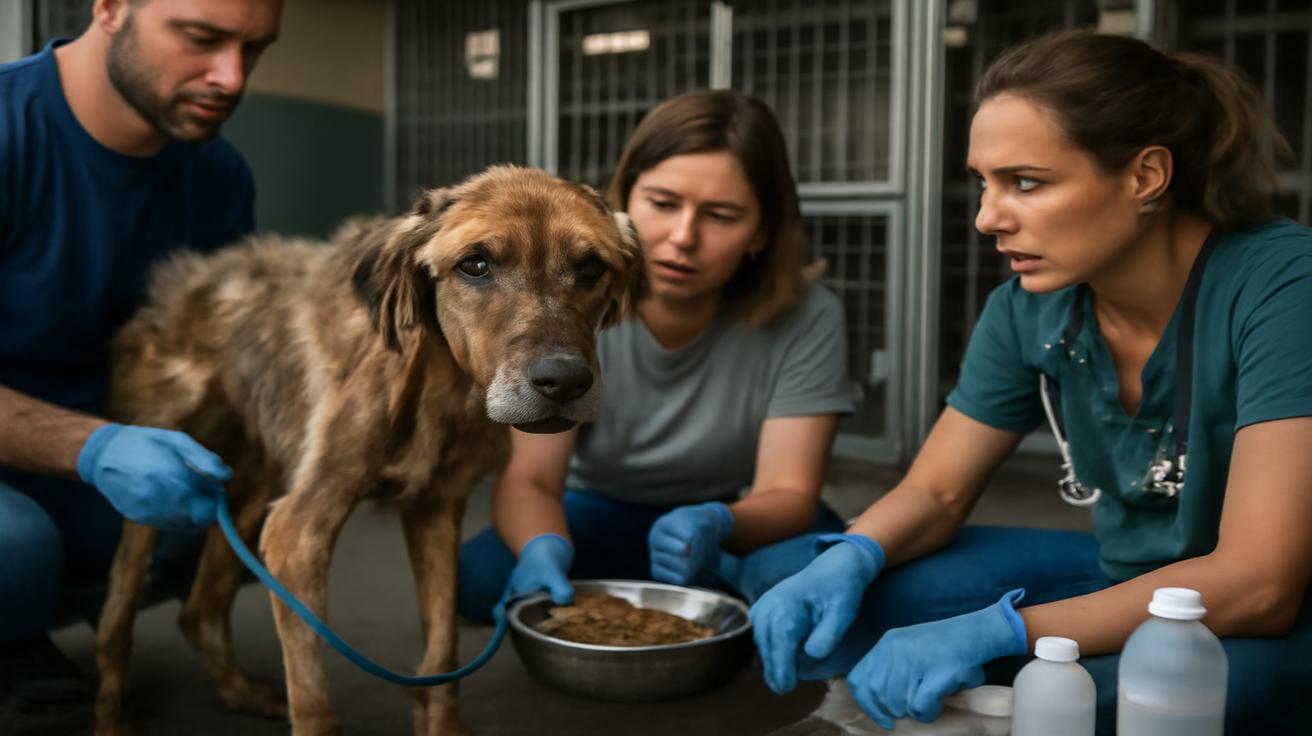
The dog came back on a rainy Tuesday, carried in like a bundle of old laundry. The lobby smelled of wet coats and disinfectant, and the usual hum of conversation dimmed as soon as the volunteers saw him. His name, according to the intake file, was Murphy—brown and white, mixed breed, about six years old. But the dog on the stretcher looked more like a ghost. Ribs showing. Patches of raw, angry skin. Eyes dulled to a flat, distant amber that had seen too much, too fast. Someone whispered, “Is that really Murphy?” and the room seemed to hold its breath.
When a Familiar Dog Comes Back
Murphy had once left this same shelter with a red nylon collar, a bag of food, and a family who had promised photos and holiday cards. The staff remembered the day vividly. He had pressed his nose into every hand, tail wagging in wild, lopsided circles. Adoption days are like that: a line of goodbyes and small heartbreaks tinged with deep hope. Murphy’s sendoff had felt particularly right. A house with a yard. Two older kids. A man who had knelt on the lobby floor and said, “You’re home now, buddy,” into Murphy’s fur.
Now, months later, it was a different man who carried him in—face turned away, jaw locked. A quick signature on a surrender form. A muttered story about allergies, about “not working out,” about “problems.” Volunteers have heard versions of this script a hundred times. They know when there are missing chapters. Still, the staff said thank you, took the leash, did not raise their voices. The important thing was that Murphy was back, and back in time.
Up close, he smelled of yeast and stress and something metallic, like coins left too long in a pocket. The soft fur on his ears was gone, replaced by cracked, flaking skin. His paws were swollen, and the pads were rough as sandpaper. A scar, new and jagged, ran along his right hind leg. When the vet tech lifted his chin gently, he did not pull away—but he also did not lean in. He hovered in that strange middle ground: too tired to resist, too unsure to trust.
The Quiet Assessments and Unspoken Promises
The shelter’s exam room is small—a metal table, a computer, drawers full of bandages and bottles with names that sound like spells. But on days like this, it becomes a kind of triage chapel. Someone closed the door softly behind them. Rain tapped against the high, frosted window. The fluorescent lights hummed; Murphy’s breathing came in short, shallow puffs.
Dr. Liao, the shelter veterinarian, moved with a practiced calm. Her hands were gentle but efficient, fingers tracing over bones, joints, and scars with a musician’s precision. Heart rate: fast. Temperature: slightly elevated. Weight: far too low. She spoke softly, but not in baby talk—just a steady stream of explanation, for the volunteers’ sake as much as for her own.
“He’s dehydrated. Look at this skin turgor. Severe dermatitis. Possible untreated allergies. I’m seeing pressure sores here and here. We’ll need blood work, parasite checks, full panel. He’s going to hurt for a while.”
Murphy stood as still as a statue during the exam. When the needle went into his foreleg for the blood draw, he only flinched once, then stared past them all at the wall. That vacant gaze hurt more than any of the physical wounds. A healthy dog reacts—licks a hand, pulls away, complains. This was a dog who had learned there was no point in trying.
Outside, in the lobby, a thunderstorm rolled over the city, low and rumbling. Inside, the volunteers exchanged looks—the quick, silent kind that carry whole conversations. You could see the question in each pair of eyes: How do we fix this? And beneath that, the promise that anchors them all to this hard work: We will.
Building a Plan, One Small Step at a Time
Rehabilitation, the slow stitching-together of a broken dog, rarely looks like the dramatic montage people imagine. There are no instant transformations, no neat 30-second clips of “before” and “after.” Instead, it is built out of small, consistent acts—measured meals, quiet walks, steady hands that do not flinch. For Murphy, the plan started that very afternoon, written on a whiteboard with blue marker, smudged at the edges.
| Focus Area | Goal | Key Actions |
|---|---|---|
| Physical Health | Restore weight, heal skin, manage pain | Gradual feeding schedule, medications, medicated baths, regular vet checks |
| Emotional Safety | Rebuild trust and reduce fear | Consistent caregivers, calm environment, gentle handling, predictable routines |
| Behavior & Training | Teach coping skills and basic cues | Positive reinforcement, short sessions, no punishment, enrichment games |
| Socialization | Reintroduce safe contact with people and dogs | One-on-one visits, controlled meet-and-greets, reading body language |
It’s not a flashy plan. There are no heroic gestures written on that board. Just the quiet discipline of care, spread out across days and weeks. Volunteers signed up for shifts—morning feeding, afternoon walks, evening enrichment. Someone drew a small brown-and-white dog in the corner of the board with a lopsided smile. Underneath it, in block letters, one of the teens wrote: “MURPHY IS WORTH IT.”
The First Nights: Silence, Shadows, and Small Miracles
The shelter after hours is a different world. The bustle of adopters is gone, replaced by the steady chorus of kennels settling in: the rhythmic thump of tails, occasional barks that echo down the concrete halls, the soft rustle of blankets being turned in circles before sleep. The overhead lights dim, leaving pools of gentle yellow near the doors. It smells like bleach, kibble, and the faint sweetness of the peanut butter used to hide pills.
Murphy’s first night back, he lay at the far end of his kennel, facing the wall, as if the rest of the world had nothing left to offer him. The volunteers had layered his space with thick blankets, a memory-foam pad donated by a local pet store, and a single stuffed toy: a floppy, gray rabbit with one ear already chewed by some dog long ago. He ignored them all.
It was Elena, a volunteer with quiet eyes and callused hands, who pulled up a folding chair outside his kennel. She didn’t talk at first. Didn’t coax, didn’t coo his name. She just sat there, feet planted, hands folded loosely in her lap. Her phone stayed in her pocket. She listened to his breathing, to the soft scratch of his claws when he shifted. After twenty minutes, she began to read out loud, her voice low and steady—an old paperback she’d grabbed from the “Free Books” bin by the bus stop.
Murphy did not move. But the muscles in his shoulders loosened, fraction by fraction. When the thunder rolled again outside, he flinched, then stilled, then listened to the rhythm of Elena’s voice. It wasn’t a story about dogs or miracles or second chances. It was some mystery novel about a small town and a long-buried secret. It didn’t matter. What he was learning, slowly, was that the voice didn’t change. It did not yell. It did not snap. It didn’t disappear when he braced for it to turn sharp. It just carried on, offering sound instead of silence, company instead of absence.
By the third night, he had shifted a few inches closer to the front of the kennel. His head stayed low, but his nose pointed toward the sound. Elena leaned back in her chair, watching the small rise and fall of his ribcage, and allowed herself the smallest hint of relief. Healing in a shelter often starts this way: with movement barely noticeable, a dog choosing to be one step closer than before.
The Slow Art of Trust
In the weeks that followed, Murphy’s rehabilitation became a kind of collective art project—brushstrokes of kindness layered over the rough canvas of his past. No one knew exactly what he had been through, but his body told part of the story, and his behavior filled in the rest.
He startled at fast hand movements. Froze at the sound of a metal bowl scraping against the floor. Flinched when someone dropped a mop bucket. He guarded his food bowl with a low, warning growl—not lunging, but hunched over it, shoulders bunched, eyes wary. He seemed torn between hunger and fear, shivering slightly as he ate, as if expecting the meal to vanish mid-bite.
The volunteers took notes, conferred with Dr. Liao and a behaviorist named Jonas, and shifted the plan. Slow, they reminded each other. Slower than that. For the food guarding, they started a simple protocol. A volunteer would sit several feet away while Murphy ate, back turned slightly, body language soft and curved. No staring. No reaching in. Just proximity. Over days, that distance narrowed. They began tossing a small, tastier treat—chicken, a bit of cheese—into his bowl as they walked past, pairing the presence of a person with something good instead of bad.
For his fear of noises, they adjusted the environment. A white-noise machine near his kennel to soften the sharp edges of clanging doors and barking. Quiet hours where only a couple of volunteers were allowed in the wing, moving slowly, speaking in low tones. When the storm forecast showed thunder on the way, someone always made sure he had a visitor for those hours—Elena reading, or Jonas doing gentle, short training sessions that mostly involved tossing treats and saying, “Good boy,” in a tone that never wavered.
Trust, in Murphy’s world, began to look like this: a tail that flicked once, almost involuntarily, when a familiar volunteer approached. A head that lifted when someone said his name. A body that no longer pressed itself into the farthest corner of the kennel, but hovered closer to the front, as if maybe, just maybe, the world beyond the bars held something worth walking toward.
Relearning Joy, One Walk at a Time
The first time Murphy stepped outside the shelter yard, the air was cold enough to turn every exhale into a small cloud. The sky was a pale, washed-out blue, and the parking lot glistened with the remnants of last night’s rain. He hesitated at the doorway, nails tapping lightly on the concrete, nostrils flaring at the flood of scents: damp earth, exhaust, the fading trace of another dog’s passing.
“Easy, buddy,” murmured Jonas, holding the leash with loose, relaxed fingers. No tugging. Just an invitation.
Murphy’s paws touched the grass like he was stepping onto thin ice. Each step was a question. His spine stayed stiff, tail low but no longer tucked painfully tight. They didn’t go far that first day—just a slow loop around the building, pausing when a car door slammed, when a truck rolled by, when the wind rattled the bare branches overhead. Every time he glanced back at Jonas, the man met his eyes briefly and then looked away, offering the reassurance of attention without the pressure of a stare.
As his strength returned, their walks lengthened. The volunteers rotated, each bringing their own presence to his world. One of the teens, Maya, liked to walk him early in the morning, when the neighborhood was barely awake. The streets were lined with frost, and the smell of woodsmoke drifted from chimneys. One day, a flock of pigeons took off suddenly from a telephone wire, their wings beating the air into a muffled roar. Murphy froze, then pivoted, eyes wide.
“You’re okay,” Maya said, standing still, giving him the slack he needed to look, to process. The moment stretched. Then, to her surprise, he did something entirely new: he sniffed the ground, shook out his fur, and resumed walking. Not fast. Not with the careless bounce of a carefree dog. But forward, choosing movement over shutdown.
These micro-choices were cause for celebration inside the shelter. They went on Murphy’s progress chart like trophies. “Walked past loud truck—no meltdown.” “Took treat while thunder in distance.” “Wagged tail (small, but real!).” Every new behavior was a tile in the mosaic of his rehabilitation, built not through force, but through patience and the steady offering of better experiences.
Finding His People Again
Emotionally, the biggest shift came the day Murphy chose contact.
It was a sunny afternoon, and the play yard grass had grown long and cool. Volunteers liked to bring dogs here to feel something other than concrete under their paws. Murphy had been coming out for short sessions—mostly pacing, sniffing, glancing back at the door, as if counting the seconds until he could return to the familiarity of his kennel.
On this particular day, Elena sat on the ground, legs crossed, her back against the chain-link fence. She didn’t call him. Didn’t pat her knees or clap. She simply sat, watching a leaf turn lazy circles in the breeze, holding a small handful of treats loosely in her palm.
Murphy circled the yard, nose to the ground. He checked the perimeter, as he always did, mapping the space. Then, without fanfare, he veered toward her. Every muscle in his body looked poised for retreat, but his paws kept making quiet prints in the grass, closing the distance.
He stopped just outside arm’s reach. Elena didn’t move. A minute passed. Two. Birds chattered in the trees; a car door slammed somewhere out front. Finally, Murphy took one step closer, then another, and stretched his neck toward her hand. His nose brushed her fingers—soft, cool, hesitant. He took a treat, chewed once, then backed up a few inches, as if astonished by his own bravery.
Elena exhaled, realizing she’d been holding her breath. She let another treat rest on her palm, and this time, when he approached, she very slowly turned her hand, letting her fingers graze the side of his muzzle. A touch as gentle as a whisper. He flinched, then leaned—just a fraction of his weight—into her hand.
In that moment, hope stopped being abstract. It had weight and texture: the warm curve of his skull under her palm, the faint tremor of a dog relearning the shape of kindness.
Preparing for a Different Kind of Future
Rehabilitation is not about erasing the past. The volunteers knew that. There would always be echoes of whatever Murphy had gone through—certain sounds he might never love, sudden movements that would always trigger a flicker of old fear. The goal was not a perfect dog, but a dog who could live in the imperfect world of humans with as much ease and safety as possible.
As his body filled out, his coat began to shine again, soft patches spreading over the once-raw skin. His eyes, once flat, now followed people as they moved past his kennel, assessing, curious. He loved puzzle feeders, nosing them around with clumsy determination to free each piece of kibble. He tolerated nail trims. He accepted baths, standing stoic under the warm water, occasionally closing his eyes as if, for a moment, it felt good.
The volunteers began to talk quietly about adoption—but differently, this time. Not just any home. The right home. One with patience and a predictable routine. Adults or older kids who understood body language, who wouldn’t take a growl as a personal insult, but as communication. People willing to continue his slow, careful training and to accept that some scars are forever.
Applications came and went. Some families wanted a dog they could take to busy breweries and crowded festivals—Murphy wasn’t there yet, and might never be. Others lived in apartments with thin walls and lots of noise. The adoption coordinator, a firm but kind woman named Rosa, gently steered them toward other dogs who would thrive in that environment. Murphy’s file grew thick: medical reports, behavior assessments, progress notes, photos of him sunbathing in the yard or curiously sniffing at a new toy.
Then, one afternoon, a couple walked in with a slow, thoughtful air that matched the rhythm of his story.
The Day He Chose Again
They were an older pair: soft-spoken, wearing weathered jackets that smelled faintly of coffee and sawdust. Their last dog, Rosa learned, had passed away after a long, loved life. They weren’t in a rush to “replace” him; they were looking to “welcome” someone new, if that someone happened to be the right fit.
Rosa brought them to the viewing window near Murphy’s kennel. “He’s special,” she said, with the barest smile. “He’ll need time. But if you’re open to a slower relationship, he might be your dog.”
Murphy watched them from his bed, eyes alert but not frantic. The man, whose name was Daniel, sat on the floor outside the kennel, knees creaking softly as he lowered himself. “Hey, pal,” he said, voice gravelly but gentle. He didn’t reach for the bars. Didn’t whistle. He just sat.
After a long minute, Murphy stood. One step. Two. He approached the gate, nostrils flaring. The woman, Lila, stayed back, hands tucked into her pockets. She met his gaze with a small, genuine smile. “You look like you’ve seen some things,” she murmured, more to herself than to him.
The meet-and-greet in the visiting room was quiet and unhurried. Murphy explored, sniffing chair legs, corners, the hem of Lila’s coat, the cuff of Daniel’s jeans. When Daniel finally offered his hand, palm down, Murphy gave it a measured sniff and then, after a pause, rested his chin there—just for a heartbeat, just long enough to feel the roughness of the man’s calluses and the stillness of his presence.
Watching through the small window, Elena felt a tightness in her chest loosen. Not from relief alone, but from something deeper: the knowledge that all those nights of reading, all those careful walks, all the quiet, persistent work of many hands had brought him to this room, to this choice.
The Unseen Work Behind Every “Happy Ending”
Stories about shelter dogs often end with the adoption day photo—a big grin, a wagging tail, someone holding a “Gotcha Day!” sign. That photo will exist for Murphy, too. There will be a shot of him with a new collar, standing between Daniel and Lila, the shelter’s brick wall behind them and the parking lot stretching out toward whatever comes next.
But the real story lives inside the weeks and months that led to that moment: the smell of medicated shampoo on hands gone wrinkled from too many baths, the late-night bus rides volunteers took just to spend an hour sitting on a cold floor reading to a dog who didn’t yet know how to listen, the careful charts and plans and quiet professional consultations.
It lives in the way people chose, over and over, to show up for a dog who had been let down before. In the way they rallied—not with fanfare, but with food scales and pill organizers, with soft words and firm boundaries, with patience measured not in days, but in the number of times they were willing to say, “It’s okay, you’re safe,” and mean it.
Not every dog gets a story like Murphy’s. Not every rehabilitation ends in a perfect match. But every time a volunteer bends down to straighten a blanket, to refill a water bowl, to offer a treat with an open palm and an open heart, they are betting against the odds that kindness, repeated enough times, can rewire a life.
Murphy will carry his past with him into his new home. There will be storms that send him under tables, sudden noises that make him startle. There will also be afternoons where he naps in a patch of sun on a living-room rug, evenings where he rests his head on Daniel’s knee while Lila reads nearby. He will learn the sound of their footsteps, the pattern of their days. Eventually, he will stop bracing for things that never come.
In a small office at the shelter, his file will be closed and filed away, the whiteboard wiped clean for the next dog who arrives needing a different kind of plan, a new mosaic of care. But for the people who touched his life, Murphy will remain more than a case number. He will be a reminder of what is possible when an entire community refuses to look away from the hard parts, choosing instead to lean in—to rally, to rehabilitate, to believe that even the most battered spirits can learn, slowly and bravely, to trust again.
FAQ
How long does it usually take to rehabilitate a dog like Murphy?
There is no fixed timeline. Some dogs show progress within weeks; others need many months or even longer. Healing depends on the dog’s past experiences, current health, and the consistency of care. The focus is on steady, sustainable progress, not rushing to an artificial “finish line.”
What are the most important elements of successful rehabilitation?
Consistency, patience, and predictability are key. Dogs like Murphy need regular routines, gentle handling, positive reinforcement, and a calm environment. Medical treatment, behavioral support, and emotional safety all work together to help them recover.
Can any shelter dog with trauma be fully “fixed”?
“Fixed” isn’t the right goal. Many traumatized dogs can improve dramatically, but some may always have sensitivities or triggers. The aim is to give them tools to cope, reduce their fear, and help them live safe, comfortable lives with people who understand and respect their limits.
How can someone support dogs undergoing rehabilitation if they can’t adopt?
There are many ways to help: volunteering at a shelter, fostering, donating supplies or funds, sharing adoptable dogs’ stories, or offering skills like photography, writing, or transport. Even a few hours a month of calm companionship can make a real difference.
What should adopters know before taking in a dog with a difficult past?
Adopters should be ready for a slower relationship and willing to learn about canine body language and fear-based behavior. They need patience, a predictable routine, and a commitment to positive training methods. Most of all, they should be prepared to celebrate small victories and offer unconditional, steady care over time.



Leave a Comment