
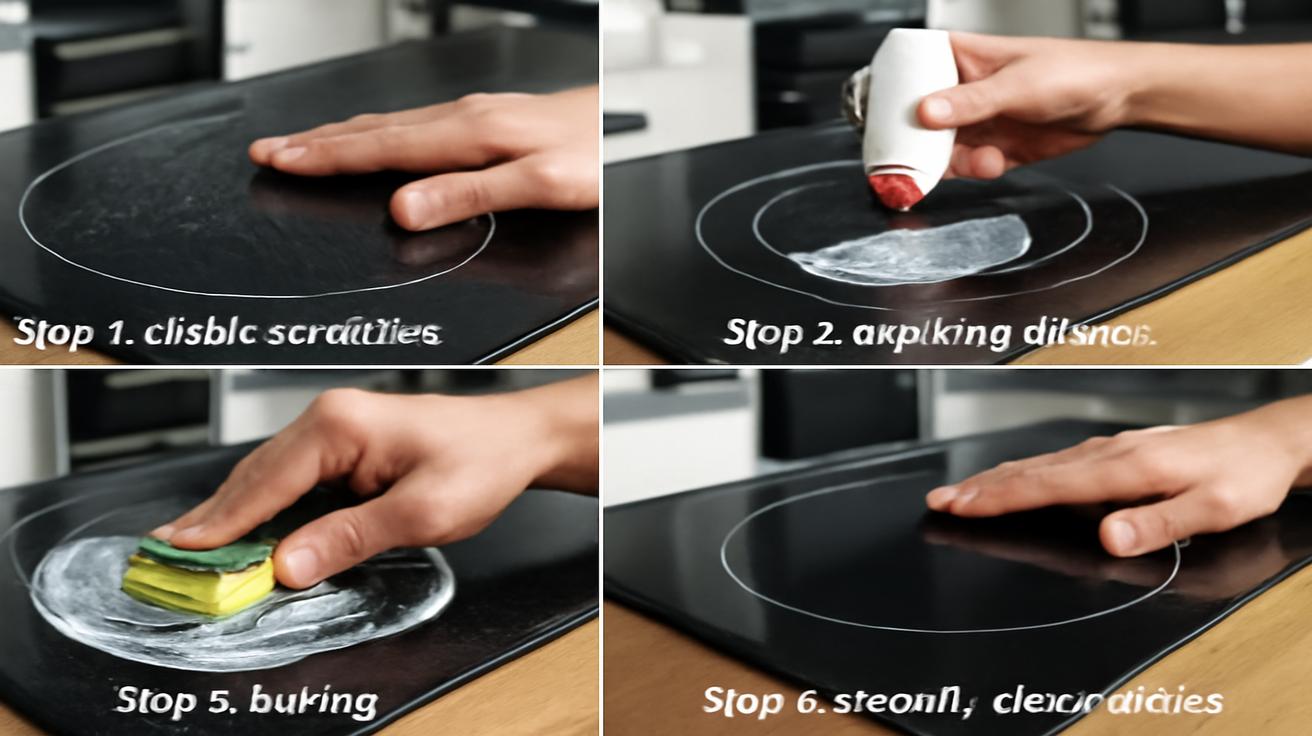
The first time you notice them, they look almost harmless. Faint, silvery arcs catching the light at a certain angle on your glass-ceramic cooktop. You tilt your head, squint, run your fingertips across the surface. A tiny resistance under the pad of your finger. Not just a smudge. Not just a streak of last night’s pasta sauce. Scratches. Real ones. Your stomach sinks a little, imagining the once-flawless black glass going cloudy and tired over the years, each meal leaving its mark like tree rings on a stump. But what if those thin scars aren’t actually the end of your cooktop’s beauty? What if most of them can be coaxed away, step by simple step, until that smooth, uninterrupted surface returns like a calm lake after the wind dies?
The Quiet Drama of a Scratched Cooktop
Glass-ceramic cooktops seem almost impossibly sleek when they’re new. They sit there like obsidian stone, reflective and pristine, humming quietly with potential heat. It’s part of why people fall in love with them: no clunky coils, no busy metal grates, just a single smooth plane where water boils and sauces simmer.
Then real life moves in. A gritty pan bottom meets the surface. A sugar spill caramelizes under a pot. Someone slides a heavy stockpot across the burner instead of lifting it. Over time, the cooktop begins to tell the story of everything that has happened on it—each scratch a chapter written in tiny white lines.
There’s a quiet drama in that moment when you first really see the damage. You bend closer. You notice how the light fractures where it once flowed uninterrupted. You imagine every guest you’ll have, every time you’ll glance over while cooking, eyes catching on that cluster of fine scratches right where you sear steaks. You can almost feel the grit that caused them, still ghost-like under your fingertips.
But here’s the reassuring truth: many of those marks are not permanent scars at all. Glass-ceramic is tougher than it looks, and the top layer can often be gently polished back to something that feels almost new. The process isn’t glamorous. It’s not a viral hack in ten seconds or less. It’s four simple steps, done with care instead of speed, that give your cooktop a second chance.
Why Scratches Happen in the First Place
Before we get to those four steps, it helps to understand the enemy. Scratches on glass-ceramic don’t usually appear from heat; they come from friction and grit. Think of your cooktop as a calm, dark pond. Anything dragged across its surface leaves a trail, especially if tiny grains of sand, sugar, or burnt debris are trapped beneath.
A pan with a rough or warped bottom can be especially cruel, grinding microscopic particles against the glass as it moves. So can a pot that was brought straight from a dusty shelf to a hot burner. And then there are those hardened spills—boiled-over jam, crusted starch, sugar that’s fused into a glossy, caramelized patch. Once they’ve cooled and hardened, they can act like little blades when you try to scrape them with the wrong tool.
Not all lines you see are true scratches, though. Some are just stubborn streaks, mineral residue from water, or half-burnt food that clings like a faint shadow. That’s actually good news. It means that, with the right attention, many marks can be reduced, or even erased entirely, with no more drama than polishing a fogged mirror.
Step One: See the Surface for What It Really Is
The first step is less about scrubbing and more about seeing. You need to meet the cooktop as it is, not as you fear it might be.
Start with a cool surface. Let it sit until there’s no warmth left; glass that feels even mildly warm can give you false readings on what’s really baked on and what’s just smeared. Turn off the overhead lights and bring in a single, strong light source—your phone’s flashlight works well. Hold it at a low angle to the glass, letting the beam skim across instead of shining straight down.
In this raking light, the surface comes alive with detail. You’ll notice differences: soft, cloudy patches that look like residue; fine white lines that catch sharply; dull gray arcs where pans have spun or been dragged. Try running a fingernail lightly over a line. If you can feel it as a tiny groove, it’s likely a real scratch. If it’s more of a smear that vanishes when wet, that’s residue waiting to be removed.
This pause, this careful inspection, is important. It keeps you from going at the cooktop blindly and doing more harm than good. It’s the moment where you stop seeing the surface as “ruined” and start seeing it as a project, a landscape that can be worked on, section by section.
Step Two: A Thorough Clean, Not a Rough One
Most people have a default response to stubborn mess: scrub harder. On glass-ceramic, brute force is the quickest way to transform small imperfections into darker, more permanent scratches. So instead of scouring, you’re going to soak, soften, and glide.
Sprinkle a thin veil of baking soda over the scratched and stained areas, like dusting flour on a dark countertop. Then drizzle or spray a little warm water to turn the powder into a soft paste. You’re not building a crust here; you’re creating a cushion. Let that mixture sit for ten to fifteen minutes. During that time, it loosens burnt-on residues and lifts fine grit away from the glass.
Now take a soft, non-abrasive cloth or a dedicated glass-ceramic cleaning pad. No rough sponges, no steel wool, no multi-surface scrub pads that feel even slightly scratchy. Use gentle, circular motions as if you’re polishing a lens. Listen to the sound. A gritty, raspy noise means there’s still debris under the cloth; pause, wipe away the paste, rinse the cloth, and start again with fresh paste if needed.
When the residues have surrendered and the paste feels smooth against the glass, wipe everything away with a damp cloth. Then take a dry microfiber cloth and buff the surface. Only after this deep clean will you really see what scratches remain and what turns out to have been nothing more than stubborn grime with good acting skills.
Step Three: The Four-Step Scratch Rescue Ritual
Once the surface is perfectly clean, the real rescue work begins. The idea here is simple: very gently polish the outermost layer of the glass-ceramic, smoothing out light scratches so they stop breaking the light. You’re not erasing grooves with brute abrasion; you’re refining them with patience.
The four steps unfold like a modest, careful ritual:
1. Isolate the傷 (the scar). Focus on one area at a time—an arc where a pan was dragged, or a cluster of hairline scratches in a busy burner zone. It’s easier to work slowly and precisely on small territories than to attack the entire cooktop at once.
2. Apply a polishing medium. A specialized glass-ceramic cooktop cleaner or cream works best here. These are designed with ultra-fine polishing agents that respect the surface while still gently wearing down high points. Place a small dab—no more than a pea-sized drop—on a soft, folded cloth and press it against the scratched region.
3. Polish in calm, consistent circles. With light to moderate pressure, start making small, overlapping circles. Don’t rush; you’re not scrubbing a pan, you’re coaxing the surface back into smoothness. Stay with the same rhythm for a couple of minutes, keeping your hand steady and your focus on that one patch of glass. Every so often, lift the cloth and peek. The goal is subtle change, not instant transformation.
4. Wipe, inspect, repeat if needed. Wipe off the polishing cream with a clean, damp cloth, then dry and inspect under angled light again. Some scratches fade almost immediately, turning from sharp white lines into softer, grayer shadows. Others may require a second or third gentle pass on another day. It’s better to under-polish several times than to overdo it in one go.
There’s a quiet pleasure in this kind of work. You’re not just cleaning; you’re restoring. The cooktop slowly begins to look less like a battlefield and more like the calm, dark surface you remember. Tiny arcs that once shouted now whisper—or vanish entirely.
| Step | What You Do | What You Notice |
|---|---|---|
| 1. Inspect | Use angled light and fingertips to locate real scratches vs. residue. | Lines that catch your nail are true scratches; smears often aren’t. |
| 2. Deep Clean | Soften residue with baking soda paste and wipe with a soft cloth. | Surface looks clearer; many “scratches” quietly disappear. |
| 3. Polish | Apply a small amount of cooktop cream and polish in slow circles. | Light scratches soften; glass feels smoother to the touch. |
| 4. Protect | Adopt gentle habits and regular care to prevent new marks. | Surface stays clearer for longer and future scratches are rarer. |
Step Four: Protecting the Newly Quiet Surface
Once you’ve done the work—softened residues, polished away the harshest lines, watched the glass darken and smooth again—there’s a subtle shift in how you relate to the cooktop. It stops being a background appliance and becomes a surface you’re protective of, the way you might be with a favorite wooden table or a cherished knife.
Protection isn’t about wrapping it in fear; it’s about small, repeatable habits:
- Lift, don’t drag. Get into the reflex of lifting pots and pans when you move them, even a few centimeters. That single habit can eliminate most of the long arc scratches that haunt glass tops.
- Check pan bottoms. Flip them over. Feel the underside. If you sense rough patches, baked-on grease, or warped metal, clean them or set them aside for other uses. A smooth base is your cooktop’s best ally.
- Wipe as you go—gently. After cooking, let the surface cool, then sweep away loose crumbs and grains with a soft cloth before any deep cleaning. It’s often the invisible grit, not the cleaning itself, that cuts fresh lines into the glass.
- Use the right tools. Keep a dedicated glass-ceramic cleaner or cream nearby and a stack of non-abrasive cloths. When sugar, syrups, or thick sauces boil over, tend to them sooner rather than later; sugars in particular can etch if left to burn.
These aren’t dramatic gestures. They’re quiet rituals that slowly shape how your kitchen ages. With them, the polished cooktop stays smoother longer, its reflection clear, its stories told in the meals you make rather than the scars you collect.
When Scratches Refuse to Disappear
Not every mark can be coaxed away. There’s a point where a scratch crosses from “surface memory” into “structural reality.” You’ll know it because, even after careful cleaning and polishing, the line still looks bright and distinct in the light, and your fingernail catches sharply as it passes over.
These deeper scratches are reminders that glass-ceramic, while strong, is not invincible. They rarely affect basic function; the burner will still heat, the pot will still boil. But they can be frustrating, like a permanent crease on a favorite book cover. In those cases, your job shifts from erasing to softening their presence and preventing more from appearing nearby.
You can still gently polish around them to reduce their visual impact, blending them into a surface that feels largely smooth. Over time, as new, lighter marks appear and are carefully buffed away, those old deeper lines become just one part of the cooktop’s subtle patina—visible, but no longer the only thing you see.
There’s a quiet acceptance in that, too. Kitchens are working spaces. No matter how carefully you move, life leaves traces. The goal isn’t to preserve a museum piece under glass; it’s to live with your tools—respecting them, maintaining them, and giving them fresh starts when you can.
The Pleasure of Restoration
Restoring a scratched glass-ceramic cooktop is really about slowing down in a place we usually rush through. Instead of flinging pots and wiping mindlessly, you pause, observe, and touch with purpose. The four simple steps—inspect, deep clean, polish, and protect—are not just maintenance tasks. They’re a small, tactile conversation with an object that sees you through late-night cooking marathons, early-morning coffee rituals, and the mess of a hundred family dinners.
You’ll feel the difference under your fingertips when it’s done—the way a carefully polished surface offers no resistance, no snag of nail on glass. You’ll see it in the way light moves across the cooktop again, reflecting pans and windows and the soft glow of your kitchen at night. And you’ll know that, for all the wear and tear a busy stove endures, scratches on glass-ceramic cooktops can often be rolled back, their stories softened into the background, in four simple, patient steps.
Next time you notice those faint, silvery arcs in the morning light, you won’t feel that little lurch in your chest. You’ll know they’re not the end of elegance, just a beginning. An invitation to a quiet ritual, a slow afternoon, and the satisfying, almost meditative work of bringing a surface back to calm.
Frequently Asked Questions
Can all scratches on a glass-ceramic cooktop be removed?
No. Light, surface-level scratches and scuff marks can often be minimized or nearly erased with gentle polishing and proper cleaning. Deep scratches, where your fingernail catches firmly, usually cannot be fully removed, but their appearance can sometimes be softened.
Is baking soda safe to use on my glass-ceramic cooktop?
Used correctly, yes. A thin, damp paste of baking soda applied with a soft cloth can help lift residue without harsh abrasion. The key is to avoid heavy pressure, rinse thoroughly, and never combine baking soda with rough scrubbers.
What kind of cloth should I use to clean and polish?
Use soft, non-abrasive cloths—microfiber is ideal. Avoid rough kitchen sponges, scrub pads, or anything that feels scratchy to your skin; if it feels harsh on your hand, it’s too harsh for the cooktop.
Can I use regular glass cleaner on a glass-ceramic cooktop?
Regular glass cleaner can help remove fingerprints and light smudges, but it’s not designed to tackle burnt-on residues or help with scratches. For deeper cleaning and polishing, use a cleaner or cream specifically made for glass-ceramic cooktops.
How often should I polish my cooktop to keep scratches away?
Polishing doesn’t need to be part of your daily routine. Reserve it for when you clearly see fine scratches or dullness, perhaps once a month or after heavy use. Daily or weekly care can simply be gentle wiping and occasional deep cleaning without abrasive effort.
Will scratches affect how well the burners work?
In most cases, light and moderate scratches do not affect performance. The heating elements will still function normally. Only severe damage, such as cracks or chips, raises concerns about safety and may require professional evaluation.
What’s the best way to prevent new scratches from forming?
Lift pans instead of sliding them, keep pan bottoms clean and smooth, wipe away gritty spills once the cooktop is cool, and use only soft cloths and appropriate cleaners. Those small habits make a big difference in keeping the surface smooth and clear over time.








Leave a Comment