
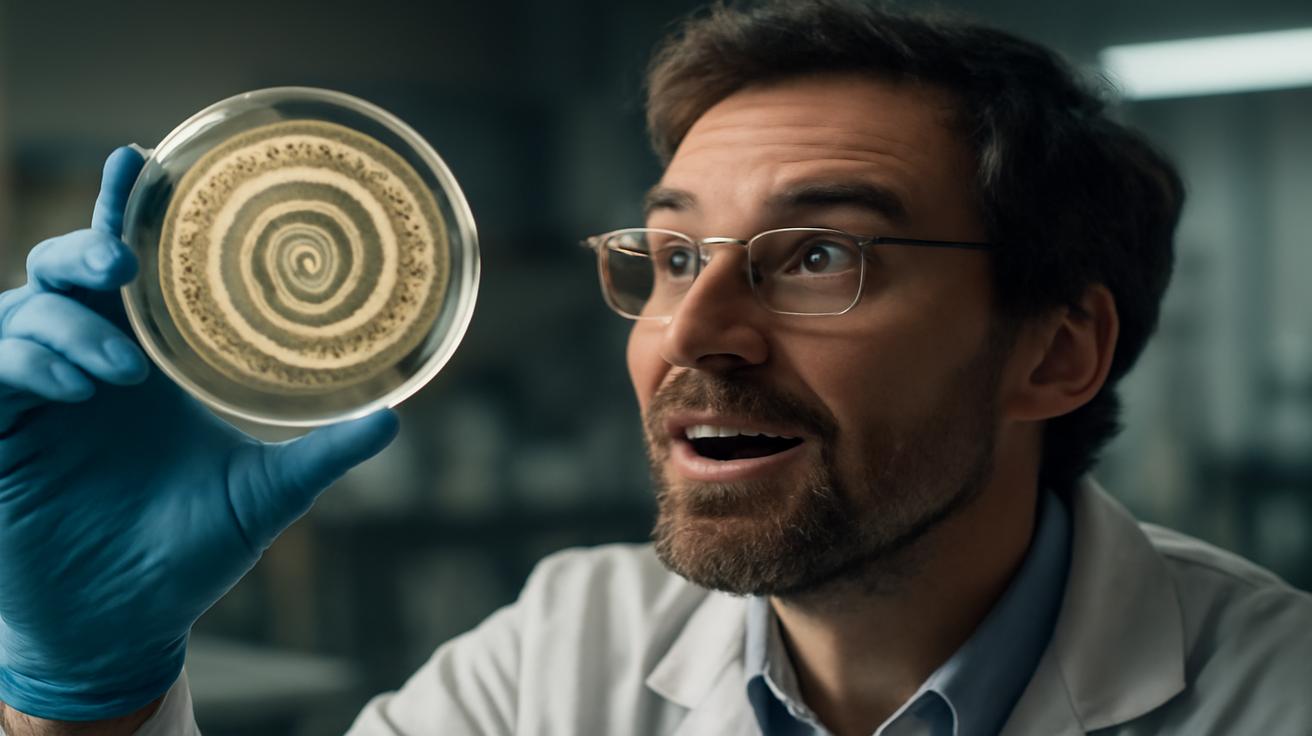
The first sign that something didn’t add up was a whisper of color in a petri dish—a faint blush in a colony of bacteria that should have behaved like a thousand others. A young researcher noticed it late one evening, the lab emptied out, the hum of incubators and the soft flicker of instrument lights her only company. She marked it down as an anomaly, a tiny glitch in an ocean of data. But that small irregularity, that almost-forgotten smear of pigment, would end up helping topple an 80-year-old assumption about how life itself is organized.
For decades, biologists have been haunted by a puzzle: why do living things—from microbes to whales—seem to follow odd, recurring patterns in size, energy use, growth, and lifespan, yet never quite line up with the tidy rules written in textbooks? Hidden inside those mismatches, scientists suspected, was some deeper order. Now, a new study claims to have found it: a biological law that cuts across species, ecosystems, and even evolutionary history, turning an old mystery into a new map of life.
The Ghost in the Data
To understand why this discovery matters, you have to go back to the 1940s, when researchers first noticed a strange regularity: bigger animals use more energy overall, but less energy per unit of body weight. A mouse, for example, burns calories like a tiny furnace, while an elephant’s cells idle along at a slower pace. Yet if you plotted their metabolic rates against their size, you didn’t get a straight line—you got a curve that kept reappearing, from insect to mammal to plant.
This pattern became known as Kleiber’s law, an equation that tried to capture how metabolism scales with body size. It was simple, elegant, and infuriatingly incomplete. It worked well—until it didn’t. Certain species fell off the line. Whole ecosystems refused to behave. Microbes laughed in its face. For eighty years, textbooks nodded to this law as “almost right,” like a skeleton missing half its bones.
Scientists tried everything to make the numbers line up. They tinkered with equations, added caveats, carved out exceptions. Some argued that the answer lay in how blood vessels branched; others claimed it was about surface area and heat loss, or evolutionary pressures, or the constraints of physics at cellular scales. But the patterns still kept fraying at the edges. Nature, it seemed, wasn’t interested in obeying anyone’s tidy math.
And yet, like a recurring melody in different songs, certain ratios and rhythms of life kept appearing: common sizes in insect communities, typical lifespan ranges, familiar shapes in growth curves. These echoes nagged at researchers. There was something there—a ghost in the data—waiting to be named.
The Law of Living Trade-Offs
The breakthrough began not with whales and elephants, but with much humbler creatures: bacteria and single-celled algae. A team of biologists, data scientists, and theoretical physicists from several institutions decided to stop asking, “How much energy does an organism use?” and instead asked, “What is that energy being traded for?”
Growth. Survival. Reproduction. Repair. Defense. Every organism, they realized, is constantly negotiating among these demands. You can’t have it all. A fast-growing bacterium might divide rapidly but die quickly. A slow-growing tree may live for centuries but invest heavily in wood and bark instead of seeds. Life, at every level, is a ledger of trade-offs.
The researchers suspected that beneath the messy surface of evolution, there might be a consistent rule governing how organisms divide their limited energy among these competing tasks. So they pulled together a colossal dataset: over 10,000 species, from ocean plankton to redwoods to finches to fungi, along with more than a million measurements of growth rate, body size, metabolism, lifespan, and reproductive output.
Then came the hard part. They fed it all into models that didn’t assume a particular answer but instead asked: if there were a single equation that balanced these trade-offs across all life, what would it look like?
Slowly, a pattern emerged—less like a sharp line, more like a woven fabric. At its core was a simple rule: for any organism, the way energy is split between growth and reproduction on one side, and maintenance and survival on the other, falls along a narrow, predictable curve. That curve changes with environment and evolutionary history, but its underlying shape appears to be constant, echoing across branches of the tree of life.
This is what the team is calling a new biological law: a universal trade-off principle that links metabolism, growth, and lifespan in a single framework. Kleiber’s venerable law, it turns out, was just one visible edge of a much larger pattern, like a single contour line on a vast topographic map.
The Night the Curves Lined Up
In the lab, the moment of clarity wasn’t a bolt of lightning. It was quieter than that. The lead data scientist, hunched over a monitor, watched as the software spit out a graph: thousands of dots—each dot a species, each species a history of adaptation—clustered not in chaos, but along a tight, swooping arc. The room was still; the only sound was the gentle rumble of the building’s ventilation.
She called in her colleagues one by one. The microbiologist came first, wiping her hands on her lab coat, still smelling faintly of agar and ethanol. Then the ecologist, phone buzzing in his pocket with messages from field assistants halfway around the world. The evolutionary theorist arrived last, skeptical as always.
They stared at the screen. If the law was real, fast-living species—mayflies, annual grasses, certain bacteria—should cluster near one part of the curve: high energy toward growth and reproduction, low investment in long-term repair. Long-lived species—elephants, giant tortoises, towering conifers—should gather at the other: pouring energy into survival, maintenance, and risk reduction, trading speed for endurance.
That’s exactly what they saw. Even stranger, outliers weren’t truly outliers. The weird cave fish that barely age; the desert shrubs that leaf out only a few days a year; the deep-sea microbes that live on geological timescales—all of them still sat near the same invisible scaffold, as if following local variations on a global rulebook.
The data began to tell a story. Life isn’t following separate rules in separate places; it’s improvising on a shared theme. The mystery of scaling and metabolism wasn’t just about size—it was about choices. Energy, finite and precious, had to be spent somewhere. The law simply revealed the hidden budget sheet.
| Life Strategy | Typical Organisms | Energy Focus | Traits Along the New Law |
|---|---|---|---|
| “Live Fast, Die Young” | Bacteria, fruit flies, annual plants | Growth & reproduction | High metabolism, rapid growth, short lifespan |
| “Slow and Steady” | Elephants, tortoises, large trees | Maintenance & survival | Lower metabolism, slow growth, long lifespan |
| “Opportunists” | Weeds, invasive species, some fish | Flexible between growth and survival | Shifting position along the curve with environment |
| “Extreme Survivors” | Deep-sea microbes, desert shrubs | Long-term maintenance under stress | Very slow metabolism, extremely long effective lifespan |
The Body’s Budget Sheet
Step back from the graphs for a moment and imagine your own body as an economy. Every bite of food you take becomes energy that must be allocated. Some of it goes to building and repairing tissues. Some goes to thinking, moving, staying warm. Some would, in our evolutionary past, have gone toward having and raising offspring. The new law suggests that across species, this accounting follows a surprisingly consistent structure, even when the numbers change.
In humans, this reframes how we think about health and aging. If there is a universal curve linking growth, reproduction, and survival, then many of the chronic diseases of modern life—cancers, metabolic disorders, degenerative conditions—may be seen as tensions within that trade-off. Are we pushing our biology toward a regime it wasn’t tuned for? Are we borrowing energy from one part of the budget and quietly going into debt somewhere else?
One practical implication the researchers are exploring is how this law could refine medical predictions. If you can measure a few key traits—growth rates in tissues, baseline metabolism, cellular repair capacity—you might be able to place an individual, or even a specific organ or cell type, on the curve. That position could help forecast resilience to stress, likely disease trajectories, or how a body might respond to certain therapies.
Yet the law also carries a humbling message: there is no free lunch in biology. Extending lifespan without changing other parts of the budget may not be possible. Boosting growth—whether in crops, livestock, or human tissue—will almost always come with hidden costs to maintenance or resilience. “You don’t escape the trade-off,” one of the authors said. “You just move along it.”
A New Lens on Ecosystems
Zoom out again—from bodies to forests, reefs, grasslands. Ecologists have long puzzled over why some ecosystems are dominated by a few large, slow-growing species, while others pulse with swarms of tiny, fast-living ones. The new biological law offers a way to quantify these differences, not just describe them.
Picture a mountain hillside. Near the base, the soil is deep and moist; towering trees rule, slow and enduring. Higher up, the soil thins, the wind picks up, and low shrubs and grasses take over. Higher still, only moss and lichens cling to rock. Each zone, the researchers found, has its own characteristic “position” along the universal trade-off curve—not at the level of individual species, but at the level of the entire community’s energy budget.
When climates shift—when drought deepens, temperatures climb, or human land use reshuffles entire landscapes—communities are forced to slide along that curve. Fast-living pioneer plants might replace long-lived trees. Opportunistic fish might crowd out slow-breeding species. Even the microscopic life in soil and ocean water shifts its strategy in ways that can now be mapped and, potentially, predicted.
This offers a powerful new tool for conservation. Instead of only counting species, we can track how whole ecosystems are moving along the trade-off spectrum, and what that means for their stability and future. It may help identify tipping points: thresholds where an ecosystem, pushed too far toward one extreme, becomes fragile and prone to collapse.
Cracks in the Exceptions
Of course, bold claims about “universal laws” tend to make scientists nervous. Biology is notorious for its exceptions—deep-sea worms with symbiotic bacteria, jellyfish that seem to loop their life cycle backwards, seeds that wait centuries to sprout. For months, the research team tried to break their own rule, hunting for organisms that stubbornly refused to fall on the curve.
They came close. Certain parasites, with life cycles braided through multiple hosts, seemed to defy the pattern. Some symbiotic systems—coral and algae, lichens, gut microbiomes—also looked strange when treated as single “organisms.” But when the team zoomed out and treated these as networks of energy exchange rather than lone individuals, a new order emerged. The pieces might not obey the curve on their own, but the system as a whole did.
That doesn’t mean the law is ironclad. Already, critics are probing its mathematical foundations, questioning whether the patterns are truly universal or just impressive coincidences shaped by shared ancestry. Others point out that humans, with our technology and culture, are systematically rewriting our own energy budgets in ways evolution never anticipated.
And yet, even these critiques underline something intriguing: in order to argue about the law, you have to take seriously the idea that there might be such a law at all. For a long time, many biologists were wary of that notion, preferring to see life as a patchwork of contingencies, accidents, and local adaptations. This new work doesn’t erase that complexity, but it suggests that the patchwork is stitched to a deeper fabric.
What It Feels Like to Name a Law of Life
Ask the researchers what the discovery felt like, and they don’t talk much about equations. They talk about texture: the texture of a rainforest canopy seen from above, where every leaf is an act of energy allocation. The sensation of wading through a tide pool, each flicker of movement a tiny gamble on growth or safety. A world that had always been teeming now appears, in some strange way, more organized.
One of the team members remembers walking home on the night they first agreed they were looking at something bigger than a clever model. It was late; the city was damp from a recent rain, streetlights reflecting in small puddles. Passing under a tree, he glanced up at its branches, thought about its rings hidden in the trunk, its careful spending on leaves each spring, its slow investment in bark and roots and fungal partnerships. He says he felt, almost physically, the weight of countless such negotiations happening every second around him.
“It wasn’t that the world suddenly made sense,” he recalls. “It was that the messiness started to feel like a pattern I could almost follow with my finger in the air.”
The Next Mysteries This Law Unlocks
Declaring a new biological law isn’t an end point; it’s a call to new questions. If there is indeed a universal trade-off curve underlying metabolism, growth, and lifespan, what sets its shape? Is it governed purely by physics—the limits of diffusion, thermodynamics, and molecular noise? Or is it an emergent property of evolution itself, the averaged result of billions of years of trial and error?
The team is already collaborating with climate scientists to plug the law into global models. If we can better predict how life will redistribute its energy under warmer, more volatile conditions, we might refine forecasts of carbon cycling, species turnover, and ecosystem resilience. Agricultural researchers are asking whether this framework can guide breeding and genetic engineering—nudging crops along the curve in smarter, less self-defeating ways.
Perhaps most tantalizing, astrobiologists have taken notice. If life elsewhere in the universe must also juggle growth, reproduction, and survival under finite energy, then something like this trade-off law might apply far beyond Earth. We don’t yet know what alien metabolisms might look like, but we do know they will pay a price for every choice. The new law gives us a theoretical compass for imagining those possibilities.
Back in that quiet lab, the irregular blush in the petri dish—the anomaly that helped start it all—has long since faded. The plates were washed, the cultures archived or discarded, the room cleaned. What remains is something both abstract and deeply tangible: an equation, yes, but also a way of seeing.
Life, from the smallest bacterium to the tallest tree, is no longer just an endless parade of differences. It is, at its core, a shared story about what you do when you can’t do everything. A story of budgets and bargains written into every heartbeat, every leaf, every cell division—a story that, after eighty years of chasing ghosts in the data, finally has a law to call its own.
Frequently Asked Questions
What exactly is this new biological law?
It’s a proposed universal rule describing how all organisms allocate limited energy among growth, reproduction, maintenance, and survival. Instead of viewing metabolism, lifespan, and growth separately, the law ties them together as parts of a single trade-off curve that appears consistent across most forms of life.
How is it different from Kleiber’s law?
Kleiber’s law focuses on how metabolic rate scales with body size, and it works best for large animals. The new law is broader: it incorporates not only metabolism and size, but also growth rate, lifespan, and reproductive output, explaining why Kleiber’s law sometimes holds and why it fails in other cases.
Does this mean there are no exceptions in biology?
No. Biology remains full of unusual cases, especially among parasites, symbiotic systems, and organisms in extreme environments. However, when studied as energy-exchanging systems rather than isolated oddities, many of these “exceptions” still roughly follow the same underlying trade-off curve.
How could this law affect human medicine?
If validated, it could help doctors better understand the balance between growth, repair, and long-term survival in our bodies. That might refine predictions about aging, disease risk, and how certain treatments shift our internal energy budgets, making medicine more personalized and preventative.
Can this law help with climate and conservation work?
Yes. By describing how organisms and ecosystems re-balance growth and survival under changing energy conditions, the law can improve models of how communities respond to climate shifts, habitat loss, and other stresses, potentially guiding more effective conservation strategies.
Is the scientific community in full agreement about this law?
Not yet. The idea is exciting and supported by large datasets, but it is still being tested, debated, and refined. Other research groups are now working to validate, challenge, or extend the proposed law in different ecosystems and with new types of data.
Could this apply to life beyond Earth?
In principle, yes. Any life form must balance energy between building, reproducing, and staying alive. While the exact numbers and mechanisms would differ, the underlying trade-offs may be universal, giving astrobiologists a framework for thinking about alien ecologies.







Leave a Comment