
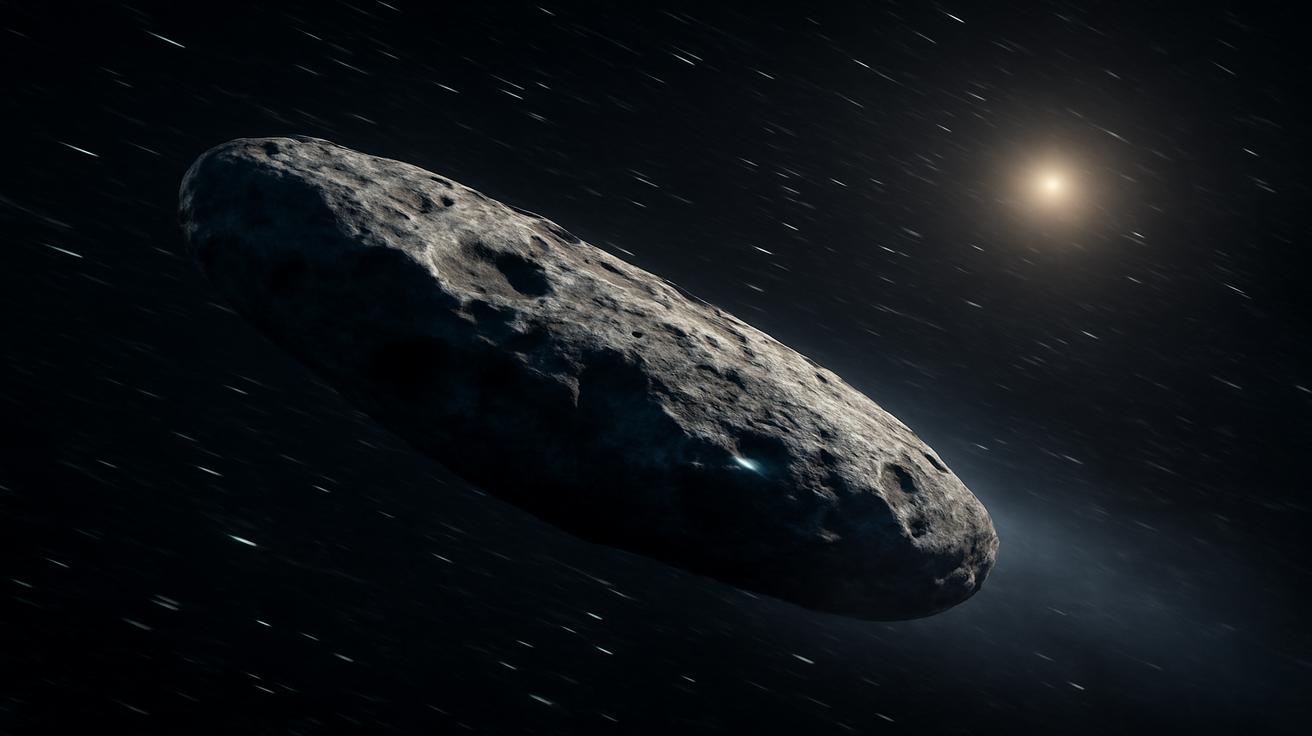
The first alert came in the middle of an ordinary Tuesday, the kind of day that slips past without leaving fingerprints. In a basement control room washed in the pale glow of monitor light, an intern at a small observatory leaned closer to his screen. Something thin and sharp and bright had just knifed across the data feed—a streak where only the slow, stately drift of stars usually lived. He frowned, zoomed in, and for a long moment, forgot to breathe.
It wasn’t moving like anything he’d ever seen before.
When the Sky Misbehaves
By the time the senior astronomer jogged into the room, coffee sloshing over the rim of her mug, the entire array was already re-aiming. On screens, the familiar points of light began to shift as software hunted for this new arrival. Outside, the actual sky over the observatory still looked calm, its darkness pinned down by indifferent stars. But beneath it, people were suddenly, electrically awake.
“Run it again,” the astronomer said, eyes narrowed.
The object appeared as a small, needle-fine smear. Then the numbers began to resolve: brightness, apparent trajectory, rate of change. The calculations came back in a rush—velocity, vector, a first crude orbit estimate. And with it, a chill twist of impossibility.
Whatever this was, it was moving far too fast to be from around here.
Within an hour, other observatories were online. Data zipped through the quiet arteries of the internet, leaping from mountaintop telescopes to urban universities to radio arrays in lonely deserts. As astronomers compared notes, a pattern emerged, clear enough to make stomachs drop.
This object was coming from deep interstellar space, from somewhere beyond the fuzzy border of our own solar system—moving at a record-breaking speed and heading, unmistakably, in our direction.
A Visitor Without a Return Ticket
The last time astronomers spoke this breathlessly about a celestial interloper was in 2017, when a cigar-shaped rock called ʻOumuamua briefly swept through our neighborhood. Two years later, a second visitor, comet 2I/Borisov, confirmed it wasn’t a fluke: things from other star systems really do wander through ours. But even those surprises came wrapped in the familiar language of orbital mechanics, their speeds high but survivable within the gravity dance of our Sun.
This new object… didn’t cooperate with familiar language.
As observations piled up, numbers that first looked like errors kept being confirmed. Its heliocentric speed—the speed relative to the Sun—wasn’t just high, it was unprecedented. This thing wasn’t drifting. It was tearing through the void.
“Imagine a cosmic stone skipping over a black lake,” one dynamicist said in a late-night briefing. “Now imagine it’s a bullet instead of a stone.”
To the naked eye, of course, there was nothing to see yet. No bright smear in the sky, no sudden guest star near the Moon. But in the data, in rows of figures and error bars and fit lines, the story was becoming clear: the object was on a hyperbolic trajectory, meaning it would never be captured by the Sun. It was merely visiting, screaming in from one side of the solar system, arcing in a long, fierce curve, and then, if it survived the trip past our star, slingshotting out into the dark again—forever.
Unlike previous visitors, though, this one was aimed not just at the general area of the inner solar system. Its calculated path was threading uncomfortably close to the invisible sphere that marks our planetary neighborhood. Close enough, perhaps, for a brief, intimate look.
Listening to a Stranger in the Dark
Before anyone could argue about what it was, the global network of telescopes had to answer a simpler question: what did it look like?
It was still distant, still little more than a blot of light on a CCD sensor. But each observatory added a new brushstroke. One recorded how its brightness changed over hours—flickering with a rhythm that might hint at its spin. Another recorded its color, in the crude, stuttering language of filtered light. Radio dishes listened for emissions. Infrared arrays hunted for warmth.
The first surprise: it wasn’t bright like a shiny rock or a glittering iceball. Its reflectivity seemed muted, more like dark charcoal than fresh snow. And yet, unlike ʻOumuamua, it didn’t show the same dramatic, puzzling changes in brightness that suggested an absurdly elongated shape. This one seemed… lumpier. More compact. Roughly, perhaps, like a misshapen asteroid only a few hundred meters across.
The second surprise came from its spectrum. As light from distant stars bounced off the object and slipped into our instruments, it carried a fingerprint—frail, noisy, but telling. There were hints of carbon-rich material, possibly ices, possibly complex organics scorched by ages in interstellar space. Some wavelengths dipped and rose in ways that didn’t perfectly match any known class of object in our own system.
“It’s like hearing a language that’s just close enough to your own to be eerie,” one astronomer said. “You recognize the grammar, but the accent is all wrong.”
Within the scattered clusters of research teams, somebody made the comparison that would echo in headlines within days: this could be the equivalent of a message in a bottle—only the message was not deliberate, and the bottle had been tumbling between stars for millions of years.
What the Numbers Whispered
Amid the poetic metaphors, the core of the discovery lived in something perfectly unromantic: a growing spreadsheet of measurements. Night after night, telescopes tracked its changing position against background stars. From those tiny shifts, refined trajectories emerged.
The object was inbound on a path steeply inclined to the plane of our solar system, like a stone thrown at a tilted angle toward a spinning plate. Its incoming speed, even accounting for the Sun’s pull, placed it decisively among the fastest natural objects ever recorded near our system. Faster than typical comets from the distant Oort Cloud. Faster than most known asteroids. Not quite relativistic, nowhere near light-speed—but on the scale of celestial mechanics, it was a race car among sedans.
Below is a simplified snapshot of how this visitor compares with other well-known travelers through our solar neighborhood:
| Object | Type | Origin | Approx. Speed Near Sun | Trajectory |
|---|---|---|---|---|
| Typical Near-Earth Asteroid | Asteroid | Inner Solar System | 20–30 km/s | Bound orbit |
| Long-Period Comet | Comet | Oort Cloud | 40–70 km/s | Highly elongated, usually bound |
| ʻOumuamua | Interstellar object | Another star system | ~87 km/s | Hyperbolic, unbound |
| 2I/Borisov | Interstellar comet | Another star system | ~60 km/s | Hyperbolic, unbound |
| New Interstellar Visitor | Unknown (asteroid/comet-like) | Another star system | Record-breaking; higher than above | Steep hyperbolic, unbound |
On mobile screens, that table compresses into a kind of quiet scoreboard—a reminder that in space, speed is story. And this story was beginning to edge from simply curious toward historically important.
Between Wonder and Worry
Whenever something “from another solar system” and “headed toward us” appears in the same sentence, a reflexive shiver runs through the public conversation. The first press releases were cautious, but social media spun ahead of them, as it always does. Were we in danger? Was this some doomsday rock? Could something moving so fast ram into Earth?
Inside the actual observatories, the mood was less apocalyptic and more mathematical. Planetary defense specialists began their own parallel modeling, this time focused less on cosmic origin stories and more on impact probabilities. Within days, the consensus was reassuring.
Yes, the object was racing inward at record interstellar speed. No, it was not on a collision course with Earth.
The same calculations that told astronomers how strange its path was also told them it would miss our planet by a wide margin—cosmically close, perhaps, but practically safe. There would be no Hollywood fireballs, no sudden new crater testifying to our encounter with alien stone. The danger boxes, so essential in the modern age of sky-watching, stayed mostly un-ticked.
Instead, a different emotion took its place: urgency.
“We are not getting a second chance,” one mission planner said. “This object doesn’t loop back. It doesn’t belong to the Sun. If we want to greet it, we have one shot while it screams through the inner system—and then it’s gone.”
That urgency ignited dormant fantasies. For years, a small but persistent faction in the space exploration community has dreamed of a rapid-response “interstellar interceptor”—a spacecraft designed to launch on short notice and chase down objects exactly like this. Concept studies had been drawn up, papers published, conferences held. But without a clear trigger, such a mission remained, like so much in science, a beautifully detailed “what if.”
Now, an interstellar “what if” was hurrying toward us, and calendars started to matter. Could anything be launched in time? Could an existing spacecraft be re-tasked, or a small probe be thrown together and hitched to a rocket already in line? An entire field, usually measured in decades, found itself trying to think in months.
What Might We Learn If We Caught It?
Even if no hardware could meet the deadline, the sky itself was still an instrument. As the object came closer, the resolution of our telescopes would improve. We might see its shape more clearly, measure the dust it shed—if it shed any at all—watch how sunlight and solar wind scraped against its surface.
The questions scientists whispered to one another were deceptively simple:
- What is the chemistry of rocks born around other stars?
- Do their comets carry the same water fingerprints as ours?
- Are the organic molecules that decorate our own cosmic ice common out there, too?
Each answer would bleed into much larger stories: how worlds form, how often Earth-like planets might arise, whether the seeds of life are scattered easily through the galaxy or hoarded by only a few rare systems. An object like this is, in a way, a sample return mission launched by another star—delivered without design, but no less precious for that.
There is also a deeper, almost philosophical jolt in watching such a visitor flash through our skies. There’s something oddly humbling in realizing that for countless millennia, fragments of foreign solar systems have likely been passing through our own unnoticed, like strangers slipping through a city crowd at night. Only now, with our arrays of lenses and detectors, our patient algorithms chewing through data, are we alert enough to spot them and say, you are not from here.
Tracing the Object’s Ancestry
In the part of astronomy that borders on forensic detective work, another effort now unfolded: tracing the visitor backward, upstream along its path, to guess at where it might have come from.
Space, unfortunately, does not hand out neat travel logs. Over millions of years, tiny gravitational tugs from stars, nebulae, and even the slowly changing structure of our galaxy warp trajectories beyond easy reconstruction. Still, some things can be done. Using the incoming velocity and direction, astronomers can roll back the clock in computer simulations, letting the object’s path unfurl backward through a model of the local stellar neighborhood.
“It’s like asking, if this leaf is here in the river now, which bank did it fall from?” one researcher explained. “The water is complicated, the currents twist, but you can at least narrow down which stretch of forest to look at.”
Candidate systems begin to appear: nearby stars with protoplanetary disks in their ancient past, or worlds that might have once played a gravitational billiards game violent enough to fling debris into interstellar exile. None of this will ever be certain in the way a laboratory experiment might be. But even a plausible link—this object could have come from there—shrinks the galaxy emotionally, if not physically. It turns the night sky into a map of potential “birthplaces” for the rock streaking overhead.
The Human Scale of a Cosmic Encounter
While all of this modeling and measuring happens, life down on Earth continues in its indifferent churn. Somewhere, a child will wander outside one crisp evening later this year, look up, and see a slightly brighter dot among the others: maybe a moving streak in a long-exposure photo, or a tiny visitor pointed out by an enthusiastic parent with a backyard telescope. To them, it will be a neat fact, an “I saw it” moment.
But to the people hunched over their consoles and debating orbital fits, this is something different—almost intimate. An encounter not just with “space” in the broad, featureless sense, but with a piece of another solar system’s story brushing against our own.
It’s easy, standing under the stars, to feel separated from the rest of the galaxy, as if the void is a kind of moat. But objects like this remind us that the moat is, in fact, a highway. Stellar systems are not sealed snow globes. They leak. They trade material—quietly, slowly, constantly. Every so often, one of those exchanged pieces becomes visible to the current dominant tool-using species in this corner of the Milky Way. For a brief moment, we get to notice.
When the object finally swings past perihelion—the closest point to the Sun—its speed will peak. Heated, perhaps shedding some of its outer layer, it will flash through the inner system, then begin to climb back out. The Sun’s gravity will bend its path but not own it. On the way out, it will dim. Night after night, telescopes will strain a little harder to pick it out from the background. At some point, it will slip below the threshold of our instruments, become numerically present but visually gone.
And then it will keep going, of course. Our awareness does not bracket its existence. Long after any traceable human civilization is gone from Earth, that object—scarred, warmed, perhaps cracked—will be adrift in the cold once more, a small fragment of distant planetary history moving through the dark.
Questions We’re Left Holding
Discoveries like this tighten something in the chest. They also leave behind a handful of new questions to lay alongside the old ones.
How many more such visitors have we missed, their brief arcs through our skies lost in the noise of our incomplete watching? How many pass through the outer reaches of our system every decade, never venturing close enough for us to see? If we built the right sentinels—space-based telescopes with wide eyes and fast reflexes—could we catch not just one or two, but dozens in a lifetime?
There are practical motivations too. Someday, centuries or millennia from now, humanity—or whatever inherits our curiosity—may want to travel outward in a serious way, hopping between stars. Understanding the raw materials and histories of other systems might guide where we go first, and how.
For now, though, we’re in the listening phase. Watching, recording, waiting for this record-breaking stranger to dart through our yard. In that watching, there’s a subtle re-centering of perspective. Earth is still the only known cradle of life we have. But it is not, and never has been, an island in a static sea. The cosmos is busier than it looks—stones are thrown, stars tug at each other, and every once in a while, one of those stones happens to blaze close enough for us to see and wonder about.
Somewhere, tonight, that intern who first noticed the odd streak will step outside and stare up at the same sky that startled him on his monitor. It will look normal, unchanged. Yet he will know, with a private thrill, that it is not. There is something out there on a line that did not begin here, moving faster than anything we routinely call “ours,” on a path that will never circle back.
For a species just learning to read the faint handwriting of the heavens, it feels a bit like opening your front door in the middle of the night and seeing a stranger walk briskly past on the road—head down, going somewhere you cannot follow, but leaving you more aware than before that the darkness beyond your fence is full of travelers.
FAQ
Is this interstellar object going to hit Earth?
No. Current trajectory calculations show that the object will pass safely by Earth, at a distance large enough to pose no impact threat. Although it is heading into the inner solar system, its path does not intersect our planet.
How do scientists know it’s from another solar system?
The giveaway is its speed and trajectory. The object is on a hyperbolic orbit—its velocity is too high for the Sun’s gravity to capture it into a closed loop. When astronomers trace that orbit backward, it does not match any known family of comets or asteroids that originate within our own solar system, strongly suggesting it came from interstellar space.
Why is its speed such a big deal?
Among all known natural objects passing near the Sun, this one ranks near the top in terms of velocity. Its record-breaking speed confirms that it is not bound to the Sun and hints at a dramatically energetic ejection from its home system long ago. It also makes any potential spacecraft rendezvous extremely challenging.
Could this object be artificial, like an alien probe?
There is no evidence so far that it is artificial. Its brightness, spectrum, and behavior are consistent with a natural body such as a dark, rocky or icy fragment. While it’s tempting to imagine alien technology, scientists first exhaust far more likely natural explanations—and so far, those fit the data.
Will we be able to see it without a telescope?
Most likely, it will remain a telescopic object, visible only through moderate to large telescopes under good conditions. However, during its closest approach to the Sun, it may briefly brighten enough for skilled amateur observers with decent equipment to track it, guided by detailed star charts from professional observatories.
Can we send a spacecraft to intercept it?
In principle, yes—but in practice, it is very difficult. The high speed and limited warning time mean that any mission would require both rapid development and powerful rockets. Space agencies are actively studying concepts for future “interstellar interceptor” missions precisely because of objects like this, but having a ready-to-launch spacecraft today is unlikely.
What makes this discovery scientifically important?
Each interstellar object we detect is a sample from another planetary system. By studying their composition, behavior, and trajectories, scientists gain insight into how planets form around other stars, how common certain materials are in the galaxy, and how frequently systems eject debris into interstellar space. This new, unusually fast visitor expands our small but growing catalog of such messengers.







Leave a Comment