
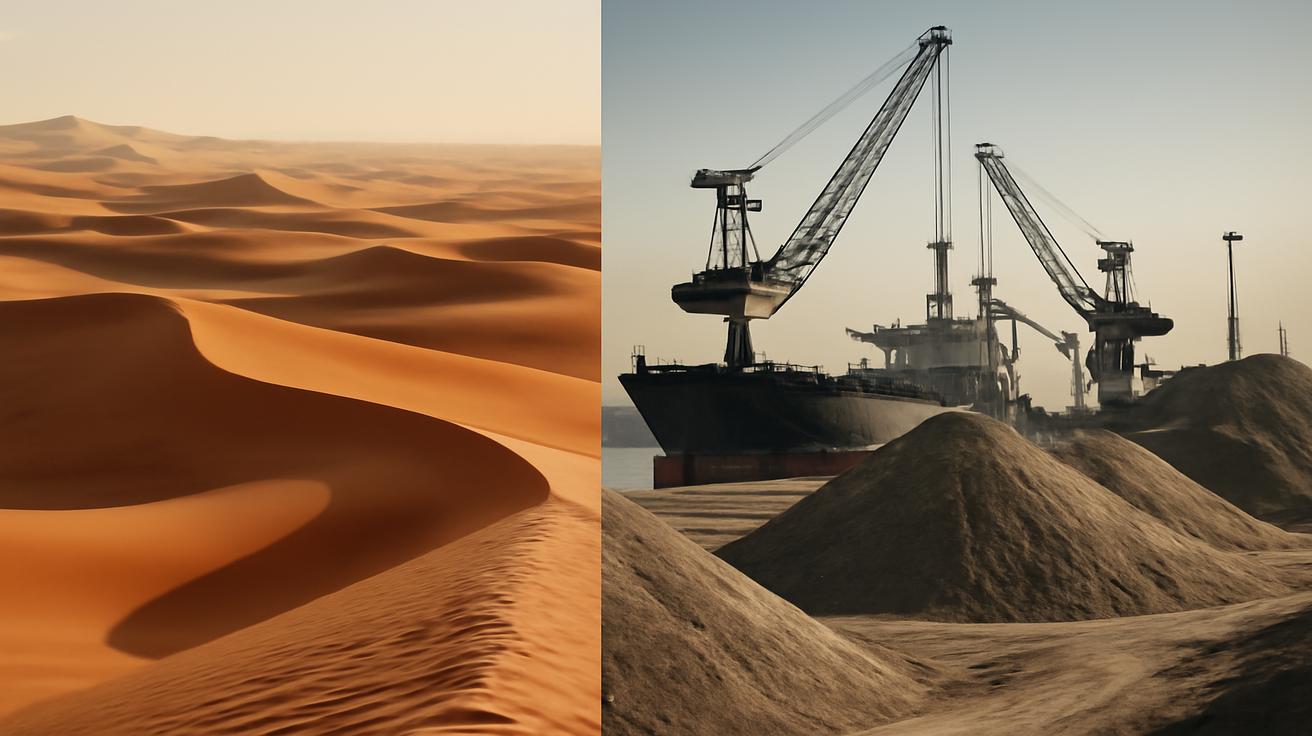
The ship looks wrong on the horizon. It rises from the blue of the Arabian Gulf with its belly low and heavy, crawling slowly toward the shore of Dubai. From the beach, the air smells of salt and diesel. Waves slap against its rust-red hull as cranes unfold like metal giraffes from the dock, reaching, ready to feed on the cargo inside. And what the ship carries—what has traveled thousands of kilometers across oceans—is not oil, not food, not luxury cars, but something far more ordinary and far more unbelievable.
Sand.
In the blazing heart of the Arabian Peninsula, where dunes roll like golden oceans and dust storms paint the sky, countries like Saudi Arabia and the United Arab Emirates import millions of tons of sand every year. At first, that sounds like a punchline to a bad joke. Sand? In the desert? But the scene plays out again and again along the coasts of the Gulf: bulk carriers unloading pale, coarse grains from distant shores, trucks lining up to haul it inland, men in hard hats shouting over the whine of machinery as another mountain of imported earth grows taller in the sun.
To understand why, you have to get close to the sand itself—feel it, roll it in your fingers, hold it up against the light. You have to listen to the story of each grain, and of the cities that are rising on its back.
The Desert Sand That Doesn’t Work
Take a handful of sand from the Empty Quarter, that colossal desert spreading across Saudi Arabia and the UAE like a sleeping golden sea. Let it pour through your fingers. It slips away too fast, silk-smooth, almost powdery. The wind has been working on these grains for millions of years, tumbling them over dunes, polishing their edges into perfect little spheres. They glitter in the sun, but under a microscope, they look too neat—too rounded, too uniform.
Now place that same grain beside a sample of sand dredged from a riverbed somewhere in India, or scooped from a quarry in Pakistan, or trucked in from a coastal pit in Australia. That second grain is sharper, more angular, still scarred from its journey down mountainsides or through river channels. It has edges, corners, bite.
Those edges make all the difference.
Modern cities—like the forest of glass towers along Sheikh Zayed Road in Dubai, or the growing skyline of Riyadh’s King Abdullah Financial District—are held together by concrete. Concrete is, at its simplest, a mixture of cement, water, and aggregate. Much of that aggregate is sand. But not just any sand. Concrete sand needs grains that lock together, that create friction, that give strength and density to the mixture.
Desert sand, rounded smooth by eons of wind erosion, behaves like marbles in a jar. Pile them up, and they slip, slide, rearrange easily. Mix them into concrete, and the result is weak and crumbly, like trying to build a wall out of ball bearings. River sand and crushed rock sand, on the other hand, interlock. They give concrete its backbone.
So here’s the heart of the paradox: Saudi Arabia and the UAE are surrounded by too much of the wrong kind of sand.
The Hidden Empire of Sand
Once you start looking for sand, you see it everywhere in the modern Gulf. It is there beneath the mirrored skins of Dubai’s skyscrapers, inside the foundations of Burj Khalifa, under the runways of airports that host tens of millions of travelers every year. It’s in the roads that slice through the desert like ribbons of asphalt, in the bridges arcing over man-made canals, in the underground pipes and metro tunnels that cities now depend on.
Walk through the early morning streets of Abu Dhabi, when the sun is only beginning to burn off the haze and the city is still half-asleep. Workers in neon vests sweep dust from sidewalks made of concrete pavers, their brooms whispering over sand-based mortar. Delivery vans bump over speed humps poured from sand-rich concrete. A construction site starts up nearby: the crack of rebar, the whine of a cement mixer, the thud of a wheelbarrow. All of it, every motion, is part of a global trade most people never see.
Sand is now the second most-consumed natural resource on Earth after water. It is in glass, in silicon chips, in paint, in ceramics. But above all, it is in concrete. And as Saudi Arabia and the UAE race to transform their economies—from oil-rich exporters to hubs of tourism, technology, finance, and culture—their hunger for sand has exploded.
They use far more of it than their own usable domestic supplies can easily provide. Coastal and river sources in the region are limited, heavily regulated, or ecologically sensitive. Crushing rock to make artificial sand helps, but requires energy, machinery, and suitable stone deposits. So these countries turn outward, tapping into a vast, often poorly regulated, international market in sand.
| Use | Type of Sand Needed | Why Desert Sand Fails |
|---|---|---|
| Structural concrete (buildings, bridges) | Angular river or crushed rock sand | Rounded grains reduce strength and compaction |
| Glass and high-quality silica products | High-purity silica sand | Desert sand often too impure or inconsistent |
| Land reclamation and coastal projects | Marine or suitable coastal sand | Wind-blown sand too fine, easily eroded by waves |
| Road base and foundations | Well-graded construction sand | Poor grading and roundness cause instability |
What looks like dull beige dust beneath your feet is, in economic terms, a strategic resource.
The Islands That Ate the Sea
Few places on Earth demonstrate the appetite for sand as dramatically as the artificial islands of the Gulf. Fly into Dubai on a clear day and press your forehead to the airplane window. Below, the coastline looks almost impossible: vast palm-tree-shaped islands, a world map sketched in miniature just offshore, peninsulas that did not exist a few decades ago reaching like fingers into the water.
To create these, enormous dredging ships sucked sand from the seabed and sprayed it into precise, GPS-guided shapes. Billions of tons were moved, sculpted, compressed. The Palm Jumeirah alone used enough sand and rock to build a wall two meters high and half a meter thick around the entire Earth. And that was just one project in one emirate.
But even marine sand has its limits. Over time, nearshore deposits get depleted or protected for environmental reasons. Removing too much sand from seabeds and coasts can accelerate erosion, damage fisheries, cloud the water, and destroy habitats. As the easy-to-access local sources shrink, the Gulf’s building boom turns further afield—importing sand from neighboring countries, from South Asia, sometimes even from as far as Europe or Africa.
Saudi Arabia’s own ambitions are no smaller. The futuristic megacity NEOM, projected along the Red Sea coast, is being marketed as “the world’s most ambitious project.” It promises floating industrial platforms, linear cities stretching across the desert, and high-tech hubs weaving through mountains and along shorelines. Every kilometer of road, every foundation, every quay and runway will demand sand—strong, reliable, construction-grade sand.
It’s almost surreal: in a land where dunes pile hundreds of meters high, planners and engineers sit in offices scrolling through spreadsheets of imported aggregate, negotiating contracts for grains that traveled halfway around the world.
Why Not Just Use the Desert Itself?
Imagine standing on the edge of the Rub’ al Khali, the Empty Quarter, just after dawn. The air is cool, and the sand glows a soft rose-gold. Each footstep makes a faint sigh as you sink in, the grains flowing away from your weight. It feels endless, like an ocean frozen mid-wave. Surely, you think, there must be a way to use all this.
Researchers and engineers in the region have thought the same thing. Over the past decade, universities, tech startups, and construction giants have experimented with ways to make desert sand useful. They have tried mixing it with special binders, combining it with fibers, chemically treating it, or blending it with crushed rock. They’ve pushed 3D printers to extrude walls from sand-based mixtures, imagined robot swarms building with what lies beneath their treads.
Some of these ideas have moved beyond the lab. Certain non-structural uses—like decorative panels, low-load walls, and landscaping blocks—can incorporate desert sand when combined with other materials. Crushed rock produced within the region is increasingly used to create artificial angular sand that behaves like its river-born cousin. Regulations and building codes are slowly evolving to accept new mixtures that reduce dependence on imported materials.
But for the high-rise cores, the overpasses, the stadiums, the sheer weight-bearing bones of cities, the standards remain strict. Safety codes and long-term durability demand materials that behave in predictably strong ways, tested and certified. And so, even as innovation creeps forward, the ships keep coming, their holds full of foreign sand.
The Global Cost of Every Grain
On paper, importing sand can look straightforward: you buy a commodity from wherever it is cheapest and most available. In reality, the sand story is tangled up with environmental and social consequences that reach far beyond the Gulf.
Rivers in some exporting countries have been mined so aggressively that their banks collapse, villages lose land, and bridges become unstable. Illegal sand mining has sparked conflicts, corruption, and even violence in parts of South and Southeast Asia. Coastal ecosystems suffer when dunes are stripped or seabeds dredged—mangroves die, fish lose their breeding grounds, and shorelines retreat under relentless waves.
Climate change is quietly entangled with this as well. Producing cement for concrete already accounts for a significant share of global carbon dioxide emissions. Moving millions of tons of sand on fuel-burning ships adds another layer of environmental cost. The glittering malls, cooled promenades, and airy museums of Riyadh, Jeddah, Dubai, Abu Dhabi, and Sharjah carry within their walls a hidden story of emissions, erosion, and distant landscapes reshaped.
To their credit, Gulf states are increasingly aware of this. Saudi Arabia and the UAE have both spoken about sustainability, circular economies, and greener construction. Pilot projects test concrete mixes that use less cement, recycled aggregates from demolished buildings, or industrial byproducts like fly ash and slag. Some developers are experimenting with modular construction and alternative materials—timber, steel hybrids, or new kinds of geopolymers.
Yet for now, sand remains irreplaceable at scale. The gulf between what we know we should change and what we are still doing yawns as wide as a dredged shipping channel.
Futures Written in Dust
Stand on Dubai’s Kite Beach on a hazy afternoon and watch the skyline wobble in the heat. The wind carries the faint tang of the sea and a drier, dusty smell from inland. Children build sandcastles near the waterline with grains that were once part of the seabed, or arrived in a barge from somewhere far away. Behind them, the city glows—steel, glass, stone, and concrete, all of it resting on millions of tons of carefully chosen sand.
Over in Riyadh, the urban fabric stretches outward, swallowing what used to be open desert. New neighborhoods rise in rhythmic rows of villas and apartment blocks. Beneath the fresh asphalt of highways and the smooth tiles of shiny new malls lies the same story: imported aggregate, mixed in hot, dry air, poured into molds, curing under a sun that has watched this land for millions of years.
There is a deep irony here. For centuries, the desert was seen as empty, harsh, something to be endured or crossed, not built upon. Now it is the stage for one of the most intense urbanization projects in human history—and it cannot fully supply the very material needed to anchor that transformation.
This is not just a story about two countries and their construction habits. It is a glimpse into a planet where the most ordinary things—air, water, sand—are becoming economic and geopolitical questions. Where we once imagined limits in terms of rare metals or fossil fuels, we are now running into constraints on the most basic building blocks of our world.
One day, future historians may look back at satellite images of the early 21st century Arabian Peninsula: the bloom of cities in the sand, the artificial islands like strange ornaments pinned to the coastline, the mirrored façades catching the sun. They may talk about the age when we moved mountains grain by grain, shipped beaches across continents, and built entire civilizations on foundations poured from distant shores.
By then, perhaps, the desert itself will finally have found its place in construction—through new technologies, new materials, and new priorities. Perhaps the dunes will no longer be just scenic backdrops or obstacles to be tamed, but partners in more careful, closed-loop systems of building and rebuilding.
Until then, the ships will keep arriving. Cranes will keep lifting. Somewhere, far beyond the horizon, a riverbank will feel itself thinning, another stretch of seabed will shudder under the drag of dredger pipes. And on a Gulf beach, someone will scoop up a handful of sand, let it run through their fingers, and never suspect how far those tiny grains have traveled, or how much of the modern world rests upon them.
Frequently Asked Questions
Why can’t Saudi Arabia and the UAE just use their desert sand for concrete?
Their desert sand is mostly wind-blown and highly rounded. For strong concrete, you need more angular grains that interlock and create friction. Rounded desert sand behaves like tiny marbles and leads to weaker, less stable concrete.
What kind of sand do they import?
They typically import river sand, marine sand, and crushed rock sand. These sands have sharper, more angular particles and the right size distribution for construction, especially for structural concrete and land reclamation.
Are there environmental problems with global sand mining?
Yes. Excessive sand mining can erode riverbanks, damage bridges, destroy habitats, disrupt fisheries, and accelerate coastal erosion. In some countries it has led to illegal mining, corruption, and local conflicts.
Is anyone trying to use desert sand in a different way?
Researchers and companies in the Gulf and worldwide are experimenting with special binders, additives, and 3D-printing techniques to make desert sand usable in non-structural elements or as part of blended materials. Progress is real, but large-scale, code-approved solutions are still emerging.
Could alternative materials replace sand-based concrete in the future?
Partially. Options include using more recycled aggregates from demolished buildings, developing low-cement or geopolymer concretes, and increasing the use of steel, engineered timber, and modular systems. However, given the scale of global construction, sand-based concrete is likely to remain dominant for some time, even as its formulas and sources evolve.






Leave a Comment