
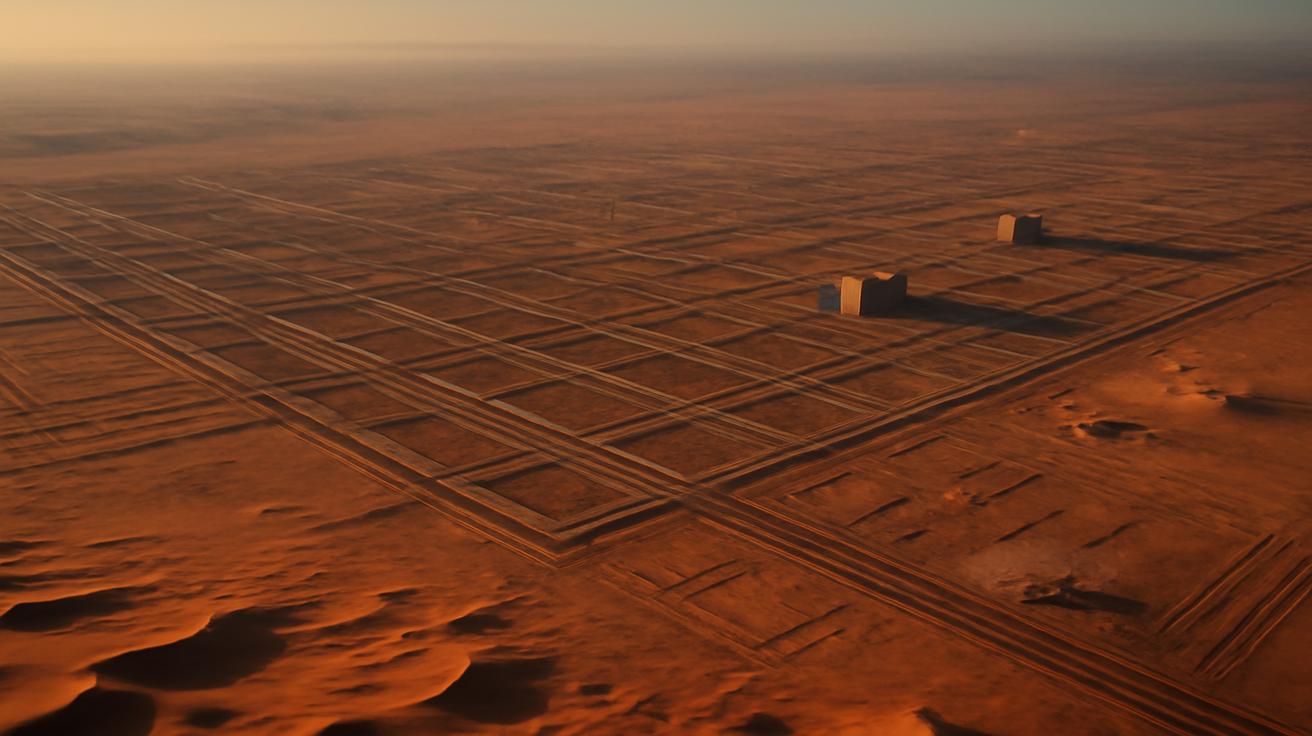
The desert at dawn looks almost empty from the sky. Sand ridges soften into mauve and silver, shadows stretch like ink, and here and there a tire track or a lonely road scribbles across the land. But as the satellite imagery sharpens, the emptiness begins to fracture. Straight lines appear where nature rarely draws them. Long pale scars cut across the ocher ground. Grids emerge in the middle of nowhere—construction camps, service roads, excavations. And then, like something out of speculative fiction, you see it: a ruler-straight incision, hundreds of kilometers long, being carved into the wilderness. This is where Saudi Arabia’s 2 trillion dollar desert megacity, known as NEOM—and its most audacious centerpiece, The Line—is taking shape.
The Line That Cut Across the Desert
From ground level, NEOM is still mostly promise, press release, and futuristic render. From orbit, it is something far more tangible and far more unsettling: a deliberate redrawing of a landscape that has been more or less continuous for millennia. The satellite images—tiny to human eyes yet sweeping in scale—show just how aggressively this vision is being laid into the bones of the desert.
The Line is conceived as a 170-kilometer-long linear city, two parallel mirrored walls rising up to around 500 meters, with a footprint only a few hundred meters wide, sealed together like a glass-and-steel canyon. No cars. No streets. Powered by 100% renewable energy, according to its designers. Within this shimmering corridor, up to nine million residents are supposed to live in stacked layers of housing, schools, gardens, offices, and public spaces, all within a five-minute walk of everyday needs.
On glossy screens, the concept plays like a utopian trailer: greenery suspended in mid-air, clean transit systems gliding silently along the length of the structure, people strolling through cool shaded spaces as the desert sun glows harmlessly outside the mirrored shell. But the satellites tell a grittier story. In the latest high-resolution shots, you can trace the route of The Line like a surgical incision. Bulldozers have shaved off the top layer of desert crust. Access roads thread in from the coast. Massive staging areas appear as pale rectangles—foundations of a future that has not yet learned how to walk, let alone run.
From above, the line isn’t yet a wall of glass; it’s a wound. A geometric gash imposed on a place whose curves were shaped by wind, ice ages, and time on a scale that defies states and their pet projects. And as the incision grows, so does a question that can’t be seen from space but can be felt from almost anywhere on Earth: who is this really for?
The Mirage of a “City of the Future”
Saudi Arabia has framed NEOM as a kind of global reset button—a chance to design a city “from scratch,” free of car dependence, pollution, and the messy inefficiencies of existing urban sprawl. In principle, many urban planners would nod along. We need new models. We need experimentation. We need boldness. But in the gleaming trailers and the satellite shots, a tension becomes impossible to ignore: the scale and price tag of this experiment—around 2 trillion dollars—look less like a laboratory for humanity’s shared future and more like a hyper-curated playground for a very specific slice of it.
Zooming in on the images, you can pick out the human machinery of that ambition. Construction camps sit in tidy rows, each unit a white dot against the tan, forming perfectly aligned grids that are nowhere to be found in nature. Temporary roads snake outward, improvising a nervous system for a city that does not yet breathe. Dust plumes streak the images like faint brushstrokes on old film stills—each one a reminder that the creation of something so monumental begins with the erasure of something else.
It’s here that the word “mirage” floats uncomfortably into view. Not because the project is fake—there are real machines, real workers, real money— but because of what gets blurred by the heat shimmer of the narrative. The promise: a carbon-neutral, hyper-efficient, human-centered city. The tradeoff: a vast extraction of land, water, labor, and attention in one of the harshest ecosystems on the planet, at a speed and scale more akin to conquest than careful cultivation.
Maybe the mirrors planned for the outer facade are an accidental metaphor. From the ground, they’re supposed to reflect the mountains, the sky, the dunes—disappearing into the landscape, the designers claim. From space, however, the reflection doesn’t matter. The satellites only see the footprint, the cut, the cleared ground. They see the project not as a seamless illusion but as patterns of disturbance and control.
The Desert’s Other Residents
On the satellite maps, you can trace wadis—ancient dry riverbeds etched through the hills. In older images, some of these are faint but still intact, lines that remember water in a place that rarely sees it. In newer shots, you can see where roads slice across these invisible watersheds, where future foundations are staked out near habitats that have hosted migratory species for generations.
The desert is easy to caricature as empty. But ecologists know otherwise. Beneath those pale expanses are intricate relationships between hardy plants, insects, reptiles, small mammals, migrating birds. Even in seemingly barren zones, thin veils of crust microbes help anchor the soil, holding the ecosystem together. These networks are delicate, tuned to scarcity and extremes. They are not built to withstand a 170-kilometer wall suddenly rising in their path.
From above, you can’t see every uprooted shrub or disturbed den. But you can see the cumulative effect: the arrival of order—grids, angles, symmetry—cutting into the desert’s layered irregularity. Where camps sprawl, the ground is scraped bare. Where staging areas grow, we see pale scars that weren’t there a few months ago. The pattern is familiar from other megaprojects around the world, yet something about its precision in this context feels especially stark, like laying graph paper over a sand dune.
Human Footprints, Human Costs
There is another pattern faintly legible in the satellite imagery—villages that have grown quiet, roads that no longer lead to anywhere they once did. Beyond the architectural spectacle, NEOM has a human story that is far less polished than the project’s official imagery, involving the displacement of local tribes, contested land rights, and whispered accounts of forceful evictions. Much of this cannot be “seen” directly from orbit. But you can see the shadows of its impact.
Consider the before-and-after frames of certain valleys. In earlier imagery, there are modest clusters of dwellings, farmland carved into the slopes with a kind of rough pragmatism, wells and tracks that follow the contours of the land rather than defy them. In more recent frames, you see demolition patterns—cleared areas where structures once stood, fresh access roads pushing into previously unmarked terrain. What satellite imagery reveals with cruel clarity is that the “blank slate” advertised for NEOM was never blank at all.
Down at ground level, news has seeped out about families being asked—or pushed—to leave ancestral lands, about arrests and worse for those who resisted. Most of these stories travel as human testimony, not as images from orbit. And yet, the satellites play their own quiet role, confirming that change on the ground is happening swiftly, not just as renderings but as irreversible reconfiguration.
Meanwhile, the workers who bring the vision to life form another invisible population from the sky. You can see their camps, but not their faces or their contracts. You see the grid, not the conditions. The story of Gulf megaprojects has long included difficult questions about migrant labor, worker protections, and unequal bargaining power. Those questions hover over NEOM like a heat haze, hard to capture in pixels but inseparable from the ethics of who benefits and who pays.
Who Is the Future Being Built For?
Saudi officials describe NEOM as a gift to humanity—a template for future cities worldwide. Yet the economic logic that pulses beneath the project is not especially mysterious: diversification away from oil, attraction of foreign investment, branding power in a world hungry for the next spectacular thing. The price tag—about 2 trillion dollars—invites its own line of inquiry. When a state spends this much money on a single, ultra-concentrated project, what alternatives are being left on the table? What does it mean to pour resources into an experimental corridor for a few million hypothetical future residents, while existing cities and villages across the region face real, immediate needs for water, affordable housing, greenery, and climate adaptation?
Look again from orbit. NEOM occupies a swath of northwestern Saudi Arabia that could have been many things: a mosaic of smaller resilient settlements, for example, or restored ecosystems that buffer coastal areas against the worst roll of climate dice. Instead, all bets are placed on a single linear narrative, a straight shot from “old way” to “new way,” compressed into one monumental gesture.
To ask who this future is for is not to deny the potential value of innovation. It is, rather, to ask about access. Will an ordinary teacher, nurse, or mechanic from elsewhere in the kingdom—or from neighboring countries—find a home in NEOM that is genuinely affordable, humane, and secure? Or will The Line become a rarefied enclave, a climate-controlled prestige corridor where the global elite can sample a curated “sustainable lifestyle” while the external costs of that lifestyle—labor, land, water, energy—are invisibly absorbed by others?
At its core, this is a question of distribution, not only of wealth, but of risk and reward. Who gets the upside of the experiment if it succeeds? Who bears the downside if it fails, stalls, or locks in a fragile system that proves harder to maintain than to design?
The Numbers Behind the Mirage
The scale of NEOM is hard to grasp in words alone, so it can help to see some of its stated ambitions lined up against familiar reference points.
| Aspect | NEOM / The Line | For Comparison |
|---|---|---|
| Estimated Cost | ~$2 trillion (projected) | More than the GDP of many countries in a year |
| Planned Length of The Line | ~170 km | Roughly the distance of a long intercity train ride |
| Target Population | Up to 9 million residents | Comparable to a large global metropolis |
| Building Height | Around 500 m | Not far from the world’s tallest skyscrapers |
| Footprint Width | ~200 m | About two city blocks across |
On a mobile screen, these numbers compress into a neat vertical list, but each cell in that table represents a web of consequences. To raise mirrored walls half a kilometer high across 170 kilometers of desert demands unprecedented feats of engineering, yes, but also unprecedented consumption of raw materials, energy, and logistics. Even if every operational kilowatt-hour is “renewable,” the embodied carbon in the construction itself will be colossal.
Satellite images already show the early stages of those inputs: new roads for heavy trucks, quarries opening up, coastal infrastructure expanding to receive shipments. A city that claims to reimagine our relationship with the planet begins, like so many before it, by intensifying pressure on that very planet.
Sustainability or Spectacle?
The rhetoric around NEOM leans heavily on sustainability. Fully powered by renewables. Zero cars. Minimal land footprint per capita. At a certain altitude—literal and metaphorical—these claims sound reassuring. Yet seen through the more dispassionate eye of satellite data, another interpretation emerges: sustainability as spectacle, as branding, as an aesthetic.
True sustainability is often unglamorous: insulating existing buildings, upgrading public transit in older neighborhoods, restoring wetlands, retrofitting infrastructure, adopting policies that reduce waste and overconsumption. It thrives in incremental improvements, in local adaptations, in designs that grow organically from the conditions on the ground. These rarely produce images dramatic enough to make global headlines.
The Line, by contrast, is almost pure image. It is designed to look revolutionary from every vantage point—the polished CG fly-through, the ground-level photo, the astronaut’s view. That doesn’t automatically make it hollow. But it does raise the risk that the project’s success will be measured more in visual impact and investor sentiment than in quietly functional, equitable lifeways.
If the satellites could record sound, what would we hear along the growing scar of The Line? The rumble of construction, the brief lives of work camps, the conversations between migrants far from home, the last songs of birds pushed from their nesting spots, the buzz of drones mapping the next phase. The soundtrack of a future that feels less like an ecological turning point and more like a rebranded continuation of the old logic: dominate, extract, enclose, curate.
The Disturbing Question Hanging Over the Sand
In the end, the satellite images of NEOM confront us with a strange dual reality. On one hand, they prove that our species is capable of extraordinary coordination, of bending resources and technology toward a vision at astonishing speed. On the other hand, they reveal just how narrow that vision can be, how much it can revolve around spectacle, control, and the priorities of those already holding power.
From the sky, the incision of The Line crawls slowly outward, more segments appearing every few months. On the ground, glossy promotions promise a life where everything is within walking distance, where nature is “enhanced” inside the glass while the harsher outside world is kept at bay. It’s a seductive idea for anyone exhausted by traffic jams, pollution, and climate anxiety.
But the disturbing question that grows louder with each new satellite pass is this: is NEOM a prototype of a more just, livable world for many—or a fortified showroom of the future for a privileged few? In a century defined by climate disruptions, mass migrations, and deepening inequality, are we investing our vast collective resources into resilience for all, or refuge for those who can pay to step inside the mirrored walls?
The sand below NEOM has seen civilizations rise and fall, trade routes flourish and fade, climates shift and recalibrate. Long after the last render of The Line has fallen out of fashion, the land will still remember what was done to it. The satellites will move on, turning their gaze toward the next megaproject, the next bold reboot. But the trace of this line—physical, ecological, ethical—will remain etched into the desert.
As more images stream down from orbit, as the incision grows longer and deeper, it becomes harder to pretend that this experiment concerns only those within its planned walls. NEOM is not just a Saudi story; it is a mirror held up to our shared moment. It asks whether we will face a fractured world by building spectacular citadels in the sand—or by doing the quieter, harder work of making the places we already inhabit more humane, more fair, and more in tune with the land that holds us.
FAQ
What is NEOM and The Line?
NEOM is a planned megacity in northwestern Saudi Arabia, envisioned as a high-tech, climate-conscious economic zone funded at a projected cost of around 2 trillion dollars. The Line is its most famous component: a proposed 170-kilometer-long linear city with mirrored facades, designed to house up to nine million people in a dense, car-free corridor.
What do satellite images actually show about The Line?
Recent satellite imagery reveals early-stage construction: long trenches, cleared land, access roads, construction camps, and staging areas along the proposed route of The Line. While the futuristic architecture is not yet visible, the footprint of the project—its physical impact on the desert landscape—is already clear.
Why are people concerned about NEOM’s impact?
Concerns center on environmental disruption in a fragile desert ecosystem, the displacement of local communities, the treatment of migrant workers, and the possibility that the project will primarily benefit wealthy residents and investors rather than the broader population. The enormous cost also raises questions about alternative ways those resources might have been used.
Is NEOM really sustainable?
NEOM’s planners promise 100% renewable energy, car-free living, and a small per capita land footprint. However, sustainability experts point out that the vast resource demands and embodied carbon of constructing such a massive, experimental city may undercut these claims, especially when compared to improving and retrofitting existing cities in more modest, distributed ways.
Who is likely to live in The Line if it is completed?
Officially, NEOM is intended for a wide range of residents, from local citizens to international professionals. However, the high cost, high-tech emphasis, and branded exclusivity suggest it may primarily attract affluent residents and corporations. Whether ordinary workers and lower-income families will be able to live there on fair terms remains an open and pressing question.





Leave a Comment