
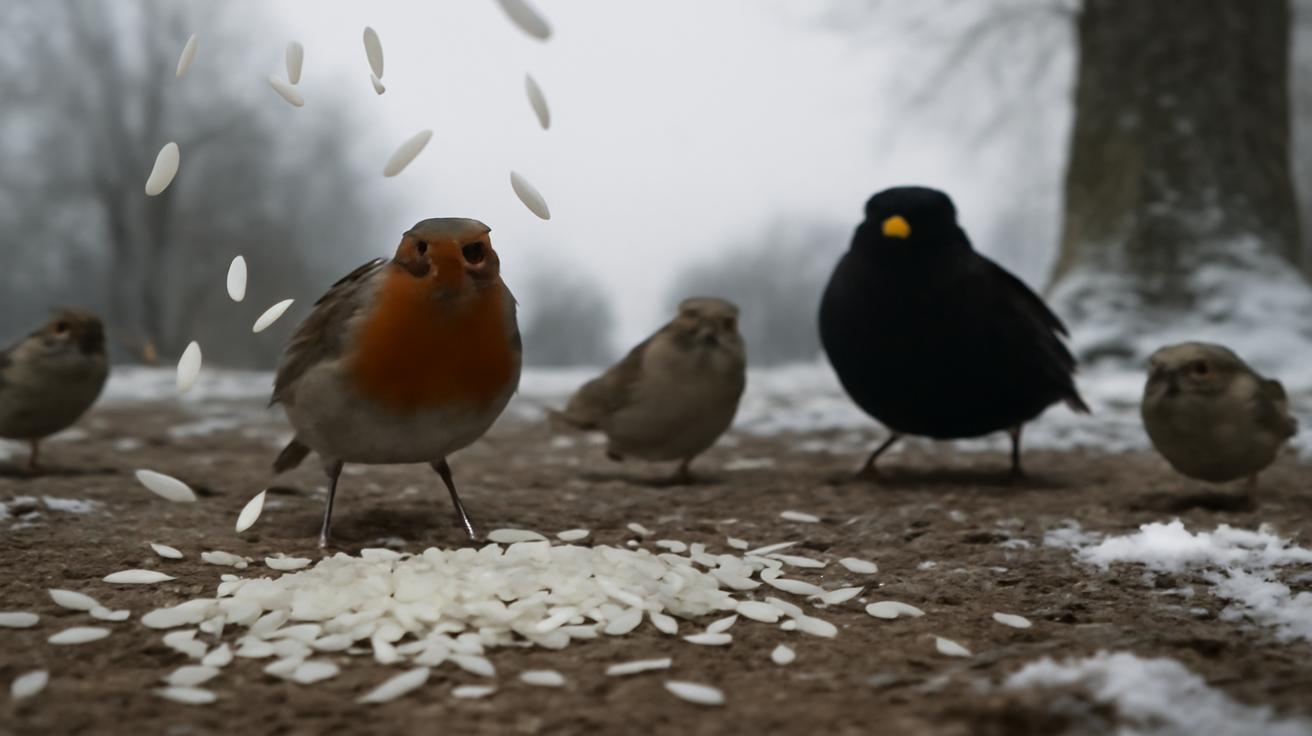
The first robin appeared just after dawn, a small russet flame against the dull, frost-stiffened lawn. It landed, cocked its head, and began to hop across the glassy grass as if the temperature didn’t bother it at all. But from my kitchen window, fingers curled around a mug of hot tea, I could see the truth in the bird’s movements: shorter hops, more frantic pecks, the restless zig-zag of a creature burning precious energy in a world that had abruptly turned hard and stingy.
The cold snap had arrived overnight, painting every leaf and paving stone with a brittle white crust. The bird feeders swung slightly in the pale morning light, already dusted in frost, visited by cautious blue tits and a single blackbird who puffed out its feathers until it looked almost spherical. Food was suddenly not just important, but everything. And according to the RSPCA, one simple ingredient from your kitchen could make all the difference for these tiny, determined survivors.
The Simple Kitchen Staple That Can Save a Life
There’s a particular kind of quiet that comes with deep winter cold. It’s not silence exactly—there’s the creak of frozen branches, the faint rush of distant traffic, the soft crackle as frost thaws under the first weak rays of the sun. But the birdsong is thinner, more tentative. Energy is rationed carefully; every note, every flutter must be worth the cost.
This is why, during a cold snap, the RSPCA strongly recommends something almost absurdly simple: scatter a handful of plain porridge oats on the ground.
Not fancy seed mixes. Not specialist suet cakes. Just the same humble oats that sit in your cupboard, waiting to be turned into breakfast. To us, they’re a weekday staple. To a robin or a blackbird in sub-zero temperatures, they can be the difference between surviving the night and not waking up at all.
The logic is straightforward and surprisingly moving. When the earth is frozen, the rich menu of invertebrates, worms, and grubs that ground-feeding birds usually rely on is suddenly locked away beneath a layer of ice and hard soil. Robins, blackbirds, wrens, dunnocks—many of our familiar garden companions—are specialists at working the leaf litter and soil surface. Overnight, their pantry is bolted shut.
By scattering oats directly onto the ground, you become, in a quiet way, the key to that locked door.
Why Oats Work So Well for Robins and Their Neighbours
Stand outside on a frosty morning with a small bowl of dry oats in your hand, and you’re holding concentrated fuel. Each flake is a compact bundle of carbohydrates, easy to spot against the pale lawn, and simple for a small beak to grab and swallow.
Robins in particular are well suited to take advantage of this. Unlike finches, who prefer to cling to feeders and shells seeds with their beaks, robins are ground feeders by instinct. They like to hop under shrubs, along borders, beneath hedges. Sprinkle oats there, and you’re speaking directly to the robin’s natural feeding behaviour, rather than forcing it into something unfamiliar or risky.
The RSPCA’s guidance is clear: in cold snaps, high-energy, easy-access food can make a decisive difference. Oats are:
- Quick to find – they stand out against snow or frosted grass.
- Easy to digest – especially important when birds are already exhausted.
- Widely available – many households already have a bag in the cupboard.
But, as with so many simple remedies, there’s a right and a wrong way to do it.
How to Scatter Oats Safely (And What to Avoid)
The first time I tried it, I stepped outside into the thin, biting air and felt instantly clumsy. The frost snapped beneath my boots; my breath hung in hazy puffs. The garden looked still and empty, but I knew from the faint rustle in the hedge that I was being watched.
From a small tub I scattered a light handful of oats in a broad, gentle arc across the lawn, some under the old apple tree, some beneath the climbing rose, and a few near the stone birdbath that had frozen solid. Then I stepped back and waited.
Within minutes, a robin materialised as if conjured by the oats themselves. It landed close to the hedge, gave me the kind of suspicious once-over only a robin can manage, and then, deeming me harmless, began to feed—quick, precise pecks, each flake disappearing into that tiny, earnest beak.
To make this small ritual as safe and effective as possible, the RSPCA advises a few simple rules:
- Use only plain, uncooked porridge oats. No flavourings, no added sugar, no syrup, salt, or instant varieties with artificial ingredients.
- Scatter sparingly. A little and often is best. A thin dusting over the same areas each day during the cold spell is far more helpful than a heavy pile that will go soggy or attract unwanted pests.
- Keep it low and local. Robins and blackbirds feed on the ground, so there’s no need to put oats in high feeders. Just sprinkle them where birds naturally explore: near hedges, borders, under shrubs.
- Refresh daily. Remove any old, wet leftovers and add a fresh sprinkle. This helps prevent mould or bacteria building up.
And just as important as what to do is what not to do.
- Don’t cook the oats. Cooked porridge becomes sticky and gluey, which can be harmful if it clogs delicate beaks or feathers.
- Don’t mix them with milk. Many birds struggle to digest dairy properly; clean water nearby is better.
- Don’t leave out salted foods. Salted nuts, salted leftovers, or processed snacks can be dangerous for birds in even small quantities.
In other words: keep it simple, keep it clean, and keep it consistent.
The Hidden Struggle of a Winter Robin
It’s easy, from behind double glazing and central heating, to underestimate what cold really means to a bird that weighs less than a £1 coin. A robin may look jaunty, with that defiant red chest and fierce little eye, but its reality is brutally mathematical: it must eat enough each day to survive the night.
Unlike many birds that migrate to softer climates, most British robins stay put. This loyalty to place is one of the reasons we feel such a peculiar affection for them; they are our constant companions in a shifting year. But that loyalty has a cost. When the temperature plunges, a robin’s tiny body goes into high gear, burning calories at a ferocious rate simply to stay alive.
On a bitter night, a small bird can lose up to 10% of its body weight just in staying warm. Imagine losing that much of yourself between dusk and dawn. Now imagine doing it with no guarantee that tomorrow’s breakfast will be available, or that the soil won’t be sealed tight beneath a glassy sheet of ice.
This is where those scattered oats become more than just bird food. They become a margin of safety, a buffer against the worst of the cold. A robin who finds a reliable patch of oats at dusk is a robin whose odds tilt quietly, but significantly, toward survival.
And it’s not just robins who benefit. Blackbirds, thrushes, dunnocks, and even the occasional shy wren may wander out to investigate. In the shared territory of a garden, a few spoonfuls of oats transform into a small, generous commons—a place where winter-struck creatures can top up their tanks and carry on.
Adding Variety: More Cold-Weather Treats from Your Kitchen
While plain oats are a star player in this story, they’re far from the only helpful thing hiding in your cupboards. In the spirit of quiet winter hospitality, you can put together a thoughtful spread using simple ingredients, provided you follow RSPCA-style guidance and a bit of common sense.
| Food | Suitable For | Important Notes |
|---|---|---|
| Plain porridge oats | Robins, blackbirds, thrushes, dunnocks | Scatter dry on the ground; no milk, sugar, or flavourings. |
| Unsalted, chopped peanuts | Tits, finches, nuthatches | Use in a suitable feeder or finely crushed for smaller birds. |
| Raisins and sultanas | Blackbirds, thrushes, robins | Soak briefly in water to soften; avoid if you have dogs, as raisins are toxic to them. |
| Grated mild cheese | Robins, wrens, dunnocks | Use sparingly; avoid strong, mouldy, or processed cheeses. |
| Chopped apples and pears | Blackbirds, thrushes, fieldfares, redwings | Place on the ground or a low table; remove any rotting fruit. |
You don’t need to lay out a grand feast. In fact, it’s better if you don’t. A few carefully chosen extras, refreshed daily, are enough. The heart of your effort can remain as modest as that sprinkle of oats on the frosted ground.
Turning a Garden into a Winter Refuge
The change doesn’t happen overnight. One day your garden is simply the backdrop to your life: a patch of lawn, a few shrubs, perhaps some pots or a sagging fence. Then the cold comes, you scatter some oats, and you start to notice things you never really saw before.
The robin doesn’t just appear; it arrives from a particular angle every time, slipping under the low branch of the laurel. The blackbird favours the dampest corner of the border, throwing aside leaves with a brisk, impatient flick. The dunnock, that quiet, brown shadow of a bird, edges nervously along the fence line before dropping down to snatch a single oat and retreating again.
Small patterns emerge. You notice the times of day when the birds visit most. You learn which spots they prefer and which they avoid. Perhaps you move where you scatter the oats, tucking them closer to shrubs where birds feel safer from cats or sparrowhawks. Without quite meaning to, you start to design your garden not just for yourself, but for them.
An old clay pot laid on its side becomes a wind-break. A dense shrub left untrimmed until spring becomes a shelter. A birdbath, thawed each morning with a kettle of warm (not hot) water, becomes a vital drinking station when everything else is locked in ice.
And all the while, the oats go out. A soft rattle against the tub, a faint patter as they land on the cold soil. It is such a small act that it almost feels like nothing. But the garden keeps changing, subtly, becoming not just a piece of property but a shared space—a place where your daily routines intersect with the urgent lives of creatures balancing on the edge of each freezing night.
The Quiet Joy of Helping: What You Get in Return
There is, of course, an entirely selfish side to all this generosity. Once you begin to feed birds thoughtfully in winter, the pleasures come back to you in ways that are hard to measure but impossible to ignore.
You’ll find yourself pausing more often at the window. The morning rush to get ready will be interrupted by a sudden, silent moment as you notice the first visitor of the day: the robin, perhaps, puffed up against the cold but still fiercely alive. On especially harsh mornings, the sight of that tiny chest, glowing against the grey, will feel like a small act of defiance against the season itself.
Over time, individual birds begin to feel familiar. The slightly scruffier blackbird, the bolder robin who ventures closer to the house, the gang of blue tits that seem to move as a single restless thought. You’ll see tiny dramas play out: pecking orders, squabbles, fleeting truces. Your garden becomes a living, shifting narrative instead of a static view.
And perhaps, in the long, flat weeks of winter, that connection brings something steadying. A reminder that even in the quietest season, life is busy just beyond the glass. That survival can be helped along by something as ordinary as a handful of oats. That kindness does not always need to be grand to be meaningful.
From This Morning Onward
Tomorrow morning, when the light is still thin and the air stings your lungs, you could walk out into your own small territory with a tub of oats. You could feel the crunch of frost underfoot, the static chill that creeps through your coat, and know that the creatures watching from hedge and fence and bare branch are facing a far steeper challenge than you.
Scatter the oats. Just a little, in a few well-chosen places. Step back. Wait.
Perhaps nothing will happen right away. Perhaps the first visitor will wait until you’ve gone back inside, until the door is shut and the kettle is boiling. But once they’ve found it—once the robin has learned that your garden offers reliable help during the hardest days—they’ll remember. Birds are excellent at mapping their world, at building mental routes between safe places and good feeding grounds.
And as the cold snap deepens or returns—as it often does, just when you’ve dared to hope spring might be close—you’ll be ready. Not with expensive equipment or esoteric knowledge. Just with a cupboard staple and a small, persistent willingness to share.
In the end, that’s what the RSPCA’s recommendation really comes down to. Not an elaborate scheme or a complicated intervention. Just this: take the ordinary and turn it into a lifeline. Turn breakfast into survival. Turn a patch of winter-hard earth into a small, dependable hope for a bird that asks for nothing more than a place to land and a few mouthfuls of warmth.
Some rescues happen in dramatic flashes of action and sirens. Others are quieter, softer, and scattered in pale flakes across a frozen garden at first light.
Frequently Asked Questions
Can I use instant porridge sachets for garden birds?
No. Avoid instant porridge sachets, especially those with added sugar, salt, flavourings, or milk powders. Birds should only be given plain, unsweetened, unflavoured oats.
How often should I put out oats during a cold snap?
“Little and often” works best. Once in the early morning and again in the afternoon is ideal. Adjust the amount so most of the oats are eaten within a few hours, then refresh as needed.
Is it okay to mix oats with other foods?
You can offer oats alongside other safe foods like chopped fruit, grated mild cheese, or soaked raisins. Just keep each food separate in small patches so birds can choose what suits them, and avoid sticky mixes that might gum up beaks.
Will scattering oats attract rats or other pests?
If you put out more food than birds can eat, it may attract unwanted visitors. Offer modest amounts, clear away leftovers daily, and place food in open areas where birds can feed confidently but pests are less comfortable.
Can I still use my regular bird feeders as well as oats on the ground?
Yes, and it’s a good idea. Hanging feeders suit tits and finches, while oats on the ground help robins, blackbirds, and other ground-feeding species. A mix of both creates a more inclusive winter refuge for a wider range of birds.








Leave a Comment