
The rain starts in that indecisive city way—half drizzle, half mist—as Eli straddles his bike at the curb, phone buzzing like an anxious heart in his pocket. It’s 6:42 p.m., the dinner rush, and he’s already three orders deep: a vegan ramen, a pepperoni pizza with extra jalapeños, and two poke bowls sloshing around in the insulated backpack that has slowly become his whole world. A notification flashes: “Hurry! Customer is waiting.” Underneath, another line glows in bright green: “You’re just 3 deliveries away from an extra $4 bonus.”
Four dollars. Three more rides. Twelve more intersections where cars pretend not to see him.
Across town, in an eighth-floor apartment lined with plants and soft light, Maya scrolls through her delivery app. She hovers over the tip slider. The fee seems higher than last month. Didn’t she just read an article about “surcharges” and “operational costs”? She frowns, nudges the tip a little higher, then lowers it again. Rent is due, her own job is shaky, and the world feels heavy. Still, ten minutes later, when she sees Eli’s soaked hoodie and the fog of his breath in the hallway, guilt flares alongside gratitude.
“Thanks,” she says, grabbing her ramen. “Stay dry out there.”
He laughs politely, already backing away. The app has started its timer. Another rating. Another metric. Another invisible tally in a system that insists he is not an employee—only an “independent contractor”—even though his entire life now orbits around its algorithms.
The City that Eats Itself
In big cities across the world, the food we eat no longer travels to us in baskets on a market day or in the arms of friends knocking on our doors. It arrives in the glow of an app, carried by people like Eli, who crisscross the streets under the quiet pressure of digital notifications. Their work is fast, intimate, strangely anonymous. They know your favorite dish. You often don’t know their name.
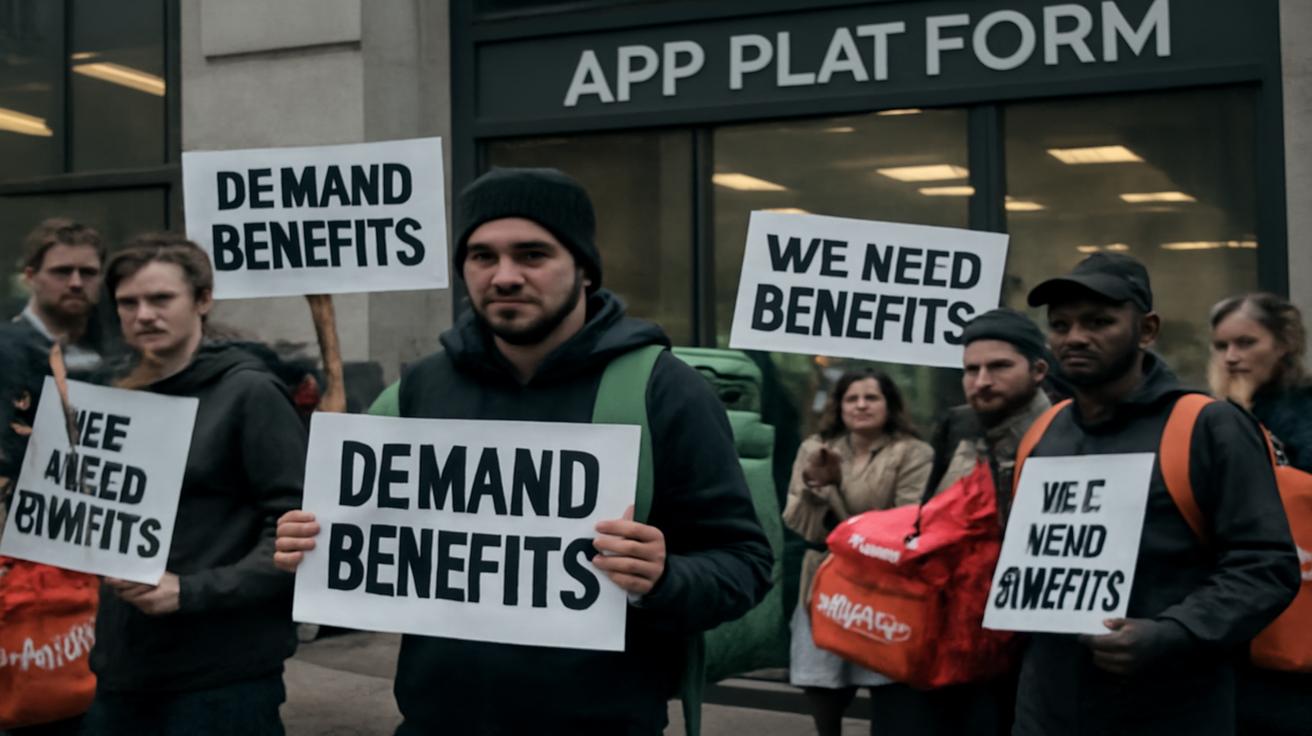
Yet beneath the clatter of takeout boxes and the warm comfort of doorstep deliveries, something is beginning to crack. Couriers are gathering outside corporate offices, blocking intersections on their bikes and scooters, holding signs painted with supermarket sharpies: “WE ARE NOT BOTS.” “BENEFITS NOW.” “NO MORE GHOST BOSSES.”
They are demanding what many workers before them fought for: stable wages, health insurance, paid sick days, protections if they are hit by cars or injured on the job, a say in the rules that govern their daily grind. In other words, they’re asking to be treated as employees—not as expendable, on-demand code fragments in a vast digital machine.
On the other side stand the platforms and, indirectly, the customers who’ve grown used to tapping their cravings into existence. The promise has always been seductively simple: cheap, fast, flexible. Work when you want, order what you want, pay just a bit more than takeout, and feel a little richer in time—even if poorer in cash. This triangle of convenience is now tightening into a knot: couriers asking for full employment benefits, platforms insisting they must preserve flexibility, and customers insisting prices must not rise “too much.”
Somewhere between these competing desires, the city itself feels the tension. You can sense it in the nervous glance of a restaurant owner skimming her monthly app fees. In the murmurs of city council meetings dissecting regulations. In the hurried, rain-slicked bike lanes where couriers swerve around parked cars, traffic, and time itself.
The Gig That Became a Lifeline
Ask the platforms, and they’ll tell you: “This is about freedom.” They highlight the college student who rides on weekends, the musician squeezing in a few hours between rehearsals, the parent who needs a schedule that bends around school pickups. These stories are not fiction. The gig, for some, really is a side hustle—quick, relatively frictionless, disposable.
But the city sidewalks tell a wider story. You see the same faces, night after night, on the same corners, in the same branded jackets and battered helmets. For many couriers, delivery isn’t a casual side gig at all. It’s the main source of income, the full-time job that somehow doesn’t come with the full-time protections.
Eli used to work in a kitchen, chopping onions for hours, sweat turning salt into a second skin. When the restaurant closed during a downturn, delivery apps promised a bridge: “Start earning in minutes.” No interview, no resume, just a background check and a working bike. The city became his office; the app, his manager.
Except this manager never sleeps. It knows his acceptance rate, his average delivery time, his reliability. If he refuses too many orders, his access to “priority” shifts quietly evaporates. If he goes offline during peak hours too often, the app’s bonuses disappear. There’s no meeting where he can plead his case, no HR department to call, just an FAQ and a support chat that loops him back through scripted messages.
Meanwhile, his body keeps the score: aching knees, sore back, lungs seared from biking uphill in winter air so cold it tastes like metal. One accident, one broken wrist, and the pay stops instantly. The app does not send flowers.
What the Numbers Whisper
Behind the buzz of notifications, this conflict is partly about math—quiet, structural math that shapes every route and rating. The delivery fee you see on your screen is only one piece of a puzzle tuned by algorithms designed to keep you ordering and the platform profitable.
A simplified way to imagine it:
| Item | Who Pays | Who Receives |
|---|---|---|
| Menu price | Customer | Restaurant (minus commission) |
| Service + delivery fees | Customer | Platform (partly pays courier) |
| Commission on order | Restaurant (through revenue share) | Platform |
| Tip | Customer (optional) | Courier |
Couriers are squeezed into the narrowest band of that chart. Their base pay is tuned by algorithms that adjust for distance, demand, and competition from other couriers. Promotions and bonuses flash in and out of existence like mirages. A $3 delivery might become $5 one day, then shrink again the next week with no explanation beyond the silent recalibration of code.
Now imagine adding full employment benefits: health insurance contributions, paid leave, disability coverage, employer taxes. These costs don’t vanish. They move. They have to land somewhere—on customers in the form of higher fees, on restaurants in the form of higher commissions, on platform profits, or some combination of all three.
This is the fuel feeding the argument. Couriers say: “We are doing a job; treat us like workers.” Platforms say: “If we do, the math breaks; customers will reject higher prices and fewer couriers will want rigid shifts.” Customers, for the most part, say nothing out loud, but their choices reverberate with each tap: order again, or close the app and cook.
Flexibility, or a Moving Target?
“I don’t want a boss,” says Laila, another courier, warming her hands around a paper cup of coffee at a gas station that doubles as a midnight rest stop for riders. “But I also don’t want to lose my income overnight because the app updated my rating, or because I got sick.”
Flexibility is the glittering word in every platform’s pitch. It suggests wide-open skies: work whenever, wherever, however. For some, that promise is real. For others, it feels more like a leash made of elastic—stretchy, yes, but always pulling you back into the same loop of busy hours and subtle pressure.
Full employment status, the kind couriers are demanding, often implies set shifts, regulated breaks, maybe a supervisor. It could mean a limit on how many hours someone can work in a day, or a cap on how many couriers can be active at once. The platforms warn that our current version of “flexible work” might become less open, more structured, more like a traditional job.
Some couriers push back on that fear. They argue that flexibility and security don’t have to be enemies. Part-time contracts, portable benefits, guaranteed minimum earnings, and the option to opt in or out of full employment are all ideas that float through protests and policy proposals.
Still, the question lingers in the air like exhaust at a red light: How much freedom is real, and how much is simply the freedom to take all the risk yourself?
Customers in the Crosswalk
In living rooms and offices, customers are watching this debate unfold on news feeds sandwiched between recipe videos and flash sales. They’re uneasy witnesses because they know they’re part of the equation. Every demand placed on platforms and couriers eventually boomerangs back toward them as a changed price, a longer wait, or a nudge to tip more.
Maya, with her plants and her ramen, is torn. She wants Eli to have health insurance. She wants him to be protected if he crashes on a slick crosswalk. She also wants to afford takeout on the nights when the world feels too heavy to cook. She’s already juggling rent, transit passes, student loans. How much more can she absorb before delivery becomes a guilty luxury instead of a small mercy?
On social media, comments flare beneath stories about new regulations: “Pay them properly!” sits right next to “I’m not paying $8 just to get a burger delivered” and “Guess I’ll go back to picking up my own food.” The city’s conscience is split down the middle, tugged between ethics and exhaustion, solidarity and survival.
Meanwhile, each time a customer opens the app and winces at a higher fee, pressure builds behind the scenes. Platforms quietly test new models: subscription passes, surge pricing, “priority delivery” for extra money. Restaurants experiment with their own delivery services, straining to match the reach and convenience of the apps without drowning in logistics.
It’s easy to forget that all of this rests on an extremely simple, human gesture: one person bringing food to another. Our digital layers have made that ordinary moment into a marketplace of moral decisions.
Platforms on the Defensive
In glass towers and minimalist conference rooms, executives talk in the language of scale and sustainability. They lay out charts predicting what full employment classification for couriers could mean. They see sharp climbs in labor costs, warnings that investors might flinch, fears that their fragile path to profitability could shatter.
They argue that if couriers become employees, they’ll have to limit the number of active workers to control costs. No more turning on the app for 40 minutes between classes, they say. Shifts will need to be scheduled, performance tightly managed, demand anticipated in advance. The messy, friction-filled world of traditional staffing will return, colliding with the unpredictable storms of city life—rain, traffic, sudden cravings, viral trends.
Some platforms experiment with half-steps: small insurance protections, limited accident coverage, hardship funds. These efforts float like bandages over a deeper wound. Couriers counter: “Why should our safety depend on goodwill or special programs? Why not legal rights?”
City governments, regulators, and courts watch this ping-pong match and start scribbling rules. In a few places, laws treat couriers closer to employees. In others, new categories emerge: “dependent contractors” or platform workers with partial protections. But the patchwork nature of these efforts means the same app can feel like a different job from one city to another.
Amid the legal jargon and economic models, the core question remains disarmingly simple: When a person works full-time for a single system, following its rules, earning their entire livelihood through it, what do we owe them?
A City of Invisible Threads
Stand on any busy corner at dusk, and you can see the future of this argument zipping past in streaks of red taillights and tiny delivery bags. The city hums, powered by countless invisible threads: the person who made your food, the one who delivered it, the one who coded the app, the one who set the prices to perfectly tempt you.
Food delivery used to be a side service, a small niche tucked into the margins of restaurant life. Now it is an ecosystem of its own, woven tightly into how we live. For some neighborhoods, especially where public transit is thin and grocery stores are far, it’s not just convenience—it’s access.
As couriers organize—sometimes in loose, encrypted chat groups, sometimes in formal unions—they challenge us to look at those invisible threads. To see that flexibility without stability can feel less like freedom and more like walking a tightrope over asphalt. To recognize that the low fee we celebrate at the checkout screen might be subsidized by someone else’s broken bike, untreated injury, or unpaid sick day.
And yet, it’s not as simple as flipping a switch and declaring everyone an employee. Small restaurants fear more fees. Customers fear another bill swelling at the end of the month. Platforms warn of shrinking service areas, slower deliveries, fewer options.
We are, all of us, stuck in a very modern paradox: wanting justice to be done, but hoping someone else will pay for it.
Listening for a Different Future
On a quiet Tuesday, between lunch and dinner, the streets soften. The rush recedes. Eli leans his bike against a park bench and finally exhales. His phone is momentarily still. The clouds have broken open just enough for a narrow shaft of sunlight to find the scuffed toes of his shoes.
He thinks about quitting sometimes. About finding something “normal,” with a clock to punch and a uniform to return, a manager whose voice he can actually hear. But then he remembers the taste of being trapped behind a fryer, the rigid schedule that clashed with his night classes, the way a single late bus could throw his whole day into chaos.
He also thinks about his friend who was hit last winter and couldn’t work for months, savings drained, no safety net. About the riders who disappeared from the chat groups after an accident or an illness, their presence erased from the app with the same finality as a completed order.
He doesn’t want to lose flexibility. He doesn’t want to lose control. He wants something harder to describe: a balance where he’s not treated like a ghost by the company whose logo he wears.
Out beyond the park, in apartments and offices, in restaurants and municipal buildings, the city waits for an answer. We are still drawing the map of what work looks like in a world where jobs arrive as push notifications and bosses exist as lines of code.
If we listen carefully—to couriers at gas stations, to customers at kitchen tables, to restaurant owners balancing ledgers, to policy makers stumbling through new vocabulary—we might begin to sketch a different arrangement. One where the cost of our convenience is shared more honestly. Where flexibility doesn’t demand invisibility. Where full employment benefits, or something very close to them, are not reserved only for the lucky few who still fit into old models of work.
For now, the tension rises with the steam from takeout containers. The bikes keep moving. The apps keep glowing. And somewhere between the tap of an order and the ring of a doorbell, a new understanding of labor is trying to be born.
Frequently Asked Questions
Why are food delivery couriers asking for full employment benefits?
Many couriers work full-time hours for a single platform, yet receive none of the protections traditional employees get, such as health insurance, paid sick leave, or injury coverage. They face high risks on the road, unpredictable income, and algorithm-controlled access to work. Full employment benefits are seen as a way to gain stability, safety, and a voice in decisions that shape their livelihoods.
Would giving couriers full employment status eliminate flexibility?
Not necessarily, but it could change how flexibility is structured. Platforms argue that employee status would require scheduled shifts and tighter staffing control. Couriers and some policy experts counter that flexible, part-time, or hybrid models are possible—offering both protections and some degree of schedule choice. The outcome depends on how laws and company policies are designed, not on a single fixed model.
How would stronger protections for couriers affect customers?
Stronger protections almost certainly mean higher costs somewhere in the system. Customers might see higher fees or slightly higher menu prices. However, these changes would reflect a truer cost of safe, sustainable delivery work, rather than offloading most risks onto couriers alone. Some customers may order less frequently, while others may accept modest increases as part of a fairer arrangement.
What role do tips play in courier earnings?
Tips can make up a significant portion of a courier’s income, especially when base pay per delivery is low. Many couriers rely on tips to reach a livable hourly rate. However, dependence on tips makes income volatile and vulnerable to customer moods, economic downturns, and shifting norms—another reason some couriers push for stronger base pay and benefits.
Is there a middle ground between contractor status and full employment?
Several ideas are being explored: creating a legal category for platform workers with partial protections, setting minimum earnings per hour of active work, offering portable benefits that follow workers across apps, or letting couriers choose between contractor and employee models. None of these solutions are perfect, but they suggest that the debate is not just “all or nothing”—it’s about designing a new kind of safety net for a new kind of work.







Leave a Comment