
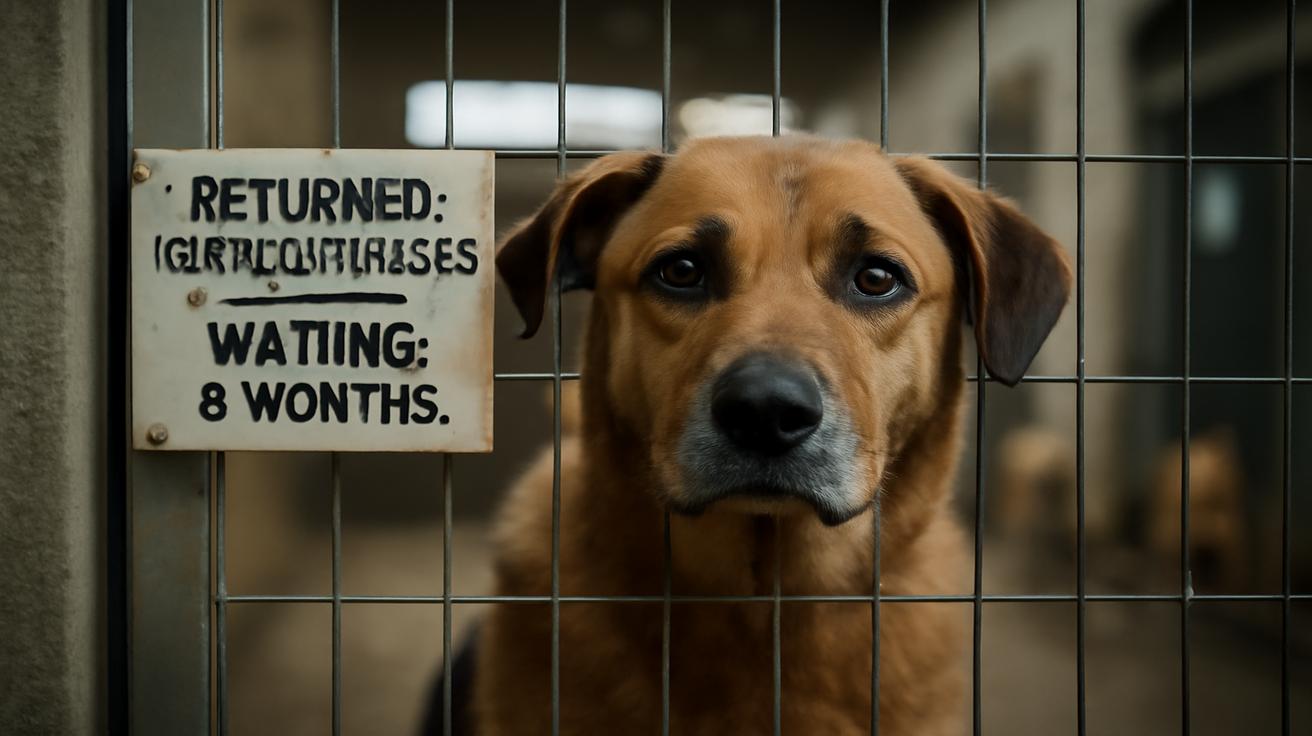
The sound that always gets to you first isn’t the barking. It’s the silence between the barks—the held breath, the small, fragile pocket of hope that lives in every pause. On a gray Tuesday afternoon, in a shelter that smells faintly of disinfectant and worn-out blankets, a dog named Milo sits and waits inside that silence. He knows the sound of footsteps in the hallway now. He knows the jingle of keys. And slowly, painfully, he’s starting to recognize the sound of people walking past his kennel… without stopping.
The Dog Who Thought He Was Already Home
Before Milo ever knew these concrete walls or the sharp echo of metal doors, there was a different soundscape: the soft clink of a cereal bowl on a kitchen counter, the rustle of mail slipping through a slot, the faint hum of a TV that was always just a little too loud. Milo had a home once. He had a bed—technically it was a blanket folded twice beside the couch—but it smelled like his people and that was enough.
He learned the rhythm of that life quickly. Morning walks on damp sidewalks, his nose mapping the neighborhood like a living atlas. The late-afternoon sun spilling in through the front window, making warm puddles of light where he liked to nap. The way his person’s voice shifted from rushed and clipped during weekday mornings to loose and playful on weekends. He was a good dog, and because dogs are wonderfully simple in this one sacred way, he believed that being loved once meant being loved always.
Then came the boxes. They appeared in stacks overnight, filling corners and swallowing up familiar objects. His food bowl moved into the hallway; his blanket disappeared into a crate. There were stressed voices behind closed doors, the kind of whispered arguments that humans think dogs don’t notice. Milo noticed. He always noticed when the tension in the air pressed down on him like an unexpected thunderstorm.
He heard the words “rent increase” and “eviction notice”, heard the phone calls with phrases like “no pets allowed” and “I don’t know what else we can do.” He watched his person sit on the floor and bury their face in their hands, the smell of salt and confusion hanging in the air. And one day, he rode in the car, his tail thumping against the seat, not knowing this drive would be the one that unstitched his whole world.
The shelter staff met them with practiced kindness. Paperwork rustled. A pen scratched across lines that listed his age, his color, his microchip number, the word “surrender reason: housing issues” circled neatly in blue ink. His person cried, hugging him so tightly he could feel their heartbeat race against his ribs. Then the door closed, just like that. The car pulled away. The sound of the engine faded. And Milo, who had done nothing wrong, was suddenly homeless.
The Slow Vocabulary of Shelter Life
Milo arrived with a collar that still smelled faintly like laundry detergent and the ghost of a familiar perfume. The staff gave him a new tag with a new number, and he entered the vocabulary of the shelter: “intake,” “kennel,” “behavior evaluation,” “adoptable.” He learned this new language the way dogs always learn—through tone and repetition, through the energy crackling in the air.
The days arranged themselves into a pale, looping pattern. Morning cleaning, the hiss of hoses and the scrape of metal bowls on concrete. Volunteers moving up and down the corridor, cheerful voices saying, “Good morning, sweet boy!” and “We’re gonna find you a home, okay?” Afternoon visiting hours, when the world opened for a brief time and strangers walked past like shoppers in a windowed mall of second chances.
Milo’s kennel became his entire universe: a bed, a blanket, two bowls, a couple of toys that collected a layer of hair and drool and hope. He started to recognize the subtle choreography of interest. There were people who looked at every dog, their gaze soft and open. There were people who walked quickly, eyes averted, as if they couldn’t bear to see all the wanting eyes behind glass. And there were people who stopped at his door, just for a second, their gaze scanning the info card clipped beside his kennel.
“Returned… housing issues,” they would read aloud. “Oh, buddy.” Their voices always dipped on that last word. It was pity wrapped in resignation. Housing issues. It sounded so sterile, so clinical. As if this dog were a logistics problem, not a living, breathing creature who had once followed the same pair of feet from room to room, just for the comfort of being close.
What “Housing Issues” Really Means
On the shelter’s intake form, “housing issues” fits neatly into a small checkbox. In the world beyond those walls, it translates into a messy storm of realities: rising rents, pet size restrictions, weight limits, breed bans, landlords who won’t budge no matter how well-behaved the dog is.
For Milo’s person, it had meant a sudden eviction notice taped to the front door, a frantic search through online listings, and the crushing realization that every apartment even close to affordable also had the same line in bold type: “No pets.” In the end, faced with homelessness or surrendering a dog, they made the decision that still kept them awake at night long after the moving truck was unpacked.
Milo never knew any of this, of course. He only knew that the world he understood evaporated, and in its place there was this—cement floor, stainless steel, and a parade of faces that smiled and then moved on.
The Counting of Days
In nature documentaries, time-lapse sequences make the passing of days look elegant, almost beautiful—clouds rushing across the sky, shadows stretching and shrinking. In a shelter kennel, time doesn’t rush; it thickens. It becomes something you wade through.
The staff started to mark Milo’s stay in their own quiet way. “He’s been here a month already,” someone would murmur while slipping him an extra treat. Two months. Three. The notes on his chart grew longer: “Walks nicely on leash,” “Loves tennis balls,” “Nervous around loud noises,” “House-trained,” “Previously lived with children.” They added photos to his profile—Milo in the yard with ears perked; Milo sitting politely with a volunteer, eyes focused, waiting for the “okay” to take a treat.
Yet still, day after day, he watched other dogs come in scared and trembling, then leave with families and car rides and bright promises about “forever.” Puppies went fastest, as they almost always do. Small dogs with curly coats and photogenic faces followed. Even the skittish ones sometimes found that perfect person who saw past the trembling to the trembling heart within.
Milo was a medium-sized dog with a tan coat and a few white patches. Not small enough to slip under a landlord’s weight limit, not unusual enough to stand out at a glance. Charming, but in a quiet way. It’s unfair, but in crowded shelters, quiet charm can be easy to overlook.
Every afternoon, as visiting hours began, Milo performed the ritual he had unknowingly practiced into perfection. He would stand when footsteps approached, tail wagging in a hopeful rhythm, ears lifted but not too high—eager, but not wild. He’d press gently against the kennel door if someone crouched down to greet him, leaning his body just slightly into their fingers as they reached through the bars. He gave his best “I could be yours” eyes to everyone who paused, his whole expression saying, I will love you with everything I have, if you’ll just pick me.
Sometimes, they almost did. They would ask about him, nodding as the staff explained his story. “Returned due to housing issues, not behavior,” they emphasized. “He’s a really good boy.” And they meant it. They weren’t selling; they were testifying. But interest is a delicate thing, easily swayed by logistics and timing and that intangible “spark.”
Life Between Hope and Heartache
On the edges of Milo’s world, tiny kindnesses bloomed. A volunteer who always sneaked him an extra five minutes in the outdoor yard. A staff member who washed his favorite blanket first when doing laundry so it would come back to him still warm and smelling faintly of sun. A teenager completing community service hours who sat cross-legged by his kennel, reading her homework out loud just to keep him company.
There were bad days, too. Days when a particularly loud dog down the row set off a chain reaction of barking and anxiety that left Milo pacing his kennel, eyes wide, muscles tense. Nights when a storm rattled the roof, and flashes of lightning turned shadows into something alien and unsettling. He adapted as best he could, as animals do, tucking his softer parts deeper inside, waiting for whatever would happen next.
Still, even on the hardest days, there was the walk. Twice a day, weather permitting, a leash would slip through his collar and the world would widen for a little while. He learned the layout of the shelter yard: the particular corner where the grass grew a bit taller, the tree that housed a squirrel who took his heckling duties very seriously, the spot along the fence where the late-afternoon sun found its way through.
If you watched closely, you could see him change when he was outside the kennel—how he moved with a lighter step, how his tail loosened into an easy curve instead of a tight, hopeful wag. Here, just for a few minutes, Milo wasn’t “returned for housing issues.” He wasn’t a case file or a number listed on an adoption page. He was simply a dog again, sniffing, trotting, pausing to tilt his head at distant sounds only he could fully decode.
The Humans on the Other Side of “No Pets”
For every dog like Milo sitting in a shelter, there’s often a human somewhere scrolling through rental listings or arguing with a landlord, wishing the rules were different. The phrase “no dogs” doesn’t just close the door on animals; it wedges itself into the lives of people who already consider those animals part of their family.
These problems can feel huge and untouchable, the kind of systemic tangles that individuals can’t easily fix. Yet change, in its quiet way, often starts small—with one conversation, one choice, one moment of deciding to look a little more closely at the life behind the label.
If you’ve ever wondered what “returned due to housing issues” might look like in actual lives, it can be as simple and heartbreaking as this: a child sleeping with a dog’s worn collar under their pillow because that’s all they have left, or a former pet parent who avoids the dog aisle at the store because the sight of squeaky toys hurts too much.
For Milo, all of these invisible human stories condensed into his own reality: a kennel, a blanket, kind strangers, and the long, slow wait for someone whose circumstances and heart could finally align.
A Table of Milo’s Shelter Days
For the staff, Milo’s journey could be summarized in a few key notes, the kind you might see scribbled on a clipboard or typed into a shelter database. It looks something like this:
| Detail | Description |
|---|---|
| Name | Milo |
| Age | 4 years |
| Reason Returned | Housing issues (no-pets rental, eviction) |
| Time in Shelter | Several months and counting |
| Personality | Gentle, loyal, loves walks and quiet company |
| Ideal Home | Stable housing, patient adopter, time for walks and cuddles |
On paper, it’s organized and tidy. In reality, each of those lines is a whole story—a life interrupted, a dog enduring, a shelter doing its best to hold the space between loss and possibility.
The Day Everything Almost Changed
On a bright, cool morning somewhere around the fourth month of Milo’s stay, a family walked in: two adults, one teenager, and a boy of about eight with a cowlick that refused to be tamed. They moved slowly down the aisle, stopping at nearly every kennel, voices low, hands stretching out to offer quick, apologetic pats through the bars.
When they reached Milo, the boy crouched down so fast his sneakers squeaked on the floor. Milo came forward, polite and hopeful as always, pressing his nose gently to the gap. The boy laughed, a quick surprised sound, and then did something unusual—he just stayed there. He didn’t move on after a few seconds the way most visitors did.
“What about this one?” the boy asked, without taking his eyes off Milo. “He looks like he needs us.”
The words hung in the air, almost sacred. The staff member who had been trailing them smiled cautiously, then began the well-practiced litany of information: age, temperament, “returned due to housing issues, not his fault.” The adults asked thoughtful questions. The teenager snapped a quick photo and smiled when Milo tilted his head towards the camera.
Paperwork was discussed. A home visit was scheduled. The boy pressed his palm flat against the kennel door and whispered, “See you soon, okay?” Milo watched them leave with that same mix of hope and dread that shelters dogs learn too young: the ache of wanting paired with the fear of wanting too much.
Days passed. The staff checked voicemail, refreshed email inboxes, glanced at the door each time the bell chimed. Sometimes everything comes together the way you want it to, as if kindness and timing finally agreed to cooperate. Sometimes, though, life tangles itself again.
This time, the call came with apologies. The family’s application had been approved, but at the last minute, their landlord added a new restriction: weight limit, twenty-five pounds. Milo was nearly twice that. Rules were rules, they had been told. Exceptions were not possible.
The staff member who took the call looked over at Milo’s kennel, where he lay with his head on his paws, watching the corridor. Quietly, she hung up the phone, walked over, and slipped him a treat through the bars. Her eyes shone with frustration that had nowhere to go.
“It wasn’t them,” she murmured to him, as if he might understand. “It was the rules.”
The Long Wait for “Forever”
Months in a shelter can soften some dogs, turning their exuberance into something gentler. It can harden others, too, layers of wariness forming like sediment. Milo stayed somewhere in between. He was slower to rise when visitors came now, his hopeful wag paced carefully, as if he’d learned to ration his heart.
And yet, if you sat with him—really sat, not just a quick hello—you’d find him leaning into your side, the weight of him a steady presence. You’d see the way his eyes closed halfway when you scratched that one spot just behind his shoulder. You’d watch his guard unclench, little by little, replaced by something softer: trust, fragile but still there.
Forever homes are funny things. We talk about them as if they’re a destination pinned neatly on a map, a place you arrive at and never leave. In reality, they’re made moment by moment: rent paid, landlords negotiated with, dogs walked and fed, couches shared, patience extended on hard days. They are, at their core, an agreement between lives: I’ll stay, if you’ll stay. I’ll keep trying, if you will.
Milo doesn’t know the word “forever,” but he knows the feeling of continuity, of belonging. He knows what it is to have a spot that is his, a routine that hugs his days like a well-worn jacket. Somewhere out there, perhaps even as you read this, the person meant to share that continuity with him is scrolling through photos or walking down shelter aisles, not yet realizing that the quiet, tan dog with the gentle eyes is the missing piece of their daily life.
What We Can Do for Dogs Like Milo
The story of a single dog in a single shelter carries within it the outline of a much larger picture—one where housing, policy, and compassion intersect in complicated ways. While not everyone can change the rules of the rental market or rewrite pet policies overnight, there are things each of us can do that matter deeply to dogs like Milo.
If you’re able to adopt, you can walk into a shelter and ask a simple, powerful question: “Who has been here the longest?” Often, the staff will light up, because you’re not just looking for the cutest puppy in the front row; you’re offering a lifeline to the quiet souls waiting in the back.
If adoption isn’t possible right now, fostering can be a bridge between instability and home—a way to free up shelter space and give a dog a crucial break from the stress of kennel life. Volunteering to walk dogs, read in the kennels, or simply spend time offering calm touch and company helps them hold onto their sense of self until their person arrives.
Even conversations matter: pushing gently when you can for more pet-inclusive housing, supporting local policies that protect families with animals, challenging the idea that dogs are disposable when life gets hard. When we recognize that “returned due to housing issues” is a symptom of larger problems and not a reflection of a dog’s worth, we start to shift the ground under all their paws.
Back in his kennel, Milo lifts his head as the afternoon light slants through the high windows. Footsteps echo down the corridor. Another day, another round of maybe. He stands, shakes out his fur, and moves toward the door, tail beginning its careful, hopeful arc. For now, he waits. But somewhere between the sound of approaching shoes and the rustle of paperwork, the possibility of “forever” is still alive—quiet, persistent, and, like Milo himself, refusing to give up.
Frequently Asked Questions
Why are so many dogs returned to shelters for “housing issues”?
“Housing issues” is often a shorthand for problems like sudden rent increases, evictions, landlord restrictions, breed or size bans, or moving to buildings that don’t allow pets at all. These pressures can force even loving owners into heartbreaking decisions when they’re faced with the choice between keeping a roof over their heads or keeping their animals.
Is a dog returned for housing problems more likely to have behavior issues?
Not usually. Dogs like Milo are often surrendered specifically because of circumstances out of their control, not because they’ve done anything wrong. Many are house-trained, social, and well-behaved, which shelters will note in their profiles and behavior assessments.
How can I help dogs in shelters if I can’t adopt right now?
You can foster, volunteer to walk or socialize dogs, donate supplies or funds, share adoption profiles on social media, or simply spend time sitting quietly with shy or long-stay dogs. Every bit of consistent, kind human contact helps them stay emotionally balanced while they wait.
What should I consider before adopting a dog with a history of being returned?
Look carefully at the reason for return, ask shelter staff detailed questions, and be honest about your own lifestyle and housing situation. Make sure pets are allowed where you live, consider your long-term plans, and be prepared to offer patience as the dog adjusts to yet another big change.
Can talking to landlords really make a difference for pet policies?
Sometimes, yes. Providing references from previous landlords, offering to pay a pet deposit, or showing proof of training and vaccinations can ease concerns. While not every landlord will bend, respectful, informed conversations can occasionally open doors—for you and for dogs like Milo who just need one stable place to land.






Leave a Comment