
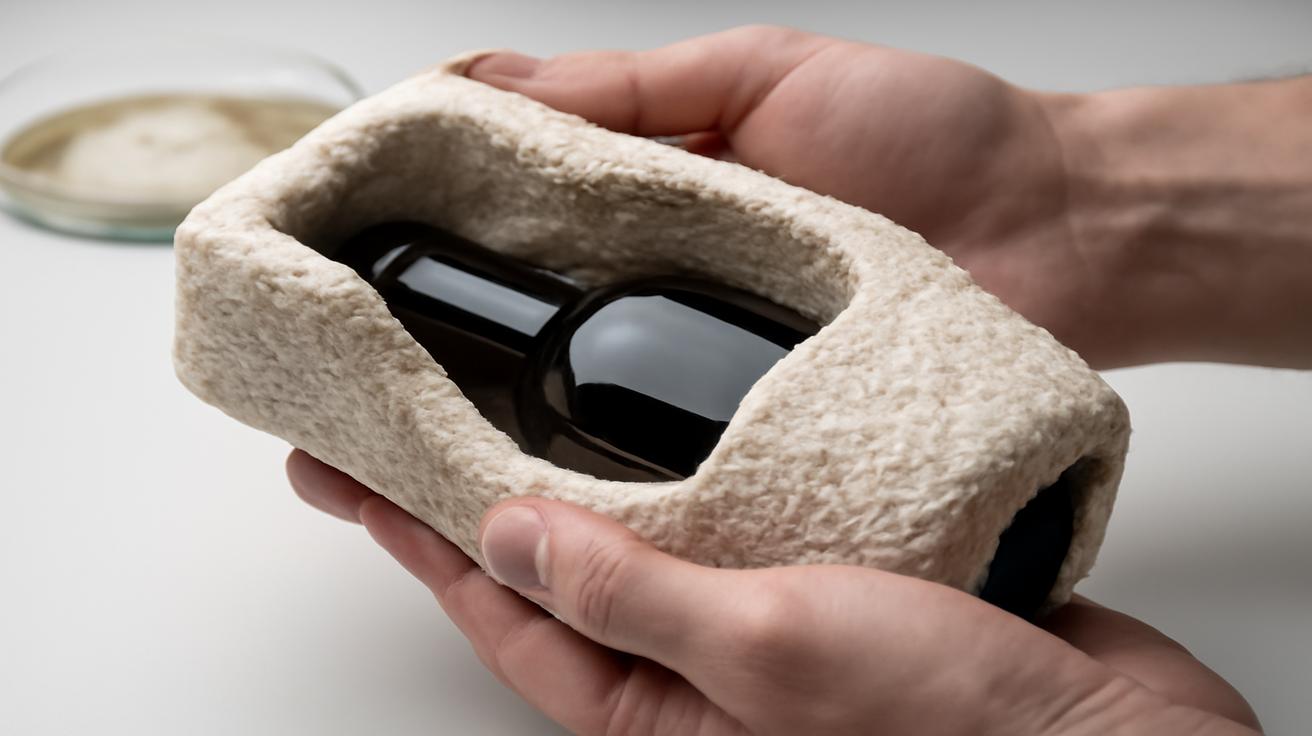
The package sits in your hand like something half-remembered from a forest walk—not quite paper, not quite cloth. It’s light, faintly textured, with the gentle give of dried orange peel. You pinch it between your fingers and wait for the telltale crackle of plastic. Nothing. Instead, there’s a hushed, fibrous whisper, like rubbing two autumn leaves together.
Somewhere in Finland, not far from a stand of birch trees and a quilt of moss, this story began with a handful of fungus, a question about the future, and a stubborn refusal to accept that plastic was the best we could do.
The day they met the fungus that eats our future
On a mist-filtered April morning, research scientist Aino Kallio pushed open the door to a small lab on the edge of a Finnish university campus. The room smelled faintly of wet soil and agar—the sterile jelly used to grow microbes. Petri dishes were stacked in neat, hopeful towers. On the far side, next to a light-filled window, stood a series of clear boxes where something pale and fuzzy was quietly claiming territory.
“It doesn’t look like much,” she remembers saying, when she first saw the fungal strain that would change everything. On the surface of a brownish substrate—a mixture of agricultural waste and carefully chosen nutrients—a white network of threads was spreading, weaving itself into a tight, living fabric. No color. No drama. Just the silent intention of growth.
The fungus had been collected from a forest floor, one of countless species that spend their days digesting dead leaves, fallen branches, and the forgotten leftovers of seasons past. In the wild, these organisms are the quiet custodians of decay and renewal. In the lab, they had a new brief: build something life could borrow, then easily return.
It was a small team with a big question. Could a fungus, given the right food and the right conditions, grow into a material that might one day replace plastic packaging—the crinkly, stubborn, almost immortal skins we wrap around nearly everything we buy?
How to grow a package from a forest whisper
Unlike plastic, which begins its life as fossil fuel wrenched from underground and turned into pellets and films in sprawling industrial complexes, fungal material starts humbly. It begins as spores or a scrap of living mycelium—the branching, root-like structure that is the true body of a fungus—introduced to plant-based leftovers: sawdust, straw, or by-products from agriculture and food industries.
Inside shallow trays, this Finnish team laid out their substrate like soil in a seedling bed. Then they introduced the fungus and watched. The lab lights hummed softly. The air held a chill tempered by warm incubators. Day by day, thin white threads spread across the surface like frost crawling over a window. They dove between particles, around fibers, knitting raw waste into something new.
To slow down enough to really see mycelium do its work is to witness a quiet engineering miracle. It doesn’t just sit on top of matter; it infiltrates it. It glues, binds, and transforms, one microscopic junction at a time. The Finnish researchers tuned temperature, moisture, and oxygen the way bakers tweak proofing times. Too dry and the growth slows to a sulk. Too warm and it races out of control, brittle and weak. Somewhere in the middle, a sweet spot: uniform growth, dense structure, a soft resilience under the hand.
After a few days, the trays no longer looked like scrap material at all—they resembled sheets of off-white foam. At that point, the team gently removed the living mats and treated them with heat to stop further growth. That final step turned a living organism into a stable material; the fungal network froze in place, becoming the backbone of something that felt startlingly familiar in the hand and yet profoundly different in its story.
The surprising feel of the future
When Aino handed one of the first successful samples to a colleague from the packaging industry, he turned it over in his hands with a kind of wary curiosity. It was thin but not flimsy, with a subtle grain like very fine felt. It flexed without creasing, bounced back from pressure, and, most importantly, held its shape.
“It feels…safe,” he said. Safe for what? For chocolate bars? For electronics? For the soft ripeness of summer berries? The team had tested all of these. With a few adjustments in growth time and substrate, they found they could shift the material’s properties: a denser structure for impact protection, a more open one for breathability, a wax-like coating (also bio-based) to repel moisture when needed.
For years, sustainability advocates had dreamed about biomaterials that weren’t just novelty items but serious contenders for mass packaging. This fungus, and the method developed around it, quietly crossed that line. Suddenly the idea of walking down a supermarket aisle without the familiar rustle and glint of plastic no longer seemed like fantasy. It felt closer—like something that might be just a few funding rounds and pilot plants away.
Why a Finnish fungus matters in a plastic-choked world
Plastic is a paradox material: both miracle and menace. It keeps food fresh, makes medical equipment sterile, and holds together the devices we rely on. It’s cheap, light, and adaptable. And because of all that, we use it as if there were no tomorrow.
But there is a tomorrow, and we are walking into it surrounded by the ghosts of yesterday’s convenience. Plastic lingers for centuries. It breaks down into fragments that ride the wind, swim the oceans, and slip into our bodies in particles too small to see. Landfills and incinerators strain under the tidal wave of disposables.
In Finland, a country where forest is more common than asphalt and where winter light filters through spruce branches for half the year, the idea that our packaging should behave more like leaf litter than like stone feels intuitive. What if our containers, films, and cushions were not destined to outlive us, but to quietly rejoin the soil within months or years?
The team’s fungus-based material doesn’t just avoid the fossil fuel origins of plastic. It can be made from agricultural by-products—husks, stalks, sawdust—that would otherwise be burned or left to rot less usefully. It grows at low temperatures compared to the energy-intensive processes that melt and mold plastic. And at the end of its useful life, under the right conditions, it doesn’t just disappear; it feeds the same world it came from.
From petri dish to packing line: can it really scale?
Hopeful prototypes are one thing; industrial reality is another. Could this quiet fungal mat ever stand shoulder to shoulder with the global plastic industry, which churns out hundreds of millions of tons per year?
To answer that, the researchers moved from tiny dishes to trays the size of baking sheets, then to shallow vats big enough to cradle hundreds of future packages at once. The process turned out to be surprisingly modular. You don’t need massive pressure or extreme heat. You need clean rooms, controlled humidity, and smart design. You need to choreograph growth like a well-run bakery operation: inoculate, incubate, harvest, cure.
And you need to make sure the material behaves predictably. So the Finnish group, partnering with engineers and material scientists, pushed samples through tests that were far less romantic than forest walks: compression tests, tear resistance, water vapor permeability, shelf-life trials. Each passed threshold turned what had been a clever lab curiosity into a candidate for real-world roles: cushioning for electronics, trays for produce, wraps for bakery goods.
For consumers, all of this hard work could one day show up as something very simple: you unwrap your new phone, or your carefully packed berries, and instead of throwing the packaging into the bin with a guilty pang, you crumble it into your compost or kitchen waste bin with a strangely satisfying sense of return.
What this fungus can (and can’t) do compared to plastic
In one of their early outreach sessions, the researchers were asked to summarize the differences between their fungal packaging and conventional plastic in a way a non-scientist could understand. The answer ended up as a simple comparison tucked into a lab notebook—a sketch that has since been refined into something like this:
| Feature | Conventional Plastic Packaging | Fungus-Based Packaging (Mycelium Material) |
|---|---|---|
| Origin | Fossil fuels (oil, gas) | Renewable biomass + fungal mycelium |
| Production energy | High heat and pressure | Low to moderate, ambient growth conditions |
| End-of-life | Persists for decades to centuries; often landfilled or incinerated | Compostable under proper conditions; returns to soil as organic matter |
| Typical use cases | Food wraps, cushioning, rigid containers, films | Protective packaging, trays, inserts, some wraps and liners |
| Biodegradation risk in environment | Very low; fragments into microplastics | Designed to break down fully, if discarded in composting conditions |
It’s not magic. There are still challenges. Pure plastic films offer an almost unsurpassed barrier to oxygen and moisture; they can be made razor-thin and crystal-clear. Fungal materials, at least in their current incarnations, tend to be thicker, more opaque, and sometimes less water-resistant without added coatings.
And yet, for a massive slice of packaging needs—cushioning, trays, containers that don’t need to be transparent—mycelium-based materials don’t just compete; they shine. They can be tailored to be shock-absorbing, breathable, or rigid, depending on how densely the fungus is allowed to grow and what it is fed. They don’t demand virgin forests; they thrive on what we already consider leftovers.
What happens when you throw it away
Perhaps the most poetic difference between the two materials reveals itself not in factories or stores, but in the quiet moment after use—when the cheese has been eaten, the headphones unboxed, the berries washed and shared.
With plastic, that moment carries a kind of helpless weight. Even the most conscientious recycler suspects that many items will someday bob in a distant sea or sit compressed in a landfill, layers of human habit stratified like sedimentary rock.
With fungus-based packaging, the ideal end is different. The researchers in Finland have watched their material soften and crumble in composting setups, surrendering its structure to microbes and worms. Over weeks to months, depending on conditions, it returns to something that looks suspiciously like the material it began with: an earthy, dark humus laced with the memory of plants and rain.
The packaging doesn’t just vanish; it contributes. It enriches soil, which feeds plants, which might one day provide the agricultural side-streams that fuel another generation of fungus. A loop, not a line.
A forest’s logic in a human-made world
The discovery in Finland is not an isolated miracle. Around the world, researchers and entrepreneurs are exploring mycelium as building blocks for everything from insulation to furniture. But there is something particularly resonant about its emergence as a plastic replacement in a country where forest literacy is almost a birthright.
In Finland, children grow up knowing the difference between spruce and pine, between chanterelle and the mushrooms best left unpicked. The forest is pantry, playground, and place of pilgrimage. It’s perhaps no coincidence that in such a culture, scientists would look to fungi—the hidden threads beneath the moss—for answers to one of our most visible problems.
When Aino talks about her work, she doesn’t use the language of conquest or extraction. She talks about collaboration. “We’re not forcing the fungus to do something unnatural,” she says. “We’re giving it a task that aligns with what it already does: bind, protect, transform. We’re just guiding the shape.”
That shift in thinking—from materials as inert objects to processes as living collaborations—may be one of the deeper revolutions hiding inside this simple-looking sheet of packaging. Instead of asking, “How do we make nature more like a factory?” the question becomes, “How can our factories behave more like forests?”
Imagining a future without plastic rustle
Fast-forward a decade, if the Finnish vision and similar projects elsewhere succeed. You walk into a grocery store. The loudest sounds are footsteps, murmurs, the hiss of refrigeration—not the staccato crackle of plastic film. Most things are wrapped in materials that feel textile-like or papery, some smoother, some softly padded, all with a satisfying, compost-ready dullness.
At home, your recycling bin no longer overflows with lightweight, awkward shapes that seem to breed overnight. Instead, a small pail in your kitchen collects not only carrot peels and coffee grounds but also the tattered remains of packages that once cradled your goods. Every few days, you empty it into a backyard compost, a communal collection spot, or a municipal system that knows exactly what to do with such bounty.
On a hillside somewhere, the soil slowly fattens. Invisible workers—bacteria, fungi, worms—sort through the offerings, turning them into structure and sustenance. Some of that enriched soil feeds trees. Some nourishes the fields that grow the stems, husks, and fibers that will one day feed the fungi in the Finnish-inspired facilities of the world.
It’s not a plastic-free utopia; there will still be applications—medical equipment, long-life infrastructure—where durable polymers make sense, at least for now. But the throwaway world, the single-use mindset, begins to look as archaic as leaded gasoline and smoking on airplanes.
Questions we still need to ask—and answer
Every bright solution casts a shadow of new questions. If fungus-based packaging scales up, how do we make sure we’re not putting pressure on other systems—like land use for growing substrate materials? Can we standardize composting infrastructure so that what is technically compostable actually ends up composted, not in landfills? How do we keep costs low enough that a supermarket in a small town, not just a high-end boutique brand, can afford to switch?
The team in Finland is wary of overpromising. They know that “forever” is a dangerous word, especially in technology. Innovations are updated, replaced, refined. But they also know that some shifts are more than iterative. They mark a departure point. The discovery that a humble forest fungus, guided carefully, can give us a serious alternative to plastic packaging feels like one of those points.
Standing in their lab, where the steady white creep of mycelium turns waste into possibility, it’s hard not to feel a twinge of perspective. For billions of years, fungi have been performing a service we barely noticed: breaking down, reforming, closing loops. Only now are we beginning to understand that the intelligence in those threads is not merely ecological, but technological—if we choose to partner with it.
Someday soon, you might hold a package grown from the logic of a forest, tear it open with the easy knowledge that you are borrowing, not stealing from the future, and hear, instead of the sharp crackle of plastic, a sound much softer: the whisper of a different way of being in the world.
FAQ
Is fungus-based packaging safe for food contact?
Yes, when produced under controlled conditions and certified for food contact, mycelium-based packaging can be safe for wrapping or containing food. The Finnish researchers carefully select non-toxic fungal strains and substrates, and the material is heat-treated to stabilize it before use.
Will mycelium packaging decompose on my shelf?
No. The packaging is “deactivated” by heat after it has grown to the desired shape, which stops further fungal growth. Under normal indoor conditions—dry and protected—it remains stable. It only begins to break down properly in composting or soil-like environments with moisture and microbes.
Can I compost this kind of packaging at home?
In principle, yes. Mycelium-based packaging is designed to be compostable. However, how quickly it breaks down depends on your compost conditions (temperature, moisture, microbial activity). Many products will also be compatible with industrial composting facilities where available.
Does fungal packaging cause allergies or mold problems?
The active, living part of the fungus is inactivated during production. What remains is a dry, inert structure made from fungal fibers and plant-based material. For most people, this poses no greater allergy risk than paper or cardboard. As with any organic material, if stored in very damp conditions, it can support mold growth, so dry storage is recommended.
Can this really replace all plastic packaging?
Not all of it. Mycelium materials are excellent for many types of protective packaging, trays, inserts, and some wraps, but ultra-thin, ultra-clear, high-barrier films for certain foods or medical uses may still require other solutions. The most realistic future is a mix: fungal packaging replacing a large share of single-use plastics, alongside other sustainable materials and smarter system design.
Is it more expensive than plastic?
Right now, early-stage materials often cost more than mass-produced plastics because the infrastructure is young and not yet optimized. As production scales and supply chains mature, costs are expected to drop, especially since the raw ingredients—agricultural by-products—are abundant and inexpensive.
Will we see fungus-based packaging in regular stores soon?
In some regions, pilot products are already on shelves, often in partnership with environmentally focused brands. Wider adoption will depend on scaling production, regulatory approvals, and retailer willingness to change. If ongoing trials remain successful, seeing mycelium-based packaging in mainstream supermarkets within the next several years is a realistic possibility.





Leave a Comment