
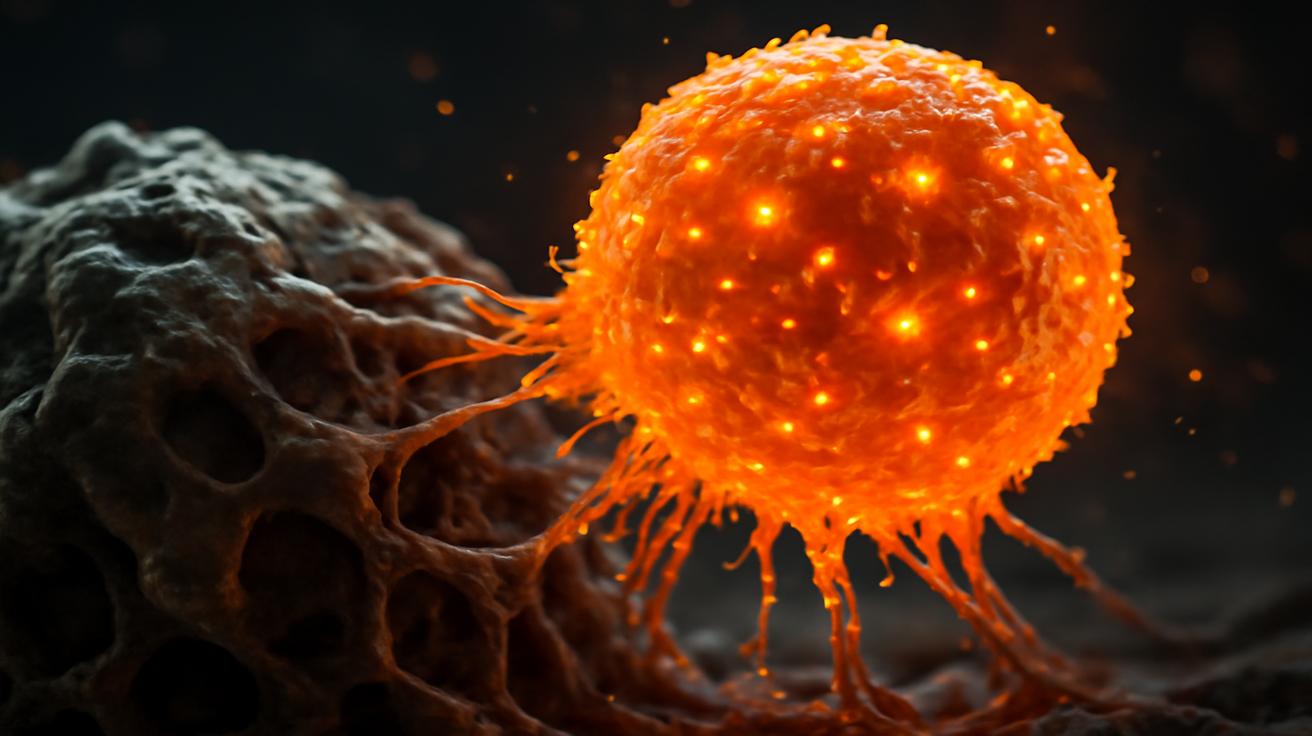
The first thing you notice is the quiet. A lab at dusk, the hum of refrigerators, the faint blue glow of incubators ticking away in the corner. On a glass slide beneath the lens of a confocal microscope, a tiny universe is lit up in fluorescent colors—greens, reds, and blues shimmering like a distant nebula. A researcher leans in, focusing carefully. On the screen, something stirs: a T cell, one of the immune system’s elite soldiers, brushes against a cancer cell. For a long time, these cells have passed each other like strangers in a crowd—present, but not truly awake to the danger. Tonight, that is changing. Somewhere in the middle of all that color and motion, the immune system is waking up.
The Silent War Inside the Body
Inside every one of us, there is a war that never quite ends. Most of the time, we never feel it; there’s no dramatic battle soundtrack, no cinematic alarm bells, just the quiet, constant work of immune cells sifting through ordinary life—dead skin, stray bacteria, the mild chaos of being alive.
Among the most disciplined fighters in this invisible army are T cells. They’re precise, highly trained, and astonishingly ruthless when they know what they’re looking for. Give them a clear target—an infected cell, a virus, or a malfunctioning cell that’s starting to turn cancerous—and they can lock on and destroy it with uncanny accuracy.
But cancer is clever. It doesn’t march into the body waving a flag that says, “Here I am.” It hides. It edits the signals on its own surface, masks itself in molecules that whisper “I’m normal” to passing immune cells. Even more chilling, it learns to lull T cells into a kind of exhaustion. The soldiers are still there, but they’re tired, confused, numbed by the signals the tumor sends out. The war continues, but some of the best fighters are half-asleep on their feet.
For years, cancer immunotherapy has focused on trying to take the brakes off these T cells—especially through drugs called checkpoint inhibitors. Those drugs have changed lives; they’ve turned certain cancers that were once almost certainly fatal into long-term, manageable conditions for some patients. But not everyone responds. For many people, the cancer still slips by, the T cells still don’t fully wake up… or they wake briefly, then fade back into exhaustion.
This is where a new, quietly radical line of research steps in: not just freeing T cells, not just pointing them at the right target, but learning how to flip the switch that brings them fully, vibrantly, back to life.
The Moment a T Cell Wakes Up
In one recent study, a group of researchers set out to understand a deceptively simple question: what, at the most intimate molecular level, separates a T cell that dozes through a tumor from one that wakes up and attacks?
They started, as many breakthroughs do, with a hint. In both animals and humans, there are rare moments when a person’s immune system spontaneously mounts a surprisingly strong anti-cancer response—tiny flares of resistance in an otherwise overmatched body. When scientists looked closely at those moments, they started to see patterns in the T cells themselves.
Cancer-killing T cells that were truly awake had a specific profile—certain genes upregulated, others quieted, a particular balance of metabolism that let them stay active and resilient instead of burning out. It was like discovering that the best fighters in a vast army all shared the same training regimen and diet.
Under the microscope and in sequencing machines, the researchers traced a signature in these awakened T cells: a network of signaling pathways that governed how the cells used energy, how they responded to stress, and how they decided whether to keep fighting or shut down. They weren’t just looking at “on” or “off” switches anymore; they were looking at the dimmer controls on the whole immune system.
What made the work different was not simply that they cataloged this awakened state, but that they found a way to nudge exhausted T cells into it—on purpose.
Finding the Immune System’s “Coffee”
Imagine you’re trying to wake up a tired friend. You could shout. You could shake them. Or you could figure out what their favorite kind of coffee is and slide a warm cup into their hand. The researchers were effectively searching for the immune system’s coffee—something that would not just jolt T cells briefly awake, but energize them in a way that was sustainable and specific.
They focused on a set of molecules that control how T cells process nutrients—things like glucose and amino acids. Tumors are notoriously greedy for fuel; they pull sugar and oxygen and building blocks out of their environment so aggressively that nearby immune cells find themselves starved. Even if a T cell wants to attack, it’s like trying to sprint with no oxygen in your lungs.
By targeting a particular metabolic pathway—tweaking the way T cells generate energy inside their mitochondria—the researchers found they could restore stamina to these cells. It wasn’t about giving them more power in a vague way; it was about shifting them from a short-burst, “I can fight but only for a moment” mindset into a long-distance, marathon-ready state. In lab dishes and animal models, T cells that had previously been sluggish suddenly began to proliferate, move, and kill again.
And crucially, this wasn’t just a matter of flooding the body with stimulants. The team discovered that certain combinations of signals—a small molecule drug here, a targeted antibody there—could gently but effectively push T cells into an awakened, cancer-killing mode without sending the rest of the immune system into harmful overdrive.
The Tumor Microenvironment: A City Under Fog
To really understand why this matters, it helps to picture the tumor not as a single invader, but as a city. The streets are crowded with cells: cancer cells, immune cells, blood vessel linings, fibroblasts, and more, all wrapped in a thick soup of chemical signals. Over time, the tumor rewrites the politics of that city. It puts up roadblocks. It spreads smog that blurs the lines between friend and foe. It bribes certain immune cells into helping it instead of fighting it.
The T cells meant to patrol this city often wander in like confused visitors. They might recognize that something is wrong, but the air is so thick with suppressive signals—molecules like TGF-beta and IL-10, checkpoints like PD-L1—that their instincts become muffled. Some turn around and leave. Others hang back at the edge, hesitant. Still others sink into that now-familiar exhausted state, present in the tumor but unwilling or unable to attack.
The new research zeroes in on this fog. Instead of simply blasting the city with more immune cells and more drugs, the scientists asked: what if we change how the T cells feel once they’re inside that space? What if, instead of becoming tired and fogged over, they become more resistant to the tumor’s tricks?
In their models, that is exactly what began to happen. By priming T cells before they entered the tumor—and in some cases, by delivering drugs directly into the tumor region—the team created pockets of clarity. The T cells seemed to “see” more clearly. They recognized cancer cells more reliably and held onto that recognition longer. In some animals, tumors that had been growing steadily began to shrink, and in a few cases, they disappeared entirely.
It wasn’t a miracle cure. Not every tumor responded. Not every T cell could be rescued. But there was something quietly revolutionary about seeing exhausted cells regain purpose in such an unfriendly landscape. A city that had trained its visitors to ignore the danger was, piece by piece, becoming visible again.
The New Playbook: Combining Old and New
Immunotherapy has always lived by a basic principle: the body, when properly guided, can be its own best defense. What this new way of waking up T cells offers is not a replacement for existing tools, but a refinement of that principle.
Checkpoint inhibitors remove certain molecular brakes that keep T cells from attacking. CAR-T therapies engineer T cells with redesigned receptors, giving them a sharper ability to recognize cancer. Cancer vaccines attempt to train the immune system to see tumor markers sooner and more clearly.
The newly discovered pathways fit into this landscape like a missing piece. Instead of just pointing T cells at the problem or freeing them to act, they change the very texture of how those cells live inside the tumor environment. Awakened T cells not only attack more vigorously, they endure longer. In early tests, combining this metabolic and signaling “reprogramming” with existing checkpoint inhibitors created a kind of layered defense: the brakes were lifted, the targets were in focus, and the engines of the T cells were tuned for the long haul.
For patients, the hope is straightforward: more responses, deeper responses, and responses that last. For clinicians and researchers, the questions multiply. How do you time the treatments? Which patients are most likely to benefit? How do you avoid waking up T cells in ways that might lead them to attack healthy tissues?
To begin to answer those questions, teams have turned to something that’s becoming a quiet revolution in itself: deeply personalized immune profiling.
Listening to Each Patient’s Immune Story
On another bench in the same lab, tubes of blood sit in a rack, each one labeled with a code instead of a name. Inside those tubes is an entire story: how that person’s immune system has lived, what infections it has seen, what stresses it has endured, and how it currently understands the presence of a tumor.
Using single-cell sequencing, advanced imaging, and machine-learning tools, researchers now comb through those stories in exquisite detail. They can map not just “how many T cells” a patient has, but what states those T cells are in. Are they energized or already sliding into exhaustion? Are they primed for rapid division or stuck in a quiet, memory-like phase? Which signals do they respond to, and which do they seem to ignore?
Matching this data with the new awakening strategy is like learning to tailor a suit instead of handing everyone the same off-the-rack jacket. A patient whose T cells are present but sluggish might benefit most from a metabolic reprogramming drug. Another, whose T cells are highly active but shut down by checkpoints, might need a different combination. Someone whose T cells are scarce or misdirected might be steered toward engineered-cell therapies, with these awakening tools layered on top.
It shifts the story from “one-size-fits-all miracle cure” to something more honest, and perhaps more hopeful: a toolkit that can be arranged and adjusted to fit the very specific immune landscape inside each body.
To capture this emerging picture, researchers are beginning to organize the complex data into simple, patient-friendly frameworks—ways to talk about where a person’s T cells are starting from, and what it might take to wake them.
| T Cell State | What It Looks Like | Possible Strategy to Help |
|---|---|---|
| Fully Exhausted | Present in the tumor but barely attacking; low energy, muted signals. | Metabolic reprogramming plus checkpoint inhibitors to restore stamina and focus. |
| Partially Awake | Sometimes attack, sometimes stop; sensitive to tumor’s suppressive signals. | Targeting the tumor microenvironment to reduce “fog,” combined with boosting T cell resilience. |
| Hyperactive but Short-Lived | Strong early response that fades quickly; cells burn out. | Fine-tuning energy use in T cells to support longer-term activity. |
| Scarce or Misguided | Few T cells in or near the tumor; may not recognize cancer well. | Cancer vaccines or engineered T cells, then applying awakening strategies to keep them effective. |
Between Caution and Possibility
All of this lives in a delicate space between excitement and restraint. New ways to wake up T cells are not yet standard treatments. Many are still in early clinical trials, where volunteers and physicians step carefully through dose levels, side-effect monitoring, and follow-up scans.
There are real risks. An immune system that is too awake can turn on healthy tissues, leading to autoimmune-like problems in the skin, gut, lungs, or other organs. The more we learn to press on the immune system’s gas pedal, the more carefully we have to pay attention to where the steering wheel is pointed.
But there are also moments that are hard to ignore. A scan where a once-solid tumor looks mottled and shrunken. Lab readings where dormant T cells suddenly show markers of renewed vigor. A patient who finds themselves, months into a trial, with a little more breath on the stairs, a little less ache in the night.
These are not yet the sweeping, universal cures that headlines sometimes promise. They are, instead, a gradual rewriting of the relationship between cancer and the immune system—a shift from resignation to negotiation. The immune system is no longer just a bystander to be occasionally nudged. It is a partner that we are learning, molecule by molecule, to speak with.
In that dim lab, the fluorescent colors still flicker. The T cell makes contact again with the cancer cell, but this time, the conversation is different. Signals flow. The T cell tightens its grip. Proteins align, pores open, lethal molecules slide across the narrow space between the two cells. Under the quiet hum of the machines, an invisible decision is made: this cell does not belong here. And for the first time in a long time, the soldier remembers what it was trained to do.
Looking Ahead: From Bench to Bedside
The road from a glowing image on a monitor to a treatment in a clinic is long, sometimes painfully so. It runs through layers of animal studies, safety trials, small patient groups, large randomized studies, regulatory reviews, and years of follow-up. Many promising ideas, no matter how elegant in a lab dish, simply don’t make it all the way.
Yet the concept at the heart of this new discovery—learning to wake up cancer-killing T cells in precise, sustainable ways—feels less like a single fragile idea and more like a direction. It opens questions that other researchers can chase from different angles: how diet and metabolism influence T cell states; how stress and sleep affect the immune landscape; how to design local drug delivery systems that alter the tumor microenvironment only where it’s needed.
In the coming years, if you walk through a major cancer center, you may begin to hear new language threaded through the old vocabulary of stage, grade, and mutation. Words like “exhaustion profile,” “metabolic fitness,” and “T cell awakening score” may slip into conversations between oncologists and patients, turning what once seemed like a faceless disease into something more textured and, crucially, more negotiable.
For patients and families moving through the labyrinth of cancer care right now, the promise is not that one new switch will fix everything. It is that the switches exist—that inside each of us are cells that can be coaxed back from the edge of fatigue, taught to see through the fog, and invited once more to do what they were always meant to do.
Out beyond the lab, beyond the hospital walls, life goes on in all its ordinary chaos: leaves pushing out on trees, traffic lights changing, children running until they’re breathless and then running some more. Somewhere inside each of those bodies, T cells are moving like quiet sentries, patrolling, remembering, learning. We’re just beginning to understand how to talk to them. And somewhere, under the lens of a microscope, one of them is waking up.
FAQ
What exactly are T cells?
T cells are a type of white blood cell that play a central role in the immune system. Some T cells directly kill infected or cancerous cells, while others coordinate broader immune responses by sending signals to other cells.
What does it mean to “wake up” cancer-killing T cells?
“Waking up” T cells refers to reversing a state called exhaustion, where T cells become tired and less effective after prolonged exposure to cancer. Researchers are finding ways to restore their energy, focus, and killing ability so they can better attack tumors.
Is this new approach already available as a treatment?
Most of these strategies are still in the research and clinical trial phases. Some related tools, like checkpoint inhibitors, are already approved and widely used. The specific methods that reprogram T cell metabolism and states are being carefully tested for safety and effectiveness.
How is this different from existing immunotherapies?
Traditional immunotherapies often remove brakes from T cells or help them better recognize cancer. The new approach focuses on changing the internal state and energy use of T cells so they can stay active longer, resist the tumor’s suppressive environment, and maintain their killing power.
Will this work for all types of cancer?
Probably not in the same way for every cancer. Different tumors create different immune environments. Researchers hope that by combining T cell–awakening strategies with other treatments, more types of cancer—and more patients—will respond, but results will likely vary.
Are there risks to boosting T cell activity?
Yes. Overactive T cells can sometimes attack healthy tissues, leading to inflammation or autoimmune-like side effects. That’s why these therapies are tested in stages and monitored closely, to find doses and combinations that are effective but as safe as possible.
What can patients do now if they’re interested in immunotherapy?
Patients can talk with their oncologist about whether approved immunotherapies are appropriate for their type and stage of cancer, and whether clinical trials are available. Each person’s situation is unique, so decisions are best made with a medical team that knows their specific case.







Leave a Comment