
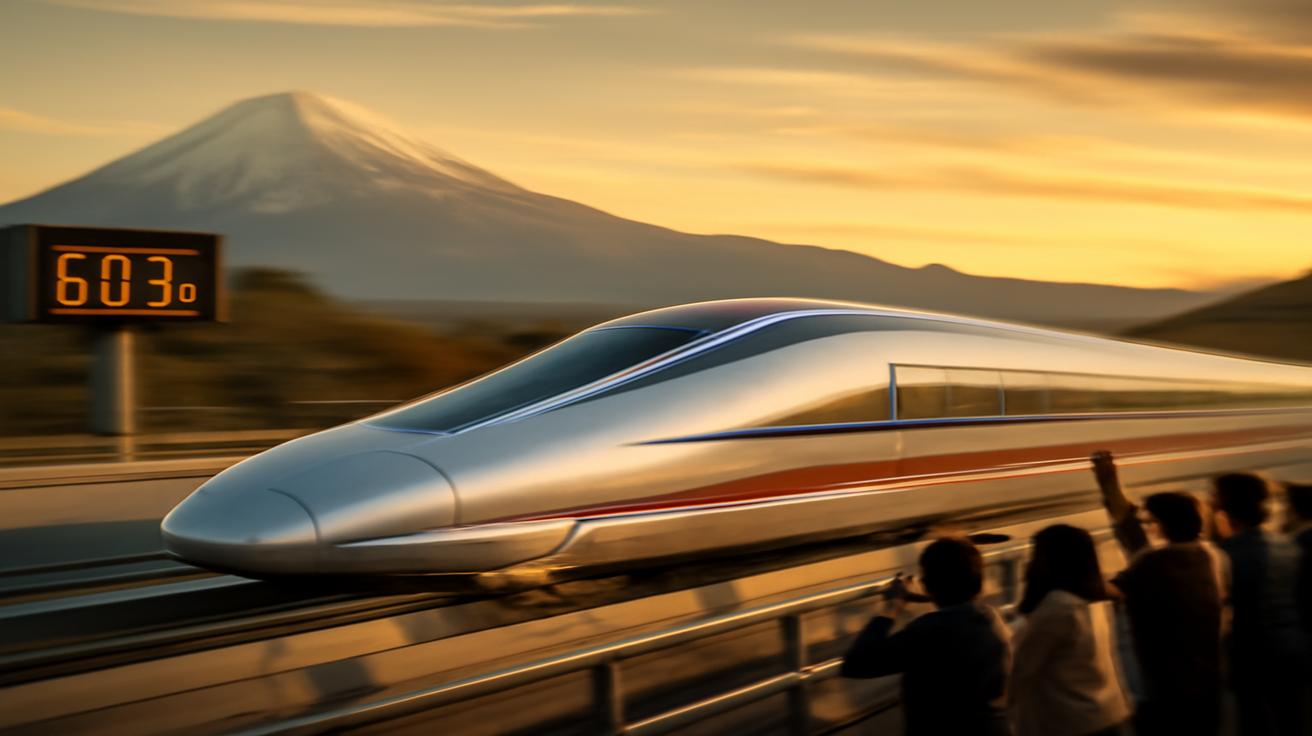
The first time you see it, really see it, you don’t think “train” at all. It looks like something that slipped through a crack in time: a silver-blue spear floating a breath above the track, humming with a low, electric promise. There’s no rumble, no heavy clatter of steel on steel. Just a soft, otherworldly whisper and the thin, rising howl of air being sliced apart. Then someone says the number out loud—603 kilometers per hour—and the rest of the world suddenly feels… slow.
The Day the Ground Learned to Let Go
The morning is cool, damp, the kind of air that clings to your skin and lifts every scent into sharper focus. A faint tang of oil. The metallic sharpness of steel. The earthy breath of concrete that has baked through too many summers. Beside the track, cameras crowd together atop tripods like mechanical birds, lenses trained on the gleaming form waiting in the distance.
People talk in hushed voices. Not because anyone has asked them to, but because something about this moment feels like standing in a chapel of speed and science. Engineers in crisp jackets glance frequently at their tablets, fingers tracing invisible lines of data. A meteorologist points at a wind chart; a technician checks a status light that glows the color of sea glass.
Out on the guideway, the maglev rests in stillness. It does not sit on the track so much as hover above it, weighed against invisible forces locked in a silent argument—gravity pulling down, magnetic fields pushing up. There is barely the thickness of a finger between the train and the concrete spine beneath it, and yet that slender gap is everything. In that gap lies the reason human beings can now move across the Earth at 603 km/h without wings.
A distant chime. A soft murmur in the crowd. Somewhere, deep inside the streamlined body of the train, power systems come to life with a muted thrum. If you were close enough, you might feel it with your teeth more than your ears—a subsonic vibration, like a storm too far away to see.
The Art of Floating Fast
Maglev. The word feels almost playful on the tongue—magnetic levitation—yet the physics are anything but child’s play. At heart, it’s simple: use magnetism to lift, guide, and propel a train so it never actually touches the track. Remove the friction of wheels on rails, and suddenly the speed limits imposed by conventional trains crumble like chalk under rain.
Two key forces are at work. One set of magnets lifts the train, canceling out its weight and letting it float a few millimeters above the guideway. Another set of magnets, arranged in a carefully timed sequence along the track, pull and push the train forward. It’s like standing on a massive, invisible conveyor belt made of magnetism and mathematics.
Inside, the experience is both deeply familiar and subtly alien. You still step through doors into a cabin. There are still rows of seats, windows framing the outside world. There are still announcements and overhead lights and the ritual shuffle of people settling in. And yet, beneath your feet, there is no gentle shudder of idle engines, no clunk of couplers, no metallic complaint from wheels waiting to roll.
When the train begins to move, it does so with a grace that feels almost unnerving. The usual cues your body has learned to expect—the lurch, the clank, the gathering roar—are missing. Instead, the acceleration feels like a hand on the small of your back, steadily, insistently nudging.
As speed builds, the landscape outside begins to blur. Trees turn into sweeping green bands. Posts along the guideway become staccato flashes of color. You feel the momentum more in the way your muscles subtly tense to keep you balanced, like standing in a slow, steady wind you can’t quite feel on your skin.
When 603 km/h Stops Being a Number
At some point, a voice crackles over the cabin speakers, calm and precise. The number is announced: 603. Kilometers. Per hour. There is a small pause after the last part, as if the announcer knows that the human brain will want just a blink more time to digest it.
603 km/h. About 375 mph. Roughly the speed of a small jet airliner in cruise. Except you are not in the sky. You’re about as high off the ground as a kitchen chair is from a floor, skimming along a ribbon of engineered earth.
Yet from your seat, there is no violence in that figure. No howling of engines, no rattling airframe, no roar of fuel being torn apart. The ride feels eerily smooth. Your coffee ripples, but does not slosh. A child two rows ahead of you is drawing a spaceship on the back of a paper napkin, pen gliding calmly along as if this were any other train.
The magic isn’t that 603 km/h is possible. We’ve sent jets faster, rockets unimaginably so. The magic is that it feels so… normal. That a number once reserved for air traffic control towers and pilot logbooks is now appearing, quietly, on a speed display at the front of a train carriage.
Faster Than Time We Remember
Outside the train’s window, the world is a watercolor in motion: fields smudged into greens and browns, distant buildings stretched into fleeting streaks of geometry. The sky seems closer somehow, as if the Earth has tilted just enough for the horizon to lean in and watch.
Inside, though, time behaves strangely. You glance at your watch, convinced that only a handful of minutes have passed since departure. Yet the onboard display—a polite strip of light near the ceiling—tells you that you’ve already devoured a distance that once belonged to the domain of airplanes and long-haul drivers.
We are used to thinking of distance as weight: something you must pay for in hours, in fatigue, in planning. A trip of 500 kilometers is usually an all-day affair. It fills you with calculations: departure times, layovers, traffic, fuel, the slow erosion of patience. But here, distance begins to feel thin and insubstantial, like fog burning off under sunlight.
That’s the subtle revolution hidden inside that staggering record of 603 km/h. It isn’t speed for speed’s sake, a mere trophy hung on a national wall. It is the quiet rearrangement of lives, cities, and landscapes. When far becomes near, when separate becomes adjacent, everything from where we work to what we call “home” starts to shift.
The Texture of Tomorrow’s Journeys
Imagine a morning where your commute crosses what used to be two or three regions, even entire states or prefectures, and yet your day begins not with an alarm at 4 a.m. and a sprint to the airport, but with a walk to a station. Not a terminal choked with security lines and luggage carousels, but a clean, bright concourse that feels more like a well-designed plaza.
You board a train instead of an airplane. No frantic checks of baggage weight, no rituals of removing shoes and belts, no long descent down a jet bridge into a metal tube that smells of recirculated air and stale coffee. Instead, you step into a space that feels more like a living room in motion—large windows, wide seats, the world gliding by rather than hiding beneath clouds.
And when you arrive? You are in the heart of a city, not marooned in an airport on its outer skin. You step out into streets, into subways, into a place already beating with daily life. The journey shrinks, but the experience expands. You begin to see travel not as a chore wedged between start and destination, but as a thread seamlessly woven into your day.
| Mode of Travel | Typical Top Speed | Approx. Time for 500 km |
|---|---|---|
| Car (highway driving) | 100–120 km/h | 4.5–6 hours |
| Conventional high-speed train | 250–320 km/h | 1.5–2.5 hours |
| Jet airliner (cruise) | 800–900 km/h | 1–1.5 hours (plus airport time) |
| Next-generation maglev (record run) | 603 km/h | Under 1 hour (test conditions) |
On a mobile screen, those numbers line up neatly, an almost clinical summary. But behind each figure is the texture of a life changed—the extra hour with family, the trip that no longer requires an overnight stay, the job that’s suddenly within reach because travel time has been halved.
The Quiet Lines on the Map
If you were to stand in a control room during one of these record-breaking runs, the romance of speed would look different. On the screens, you’d see lines and numbers more than sleek silhouettes. A live feed of the train’s position crawling along a virtual map. Air temperature. Wind speed. Vibration signatures. Power draw. Magnetic field strengths plotted like the heartbeat of a metallic giant.
The story of 603 km/h is not just one of daring ambition; it’s one of almost obsessive precision. At such speeds, the air becomes a denser, more stubborn medium. Tiny imperfections—the minuscule warping of a panel, the uneven seam in a nose cone, the subtlest misalignment in the guideway—can become problems magnified by the ruthless arithmetic of velocity.
Engineers talk about “aerodynamics” with the reverence of sailors discussing the sea. They carve and refine the shape of the maglev’s nose until the air parts around it with as little drama as possible. They sculpt underbodies and pantographs, worrying about vortices and drag coefficients the way gardeners worry about soil and sunlight.
Even the materials themselves are part of the story. Lightweight composites, heat-resistant alloys, insulation that can shrug off the subtle but relentless friction of moving this fast through air. Everything has to function flawlessly at speeds where a second is quite literally the difference between here and kilometers away.
Listening to the Invisible
Then there is the track—or more accurately, the guideway. From a distance, it looks simple: a long, elevated spine of concrete and steel. But within its structure are the coils and conductors that orchestrate the magnetic ballet keeping the train afloat and accelerating.
Sensors live every few meters along this path, eavesdropping on a conversation between train and track that happens too quickly for human senses. They measure vibrations, temperatures, field strengths, tiny shifts in alignment. If something whispers “not quite right,” the system hears it and responds—adjusting, compensating, sometimes even slowing the train before a human operator has fully registered the anomaly.
This is what allows that astonishing 603 km/h to feel, for the passenger, unexpectedly serene. A web of invisible guardians working in concert, making high speed feel as casual as strolling down a familiar street. Inside the cabin, it’s easy to forget the complexity lying just beyond the walls, humming quietly like distant bees.
Speed, But Make It Sustainable
Every record-setting machine carries a question on its back: at what cost? Speed can be intoxicating, but we live in an era where the measuring stick has changed. It’s no longer enough to ask, “How fast?” We also have to ask, “At what energy? At what emissions? At what footprint on the land?”
Maglev trains occupy a curious sweet spot. On one hand, they demand enormous precision and infrastructure. Building kilometers of guideway is no small feat; it rearranges landscapes, budgets, and priorities. On the other hand, once the system is in place, the trains themselves run on electricity—electricity that, increasingly, can be drawn from renewable sources.
Unlike planes, maglevs don’t burn fuel in flight. They don’t send exhaust streaming behind them at altitude. Their environmental story hinges on how clean the grid is, and how efficiently they use the power they are fed. At 603 km/h, a record-setting test run might not be optimized for energy use, but the technologies that make such speed possible—low drag designs, efficient propulsion, regenerative braking—are the same ones that help everyday operations sip energy instead of guzzling it.
In a warming world, the idea of drawing short- and medium-haul journeys down from the sky and onto electrified tracks is quietly radical. It suggests a future where we travel at near-jet speeds without tying ourselves quite so tightly to fossil fuels, without building ever more runways and terminals on land that could be home to forests, farms, or simply left wild.
The Human Scale of a 603 km/h World
But the sustainability question isn’t just about carbon and kilowatt-hours. It’s also about the kind of life this technology encourages us to build. Does a world stitched together by high-speed lines become more humane, or more frantic?
There’s a version of the future where faster trains simply mean longer commutes, where people are expected to stretch themselves thinner because distance has stopped being an excuse. Yet there’s another version—a more hopeful one—where speed gives us back something we’ve been steadily losing: time.
Imagine a weekend trip that no longer requires planning weeks in advance, or a reunion with an old friend in a city that used to be “too far” for anything but the rarest occasions. Imagine choosing where to live not just based on where you can reasonably drive, but on where you genuinely want to root yourself, knowing that the thread of connection to other places is strong and swift.
Technology doesn’t decide which of these futures we get. We do. The train is only ever a tool; the story is what we choose to do with it.
The Moment After the Record
Back beside the test track, the crowd watches the display as the numbers climb, shimmer, and finally peak. 603 km/h. There is no sonic boom, no visible line crossed, no fireworks. Just a murmur, a release of breath that no one realized they were holding. Some people clap. Others simply stare, as if trying to absorb the meaning behind the digits.
For the engineers and designers, the moment is both triumphant and strangely quiet. Records are waypoints, not finish lines. Already, minds are turning to the next challenge: reliability, cost, integration with existing networks, public acceptance. How do you take a number like 603 and make it not an exception, but a dependable, everyday promise—albeit at slightly more modest operational speeds?
The train eventually slows, gliding back down the guideway toward its starting point. Deceleration feels as unassuming as acceleration. The rush of the outside world returns to a pace the human eye can follow—trees regain their leaves, buildings their bricks, people their faces instead of being anonymous blurs.
When the doors open, passengers step out looking subtly altered. Not dramatically. It’s the quiet change of someone who has seen a boundary move. Someone who now knows, in their bones, that what used to be “impossible” is now just a logbook entry and a set of engineering diagrams.
Beyond the fences, life continues. Cars move along nearby roads at their patient 60 or 80 km/h. Bicycles trace slow arcs. A bird glides overhead, beating the air with ancient, practiced wings. The world hasn’t changed overnight. But somewhere, in a test facility where a train just sliced through air at 603 km/h, a new gear has clicked into place in the story of how we move.
In a few decades, children may look at old footage of clattering, wheel-bound trains the way we look at black-and-white films of the first airplanes—brave, wonderful, but clearly just the opening act. They may grow up taking for granted that you can have the speed of flight with the ease of boarding a tram. That you can step into a machine hovering a hand’s breadth above the Earth and be whisked across a continent faster than their grandparents once crossed a state.
And somewhere in the middle of that future journey, maybe they’ll glance up at a digital display, see a three-digit number glowing in soft light, and feel nothing but calm. “603 km/h,” they’ll think, if they think about it at all. “We used to call that impossible.”
FAQ
Is 603 km/h the speed passengers will experience in normal service?
No. The 603 km/h figure comes from a controlled test run designed to push the limits of the train and guideway. In regular commercial service, operational speeds are typically lower—often in the 480–500 km/h range or below—to balance comfort, safety, energy use, and maintenance costs.
How safe is a maglev train at such high speeds?
Maglev systems are designed with multiple layers of safety. Because the train is guided by the track and has no physical wheels on rails, the risk of derailment from traditional causes is reduced. Redundant control systems, dense sensor networks, and automated monitoring help detect and respond to any anomalies quickly. As with aviation, operational speeds are set well below the absolute limits found in testing.
Does floating on magnets really reduce maintenance needs?
In many respects, yes. The absence of wheel–rail contact means far less mechanical wear, fewer moving parts, and no need to regularly replace wheels or rail heads due to friction. However, maglev systems introduce other maintenance demands: precise guideway alignment, upkeep of the propulsion and levitation equipment, and monitoring of electronics and magnets.
Is maglev more environmentally friendly than flying?
It can be, especially when powered by a low-carbon electrical grid. Maglev trains produce no direct emissions along the route and can run on renewable electricity. Compared to short- and medium-haul flights that rely on jet fuel, electrified high-speed rail and maglev generally offer a smaller carbon footprint per passenger-kilometer, assuming good occupancy rates and efficient infrastructure.
Will maglev replace traditional high-speed rail everywhere?
Unlikely. Maglev offers clear advantages at very high speeds, but it also requires entirely new infrastructure and significant investment. In some regions, enhancing existing rail lines or building conventional high-speed rail remains more practical and economical. Maglev is more likely to coexist with other forms of rail and air travel, serving specific high-demand corridors where its unique strengths make the most sense.








Leave a Comment