
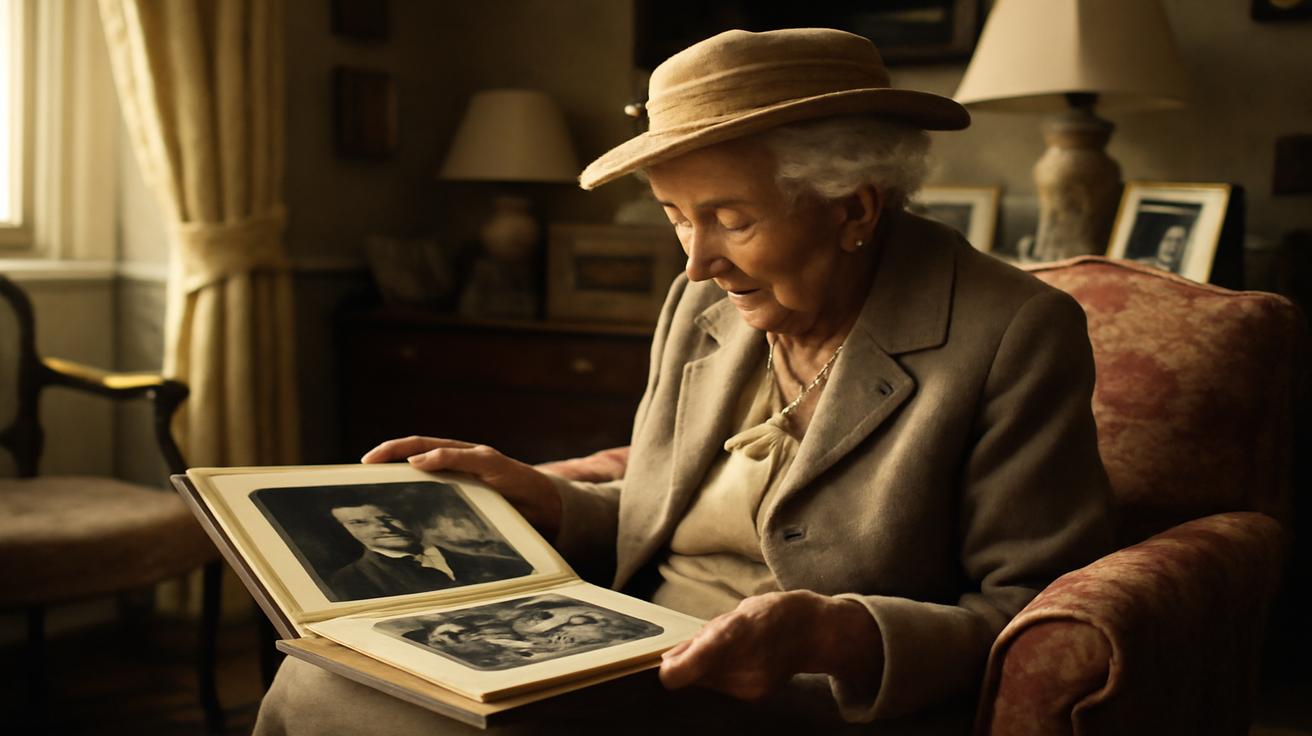
The photograph doesn’t quite seem real at first. A white-haired woman in a neat hat and pearls, standing in the late-1970s light, the colors just a little washed out by time. Her posture is straight, her gaze bright, and yet the dates under her name feel like a misprint: 1883–1981. She is Princess Alice, Countess of Athlone, granddaughter of Queen Victoria—born into a world of gas lamps and horse-drawn carriages, and still alive when people were watching “Dallas” on television and listening to ABBA on the radio. Among all the great-grandchildren and distant cousins of Britain’s royal family, she is the quiet thread that stitches the Victorian age to our own. And in the grand, noisy saga of royalty, her story has somehow slipped almost entirely from view.
A Child of the Old World
Imagine Kensington Palace in the late 19th century, before it became a place of press conferences and paparazzi lenses. The corridors smell faintly of beeswax and coal fires, the windows are thick, blurring the London streets beyond. Servants move quietly, and somewhere a child’s laughter rings up the staircase. In one of these high-ceilinged rooms, on a cold February day in 1883, Princess Alice Mary Victoria Augusta Pauline opened her eyes to a life already mapped out in bloodlines and expectation.
She was not just any royal baby. Alice was the daughter of Prince Leopold, Duke of Albany, the youngest son of Queen Victoria—the famously melancholy, black-clad monarch whose shadow stretched across most of the 19th century. From her mother’s side, Princess Helen of Waldeck and Pyrmont, Alice inherited a quieter, German-influenced upbringing, where duty and restraint sat side by side with warmth and affection.
The house of her childhood was a curious mixture of indulgence and wariness. Prince Leopold was a hemophiliac, and the specter of sudden bleeding and early death hung over him like an invisible curtain. When he died in 1884 after a fall, Alice was just a year old. She would grow up with only secondhand stories of the father whose blood disorder would ripple tragically through European royal families.
And yet, there is nothing tragic about the image of Alice as a girl: she is often described as bright, sociable, and unpretentious. She played in the long Kensington gardens under the clipped yews and sprawling chestnut trees, sharing her world with cousins who also bore the heavy weight of being “Victoria’s grandchildren.” Picture them, in white pinafores and starched collars, racing down gravel paths where today tourists queue for tickets and snap photos with their phones. For them, it was a private kingdom, bound not by fences but by protocol and governesses’ watchful eyes.
A Princess Comes of Age
By the turn of the century, the world was reshaping itself. You could see it from Alice’s windows: electric light creeping into the city, telephones sprouting in important offices, motorcars jolting down streets that still smelled of horse and hay. Within the palaces, however, time flowed more slowly. There were still afternoon teas with lace tablecloths, evenings of music and card games, and family gatherings under heavy oil portraits of long-dead ancestors.
Alice, growing into a tall, dignified young woman, had more freedom than many of her continental cousins. Her branch of the family—though very royal—was not on the very top rung of succession, loosening the cuffs of expectation. She moved in elite London circles but was known for being approachable, even witty, with a dry sense of humor that cut through the stiffness of court life.
Still, being Victoria’s granddaughter meant that marriage was more than romance; it was diplomacy in silk and satin. When, in 1904, she married Prince Alexander of Teck, she chose a man who combined both worlds—a member of the extended British royal family but without a kingdom of his own. Their wedding, held in St. George’s Chapel at Windsor Castle, unfolded in the hushed echo of stone and organ music, the air thick with incense and history.
You can imagine the scene: uniforms glittering with medals, hats towering with feathers, the rustle of gowns as courtiers leaned to catch a better glimpse of the bride. Yet under all the spectacle, Alice seemed determined to build a life that was less about display and more about service. Her married years would prove that she wanted more from royalty than simply appearing on balconies.
War, Reinvention, and a New Name
The first great shockwave that would reshape Alice’s life rolled across Europe in 1914. The Great War ripped through the web of royal relationships that had once seemed unbreakable. Cousins who had spent childhoods together now found themselves on opposite sides of barbed wire and artillery lines. German surnames, once marks of exalted prestige, suddenly became political liabilities in Britain.
Alice and Alexander were caught in that storm. He was a Teck, a member of a German ducal house that had long served within the British orbit. But in the heat of wartime suspicion, German titles drew hostility. King George V—himself a grandson of Victoria—made a sweeping decision in 1917: the royal family would renounce its German titles and take on an unmistakably English name, Windsor.
Alice and Alexander followed suit. He became Alexander Cambridge, Earl of Athlone; she, Princess Alice, Countess of Athlone. It was more than a legal adjustment; it was an act of reinvention. The old, complex lattice of German princely names crumbled away, replaced by something that sounded solidly British. In private, there must have been a sense of dislocation—an entire past compressed into something new, edited to fit the world after the trenches and the gas attacks.
Through the war, Alice was not a mere observer. She threw herself into welfare work, visiting hospitals, supporting nursing organizations, and engaging with those whose lives war had shattered. She had seen grief in her own family early on, and perhaps that made the suffering of others feel uncomfortably familiar. In the antiseptic glare of hospital wards, she shook hands, listened to stories, and looked directly at wounds others could hardly bear to see.
Across Oceans: A Royal in Exile and in Office
If you follow Princess Alice’s life on a map, the lines stretch far beyond England. One of the most remarkable things about her story is how much of it unfolded away from the stiff formality of London courts. In the 1920s, her husband served as Governor-General of South Africa, and Alice stepped into the role of viceregal consort with quiet steadiness.
South Africa in that period was a place of stark contrasts: breathtaking landscapes rolling out into high veld and distant mountains, and deep, entrenched inequalities shaping human lives. Alice moved among the white political elite, but she also saw, with careful eyes, how the structures of empire pressed upon the people under British rule. While she could not unmake those structures, she used the limited space she had to support hospitals, charities, and social initiatives—particularly for women and children.
Later, the pattern repeated on another continent. In 1940, in the tense shadows of a second global war, Alexander was appointed Governor General of Canada. Once again, Alice followed. The air in Ottawa was cold and sharp, the winters long and blue-white under snow. At Rideau Hall, the viceregal residence, Alice helped build a sense of stability for a country bracing itself against the uncertainty of war.
She visited training bases, chatted with young Canadian pilots heading off into danger, and did what she always seemed to do best: turn the distant, intimidating symbol of royalty into something human and accessible. In the worn photographs of those years, you see her bundled against the cold, smiling at crowds lined up along Canadian streets, the modernity of the 1940s glinting in the cars and coats behind her.
A Bridge Between Centuries
What makes Princess Alice’s life so quietly astonishing is the sheer span of time it covered. She was born when Queen Victoria still ruled an empire painted pink on schoolroom maps. She died when Margaret Thatcher was Prime Minister and space shuttles were taking shape in NASA hangars. Her memories—if you stack them end to end—form a panoramic gallery of modern history.
As a child, she knew the rituals of Victorian mourning, the smell of black crepe and the heavy silence around closed doors. As a young woman, she danced in the glittering twilight of the Edwardian era, when London society seemed like a constant party set against a sky no one yet suspected would darken. She witnessed the explosion of the First World War, the fall of empires, the tense optimism of the 1920s, the economic bruises of the 1930s, the storm of the Second World War, and the slow, uneasy dismantling of the British Empire.
By the time she was an elderly woman, the world around her had transformed almost beyond recognition. Air travel, television, computers buzzing away in government basements—she had outlived not just siblings and cousins, but an entire way of life. Yet those who met her in her later years often described her as alert, curious, and far from stuck in the past. She carried history with her, but it did not weigh her down.
Her long life also gave her a unique vantage point on the royal family itself. She saw it at its most imperial and its most vulnerable; she watched it adapt, tighten its belt, and begin to flirt with modern media and public relations. From Queen Victoria to Queen Elizabeth II, Alice’s story arcs across four reigns, each reshaping what it meant to wear a crown in a world that increasingly questioned inherited power.
The Quiet Power of a “Minor” Royal
In the grand, headline-grabbing narrative of monarchy, certain names dominate: queens and kings, dramatic abdications, glittering coronations. Alice was never at the center of those turning points. She was not destined for a throne. And yet, her life illuminates the quieter, often overlooked roles that keep institutions steady when history howls around them.
She chaired committees, led charitable organizations, and turned up—reliably, consistently—for the less glamorous parts of royal duty: opening hospitals, visiting schools, attending endless meetings. These are the kinds of work that rarely make front pages but weave slowly into the social fabric of a country. Her presence lent weight to causes that might otherwise have struggled for attention.
People often remarked that she seemed more interested in doing than in being seen. She had the rare combination of rank and relatability—grand enough to attract notice, grounded enough to make nervous strangers feel at ease. In this, she prefigures the modern idea of a “working royal,” someone whose value is measured less by their position on a family tree and more by the daily, visible utility of their role.
An Overlooked Life in the Royal Tapestry
Given how long she lived, and how deeply she was threaded into royal and imperial life, why does Princess Alice seem so forgotten? Part of the answer lies in the way we tell royal stories. We gravitate toward drama: abdications, scandals, forbidden love affairs, and tragic early deaths. Alice’s life, by contrast, was marked more by resilience than by rupture.
She had her share of private sorrow—children lost too soon, family tensions, the constant strain of war and change—but these were not splashed across newspapers or turned into legends. She did not run away with a lover, or spar dangerously with the press. Instead, she adapted. She changed names when the times demanded it, crossed oceans when duty called, and returned quietly to Britain when the tides of empire receded.
In a way, her very survival pushed her to the edges of the story. The Victorian era invites nostalgia; the early 20th century invites fascination; but the figures who endure into late old age often become background scenery to fresher, younger faces. By the late 1970s, when cameras turned toward the rising generation—Charles and Diana, the modernizing Windsors—Alice slipped gently out of view.
Yet if you look closely, she is there in the margins of photographs, a small, composed figure with decades of memory behind her eyes. She carried the accent and manners of a world that had mostly vanished, but she stood in rooms buzzing with modern anxieties and modern hopes.
A Life Measured in Eras
One of the simplest ways to understand the scale of Princess Alice’s life is to look at it alongside key moments in history. When she was born, most people traveled at the speed of a train or a ship. When she died, humans had already walked on the moon. Her living memory formed a bridge few others could match.
| Year | Princess Alice’s Age | World Around Her |
|---|---|---|
| 1883 | 0 | Born in the reign of Queen Victoria; Britain at the height of empire. |
| 1914 | 31 | Outbreak of the First World War; royal families torn across front lines. |
| 1917 | 34 | Renounces Germanic titles; becomes Princess Alice, Countess of Athlone. |
| 1940 | 57 | Moves to Canada as consort to the Governor General during WWII. |
| 1952 | 69 | Sees the accession of Queen Elizabeth II, her great-niece. |
| 1981 | 97 | Dies the year of Charles and Diana’s wedding, in a fully modern media age. |
Time, for Princess Alice, was not an abstraction; it was something she wore, layer upon layer, like the clothes of different eras. Bustles and corsets in childhood, looser Edwardian dresses in young adulthood, practical wartime suits, postwar fashions, and finally the easy, almost timeless uniforms of old age: cardigans, pearls, sensible shoes.
The Last Goodbye of a Victorian Granddaughter
In January 1981, when Princess Alice died at Kensington Palace, it was more than the passing of a person; it was the quiet closing of a door on the 19th century. Newspapers noted her longevity and her connections—granddaughter of Victoria, great-aunt of a reigning queen—but the world did not stop. It rarely does for the elderly, no matter how blue their blood.
Outside the palace gates, London traffic hummed and honked; television sets glowed in living rooms where people talked excitedly about the upcoming royal wedding that would define the decade’s fairy-tale fantasies. The royal family, as a public institution, was pivoting toward a new, media-saturated age. Alice had seen the prelude, but not the full drama. Her funeral was dignified, proper, respectful—another thread snipped neatly from the grand tapestry, then folded away.
And yet what she left behind was not just a name in genealogical charts. She left a model of a certain kind of royal life: serious, steady, often unspectacular, but deeply entwined with the social and political currents of her time. She showed that you could be born into grandeur and still live a life oriented toward usefulness rather than spectacle.
Remembering the “Forgotten” Royals
To remember Princess Alice is to remember that history is not only pushed forward by those at the very top. It’s also shaped by the people just offstage—those who attend the ribbon cuttings, sit through the committee meetings, and make countless journeys to hospitals, schools, and remote communities. Their faces rarely appear on postage stamps, but they create a sense of continuity that can be strangely comforting in turbulent times.
In modern conversations about royalty—about its costs, its relevance, its future—stories like Alice’s add nuance. They remind us that there have always been royals who quietly adjusted their roles to fit changing realities, who embraced new countries, new identities, and new expectations without the drama of crisis or scandal.
Princess Alice, Countess of Athlone, lived into her late nineties and yet somehow drifted out of public memory. But if you pause for a moment and picture that white-haired woman in her impeccable hat, standing between centuries, you begin to feel the texture of history differently. Her life was not a headline—it was a long, steady line, drawn carefully across the face of a changing world. And sometimes, those are the lines that hold the whole picture together.
FAQ
Who was Princess Alice, Countess of Athlone?
Princess Alice was a granddaughter of Queen Victoria, born in 1883. Through her father, Prince Leopold, Duke of Albany, she was directly connected to the core of the British royal family. She became Countess of Athlone after her marriage and the renunciation of German titles during the First World War.
How was she related to Queen Elizabeth II?
Princess Alice was Queen Elizabeth II’s great-aunt. Alice was Queen Victoria’s granddaughter, while Elizabeth II was Victoria’s great-great-granddaughter. Their branches of the family tree met in the wider network of the House of Windsor.
What made her life unusual among Queen Victoria’s descendants?
Most of Queen Victoria’s grandchildren died long before the late 20th century. Princess Alice lived from 1883 to 1981, bridging the Victorian age and the modern era. She experienced an extraordinary range of historical events firsthand, from the peak of the British Empire to the early years of the late-20th-century media world.
Why did she change her name and titles during the First World War?
Due to strong anti-German feeling in Britain during the First World War, King George V ordered members of the royal family to drop their Germanic titles. Princess Alice’s husband, born Prince Alexander of Teck, became Alexander Cambridge, Earl of Athlone. Alice adopted the title Princess Alice, Countess of Athlone, reflecting a more clearly British identity.
What roles did she play in South Africa and Canada?
Princess Alice served as viceregal consort when her husband was Governor-General of South Africa and later of Canada. In both roles, she supported charitable, social, and medical causes, visited communities and military installations, and helped project a sense of stability and care in times of political and global upheaval.
Why is Princess Alice not better known today?
Her life lacked the kind of scandal or crisis that often cements historical fame. She was never a reigning monarch and did not feature in dramatic constitutional events. Instead, she worked steadily in the background, and over time, public memory turned more toward the higher-profile royals of each era.
What is her legacy within the modern royal family?
Princess Alice’s legacy lies in her example of a “working royal” devoted to service across many decades and continents. She demonstrated how members of the extended royal family could adapt to changing times, support charitable work, and maintain dignity and relevance far from the spotlight of the throne itself.






Leave a Comment