
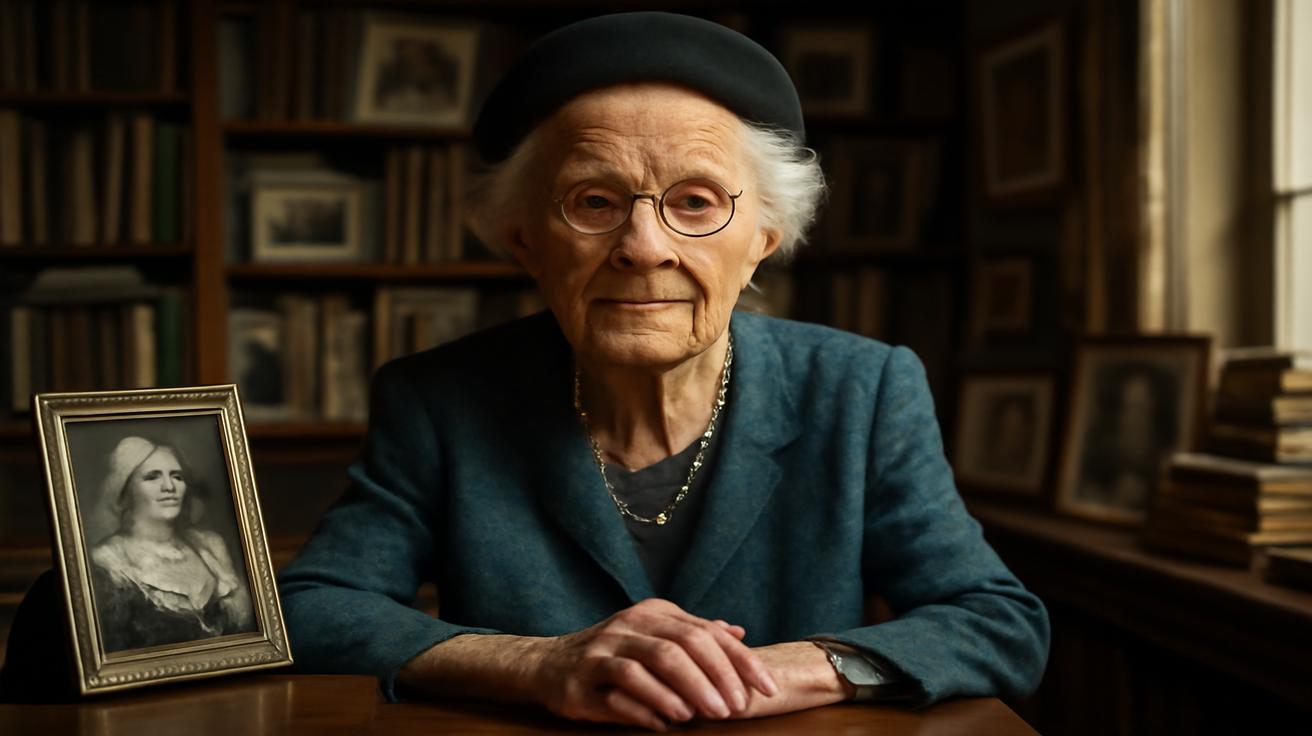
The photograph is almost misleading. A small, sharp-eyed old lady in a neat hat, handbag perched perfectly on her lap, sits in a stiff armchair as if waiting politely for tea. Nothing in that image shouts “last grandchild of Queen Victoria” or “witness to three centuries.” Yet Princess Alice, Countess of Athlone—born in 1883 and dying in 1981—was exactly that: a living thread stretched improbably between gas-lit corridors of Victorian palaces and the neon glow of late-twentieth-century streets. To read her story is to feel time folding in on itself, to realize that the era of horse-drawn carriages and the age of jet airplanes once coexisted within a single lifetime.
The Baby in the Nursery Window
Imagine London in the winter of 1883: the smell of coal smoke pressed low over the city, the soft clop of hooves on damp cobblestones, the golden haze of gas lamps shining through lace-draped windows. Inside one of those stately houses—Bournemouth, where her mother had gone for her health—a baby girl arrived on February 25, wailing her way into an empire that stretched pink across half the world’s maps. That baby was Princess Alice Mary Victoria Augusta Pauline, granddaughter of Queen Victoria, the very embodiment of dynastic hope and continuity.
Her grandmother was already an institution. By the time Alice took her first breath, Queen Victoria had been on the throne for more than four decades, a black-clad figure of mourning and moral certainty. To be born a granddaughter of Victoria was to enter a dense web of expectations, political calculations, and family dramas that spanned continents. But to Alice, at first, it was simply life: the rustle of starched petticoats, the scent of beeswax on polished floors, the click of a lady-in-waiting’s heels down the corridor.
She was the daughter of Prince Leopold, Duke of Albany—Victoria’s youngest son, clever and gentle, but shadowed by the curse of hemophilia. He died when Alice was barely a toddler, leaving behind a fragile but bright child and a widow who clung to her place in the royal fold. The early sorrow brushed against Alice like a passing draught in a grand corridor—felt, but not fully understood.
Childhood for her meant palace gardens where gardeners eyed her carefully in case she tumbled, classrooms where governesses drilled French verbs and royal etiquette in equal measure, and those intimidating family gatherings where her grandmother sat like a small, powerful storm cloud at the center of everything. And yet, amid the formality, there were moments of startling warmth: Victoria cooing over the children, offering sweets, asking in that piercing voice about their lessons, their health, their dreams.
The Granddaughter Who Watched the World Change
It’s almost dizzying to trace Alice’s childhood against the historical calendar. While she practiced piano scales and curtsies, the world outside was roaring toward modernity. Electric light began to flicker into buildings. Trains shrieked across the countryside. Motorcars, snorted at first as noisy toys, would soon startle horses in the royal mews.
You can almost picture her: a girl in stiff white dress and sash, pinched shoes on polished floors, peeking curiously from behind a curtain at some new contraption delivered to the palace gates. Her relatives were scattered across Europe’s thrones—Germany, Russia, Greece, and beyond—binding the continent together with an intricate lattice of family ties that felt—at least to them—unbreakable.
In those days, the royal family seemed eternal. Queen Victoria’s children—Alice’s aunts and uncles—were everywhere. The family gatherings were a crowded blur of uniforms, jewels, languages, and little rituals: the correct way to approach the Queen, the stories everyone knew by heart, the old songs at the piano after dinner. To Alice, this tapestry of people and customs must have felt as solid as the stone walls around them.
She could not have known that almost all of it would shatter within her lifetime—that those same cousins she played with would one day stand on opposing sides of world wars, that some would be overthrown, some executed in cellars, some exiled, some simply swept aside by the modern tide. Long before any of that, she was simply the bright, observant granddaughter, memorizing faces and voices that history would later turn into tragic footnotes.
The Young Princess Who Chose Her Own Path
When Alice came of age, Europe still believed in the stability of its royal houses, but hairline cracks were already spidering through that confidence. In 1904, at the age of 21, she married Prince Alexander of Teck, a member of the extended British royal family, quietly handsome and well-bred, hovering at the edges of the glittering core. It was a match shaped by both affection and suitability, the kind of union that kept the branches of Victoria’s dynasty neatly intertwined.
Their wedding had all the elements you might expect: uniforms glittering with medals, tiaras sparking under candlelight, the soft hiss of satin across parquet floors. Yet behind the pageantry, Alice stepped into a life that, for a royal woman of her time, would prove remarkably active and outward-facing. She would not simply be a decorative figure in the background of history—she would stand, repeatedly, at its front lines.
That sense of stepping forward rather than retreating into comfort showed early. Tall, poised, and known for her straightforward manner, Alice quickly gained a reputation less for scandal or extravagance than for a brisk, practical intelligence. If she was born into privilege, she also developed a keen sense that such privilege came with work attached.
War, Loss, and Reinvention
When the First World War broke over Europe in 1914, the royal family’s web of cousinly alliances twisted into something darker. Alice’s relatives in Germany, Russia, and elsewhere abruptly became enemies—or soon would. Her own household felt the shock of politics in an unusually personal way: her husband, Prince Alexander of Teck, carried a Germanic title that suddenly sounded jarringly out of place in a Britain gripped by anti-German sentiment.
In 1917, as the war ground on and the monarchy fought to maintain public trust, the royal family shed many of its German titles and names. The Tecks were no exception. Alexander relinquished his princely title and took up a new, very English one: the Earl of Athlone. Alice, in turn, became Princess Alice, Countess of Athlone. A small change in wording, perhaps, but one that underscored how even those at the pinnacle of society were not immune to the tremors of history.
Yet Alice did more than change titles. She threw herself into war work with a seriousness that left a mark. If you picture royal women of the era as remote figures in feathers and diamonds, you need to revise the image: nurses’ wards echoing with low voices and the soft clatter of medical instruments, the metallic tang of antiseptic in the air, the persistent ache of exhaustion. Alice moved through that world, supporting hospitals, visiting the wounded, lending not just her name but her presence to the vast, grinding machinery of care.
War took a more intimate toll as well. Her brother, Prince Charles Edward, had become Duke of Saxe-Coburg and Gotha in Germany; he served on the opposite side of the conflict. Family ties that once seemed unshakable strained under the weight of ideologies, loyalties, and the redrawn lines of maps. For a woman like Alice, born into a belief in monarchy as a scaffolding for stability, those years must have felt like watching the family home crack stone by stone.
Across Oceans: A Royal Granddaughter in Canada and South Africa
If the First World War had shaken the old world order, the years that followed began to build something new. The British Empire was slowly metamorphosing into a Commonwealth, and Alice found herself, quite literally, at its far edges. Twice in her life, she served as viceregal consort—first in South Africa and then in Canada—standing at the heart of imperial, and later Commonwealth, life on two continents.
In 1924, her husband was appointed Governor-General of the Union of South Africa, and the Athlones packed their trunks for a land very different from damp English winters. Imagine Alice stepping out into the harsh, glittering sunlight of the South African highveld, the smell of dust and eucalyptus in the air, unfamiliar birds calling from thorn trees. It was a world of guarded welcomes and deep, often unspoken tensions—white rule tightening its grip, Black South Africans and people of color pushed to the margins, the future rumbling ominously in the distance.
Alice’s role there, as always, was both symbolic and practical. She visited hospitals, schools, and charitable institutions, learning the landscape not from maps, but from faces and voices. Royal tours are often seen as ceremonial parades, but for someone of Alice’s temperament—observant, engaged—they were also windows into how people lived, struggled, and hoped.
Years later, in 1940, another posting: this time to Canada, with the Second World War now raging. Ottawa in winter was a crisp, biting cold different from anything in England—snow squeaking under boots, breath hanging visibly in front of one’s face. As Governor-General, the Earl of Athlone represented King George VI; Alice, once again, found herself walking hospital corridors, visiting training camps, lending her presence to rallies, drives, and solemn ceremonies for a new generation of war dead.
In those Canadian years, Alice had already lived through one world war, the fall of multiple monarchies, the rise of new technologies that shrank oceans into hours. Yet she moved through the conflict with a composed energy that younger observers remembered decades later. If history battered at the walls, she seemed determined to hold a door open to service, duty, and a certain kind of unwavering steadiness.
The Last Grandchild of Queen Victoria
By the time the 1950s and 60s arrived, the world had rearranged itself into a shape Queen Victoria would barely have recognized. The British Empire was dissolving into a patchwork of independent nations. Jet travel turned once-remote destinations into weekend possibilities. Television carried the monarch’s Christmas message into living rooms where children sprawled in front of glowing screens.
And there, still very much alive, was Princess Alice—the last surviving grandchild of the woman whose profile had once stared out from coins and postage stamps across the empire. It’s a staggering thought: schoolchildren in the 1970s, with their flared trousers and cassette tapes, sharing a country with someone who had personally sat on Queen Victoria’s knee, who remembered the muffled roll of carriages in palace courtyards and the nervous excitement of seeing electric lights flicker on for the first time.
Alice aged into one of those wonderfully indomitable elderly women Britain seems to produce in every generation: impeccably dressed, sharp of tongue when necessary, and quietly amused by the fuss people made over her. In photographs from her later years, she often carries that slightly quizzical look, as if privately musing, “So this is what the twentieth century turned into.”
Consider what her lifespan encompassed:
| Year | Princess Alice’s Life | World Events |
|---|---|---|
| 1883 | Born, granddaughter of Queen Victoria | Late Victorian era; gaslight and railways |
| 1904 | Marries Prince Alexander of Teck | Height of European royal diplomacy |
| 1914–1918 | Supports war effort during WWI | Collapse of old European empires |
| 1924–1930 | Viceregal consort in South Africa | Interwar tensions, rise of new politics |
| 1940–1946 | Viceregal consort in Canada | Second World War and its aftermath |
| 1981 | Dies aged 97 in London | Era of space travel, computers, and global media |
From carriages to Concorde, telegrams to television, empire to Commonwealth—a single heartbeat running through them all. When she died in January 1981 at Kensington Palace, the news read less like an obituary of one woman and more like the quiet closing of an ages-old book. The Victorian age, that distant, sepia-toned world, suddenly didn’t seem so far away. It had reached out its hand and touched the early 1980s through a woman who still remembered the sound of her grandmother’s voice.
An Ordinary Humanity in an Extraordinary Life
With all the titles and dates, it would be easy to lose sight of Alice as a person. But inside the formal portraits and the careful official biographies, glimpses of something warmer, more familiar, keep emerging. There she is, laughing with students as Chancellor of the University of the West Indies, gamely listening to their concerns and ideas. There she is, remembered by staff for her impatience with fuss, her preference for straightforward talk over flattery.
She knew grief intimately. Two of her children died before her, including her son Prince Rupert, who inherited the family’s hemophilia and died very young. That particular sorrow—one her father and grandmother had also carried—threaded through the supposedly charmed world of royalty like a quiet, persistent ache. No title could protect her from that; no palace wall could keep out the harshness of random loss.
And yet, over and over, she turned outward. Into committees, boards, charitable foundations. Into journeys that would exhaust someone half her age. Into conversation after conversation with people who would never know what it felt like to have Queen Victoria as a grandmother, but who understood perfectly well what it meant to lose a child, to live through war, to watch the world transform faster than anyone was prepared for.
In the end, that might be the most compelling thing about Princess Alice’s long life: the way it proves that history is not just a row of portraits in a gallery or a list of dates in a book. It’s breath, and footsteps, and the rustle of turning pages under a lamplight that changes from gas flame to electric bulb to fluorescent hum. It’s a girl in a starched white dress who grows into an elderly woman in a neat hat, traveling from horse-drawn carriages to jetliners—who remains, underneath it all, stubbornly human.
Why Her Story Still Echoes
Today, when we look at the British royal family, it’s tempting to see each generation as a neat, separate photograph: the Victorians in one frame, Edwardians in another, wartime monarchs in a third, modern royals in glossy color. Princess Alice’s life shatters that illusion of separation. She was the living bridge between them, the quiet continuity that shows how recent the “distant past” really is.
Think of it this way: someone alive now likely met her as a child or young adult in the 1960s or 70s. And that same person, shaking Alice’s hand in some reception line or church doorway, was only one handshake away from Queen Victoria herself. History, suddenly, is not a vast chasm. It’s a couple of outstretched hands in a quiet room.
Her story also illuminates a different side of royal life than the one that tabloids favor. There are no famous scandals attached to her name, no earthquakes of controversy. Instead, there is a steady accumulation of service, travel, conversation, grief, adaptation. If monarchy is often criticized—and sometimes rightly—for its distance from ordinary experience, Alice’s life is a reminder that even at the highest levels of privilege, there are people choosing, deliberately, to spend their time stirred into the world rather than floating above it.
In a century that saw the fall of so many thrones and the questioning of so many old assumptions, she remained—a quiet observer who rode every wave without quite being flung off. The granddaughter of a queen who ruled an empire watched that empire transform, loosen, and reshape into a community of nations. She saw two world wars, the dawn of women’s suffrage, the emergence of mass media, and the first flickers of the digital age. And through all of it, she got up each morning, put on her gloves or her academic robes or her traveling coat, and stepped out the door.
When we say that Queen Victoria had a granddaughter who lived into the 1980s, the fact sounds almost like a trick of mathematics, a curiosity for pub quizzes and trivia pages. But behind that startling stretch of time is a real person who inhabited all of it with a curious, resilient heart. To follow her footsteps is to feel the thinness of the walls between “then” and “now,” and to realize that the past is closer, and more entangled with us, than we usually dare to imagine.
Frequently Asked Questions
Who was Princess Alice, Countess of Athlone?
Princess Alice (1883–1981) was a granddaughter of Queen Victoria and the last of Victoria’s grandchildren to die. She was born Princess Alice of Albany and later became Countess of Athlone after her husband accepted the title Earl of Athlone in 1917.
How was she related to Queen Victoria?
Princess Alice was Queen Victoria’s granddaughter through Victoria’s youngest son, Prince Leopold, Duke of Albany. That made her a first cousin to many of Europe’s royals, including King George V of Britain and Kaiser Wilhelm II of Germany.
Why did her husband change his title from Prince of Teck to Earl of Athlone?
During the First World War, anti-German feeling in Britain was intense. In 1917, the royal family gave up many of its German titles and names. Alice’s husband, born Prince Alexander of Teck, renounced his German princely style and was created Earl of Athlone, giving the couple a more English-sounding identity.
What roles did Princess Alice hold in the British Empire and Commonwealth?
Princess Alice served as viceregal consort twice. From 1924 to 1930 she was in South Africa when her husband was Governor-General of the Union of South Africa. From 1940 to 1946 she lived in Canada while he served as Governor General there, actively supporting war and social efforts in both countries.
Why is she considered historically significant today?
Beyond her public service, Princess Alice is significant because her long life connected the Victorian era to the modern world. Born under Queen Victoria and dying in 1981, she experienced the transformation from empire to Commonwealth, two world wars, and enormous technological and social change—making her a living bridge across three radically different centuries.







Leave a Comment