
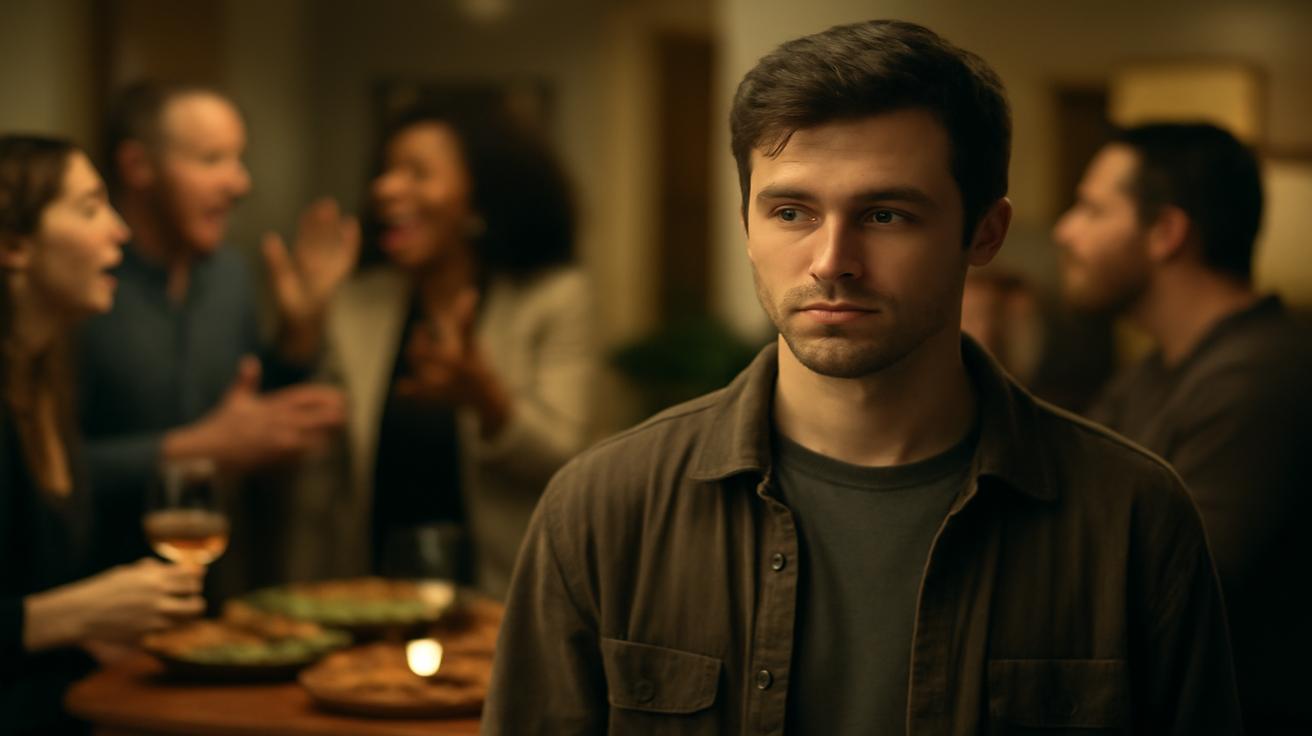
The man at the café never says much. You’ve seen him: same corner table, chipped blue mug, the kind of stillness that makes him feel almost like part of the furniture. Around him, the world swirls—people laughing too loudly, chairs scraping, cups clinking, someone retelling the same story for the third time. The loud talkers fill the room with noise. He fills it with attention. While everyone else performs, he simply watches. And somewhere behind his quiet eyes, judgments are being made—subtle, precise, and far sharper than anyone suspects.
The Secret Life of the Quiet One in the Room
The quiet observer isn’t just shy, or tired, or “not in the mood.” Often, they’re running a high-speed, silent analysis of everything that’s unfolding. They notice the way someone’s smile never quite reaches their eyes. The way the loudest friend interrupts right when the story is about to turn vulnerable. The way a hand trembles slightly as it reaches for a glass. They collect patterns like pebbles in a pocket, weighed and sorted over time.
Psychologists call this kind of under-the-surface processing social monitoring. For some people, it’s almost a hobby. For others, it’s self-defense. The brain quietly tracks who is safe, who is genuine, who is pretending, and who might hurt them later. It rarely announces its findings out loud, but the conclusions are there—and yes, they can be judgmental.
The irony is almost poetic: in a culture that often celebrates extroverts, big personalities, and bold self-expression, it’s the quiet ones who frequently know what’s really going on. The louder someone talks, the more space they occupy. But the more space they occupy, the less they often see. Attention is a limited resource. You either direct it outward to observe—or inward to perform.
Why the Silent Ones Notice What Others Miss
Walk into a crowded room and watch how different people move through it. The loud talker strides in like a warm wind, filling every corner with noise and energy. Their brain is busy juggling jokes, stories, impressions, and the constant worry of, “Am I being liked? Am I interesting enough?” They may be charismatic, but they are also distracted.
The quiet observer moves differently. Less performance, more perception. They notice:
- The glance two people share when someone mentions a sensitive topic.
- The sudden silence after a joke that landed a little too hard.
- Who checks their phone when the conversation gets real.
- Which friend never asks a single question in return.
Psychology suggests that people high in what’s called social sensitivity are better at decoding facial expressions, tones of voice, and unspoken rules. Many introverts and anxious individuals land in this category, not because they enjoy judging, but because paying close attention has been their survival strategy. If you’ve spent years worrying how you’re being perceived, you often develop a knack for reading everyone else, too.
But that’s where the quiet judging comes in. Once you see patterns, it’s hard to unsee them. You notice hypocrisy, small cruelties, manipulative charm. You watch the person who jokes at everyone’s expense, but never their own. You catalogue the friend who “forgets” your boundaries, again and again. You feel who is genuinely kind—and who is just performing kindness when others are watching.
The Harsh Truth: Quiet Does Not Mean Gentle
There’s a romantic myth that quiet people are somehow purer, kinder, more gentle-hearted than the rest of us. But silence is not the same as softness. Sometimes silence simply means the judgments stay inside.
The quiet observer might never call you out when you’re being unfair, but they’ll remember. They might not argue with you, but over time they will reposition you quietly in their inner map of trust. Someone once said, “An introvert won’t always tell you what’s wrong. They’ll just tell you less about what’s right.” That slow, secret reclassification happens in the mind of the observer constantly.
Psychologically, this makes sense. When people feel less power in a social situation—maybe because they’re outnumbered, more reserved, or socially anxious—they often gravitate towards covert strategies: silent evaluation, cautious distance, internal criticism instead of open confrontation. The mind whispers, “I see you. I don’t agree. But I won’t say it. I’ll just step back.”
Meanwhile, the loud talker barrels forward, blissfully unaware of how many small lines they’ve crossed. They didn’t notice your face fall. They didn’t sense the shift in the room. They were too busy chasing the sound of their own voice.
Table: Quiet Observers vs. Loud Talkers – What’s Really Going On?
Here’s a simple comparison to capture the contrast. It’s not about good vs. bad, but about where attention flows—and what that means.
| Aspect | Quiet Observer | Loud Talker |
|---|---|---|
| Main focus | Watching, decoding, evaluating | Expressing, performing, being noticed |
| Typical blind spot | Assuming they “know” others fully | Missing subtle emotional cues and discomfort |
| Social strategy | Caution, internal judgment, slow trust | High energy, dominant conversation, quick bonding |
| How they judge | Silently, over time, based on patterns | Out loud, in the moment, often jokingly |
| What others assume | “They’re so nice and non-judgmental.” | “They’re confident but a bit insensitive.” |
When Noticing Flaws Becomes a Quiet Habit
Spend long enough as the person on the sidelines and noticing flaws can start to feel like a reflex. You see the friend who never brings anything to the gathering but always takes home leftovers. You catch the coworker who nods in agreement in the meeting, then complains about the decision in private. You watch someone talk about mindfulness and compassion—and then tear into a waiter for bringing the wrong drink.
Psychology has a name for this tilt toward scanning for what’s wrong: negativity bias. Our brains are simply better at noticing threats, inconsistencies, and problems than they are at savoring what’s going well. For the quiet observer, this bias is often amplified by time and distance. While the loud talker rushes headlong through the moment, the quiet one stands back, sees the cracks, and quietly files them away.
The mind starts building a quiet list:
- Who didn’t say “thank you.”
- Who never apologizes.
- Who lies in small, casual ways.
- Who treats service workers differently when they think no one is looking.
It’s not all wrong. Some of this quiet judgment is accurate, protective, even wise. But when every interaction becomes an evaluation, it can turn into a kind of private cynicism. You stop giving people the benefit of the doubt. You stop believing in second chances. And from the outside, no one can see it. They think you’re just “quiet.”
Meanwhile, Loud Talkers Are Busy Ignoring the Details
If the quiet observer is constantly scanning for flaws, the loud talker often barrels past them. Not because they are kinder or more forgiving, but because their attention is used up in a different way. Their mental energy is poured into holding the spotlight—telling the story, winning the argument, landing the joke, keeping the room’s energy high.
They might be the one making everyone laugh, but they’re also the one missing the moment when that laugh turns strained. They might be the one pushing for “just one more drink,” oblivious to the friend whose shoulders are sagging with exhaustion. Their mind is focused on big strokes, not small signals.
Humans are notorious for what psychologists call self-serving bias. We assume our intentions matter more than our impact. Loud talkers are often especially vulnerable to this. “I didn’t mean it that way” becomes the shield for not noticing how people actually felt. They aren’t evil; they’re just inattentive. And when you’re inattentive, you ignore flaws—especially your own.
The Quiet Judge Inside All of Us
It’s tempting to split the world into two camps: the quiet, secretly judging observers and the loud, oblivious talkers. But most of us carry both tendencies, shifting with the room we’re in. With certain people, we become the talker: animated, expressive, not nearly as attuned to subtle cues as we think. With others, we shrink back, observing, cataloguing, quietly deciding who feels safe and who doesn’t.
There’s also a darker, more intimate layer to this. Often, people who harshly judge others are running the same script on themselves. The quiet critic in their head doesn’t turn off when they leave the café or close the group chat. It follows them home. “You sounded stupid today. You talked too much. You didn’t talk enough. They definitely noticed. They’re definitely judging you.”
The mind that notices flaws in others so easily often does so because it has been trained for years to notice its own. Childhood environments where approval was conditional, where mistakes were amplified, or where love felt unstable can create adults who monitor everything—themselves and everyone around them. Quiet judgment, in that sense, is not always arrogance. Sometimes it’s unhealed fear, disguised as sharp perception.
How Nature Mirrors the Observer and the Performer
If you take this dynamic outdoors, it’s easy to see the pattern. Think of a forest at dusk. Some animals move through it loudly, crashing through underbrush, calling out, staking their existence in noise and motion. Others move like shadows—silent, listening, picking up on tiny shifts: a twig snapping, a wing fluttering, a new scent on the wind. The loud animals dominate the soundscape. The quiet ones dominate the awareness.
Humans, for all our sophistication, are not so different. The loud talker is the jay crying from the treetop—conspicuous, attention-grabbing, hard to ignore. The quiet observer is the owl on the branch, unseen but seeing everything. Both have their place in the ecosystem. The problem isn’t that one is better. It’s that we often glorify one while underestimating the other.
Modern culture rewards volume. Jobs ask for “strong communication skills,” usually meaning “be able to speak a lot and with confidence.” Social media algorithms reward constant posting, constant sharing, constant opinion. But under all that noise, a subtler intelligence is at work—the intelligence of the watcher, the pattern-noticer, the person in the corner who picks up on the shift in the air long before anyone says a word.
Can Quiet Observation Become Compassion Instead of Criticism?
So what happens if you’re the one sitting in that café corner, secretly judging? You know you notice everything. You know when someone is being fake, or careless, or cruel. You’re proud of your perception, but you also feel how heavy it can be. It’s hard to relax in a room when you see every tiny fracture in the social structure.
The question is not whether you judge—everyone does. The question is what you do after the judgment forms. Do you freeze people in it? “She’s selfish. He’s fake. They’re ridiculous.” Or can you take one more step and ask, “What might be driving this? What pain is underneath this performance? What fear is under this bragging?”
Psychology suggests that when we expand our perspective from “what they did” to “why it might make sense they did it,” our judgments soften. Not because the behavior is suddenly okay, but because we remember that we don’t see the whole story. The quiet observer has a superpower: they notice more. That superpower becomes wise instead of bitter when it’s paired with imagination and empathy.
On the flip side, if you recognize yourself as the loud talker, constantly pushing the energy higher, you’re not doomed to a life of obliviousness. You can borrow a page from the observer’s book. Pause. Look around the room midway through your story. Notice whose eyes light up and whose dim. Ask a real question and wait for the answer. Pay attention not only to how much space you occupy, but how much space you allow.
In a way, we all need a bit of both: the courage to speak and the humility to watch. The world doesn’t need fewer voices. It needs more awareness behind them.
In the End, Everyone Is Watching Someone
Somewhere right now, there is a room full of overlapping conversations. Someone is holding court, laughing loudly, filling the air with their stories. Someone else is seated quietly near the wall, listening, measuring, noticing the cracks in the stories that never quite line up. They are not as neutral as they look. Their silence is not empty. It’s full—of interpretations, assessments, quiet decisions about who everyone really is.
Psychology doesn’t say that quiet observers are always right. It doesn’t crown them as moral authorities. It simply suggests this: people who talk less often notice more, and what they notice is not always flattering. They see the flaws loud talkers can afford to ignore.
But here’s the part worth remembering: the same sensitive radar that picks up your worst moments is also capable of seeing the smallest good ones. The quiet observer sees when you refill someone’s glass without asking. When you soften your voice with a child. When your face changes at the mention of your mother’s name. They see when you try, even clumsily, to be better than you were yesterday.
Silence holds both the harsh verdict and the gentle understanding. And every day, in a dozen small rooms and busy cafés, a quiet mind is deciding which one to feed.
Frequently Asked Questions
Do quiet observers always judge people harshly?
No. While many quiet observers do notice flaws and inconsistencies, their judgments aren’t always harsh. Some are simply cautious, gathering information to understand who feels safe. Others are naturally empathetic and use their observations to connect more gently, not to condemn.
Are loud talkers always unaware of others’ feelings?
Not always. Some loud, expressive people are very emotionally intelligent. However, when someone is heavily focused on performing, entertaining, or being liked, they are more likely to miss subtle emotional cues compared to someone who is in observer mode.
Is being a quiet observer the same as being introverted?
They often overlap, but they’re not identical. Introversion is about where you get your energy (from solitude rather than social interaction), while being a quiet observer is about how you pay attention. An extrovert can be a keen observer, and an introvert can sometimes be lost in their own head rather than truly noticing others.
How can a quiet observer avoid becoming too judgmental?
Two things help: curiosity and empathy. Instead of stopping at “That was rude,” you can ask, “What might be going on in their life that led to that?” You don’t have to excuse harmful behavior, but imagining a fuller story softens rigid labels and keeps you from turning perception into bitterness.
Can a loud talker become more observant without losing their personality?
Yes. It’s less about talking less and more about weaving small pauses into your presence. Ask more open-ended questions, leave space after you speak, and periodically scan the room for subtle reactions. You can still be lively and expressive, but with deeper awareness of how others are actually feeling.






Leave a Comment