
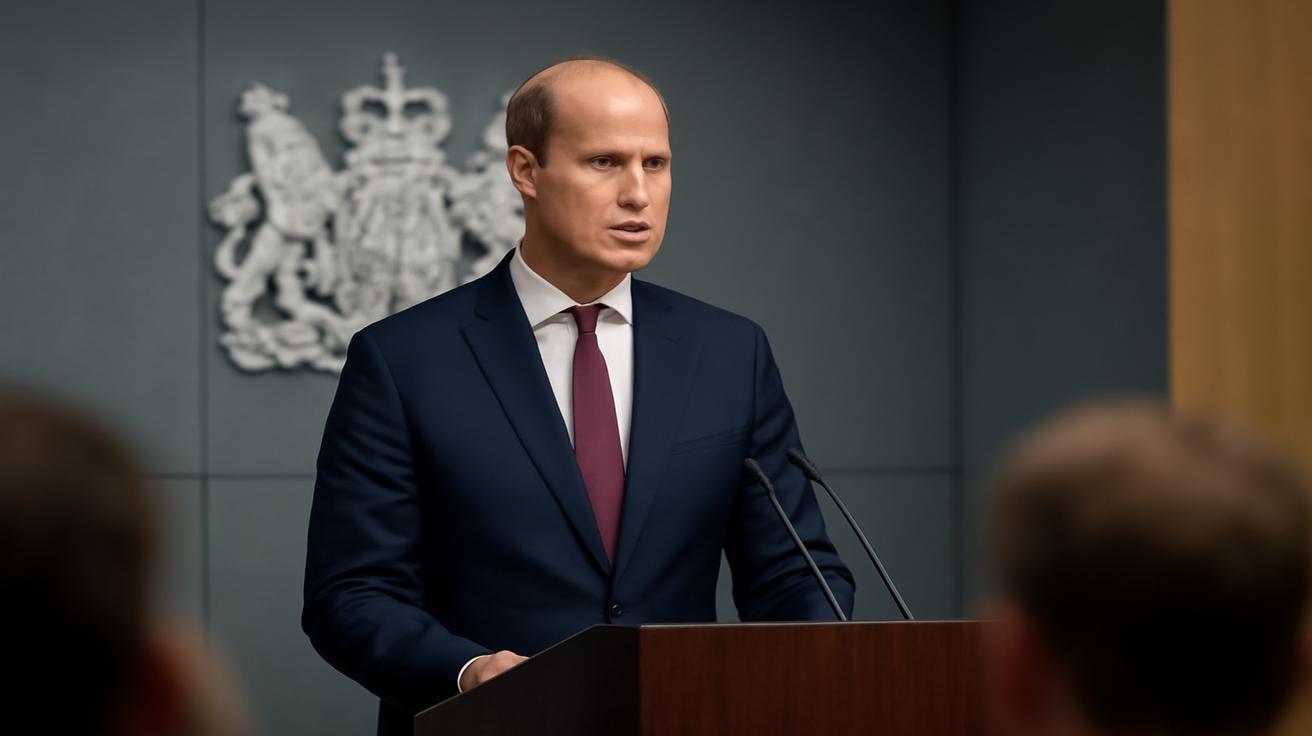
The rain starts as a mist over London, soft enough that commuters don’t bother with umbrellas, the kind of drizzle that only seems to deepen the colors of the city rather than wash them away. Outside Kensington Palace, cameras are already lined up behind metal barriers, lenses patiently pointed at a familiar doorway. It’s a scene that has replayed countless times over the last decade. But lately, something feels different. The crowd is not just waiting for a royal arrival—they are waiting for confirmation of a quiet but unmistakable shift. The man they hope to see is not the King. They’re waiting for his heir, Prince William, who, whether he likes it or not, is moving from the background into the brightest circle of the spotlight.
A Prince in Motion
Prince William steps from the dark interior of the car into the flat gray light with the unhurried gait of someone well-practiced at being watched. The press pack straightens. The public, some clutching phones aloft, some clutching each other’s sleeves, lean forward in a single, shared motion. For years, William has been a central figure in British royal life, but recently, an almost imperceptible recalibration has taken place. Appearances are more frequent. Speeches feel more pointed. His schedule, once carefully balanced between duty and privacy, seems to be expanding on one side of the scale.
Inside palace walls, aides describe it as a “natural progression.” Outside, in living rooms and newsrooms and on late-night talk shows, the language is less delicate. People talk instead about an “accelerated transition of power.” The notion hovers in the air like those low, hanging clouds over Westminster—a rumor, a reading of tea leaves, a question nobody quite wants to ask out loud: Is William quietly preparing to step into a role that might be arriving sooner than expected?
The monarchy has always been a slow-moving institution, its changes usually measured in generations rather than years. And yet, there is a sense now of something speeding up. Not a runaway train, but a train that has quietly switched tracks, gathering momentum on a new line. William, who once looked most comfortable in a flight suit or a polo shirt on a charity football pitch, now seems increasingly at ease in the steady, unblinking gaze of statecraft.
The Weight of a Future Crown
The story of Prince William has always been told in the language of inevitability. From the moment he appeared on hospital steps in his mother’s arms, the arc of his life seemed charted: boy, student, officer, husband, father, heir, king. Yet inevitability is a strange kind of burden. It doesn’t announce itself all at once. It arrives in layers, in subtle increments. An extra briefing here. A solo engagement there. A quiet word from an adviser: “His Majesty would like you to take the lead on this one.”
In the last year, the tempo of that quiet accumulation has become harder to ignore. William has led more major initiatives, fronted more public responses to national events, and stepped in at times when his father’s schedule has shifted due to health concerns and the natural toll of age. He has chaired high-level meetings about homelessness and mental health, presided over investitures with a calm, almost understated authority, and travelled alone on international visits that carry the faint echo of future state tours.
Observers note changes not just in the quantity of his work, but in its texture. There is a sharpened focus on legacy issues—climate, early childhood, youth mental health—causes that don’t just fill a diary but hint at the kind of reign he might eventually pursue. When he speaks now, it’s not simply as a patron or a guest. There’s a subtle “we” underlying his words, a suggestion that he’s thinking decades ahead, as someone who will not only advocate policy conversations but also symbolize their continuity.
The Public Mood: Curiosity, Caution, and Quiet Anticipation
On the streets, reactions are variegated, layered like the city itself. Older onlookers recall the long apprenticeship of Charles, who waited more than seventy years for the throne. They see William’s increasingly visible role as both necessary and overdue—an investment in stability in an age of unpredictability. Younger Britons, raised with social media and streaming platforms, view the Prince through a more intimate, sometimes skeptical lens, one shaped as much by memes and clips as by formal addresses.
Yet even among the skeptical, there’s an undeniable curiosity. When William walks into a community center or school, the air changes. People straighten their jackets, rehearse questions in their heads, wonder quietly what kind of king he might be. Not in the abstract way previous generations imagined remote sovereigns, but in a very real, tangible sense: Will he speak directly to the issues that shape their days? Will he adjust the tone of a thousand-year-old institution to match the tempo of a generation that expects authenticity over ceremony?
Signals in the Silence
When royal watchers talk about an “accelerated transition of power,” they’re not referring to abdications or sudden constitutional rewrites. Instead, they’re interpreting a series of careful, almost choreographed signals. The monarchy, after all, rarely shouts its intentions. It communicates in gestures: who stands on the balcony and where, who leads a delegation overseas, who hosts a state banquet when the King is unavailable.
In the last stretch of months, those gestures have often pointed to William. His name appears with greater regularity in official court circulars. He has, at times, assumed roles that bridge the formal authority of the crown and the evolving expectations of modern citizenship. Walking through charitable projects, standing at remembrance events, delivering speeches after moments of national tension—each engagement becomes both duty and quiet test.
Inside the institution, this shift is often framed as “shadow learning,” a familiar concept when a crown passes from one generation to the next. But this time, the shadow seems a bit shorter, a bit nearer. The King is still very much present. Yet for the first time, it feels as though the country is being invited to look, really look, at the person who will come next—and to begin forming an emotional contract with him in advance.
Reading the Room: Palace, Press, and Public
The palace does not publicly endorse the idea of an accelerated transition. Official responses are typically variations on a theme: the King remains committed to his role; the Prince of Wales is supporting him. And strictly speaking, that’s true. But the press, trained to read nuance the way sailors read the wind, sees more in the pattern of appearances and absences, handshakes and handovers.
Behind the cameras, journalists swap note fragments. “Did you see who took the lead at that reception?” “Look at the seating arrangement.” “Listen to how they’ve started describing his work.” Quietly, think pieces appear in weekend papers, asking whether this is a monarchy acknowledging the demands of age and the urgency of a rapidly changing world. Online, social media stitches these fragments into narrative after narrative: some breathless, some cynical, some surprisingly hopeful.
The public, watching all of this from kitchens and bus stops, hears the undertone: William is stepping into more visible leadership. He’s not king. Not yet. But the horizon line has moved closer.
| Aspect | King Charles III | Prince William |
|---|---|---|
| Primary Role | Reigning monarch and head of state | Heir apparent and increasingly visible leader |
| Public Presence | Formal, traditional, seasoned statesman | Contemporary, approachable, generational bridge |
| Key Focus Areas | Environment, interfaith dialogue, heritage | Mental health, early childhood, homelessness, climate action |
| Symbolic Role | Continuity with long royal traditions | Preview of a more streamlined, modern monarchy |
| Public Perception | Steady, dutiful, long-prepared | Relatable, future-facing, under growing scrutiny |
A Heir Shaped by Loss, Love, and Lived Experience
To understand why this moment feels so charged, you have to step back from the balcony shots and motorcades and remember the boy who walked behind his mother’s coffin down a silent London street. The world watched him then through a veil of shock and sympathy. That image has never really left the public mind. It’s part of the reason people project so much onto him now—grief and resilience, trauma and responsibility, all layered into a single figure.
William’s adulthood has been spent in a kind of negotiation with that early loss. His dedication to mental health advocacy doesn’t feel accidental; it feels biographical. When he speaks to first responders about trauma, or to young people about anxiety, there’s an audible undertow in his voice, a sense that he’s not reading from a script but from lived memory. This, too, shapes the public’s expectation of his future leadership: a hope that empathy and experience might soften the sometimes remote aura of monarchy.
Then there is his partnership with Catherine, Princess of Wales. Together, they have carefully constructed an image of family life that is both aspirational and surprisingly ordinary. School runs. Sideline cheering. Awkward jokes. The images are curated, yes, but they’re also calculated to show something rare in royal history: a future king visibly rooted in the daily rhythms of parenthood. In a world suspicious of untouchable elites, this grounded domesticity functions as a subtle argument for relevance.
The Family Factor in a Time of Transition
As William steps forward, he’s not doing it alone. Catherine’s role, though not always as loudly spotlighted, is integral to the narrative taking shape. Her work on early childhood development dovetails with his focus on mental health, forming a kind of thematic through-line: a royal couple investing in the emotional foundations of society, not just its ceremonial surface.
Their three children, still small and carefully shielded, are not yet active participants in this story. And yet, simply by existing in the public imagination, they expand the sense of continuity. When people talk about William’s transition into greater visibility, they’re also peeking tentatively beyond him, toward a future in which George, Charlotte, and Louis will come of age in a media landscape far harsher and more immediate than anything their father faced in the 1990s. William’s every move now is being watched not only for what it says about him, but for the clues it offers about the kind of royal culture they will inherit.
Between Tradition and Reinvention
The British monarchy has survived for so long in part because it knows how to perform continuity while quietly editing itself. Robes and carriages, oaths and orbs—all of it speaks of permanence. But behind the scenes, job descriptions change. Emphases shift. Hierarchies bend to political and cultural winds. William’s growing leadership role sits squarely in that tension between ancient ritual and nimble adaptation.
He is, in many ways, the embodiment of a compromise: a man born into centuries of protocol but educated in a world where leaders are expected to be accessible, articulate, and morally legible. He cannot shed the crown’s symbolism, but he can choose how to wear it. Does he lean into the mystique, or does he strip away some of the distance and speak more plainly? Each new speech, each unscripted moment, pushes the answer a little further into focus.
At public events, William often toggles between modes. One minute he’s delivering a formal address, the next he’s joking with a teenager about football or listening—really listening—to a parent talk about the strain of the cost-of-living crisis. These spells of attention, small as they are, help humanize an office that might otherwise feel impossibly remote. In an era where institutional trust is fragile, that humanness may be the monarchy’s strongest card.
Is This an “Accelerated Transition”—or Just the New Normal?
So is there truly an accelerated transition of power, or are we simply watching the natural maturation of a role that has always demanded long apprenticeships? The answer may be: both, and neither. It’s possible to see William’s new visibility as a pragmatic response to an aging monarch, a public hungry for forward-looking leadership, and a world in which figureheads are expected to be less abstract and more engaged.
At the same time, the Constitution remains unchanged. The King signs the documents, delivers the Christmas broadcast, receives ambassadors. William’s authority is still provisional, derived from his proximity to the throne rather than the throne itself. The “transition” taking place now is psychological as much as it is practical. The country is slowly, almost cautiously, rearranging its emotional furniture, making space for the idea of King William even while King Charles reigns.
In that space between what is and what will be, speculation thrives. But so does possibility.
A Country Watching the Horizon
Late in the day, the light over the Thames turns a diluted gold, streaking through office windows and catching on the glass pods of the London Eye. Newspapers at kiosks carry yet another photo of William shaking hands, William listening, William smiling politely at a podium. The commentary ranges from incisive to extravagant. Some columnists argue that a more rapid empowerment of the Prince could steady the monarchy through turbulent political years. Others warn against reading too much into scheduling and body language.
In living rooms, people flick between channels, pausing on yet another panel of experts decoding royal signals. In pubs, the conversation is far less reverent. “He seems all right, doesn’t he?” someone says, shrugging. “I just hope he gets what life is actually like now.” On social media, younger voices chime in: “If he’s going to be more visible, he’d better be willing to talk about the issues that matter to us.” Climate. Housing. Mental wellbeing. Representation. The list scrolls on and on.
William, from his vantage point, must sense the weight of those expectations. To be more visible is to be more vulnerable. Every choice—what he says, what he doesn’t, where he goes, where he stays away from—will be read as a clue to his future kingship. It’s a peculiar kind of job interview, one that takes place over years, conducted by millions of invisible interviewers scattered across towns, villages, and tower blocks.
And yet, there is also a quiet generosity in that gaze. Many who watched him grow up, who remember the boy bowed by grief and the young man seeking a life of some normalcy, are willing to give him time. They understand that he’s stepping into a role that cannot be practiced in private. The only rehearsal is the performance itself.
Standing on the Threshold
As dusk settles, the cameras outside royal residences are packed away, their tripod legs folded like the closing pages of a book. The day’s images will circulate overnight, be parsed and reposted, added to an ever-growing archive of a man gradually stepping into his future. No proclamations have been made. No constitutions altered. And yet, something has shifted, almost imperceptibly but undeniably.
Prince William now occupies a new kind of space in the national consciousness. Not just the next in line, but the next in view. More visible. More scrutinized. More central to how people imagine the years ahead. Whether this amounts to an accelerated transition of power or simply a more transparent handover than in previous generations, one thing is clear: the story of the British monarchy is, once again, changing in front of our eyes.
It changes in the soft roll of an official car through London rain. In the quiet shuffle of briefing papers behind closed doors. In the murmured questions of schoolchildren lining a corridor, and the steady responses of a prince who knows that every casual exchange is also a rehearsal for something larger. It changes in the way a country, weary from crises and wary of institutions, still finds itself leaning toward the television when he appears, wondering—not just who he is now, but who he is about to become.
The crown, for the moment, rests where it is. But the horizon is drawing closer, and on that thin line where present meets future, a tall figure in a navy suit walks steadily forward, carrying not just the weight of history, but the fragile, complicated hopes of a nation still deciding how much of its heart it is willing to give to a new kind of king.
Frequently Asked Questions
Is King Charles III planning to abdicate in favor of Prince William?
There is no official indication that King Charles III plans to abdicate. Any talk of abdication or accelerated transfer of the throne remains speculation. What we are seeing instead is Prince William taking on a more prominent supporting role, which is typical as an heir prepares for future responsibilities.
Why is Prince William becoming more visible now?
Several factors contribute to his growing visibility: the natural aging of the monarch, the need to share an increasingly demanding workload, and a deliberate effort to prepare the public for William’s eventual role as king. His expanded engagements also allow him to develop his own focus areas and leadership style.
How is William’s leadership style different from King Charles III’s?
King Charles brings decades of activism and formal experience, often framed through long-term causes like environmental protection. William’s style leans more toward conversational, people-focused engagement, emphasizing issues such as mental health, homelessness, and early childhood. He tends to present himself as a relatable, hands-on figure while still respecting traditional protocol.
Does this increased role mean William is already exercising real power?
Constitutionally, no. The King remains the head of state and the holder of formal powers. William’s current influence is “soft power”: shaping conversations, drawing attention to issues, and representing the monarchy in public. His growing visibility is about building readiness and public trust rather than wielding constitutional authority.
How might a future reign under William change the monarchy?
While no one can predict precisely, indications suggest his reign could emphasize a more streamlined, modern image of the monarchy, with a strong focus on mental health, social cohesion, and environmental responsibility. He is likely to retain core traditions while adjusting tone and emphasis to better reflect the expectations of younger generations.





Leave a Comment