
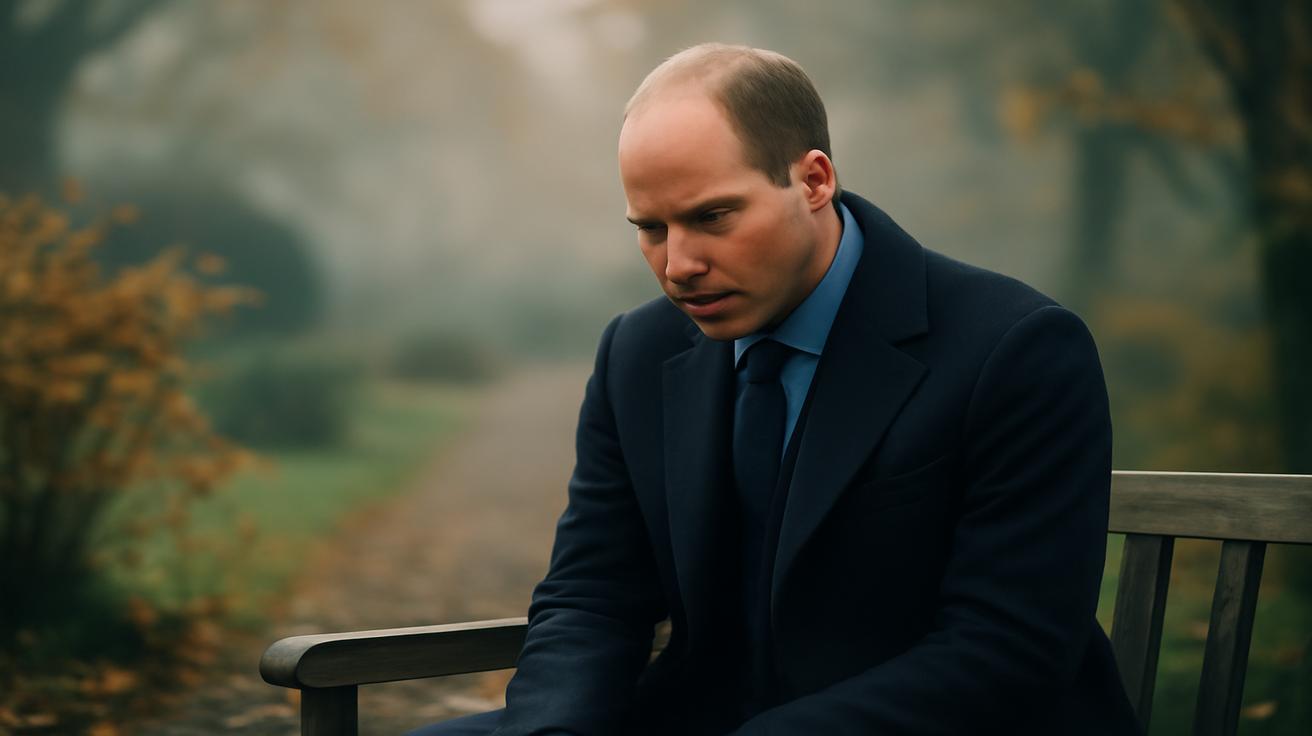
The rain had started just after lunch, the kind that falls softly at first and then settles in, as if it intends to stay. In a small Northern town hall, the air smelled faintly of wet wool coats and steaming tea. People shifted in their seats, the scrape of chair legs echoing under the high ceiling. And then he walked in—taller than many expected, tie straight, expression composed but unmistakably tired around the eyes. Prince William, heir to the British throne, paused for a brief second at the doorway, as though gathering himself, then moved forward into the room, into the waiting sea of faces and questions, and into what he would later admit has been “a brutal year.”
When the Crown Feels Heavy
There is a familiar story we tell ourselves about royalty. It’s made of balcony waves, sparkling tiaras, polished uniforms, and choreographed ceremonies. It glides over the surface of things: parades, processions, speeches timed to the second. It’s a story of continuity and tradition—unbroken lines stretching back centuries, gilded and framed like the portraits that hang in palace corridors.
But in the private spaces behind those corridors, the light is softer, the footsteps quieter, and the conversations more fragile. It’s there, in the late-night rooms and the hushed corridors, that another story has been unfolding—a story of illness, waiting rooms, uncertainty, and the kind of fear that doesn’t care what title you carry.
For Prince William, this past year has taken the mythology of monarchy and collided it—almost violently—with the vulnerability of being a husband and a son. First came the announcement about his father, King Charles III, facing a cancer diagnosis. The world absorbed the news with a collective pause: the King, so newly crowned, now navigating treatment. Then, just as the dust of public shock began to settle, came another revelation—this time about the Princess of Wales, Catherine. The beloved future queen, often seen smiling in dazzling gowns or crouched at eye level with children at charity events, was now undergoing preventative chemotherapy for cancer as well.
“It’s been a brutal year,” William acknowledged in a rare moment of emotional candor. Those words cut through the curated images and official statements like a sudden gust of winter wind, revealing something raw and recognizably human beneath the royal composure.
The Quiet Weight of Two Diagnoses
Illness, when it enters a family, does not knock softly. It barges in, rearranging calendars, rewriting priorities, reshaping time. In the case of the House of Windsor, it has also rearranged the architecture of public duty. One monarch in treatment, one future queen undergoing chemotherapy: the fairy-tale simplicity of monarchy shattered into the reality that bodies—whether royal or not—are fragile, finite, and subject to the same biology as everyone else.
In the midst of this, William stands at a crossroads defined not only by constitutional transition but by deep personal uncertainty. He has had to become, simultaneously, a steadying presence for his father, a supportive partner to his wife, and a constant source of reassurance to three young children whose understanding of words like “cancer” and “treatment” is still forming.
The palace has always operated like a stage, its performances rehearsed and choreographed, the audience watching every gesture. But cancer is unscripted. It brings late-night calls from doctors, side effects that don’t respect public schedules, and an emotional exhaustion that can’t be aired in press releases. For every official engagement William has attended, there have been unseen moments: the quiet repetition of medical terms under his breath to make them feel less alien; the steadying hand on Catherine’s shoulder before yet another test; the careful selection of words when the children ask, “Are you going to be okay?”
The line between private and public has always been fragile for the royals, but now it feels almost translucent. In this year of overlapping diagnoses, the royal family, often presented as an immovable symbol of national stability, has become something else entirely: a mirror of millions of families who have sat in waiting rooms, swallowed bad news, and tried to keep going anyway.
Living Between Hospital Corridors and Palace Halls
There’s a particular tension in William’s days now, a double life in plain sight. One minute he is stepping out of a dark car into the chill of a London morning, shaking hands with charity workers, listening to stories of hardship and resilience. The next, he is slipping into hospitals through less visible doors, past discreet security and the soft squeak of rubber soles on linoleum floors.
He has stood, no doubt, under the blue-tinged glare of hospital lights, listening carefully as specialists outlined options, risks, next steps. He has watched the way Catherine’s hand curls over the armrest during an appointment, the way his father’s jaw tightens when the word “treatment” is mentioned again. These are the small, intimate details that never appear in official photographs, but they form the real landscape of his days.
And yet, the world does not stop asking for him. There are still ribbons to cut, initiatives to support, speeches to deliver. But each engagement now carries a new undercurrent. When William speaks about mental health, there is a different timbre in his voice, because he is living inside the stress he once discussed at a professional distance. When he speaks about carers, patience, and family support, he is no longer advocating from the outside; he is describing, however obliquely, his own life.
The strain shows sometimes. In an era when the monarchy is constantly held up to the harsh light of public debate, William’s carefully measured words about a “brutal year” felt like something rare and unvarnished—a moment where the prince dropped the antique shield of protocol and admitted, in essence, that he was hurting.
A Family on the Edge of the Public Gaze
For all the attention on the King’s health, it is Catherine’s diagnosis that seems to have sent the most profound echo through the public. The Princess of Wales occupies an unusual symbolic space: she is both accessible and aspirational, photographed dropping children at school in a ponytail one day and standing in a glittering tiara the next. To see her step back from public life and speak quietly of chemotherapy shattered a persistent illusion about resilience—that it is synonymous with invincibility.
Behind palace gates, William and Catherine have reportedly been trying to preserve normality for George, Charlotte, and Louis. There is breakfast to be made, school uniforms to locate, the eternal parental negotiation over bedtime. In the middle of all this, there are medical appointments plotted like invisible stars on the family’s weekly planner. While much remains private, the broader outline is clear: they are building a cocoon of relative stability inside a storm that refuses to respect the walls of their home.
William’s role here is split between protector and partner. He is the one who, by all accounts, has driven back and forth from schools to hospitals, who has adjusted his schedule and stepped more visibly into the spotlight when Catherine and the King cannot. At the same time, he is simply a husband watching the woman he loves face something frightening and unpredictable.
The gaze of the world, always hovering, has grown both more sympathetic and more intense. We analyze his body language during public appearances, searching for signs of strain; we notice when his smile doesn’t quite reach his eyes. And somehow, in the space between our curiosity and his dignity, a bridge appears. Because if even a future king can be reduced to a worried son and anxious husband by the word “cancer,” then this sprawling national story collapses into something personal and familiar.
Duty in the Shadow of Uncertainty
The British monarchy has long thrived on continuity—the unspoken promise that, no matter the chaos of politics or the turbulence of world events, the Crown will remain a fixed point. But illness plays by no such rules. It brings with it a fog of uncertainty, a shifting landscape of progress and setbacks.
In this fog, William has had to find a new kind of equilibrium. His father’s role as King remains, but with adjustments, accommodations, and careful planning to balance state responsibilities with medical reality. William himself has stepped more firmly into the role of future monarch—not in a sudden, dramatic transition, but in a slow, quiet recalibration of presence.
He is increasingly the one people look to at public events, the one anchoring ceremonies, the one whose face, in photographs, seems to hold both present anxiety and future expectation. It’s an uncomfortable overlap of timelines: the man dealing with immediate family crises is also the man being gently ushered into a more central symbolic position.
There is a particular cruelty in how public expectation and private pain collide in such a situation. On the day William first referred to the year as “brutal,” he did so while also performing his duties, smiling, listening, responding. His words slipped out not as a dramatic confession but as something closer to a weary acknowledgment—like exhaling in a room full of strangers and hoping they will understand.
Resilience, Redefined
For years, William and Catherine have championed the topic of mental health, urging people to talk about their struggles, to seek help, to normalize feelings of vulnerability. Those campaigns now feel eerily prophetic. In this year of diagnoses and uncertainty, the couple’s private resolve is being tested in the very terrain they once mapped out for others.
Resilience, in this context, is no longer a tidy concept for a speech or a campaign brochure. It is messy and nonlinear. It looks like William cancelling engagements when necessary, then returning to the public eye with a measured apology and a brief explanation. It looks like Catherine stepping away from the constant scrutiny of cameras to focus on treatment and recovery, even as the world clamors for updates.
And it looks like both of them embracing a slower, more inward-facing rhythm for their family, even if that means frustrating public curiosity. This, too, is a kind of leadership—one that says: to care for others properly, even if you are a royal, you must first protect the fragile core of your own life.
In sharing what little they have about their journey—enough to acknowledge the seriousness, but not enough to turn it into spectacle—the couple has carved out a cautious middle path. It is an attempt to honor the public’s stake in the monarchy while insisting on a fundamental truth: that serious illness, even in a palace, is not a performance. It is a battle fought in quiet rooms, one day at a time.
What This Year Reveals About All of Us
There is something undeniably sobering about watching a royal family walk through the same fire that burns through homes across the country: cancer, fear, waiting, hoping. It strips away some of the myth and leaves behind something more fragile, but perhaps more meaningful: recognition.
The image of Prince William—standing in a village hall, or at a charity event, or in a hospital corridor—carries with it a set of unspoken questions. What does it mean to be strong when you are afraid? How do you carry on with your responsibilities when the people you love most are facing the unknown? Where does duty end and simple, human tenderness begin?
For many, the answer lies not in grand gestures, but in the small, stubborn acts of showing up. William continues to appear at engagements, not because he is untouched by what is happening, but because he is learning, in real time, how to inhabit both worlds at once. He is modeling something quietly radical for a royal: the idea that vulnerability and responsibility can coexist.
His words—“a brutal year”—do not ask for pity. They acknowledge a universal experience: that some years bring with them a weight we would never have chosen, and yet we must carry it anyway. In those years, we become softer in some places, harder in others. We learn how to comfort without promising what we cannot guarantee. We learn to live with the sound of medical terms echoing in our heads while we wash dishes, answer emails, attend meetings, or, in William’s case, shake hands with strangers and smile for cameras.
Glimmers of a Different Kind of Monarchy
As the rain finally eased that afternoon and the clouds began to lift, people filed out of the town hall with their own stories in tow. Some had come simply out of curiosity; others had faced cancer themselves, or watched parents and partners do the same. Many left talking less about titles and more about tone—the way William’s voice dipped slightly when he spoke of this year, the way he acknowledged hardship without theatrics.
In those small details, a new shape of monarchy begins to appear. It is less about distance and untouchable grandeur, and more about shared human experience. This version of royalty does not claim immunity from pain; it stands, instead, in the middle of it, trying to navigate the same emotional terrain its people know so well.
William’s future as king will be forged not only in the shadow of ancient crowns and state rituals, but also in these fragile months spent hovering between treatment rooms and official engagements, between his father’s vulnerability and his wife’s strength, between the children’s laughter and their quiet, searching questions.
It has been, by his own admission, a brutal year. But within that brutality, there has also been an unexpected gift: the dismantling of illusion. The reminder that every life, no matter how gilded, can be split open by fear and held together only by love, patience, and the willingness to keep going.
In the end, perhaps that is what will endure in people’s memories: not just the ceremonies and the speeches, but the sight—imagined or glimpsed—of a man who will one day be king, standing in a quiet corridor somewhere, coat still smelling faintly of rain, taking a deep breath before walking back into a hospital room to sit, once more, beside those he cannot imagine losing.
A Glance at the Royal Family’s “Brutal Year”
The story of this past year in the royal family can’t be captured in numbers alone, but some details help frame the emotional and practical weight Prince William has carried.
| Aspect | Details |
|---|---|
| Key Diagnoses | King Charles III and Catherine, Princess of Wales, both facing cancer and undergoing treatment. |
| Impact on Duties | Public engagements reduced or adapted; Prince William taking on increased responsibilities. |
| Family Focus | Greater emphasis on privacy, routine for the children, and time together away from cameras. |
| Public Response | Strong expressions of empathy, support, and identification from people with similar experiences. |
| Emerging Themes | Vulnerability in leadership, the human side of monarchy, and the importance of mental health and family. |
FAQ
Why did Prince William describe it as a “brutal year”?
He was referring to the emotional and practical strain of having both his father, King Charles III, and his wife, Catherine, Princess of Wales, facing cancer diagnoses and treatment at the same time, all while he continues to shoulder growing public and royal responsibilities.
How has this affected his royal duties?
William has stepped up his public role in some areas to support the King, while also adjusting his schedule to prioritize his family’s needs. Some engagements have been reduced or rescheduled to allow space for treatment, recovery, and time with his children.
What has been the focus for William and Catherine during this time?
Their main focus has been protecting their children’s sense of stability and maintaining as normal a home life as possible, alongside navigating treatment, rest, and recovery away from the deepest glare of public scrutiny.
Why has the public response been so strong?
Many people recognize their own stories in what the royal family is going through. Cancer, fear, and uncertainty are universally understood, and seeing such experiences reflected in a highly visible family has stirred empathy and a sense of shared vulnerability.
What might this mean for the future of the monarchy?
This period may help shape a more openly human, emotionally honest version of monarchy—one that acknowledges vulnerability and complexity, and connects with people less through perfection and more through shared, difficult experiences.





Leave a Comment