
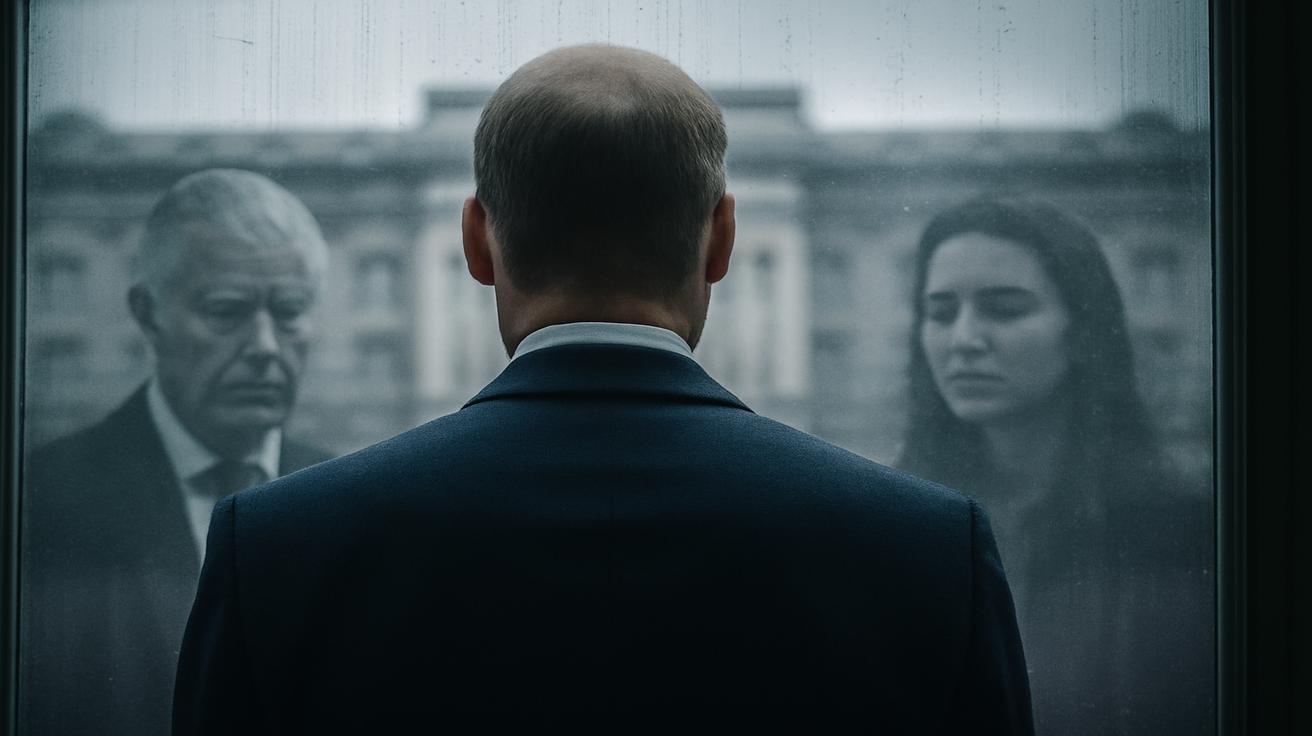
The news broke on a damp, slate-colored afternoon, the kind of day when the sky hangs low over London and the air tastes faintly of rain and exhaust. Screens lit up, notifications chimed in pockets and handbags, and a collective breath seemed to hitch across Britain: another cancer diagnosis in the royal family. This time, it was King Charles. But stitched quietly beneath the headlines was a deeper, more complicated story—because his eldest son, Prince William, was already walking through his own private storm as his wife, Catherine, Princess of Wales, faced cancer too.
In an instant, the familiar, reassuring architecture of the monarchy looked fragile: a father-king in treatment, a future queen in recovery, and one man in the middle trying to hold it all together while the world watched from behind glowing glass screens.
The Weight of a Role He’s Been Preparing for All His Life
Prince William has spent his entire existence in the long shadow of destiny. From the moment he was carried out of the hospital in his mother’s arms, cameras firing like a mechanical storm, his future was scripted in broad strokes: one day, he would be king.
But scripts don’t include the texture of real life—the smell of antiseptic corridors, the ache of waiting-room chairs, the metallic edge of fear when a doctor closes the door gently behind them. They don’t describe what it’s like for that future king to sit between two hospital beds in two different places, answering texts from palace aides while keeping an eye on his children’s homework and his father’s bloodwork.
In 2024, the royal calendar—usually a carefully choreographed dance of handshakes, ribbon cuttings, and speeches—became something messier, more human. King Charles stepped back from public life to focus on treatment. Catherine disappeared from the spotlight after abdominal surgery, and speculation swelled like a storm tide. When she finally addressed the world, calmly explaining that cancer had been discovered and that she was undergoing preventative chemotherapy, the tone was simple and stark: vulnerability dressed in quiet courage.
And in the space between those two diagnoses, Prince William’s role changed from heir-apparent-with-time to heir-under-pressure, his responsibilities expanding faster than anyone had planned.
The Private Man Behind the Public Duty
There’s a strange duality in modern royal life: a person can be one of the most recognized faces on earth and still feel intensely private. William has always gravitated toward that quieter end of the spectrum. Friends and former colleagues describe him less like a celebrity and more like a guarded, sometimes wry, deeply family-oriented man who just happens to have a job title that can never be handed in.
Now, that private man is being pulled hard by public expectations. There is the Prince of Wales in the tailored navy suit, offering firm handshakes and steady words to patients at a cancer center. And there is the husband who slips back into the car and exhales, knowing he will return home to a woman who is herself fighting the disease, and to three children who need bedtime stories, not metaphors about constitutional monarchy.
What makes this year feel so raw is not only the double blow of cancer in the royal family, but the collision of image and reality. The monarchy is built, in part, on symbolism: continuity, steadiness, a family that endures. Yet cancer is an intruder that respects no heraldry, cuts through lineages as easily as it does through lymph nodes, and forces even the most venerable institutions to admit to uncertainty.
William’s challenge is to be both: an unshakable symbol in public and an imperfect, worried son and husband in private. It’s an almost impossible emotional choreography, and you can sometimes see the strain at the edges—tired eyes during a walkabout, a fleeting stiffness in the jaw before he softens into conversation with a well-wisher.
Balancing Father, Son, Husband, and Future King
There is no handbook for how to be a prince in a year like this. No precedent manual that explains how to juggle the emotional load of a father’s diagnosis, a wife’s recovery, and an entire institution leaning slightly more heavily on your shoulders.
Think of William’s life right now as a series of constantly shifting circles: one around his father, one around his wife, one around his three young children, and one around the country that will one day call him king. Each of those circles needs him in a different way, and none of them ever fully close.
There are early mornings, packing school bags, smoothing out small anxieties: “Will Mummy be okay?” There are phone calls with doctors and palace aides, calendar revisions done in hushed tones. There are visits to see the King—sometimes formal, sometimes just father and son talking quietly, the air heavy with what’s said and what’s not. And then there’s the public role: the opening of a new facility, the speech, the comforting nod as he shakes hands with someone whose loved one has also been given that devastating word.
In that overlap lies a very modern royal story: a man trying to practice the empathy he so often talks about in his public work around mental health, only now the test is intimate and relentless. How do you stay present for everyone without coming apart yourself? How do you let yourself grieve and rage and worry, when an entire machine of tradition needs you to look composed?
The Quiet Storm Around Public Expectation
For decades, the royal family has existed in a kind of soft-focus distance for most people—present but not intrusive, a backdrop of crowns and ceremonies behind daily life. Yet in times of crisis, the public gaze sharpens. People want reassurance, visibility, a sense that those at the top are continuing on, even if a little bruised.
That gaze now points squarely at Prince William. With the King stepping back and Catherine’s appearances rare and carefully managed, William has become the most visible senior royal. Each appearance, each absence, each word feels amplified.
Commentators parse his body language. Social media circulates clips and screenshots, zooming in on the faintest flicker of emotion. Some demand more openness, more explanation, more visibility. Others argue he’s already giving too much, that a man with two close family members in cancer treatment deserves space to simply be a son and husband.
What often goes missing in this argument is the human scale of the experience. Cancer doesn’t care about constitutional roles; it brings with it the same anxieties familiar to millions of families: Will the treatment work? How will the children cope? What if the next scan brings different news?
William must carry those questions in the same mental space as where he keeps state briefings and constitutional updates. One moment, he is likely discussing the Crown’s role in a changing geopolitical landscape. The next, he might be reading a text about side effects from chemotherapy.
| Role | Key Pressure Point in 2024 |
|---|---|
| Son | Supporting King Charles through cancer treatment while preparing for increased constitutional duties. |
| Husband | Being present for Catherine during her cancer diagnosis, treatment, and recovery. |
| Father | Protecting the emotional well-being and privacy of George, Charlotte, and Louis. |
| Heir to the Throne | Taking on more public duties and representing the Crown during the King’s reduced schedule. |
| Public Figure | Managing media scrutiny and public expectations in the most turbulent royal year in decades. |
It’s in this quiet storm of expectation that the monarchy either becomes more relatable or risks feeling brittle. And whether he asked for it or not, the person at the center of that test in 2024 is William.
Cancer, Vulnerability, and the Monarchy’s Changing Image
Cancer is not new to the royal family, but the way this chapter is unfolding feels different. This time, the diagnoses landed in a world that is permanently online, where rumors race faster than official statements and where silence is quickly filled with speculation.
When Catherine chose to speak directly about her diagnosis, she did so in a setting stripped of royal spectacle: a simple bench, soft natural light, her voice steady but edged with emotion. It was intensely personal, but it was also, in its own way, profoundly public. She invited millions of people—many of whom have their own experience with cancer—into the family’s reality.
In that moment, William became not just the future king, but the partner of someone speaking openly about vulnerability. This aligns closely with themes he has championed around mental health, grief, and emotional honesty. Yet it also forces him to live those values under incredible strain.
The monarchy has long relied on a curated distance to maintain its mystique. Now, illness is forcing a different kind of connection: one built on shared human fragility. People know what chemo fatigue feels like, what the waiting between appointments does to your sleep. They see a royal family walking that road and, for better or worse, they expect a certain level of openness about it.
William, who grew up watching his mother both adored and devoured by the press, is particularly sensitive to the cost of overexposure. He knows how easily concern can slide into intrusion. So he walks another thin line: allowing enough visibility for the public to feel included, but not so much that his children grow up seeing their mother’s medical chart in headlines.
A Year That Echoes the Ghosts of the Past
For those who have watched Prince William since he was a boy, there is something haunting about this moment. The sight of him comforting others outside a hospital, or walking with slightly hunched shoulders after a difficult announcement, can’t help but summon memories of a much younger William walking behind his mother’s coffin, jaw clenched, eyes fixed forward as the world wept around him.
The royal family has always been both a family and a symbol, and William’s life has played out at that intersection more visibly than almost anyone else in modern royal history. The rawness of losing his mother so young, under such intense public scrutiny, has shaped almost every decision he’s made since: his choice of spouse, his insistence on a relatively grounded childhood for his children, his sometimes stony relationship with the press.
Now, in this turbulent year, echoes of that emotional landscape rise again—but in a new context. He is no longer the grieving child; he is the anchor figure. The child who once walked behind a coffin is now the man people look toward when they wonder what will become of the monarchy.
There is a generational shift layered into this. Charles’s illness, even if fully treatable, reminds the country that his reign, by nature, will be shorter than his mother’s. The public gaze inevitably drifts forward, to the next in line. What kind of king will William be? How will he shape the institution? These questions are being asked not in a period of calm, but in a time of frailty and fear.
In some ways, adversity can be a crucible. How William navigates this year—how he communicates, what he chooses to share, the tone he sets as both son and successor—will leave deep impressions on how people feel about his future reign. He has an opportunity, and an immense burden: to allow the monarchy to look more human without letting it seem unstable.
Finding Steadiness in Small, Ordinary Moments
For all the grandeur of palaces and the weight of ceremony, the glue that holds William’s world together right now is likely made of much smaller things. A quiet cup of tea in a sunlit corner. A short walk on the grounds with the dog, the air sharp and cool in his lungs. A silly joke from one of the children that breaks the tension at the dinner table and sends everyone into grateful laughter.
This is where the public and private worlds blur into something recognizably universal. Anyone who has walked through a family health crisis knows the strange normality that clings to the edges of catastrophe. The bills still arrive. The laundry still piles up. The dog still wants to be fed. Life keeps flowing, indifferent to the drama at its center.
William’s life, for all its privilege and peculiarities, is no different at its core. He is learning, in real time and at large scale, what it means to shoulder multiple kinds of care at once: emotional, practical, constitutional. It is not glamorous work. It’s made of showing up: to the hospital, to the school run, to the investiture ceremony, to the late-night conversation with a worried spouse.
If there is any consoling thread in this turbulent year, it’s that this kind of lived experience can deepen the empathy he has already tried to bring to his public role. The next time he speaks about carers, about mental health under pressure, about families facing illness, he will be doing so as someone who has not only read the briefing notes but walked through the fire himself.
What This Turbulent Year Might Mean for the Future
Monarchies endure not because they are unchanging, but because they learn—slowly, sometimes painfully—to bend without breaking. The House of Windsor has weathered abdications, wars, divorces, and scandal. This year’s challenge is different: it is quieter, more intimate, but no less significant. It is the challenge of showing that an institution founded on projection of strength can also acknowledge vulnerability.
Prince William stands at the center of that test. As both his father and his wife move through cancer treatment, he is being asked to be the face of continuity while living through uncertainty. The turbulence is not only institutional, but deeply personal.
Whether he wanted it or not, 2024 is becoming a defining chapter in his life story. It is the year when the abstract notion of “duty” collided with the all-too-human realities of illness and fear. It is the year when the future king discovered what it truly means to carry a family, and a country’s expectations, at the same time.
Years from now, historians will likely write about this period as a hinge moment for the modern monarchy. But for now, it is something simpler and more immediate: a man moving through hospital corridors, stepping out into the cold air, straightening his shoulders, and walking toward the cameras—aware that behind them are not just lenses, but millions of eyes, looking for a sign that, somehow, everything will be all right.
Frequently Asked Questions
Why is this considered one of the most turbulent royal years in decades?
Because two of the most central figures in the monarchy—King Charles and Catherine, Princess of Wales—are undergoing cancer treatment at the same time. This places unprecedented emotional and public pressure on Prince William while also raising questions about continuity, visibility, and leadership within the royal family.
How has Prince William’s role changed during this period?
William has taken on a significantly larger share of public and constitutional duties while also acting as a key source of support for his father and wife. He is effectively balancing the roles of future king, acting senior royal, husband, son, and father, all under intense public scrutiny.
How are William and Catherine handling public communication about her illness?
They have chosen a carefully calibrated openness: acknowledging Catherine’s diagnosis and treatment in a direct, personal way, while firmly protecting specific medical details and the privacy of their children. Their approach tries to combine honesty with boundaries.
What impact might this year have on William’s future reign?
This period is likely to shape both public perception of William and his own understanding of leadership. His experience with family illness and emotional strain may deepen his focus on mental health, caregiving, and authenticity, themes that could become hallmarks of his future reign.
Why does the public place so much attention on William during this crisis?
With the King’s schedule reduced and Catherine largely out of the spotlight during treatment, William has become the most visible senior royal. As heir to the throne and a relatively younger figure, he embodies both present responsibility and future promise, making him a focal point for concern, curiosity, and expectation.





Leave a Comment