
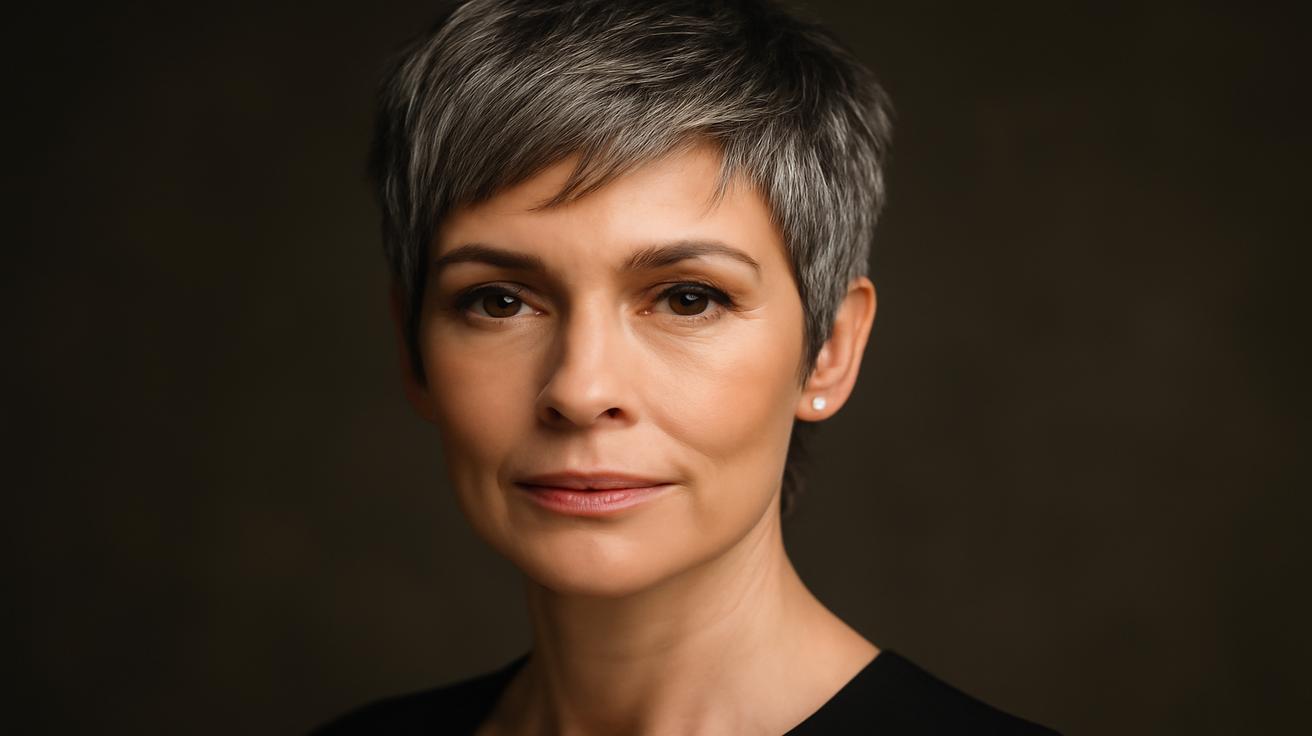
The first time you hear the scissors close around your hair at fifty-something, it can feel like standing at the edge of a cliff. Your hand goes, almost instinctively, to your nape as soft strands fall away and gather on the salon floor. The mirror in front of you reflects an in‑between moment: not quite the woman you were, not yet the woman you’re about to meet. The stylist combs through what’s left—short, feathered, startling—and your heart beats a little faster. What if this was a mistake? What if you’ve just cut away ten years of your identity? Then, slowly, you lift your chin. The light catches your cheekbones. Your eyes look bigger, brighter. And suddenly, you realize: this isn’t the end of something. It’s the beginning of something wild and bright and astonishingly you.
Why the Pixie After 50 Feels Like a Rebellion (In the Best Way)
If you grew up with the unspoken rule that “older women should keep their hair a certain way,” chopping it all off later in life can feel almost subversive. So much of how we’re taught to think about beauty is tied to length—long hair as youth, femininity, desirability. A pixie cut defies that quietly. It says: My face matters. My energy matters. The way I feel in my skin matters more than the inches I’ve left on the salon floor.
The beauty of the pixie after 50 is that it doesn’t try to hide you. It doesn’t curtain your jawline, or soften your edges under waves of hair. It does the opposite—it frames, sharpens, reveals. Done well, it can erase a decade of heaviness from your features. Your eyes become the main event. Your jawline suddenly seems more sculpted. Your neck, once hidden, lengthens your silhouette like a quiet exclamation mark.
But here’s the secret no one tells you: a pixie cut alone won’t automatically make you look younger. At 50, 60, 70 and beyond, the cut is just one ingredient. It’s the way you choose the shape, the texture, the color, and the styling that turns “nice short hair” into ten‑years-younger short hair.
Think of it like slipping into a perfectly tailored jacket versus an off‑the‑rack one. Same category of clothing, completely different energy. A pixie can either sit on your head like a practical decision or glow on you like a personal revolution. The difference lives in the details—and those details are exactly where your power lies.
Tip 1: Let Soft Texture Be Your Secret Time Machine
Hard, helmet‑like hair is what ages a pixie faster than any fine line ever could. That stiff, super‑set look that doesn’t move when the wind blows? It pulls you backward in time—but not the era you’re hoping for. To look younger with a pixie after 50, you want texture that feels like a deep breath: light, airy, touchable.
Close your eyes for a moment and picture this. Tiny, soft layers around your crown, lifted just enough to create a gentle cloud of volume. Wisps that graze your temples instead of forming a rigid wall. The back slightly tapered, not shaved tight, so you keep softness instead of severity. When you run your fingers through it, it falls back into place like it remembers where it belongs, but it never looks glued there.
This kind of texture does two important things:
- It lifts your features. Height at the crown and gentle movement draw the eye upward. That alone can make your face look less tired and more open, the way good posture transforms your whole presence.
- It adds “youthful mess.” Think about children’s hair: it’s rarely perfect. It’s a little mussed, a little undone. That slight imperfection reads as vitality. Over‑polished hair, especially when short, can look stiff and dated.
When you talk with your stylist, use words like “piecey,” “feathery,” “light,” and “undone.” Ask for soft layering rather than heavy, chunky layers. For styling at home, skip heavy gels and thick mousses. Instead, reach for a lightweight volumizing spray at the roots or a tiny dab of texturizing cream you can warm between your fingers and press into the ends. The goal isn’t perfect spikes or harsh definition; it’s that whisper of movement that looks like you woke up already interesting.
Tip 2: Find the Pixie Shape That Loves Your Face Back
A pixie cut isn’t just “short hair.” There are dozens of variations, and the way you choose them can be the difference between “wow, did you just come back from vacation?” and “whoa, that’s… severe.” At 50 and beyond, the right shape doesn’t fight your face; it collaborates with it.
Start with your face shape, but don’t get boxed in by rules. Instead, think in terms of balancing what’s already there:
- If you have softer features or fuller cheeks: A slightly longer pixie with sweeping bangs can skim the top of your cheekbones and draw attention to your eyes, not the roundness of your face.
- If your jawline is strong or angular: A more cropped pixie with subtle fringe and side texture can highlight that sculpted look in a striking way.
- If you’re noticing sagging at the jaw or neck: A pixie that’s a touch longer in front and slightly shorter at the nape can give the illusion of lift, like invisible strings pulling your features upward.
What matters most is where the lines of the cut intersect with the lines of your face. Hard, straight lines across your forehead or at your temples can exaggerate fine lines or texture in the skin. Soft, curved lines—like a side‑swept fringe, or slightly tapered sides—tend to blur those same areas in the most flattering way.
To help you visualize, here’s a simple comparison you can keep in mind when you’re sitting in that salon chair:
| Pixie Element | Ages You | Makes You Look Younger |
|---|---|---|
| Bangs / Fringe | Very short, blunt, straight across | Soft, side‑swept, gently textured |
| Sides | Shaved too close, no softness | Lightly tapered with subtle movement |
| Crown | Flat, heavy, or overly slicked down | Gentle lift with airy layers |
| Overall Shape | Boxy, rigid lines | Soft, slightly rounded contours |
Bringing photos to your stylist helps, but here’s an often overlooked trick: instead of just showing them what you like, also show them what you don’t like. “Too spiky, too flat, too boyish, too severe”—these words are invaluable. You’re not just getting a haircut; you’re co‑creating a frame for the life you’re living now.
Tip 3: Use Color (or Silver) as Your Built‑In Filter
Once your hair is short, every nuance of color becomes more visible. That can be a gift. It’s like switching your camera from low light to bright daylight—you can see everything, for better or for worse. So if your goal is to look fresher, softer, and more awake, leaning into a smart color strategy with your pixie is one of the quickest paths there.
You don’t have to go bold or high‑maintenance. In fact, the most youthful pixie colors after 50 tend to whisper rather than shout. Think of color as the world’s gentlest filter for your skin:
- Warm, soft tones—like honey, caramel, or warm beige—can bring life back to skin that’s feeling a bit dull.
- Cool, icy tones—like silver, ash, or frosted beige—can make blue or green eyes absolutely blaze, especially with a pixie.
- Subtle dimension—a few lighter strands around your face, slightly deeper tones at the nape—creates depth that makes your pixie look modern, not flat.
If you’ve embraced your natural gray or white, a pixie cut can turn that choice into a statement. Short, silver hair has a kind of cinematic drama to it, especially when it’s cut well. The key to keeping it youthful instead of harsh is tone and shine. A slightly cool, bright silver with good gloss tends to look intentional and chic. A dull, yellowed gray can look tired, no matter how great the cut is.
Ask your colorist (or look for at-home products) that focus on:
- Neutralizing yellow tones in gray or white hair.
- Adding light-reflecting gloss, not just color.
- Keeping the overall shade a touch softer around your face than at the back.
And remember: at this stage of life, color isn’t about pretending you don’t have gray hair. It’s about deciding how you want that gray—or that blonde, or brunette, or copper—to tell your story. You’re not erasing years; you’re editing the lighting.
Tip 4: Style It Like You Mean It—But Keep It Easy
A pixie after 50 should simplify your life, not add a new full‑time job. The goal is to look like you woke up radiant with minimal effort—even if you and your blow dryer know there was at least a little choreography involved.
The everyday magic lies in a few small habits:
- Learn your natural pattern. Does your hair want to lie flat, wave at the front, or spring up at the crown? Work with it, not against it. Fighting your hair into submission daily is exhausting and often looks forced.
- Invest in a tiny toolkit. You don’t need a drawer full of products. Usually two or three are enough: a light volumizing spray or foam, a texturizing cream or paste, and maybe a shine serum if your hair tends to look dry.
- Master the two‑minute refresh. On second- or third-day hair, a quick spritz of water or lightweight spray at the roots and a finger tousle with a bit of texturizing product can reset your pixie without a full wash.
Think of styling as enhancing the cut, not reinventing it every morning. The right pixie should almost fall into place on its own. You might give your fringe a tiny twist with your fingers, lift the crown while your hair is still damp to encourage volume, or smooth a single rebellious piece. That’s often all it takes.
What truly makes you look younger isn’t a helmet of perfect hair—it’s the sense that you’re at ease. A soft, slightly playful pixie suggests motion and confidence, like you’ve got places to go and you’re not worried about your hair keeping up. It hints at a life being actively lived, not carefully managed.
Let Your Whole Look Rise to Meet Your Pixie
Something interesting happens when women cut their hair short after fifty: the rest of their style starts to shift in response. The pixie becomes this clear, bright note, and suddenly everything else—makeup, jewelry, necklines—feels invited to join the chorus.
You don’t need to overhaul your wardrobe or learn complicated makeup routines. But the shortest hair you’ve had in years will change how your face and neck interact with what you wear. This is a chance to fine‑tune the frame around your new frame:
- Necklines: Boat necks, V‑necks, and open collars often look especially lovely with a pixie, emphasizing that new, graceful line from your jaw to your shoulders.
- Earrings: With less hair competing for attention, small hoops, delicate drops, or a single bold stud can suddenly become your signature.
- Makeup: You may find you need less, not more. A bit of brightness around the eyes, some definition in the brows, and a lip color that makes you feel alive is often all you need with a pixie framing your features.
Consider your new haircut an invitation, not a demand. You don’t have to become someone dramatically different. Often, women describe feeling like their outside finally matches the way they’ve felt on the inside for years: a little braver, a little freer, a lot less interested in apologizing for taking up space.
The “ten years younger” effect people notice isn’t only about bone structure or color or texture. It’s about this—this alignment between the face you’re showing the world and the way you actually see yourself. A pixie, chosen thoughtfully and worn with ease, becomes a visible declaration of that alignment.
FAQs About Wearing a Pixie Cut After 50
Will a pixie cut make me look older if I have fine or thinning hair?
Not if it’s done well. In fact, a carefully layered pixie can make fine or thinning hair look fuller by removing weight that drags it down. The key is soft layers, gentle volume at the crown, and avoiding very tight, shaved sections that expose too much scalp.
How often should I get my pixie trimmed to keep it flattering?
Most pixie cuts look their best with a trim every 4–6 weeks. This keeps the shape intentional and prevents that in‑between stage where the style loses its structure and starts to look shapeless or heavy.
Can I still look feminine with a pixie cut after 50?
Absolutely. Femininity isn’t about hair length; it’s about how you inhabit your features and your presence. Soft texture, gentle lines around the face, flattering color, and details like earrings or makeup can all emphasize a very feminine energy with a pixie.
What if I regret cutting my hair short?
It’s natural to feel uncertain at first, especially when you’ve had longer hair for years. Give yourself a couple of weeks to adjust and experiment with styling. If you still don’t love it, hair grows—often faster than you expect. In the meantime, a good stylist can tweak the shape to better suit your face as it grows out.
Is a pixie cut high‑maintenance for someone over 50?
It can be surprisingly low‑maintenance once you find the right shape. Daily styling is usually quick—often just a few minutes. The main commitment is regular trims to keep the cut looking intentional. If you choose color, keeping it soft and close to your natural shade can make upkeep easier.




Leave a Comment