
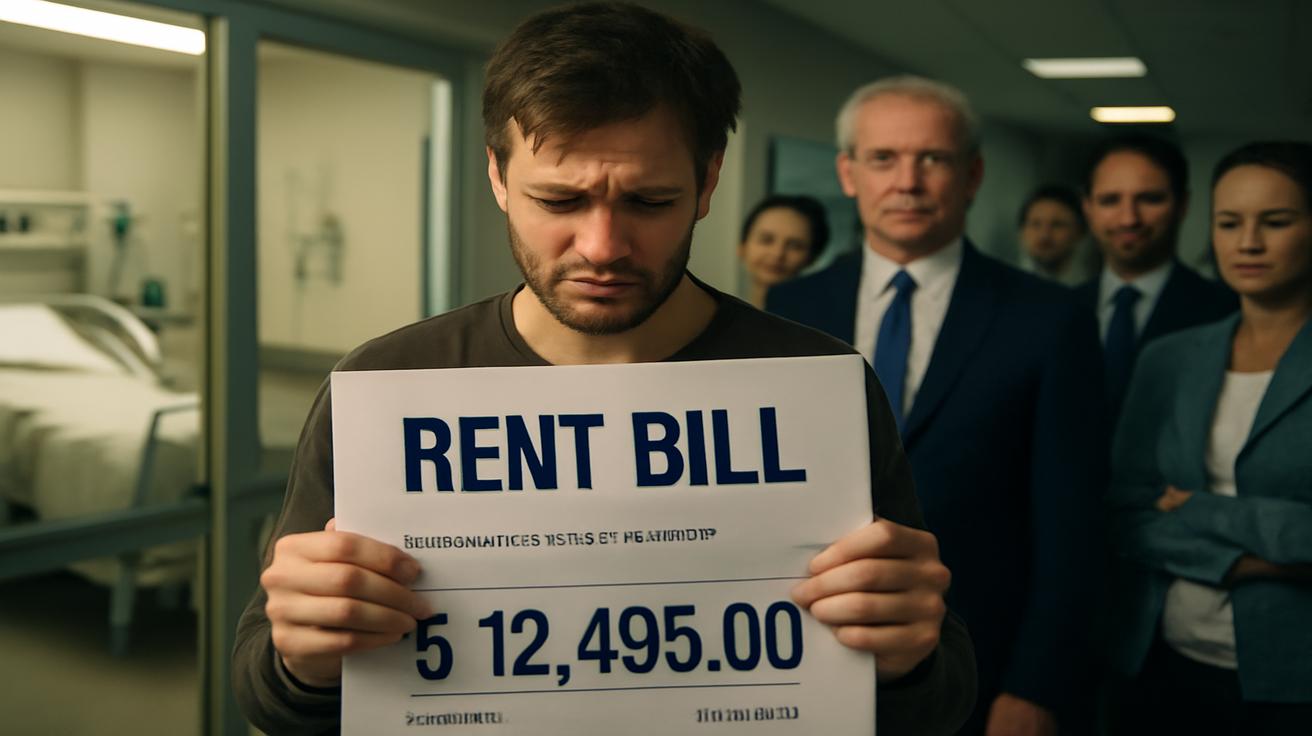
The letter arrived on a Tuesday, the kind of damp, forgettable Tuesday the English sky seems to specialise in. Daniel almost didn’t open it. Another leaflet, he thought, another quiet reminder that the world keeps advertising, keeps selling, keeps spinning, even when your own has come to a dead halt. His mother had been gone for six weeks. The flowers had browned. The casseroles from neighbours had stopped arriving. Silence had returned to the small terraced house where she’d once hummed along to the radio while ironing his school shirts.
He slit the envelope open with a butter knife, one-handed, mug of tea in the other. Steam curled up, mingling with the faint smell of dust and the lemon polish she’d always used on the sideboard. It was a hospital logo on the letterhead, blue and familiar. For a second, his chest tightened. Some part of him, the irrational part that grief refuses to let go of, expected an apology. A follow-up. Maybe even the impossible—We’re terribly sorry, there’s been a mistake.
Instead, the words that stared back at him were measured and bureaucratic.
“Dear Mr. Ellis,
We are writing regarding the outstanding payment of £3,428.16 for the continued occupation of bed 17B during the period following your late mother’s death…”
The mug of tea trembled. A brown arc sloshed over the rim and onto the laminate table. Somewhere, very far away, a delivery van reversed, its beeping steady and indifferent. And in the small kitchen that still smelt like his mother, Daniel read the sentence three times before it made any sense at all.
When a Bed Becomes a Bill
There is something almost sacred about a hospital bed once someone has died in it. For families, that narrow frame with its creaking rails and thin mattress is the last stage, the final place their loved one occupied in the world of the living. It’s where they whispered goodbye in the half‑light, where monitors fell silent, where hands were held until they went cold.
In the days after his mother died, Daniel did not think about policies, or occupancy targets, or the economics of healthcare. He thought about the way she had looked on that last afternoon—too small in all that white, with the television on but no one watching it. He remembered the smell of antiseptic and over‑brewed coffee, the soft squeak of nurses’ shoes, the hush that settles around anyone who’s close to the end.
He knew, vaguely, that there were forms to sign, machines to surrender, belongings to gather into plastic bags. What he did not know—what almost no one thinks to ask in that shattering moment—was how long the hospital would consider the bed “hers” after she was gone. The staff, kind but rushed, had murmured something about “taking your time” and “sorting affairs when you’re ready.” So he did what grieving people do. He stumbled home, clung to routine, and let the paperwork slip into a vague later.
The hospital, he assumed, understood. The system, he believed, would make allowances. For death. For shock. For the simple human fact that it is impossible to be practical about a bed when only hours ago your mother was breathing in it.
Weeks passed. Then came the invoice.
Counting Days After Death
What happened to Daniel is part tragedy, part administrative horror story, and entirely about how we choose to translate compassion into policy. It turned out that, according to the trust that ran the hospital, his mother’s bed had remained “occupied” for 23 days after she died. Her belongings, a cardigan, a bag of boiled sweets, two paperbacks, and a framed photo of Daniel as a gangly teenager, had stayed in the cabinet beside the bed. The records showed that bed 17B wasn’t reassigned during that period.
And in a cash‑starved healthcare system, an unoccupied bed was no longer just an empty space. It was a cost.
When the story finally broke in the local paper—after Daniel, bewildered and angry, had refused to pay and sought help—it did what modern outrage does best. It sped across the internet in lurid headlines and clipped video interviews, each share a small act of disbelief and fury.
“Grieving son billed thousands in bed rent after mother’s death.”
“Hospital charges for ‘ghost bed’ as family mourns.”
“Rules are rules: Trust defends policy.”
Comment sections ignited. Radio phone‑ins filled with callers. Some voices shook with indignation; others with the weary resignation of people who had seen this sort of thing coming. It was as if the nation had suddenly been invited to stand at the edge of bed 17B and decide whether what they were looking at was a tragic misunderstanding, or something colder and more deliberate.
How the Charges Stacked Up
Beneath the emotion, there were numbers. The trust explained them with the dispassion of a spreadsheet:
| Item | Detail |
|---|---|
| Daily bed rate | £149.05 per day |
| Chargeable days after death | 23 days |
| Reason given | “Bed not available for clinical use while personal effects remained on ward.” |
| Total invoiced | £3,428.16 |
On paper, it was just another line item in a system that measures almost everything—blood pressure, oxygen saturation, waiting times, bed occupancy. In real life, it was a bill arriving like a second bereavement.
“I thought at first it was some sort of scam,” Daniel told the reporter, his voice flat, like he still couldn’t quite believe he was saying the words out loud. “Then I rang the number and they told me, very calmly, that the ‘policy’ is clear. The bed is only considered vacated when the belongings are removed. My mum’s body left that ward the same day she died. But to them, she was still in debt for lying there.”
“Rules Are Rules”: The Hospital’s Defence
There is a particular chill to that phrase—“rules are rules”—when it’s dropped into conversations about the most fragile parts of human life. It’s the sound of a door closing, softly but firmly, between empathy and procedure.
The hospital trust was quick to issue a statement once the story gained traction. They expressed condolences. They said the situation was “regrettable.” But they also stood by the principle behind the bill.
“Our facilities are under extreme pressure,” read the press release, framed in clean corporate language. “We must ensure that beds are available for patients who need them as quickly as possible. Clear policies exist to balance the needs of families with our responsibility to manage finite resources. These policies are communicated on admission forms and reiterated at the point of bereavement.”
In other words: We told you. You signed. The system did what the system always does.
Behind that defence, there are truths that are, awkwardly, not entirely unreasonable. Hospitals do run at dangerously high occupancy rates. The line between full and overfull can be measured in lives. Every bed blocked by admin delay, by miscommunication, or by grief’s slow paralysis might mean a patient on a trolley in a corridor, or in an ambulance circling outside.
For some people, that reality made the hospital’s position understandable—if not comfortable. Commenters admitted, sometimes reluctantly, that in a world where healthcare budgets are stretched taut, someone, somewhere, has to keep count. Rules, they argued, exist for a reason. If everyone left their loved one’s belongings for weeks, the system would grind to a halt.
But for many others, that reasoning rang hollow against the sheer emotional weight of what was being counted. A bed that had cradled the newly dead was being weighed and priced like a hotel room overstayed.
“You don’t charge someone rent for the space their grief occupies,” one caller said on a late‑night phone‑in, her voice cracking. “You just don’t.”
A Fight That Moved from Corridor to Court of Public Opinion
Daniel did what most of us imagine we would do in his place: he refused to pay. He wrote to the trust. He sat on hold with administrators. He spoke to a charity that helps families navigate the spiky undergrowth of medical debt. Each conversation left him more exhausted than the last.
“They were polite,” he recalled. “Always polite. But it felt like talking to a wall that had been trained in customer service.”
At some point, the dispute stopped being about the money for him. It became about what it meant if he surrendered. What it would say about how his mother’s last days had been reduced to line items and clauses.
“My mum worked her whole life,” he said in one interview. “She paid her taxes. She volunteered at the hospice shop. When she got sick, we never complained about waiting times or staff being rushed. We were grateful. And then, weeks after she died, they treat her bed like a parking space that overstayed the meter. How is that right?”
On social media, the narrative picked up its own momentum. Artists sketched hospital beds with price tags dangling from the rails. Poets wrote short, punchy stanzas about grief being invoiced. A writer described hospital corridors as “toll roads between living and dead.” The story touched a nerve that ran deeper than a single disputed bill. It exposed something raw about how industrial our care of the dying has become.
And yet, beneath the noise, there were quieter questions being asked too.
Where Does Responsibility Begin—and End?
As the outrage swirled, ethicists, healthcare workers, and policy wonks stepped forward, invited into studios and columns to translate feeling into something more structured.
They asked, gently but insistently: When someone dies in a public system, what exactly are we promising families? A few days of protected time? A week? A printed leaflet handed over while their eyes are still red? And how clearly is any of that explained?
Nurses admitted, anonymously, that they often stretched or softened the rules for families in shock. “Sometimes,” one told a journalist, “you look at a son who’s just watched his mum die and you say, ‘Take whatever time you need.’ Do I mean that literally? No. I mean, ‘take whatever time you can survive taking.’ But the paperwork doesn’t understand that difference.”
Administrators, reading the same headlines, wondered if they had been set up as villains for doing what the system demanded. They worked in windowless offices, logging numbers, staring down deficits. They had spreadsheets that did not show the quality of anyone’s last goodbye, only the blunt ratio of beds available to demand.
“We don’t like sending those letters either,” one former billing officer said. “But if we don’t, the deficit grows. Then the same public that is furious now will be furious when their elective surgery is delayed because the trust is overspending. There’s no version of this where everyone is happy.”
And so the argument turned into a kind of moral tug of war, each side gripping their end of the rope, the space in the middle occupied by bed 17B—empty now, sheets changed, a new patient breathing under its fluorescent lights.
The Unseen Cost of “Efficiency”
To walk through a modern hospital is to walk through a place that is always on the edge of too much. Too many patients. Too much noise. Too many alarms. Not enough staff, not enough time, not enough space between the moment someone takes their last breath and the moment the bed is needed for someone else clinging fiercely to their next one.
On a rational level, many of us understand this. We know that the same system that cradles us in crises has to keep itself from collapsing under its own weight. We nod when experts talk about “throughput” and “turnover” and “bed‑day costs.”
But humans do not grieve rationally. We grieve in smells and textures and small objects. The cardigan that still holds warmth. The half‑drunk cup of tea on the bedside table. The photo that never got taken home because no one could bear to admit the hospital stay would end in anything other than discharge.
To turn that liminal space—the days after—but before—the tidy‑up—into a billable period feels, to many, like crossing an invisible line. It transforms the hospital from sanctuary to landlord. It tells families that the clock started not just on treatment, but on the cost of mourning.
In the middle of the storm around Daniel’s case, one palliative care doctor wrote an anonymous essay. In it, she described how, after a death, she sometimes stood for a few minutes in the doorway of the room, letting the quiet settle.
“There is a holiness to those minutes,” she wrote. “They cannot be hurried without damaging something delicate in the people who have just said goodbye. I understand the pressure on beds. I feel it every shift. But we must be very, very careful what we decide is billable in that doorway.”
A Policy Rethought, But a Question Left Hanging
Under pressure, and facing a complaint that wouldn’t quietly evaporate, the trust eventually backed down. The bill was cancelled “as a gesture of goodwill.” An internal review of bereavement and bed‑clearance policies was announced. There was talk of clearer communication, of standard grace periods, of “sensitivity training” for staff who approached families about belongings.
On paper, it was a kind of victory. The story of the grieving son who refused to pay “rent on his dead mother’s bed” slipped from the top of news homepages. Another scandal took its place. The public fury, so hot and bright for a week or two, cooled and hardened into a cultural memory—a sentence you might hear at a dinner table, starting with, “Do you remember that man who…”
But the deeper question remained, hanging in the air like the smell of disinfectant in a quiet ward. How do we want our systems to behave at the edges of life, where efficiency and humanity collide?
Because beneath the specifics of Daniel’s case lies a future that is, if anything, more squeezed—older populations, more expensive treatments, budgets that will never quite stretch far enough. There will be more policies, more fine print, more clauses written to plug the leaks between care and cost.
Somewhere, in that tangle, we will decide—consciously or by default—what is and isn’t allowed to be reduced to money. Does grief get a price tag? Does the closing chapter of someone’s life get counted in occupied bed‑days and invoices signed in blue ink?
In the end, perhaps the real outrage is not only that a son was billed thousands for the weeks his dead mother’s bed stood empty. It’s that the bill made perfect sense to the system that produced it. It was the logical conclusion of rules written without a space for that strange, unruly thing that begins the moment a heartbeat stops: the human need to linger.
Standing in his kitchen, letter trembling in his hand, Daniel felt what so many feel when they come up hard against the colder edges of our institutions—a sudden, dizzying sense that somewhere along the line, something important had been misplaced. Not just kindness. Not just tact. But the simple recognition that some spaces in life should be marked off‑limits to the ledger.
The bed is empty now. The sheets are fresh. A new chart hangs at the rail. Nurses hurry past, their shoes squeaking faintly. Outside, ambulances arrive and depart, their sirens fracturing the afternoon. The hospital keeps doing what hospitals do—saving, losing, counting, trying.
And out here, we are left arguing over a single, stubborn question: where, in all that counting, do we draw the line and say, “Here, at least, the rules are not just rules. Here, they must also be human.”
Frequently Asked Questions
Did the son actually have to pay the hospital bed charges?
No. After public attention and formal complaints, the hospital trust cancelled the invoice “as a gesture of goodwill.” However, the cancellation highlighted that the original charge was fully consistent with existing policy, which is what alarmed so many people.
Why did the hospital say the bed was still “occupied” after the mother’s death?
The trust’s position was that as long as personal belongings remained by the bed and the bed had not been formally turned over for clinical use, it was classed as unavailable for new patients. That administrative status was then tied to a daily bed rate, turning days of delayed clearance into billable time.
Is it common for hospitals to charge families after a patient dies?
Direct charging of families for post‑death bed use is not widespread, but versions of this situation can occur, especially where long‑term care, private arrangements, or complex funding rules are involved. What made this case unusual was how starkly the charge fell on a grieving relative in a public system, and how unapologetically it was initially defended.
Were the family clearly told about the policy when the mother was admitted?
The trust claimed the information was included in admission documents and reiterated around the time of death. The family, like many under extreme emotional strain, did not recall or fully register this. This gap between technical consent and meaningful understanding was one of the central moral concerns raised by the case.
What changes have been proposed to prevent similar cases?
Following the public outcry, the trust launched a review of its bereavement and bed‑clearance policies. Suggestions included automatic grace periods after death, clearer and more compassionate communication with families, and decoupling the immediate aftermath of bereavement from any form of financial penalty.








Leave a Comment