
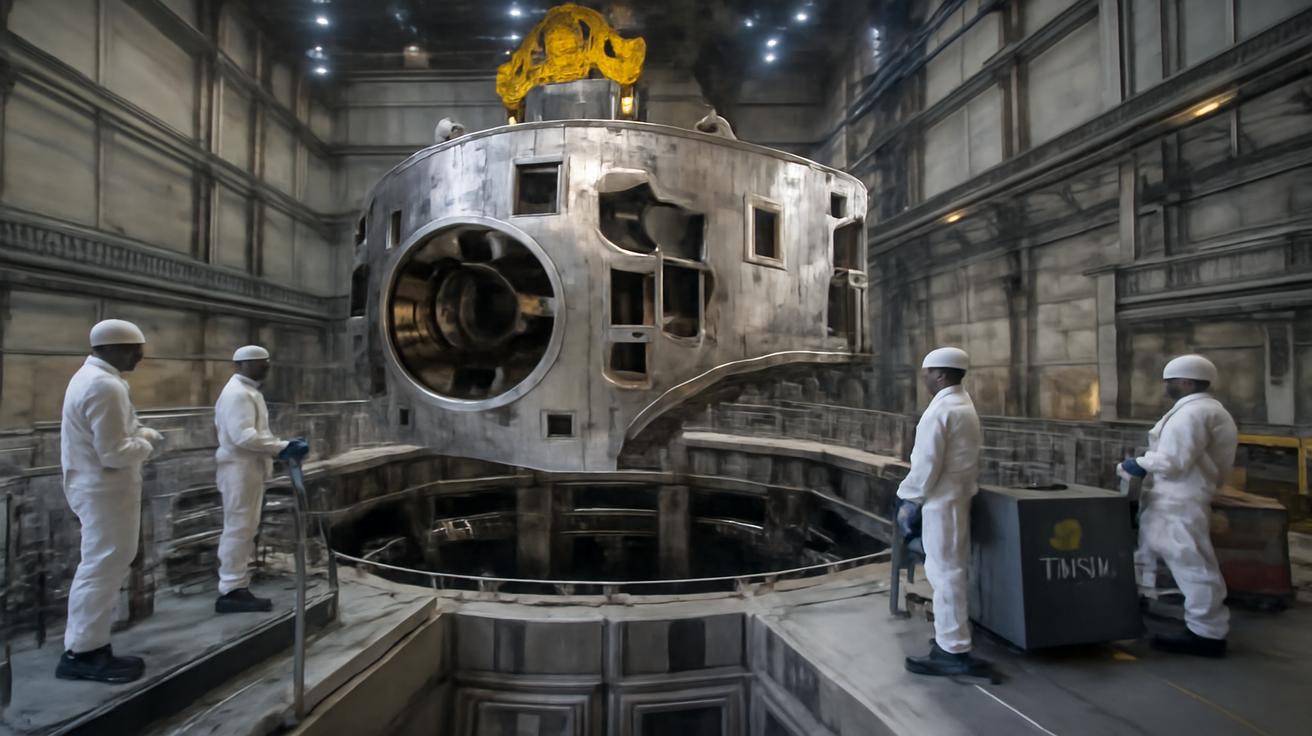
The morning light in Provence does a peculiar thing when it spills across the ITER construction site. It softens the hard edges of cranes and scaffolding, warms the silver skins of warehouse-sized buildings, and turns a forest of steel into something quietly expectant, like a landscape holding its breath. On this particular day in southern France, there is a sense—palpable even through dust and diesel—that something almost mythic is inching closer to reality. A dangling shape, the size of a small house and gleaming with polished steel, hangs from one of the most powerful cranes on Earth. This is vacuum chamber module no. 5: a fragment of the machine designed to bottle a star.
Building a Star in Slow Motion
From the ridge above the ITER site, the complex looks like a carefully choreographed collision between human ambition and the laws of physics. Trucks move along prescribed routes like clockwork, ferrying components that might weigh more than a blue whale. Technicians in bright helmets vanish and reappear among the beams. Somewhere in the heart of it all, a cavernous concrete hall awaits its newest arrival—a piece of the tokamak, the doughnut-shaped vacuum chamber where, if all goes well, hydrogen atoms will someday fuse, releasing the kind of energy that has powered the sun for 4.6 billion years.
In the air hangs the familiar soundtrack of a megaproject: the low growl of generators, the repeated beeps of backing vehicles, muffled radio calls in French, English, and a half-dozen other languages. But today’s choreography centers on a single motion: lowering module no. 5 into position with millimeter precision. Suspended from a crane capable of lifting hundreds of tons, the stainless steel segment drifts slowly toward its destination, guided by teams that have rehearsed this moment using digital twins, scale models, and long arguments over coffee-fueled meetings.
For decades, nuclear fusion has been treated as a kind of scientific mirage—always shimmering enticingly on the horizon, forever out of reach. “Thirty years away,” people joked, “and always will be.” But here, among the oaks and lavender fields of southern France, that old punchline is starting to sound lazy. Each bolted joint, each aligned flange, each hulking module lowered into the vacuum vessel is an argument against the idea that fusion is only a dream. It may still be hard, uncertain, and maddeningly complex—but it is increasingly, and unmistakably, real.
The Vacuum Vessel: A Steel Heart for an Artificial Sun
The vacuum vessel that will surround ITER’s fusion plasma is not just another piece of industrial hardware. It is more like a metal cathedral—its walls curved, buttressed, and interlocking in nine massive sectors, each as heavy as a jetliner. Inside it, emptiness is the goal: a vacuum so pure that the few remaining atoms can be counted in whispers, a space clean enough to host temperatures ten times hotter than the sun’s core.
Module no. 5 is one part of that intricate puzzle. Picture a thick, contoured shell, lined with ports and attachment points, designed to cradle an invisible ring of superheated gas swirling at unimaginable speeds. When completed, these vessel sectors will come together to form a nearly perfect torus, with each seam sealed tight, like a seamless metal donut wrapped around a thunderstorm of plasma.
The technical challenge is dizzying. The steel must be strong, but not so brittle it fractures under enormous magnetic forces. The geometry must be exact, but not so rigid it refuses to accommodate the microscopic misalignments that are inevitable when you’re moving hundreds of tons by crane. Every joint, every weld, every connection will be subject to forces that strain intuition: thermal gradients, neutron bombardment, magnetic fields powerful enough to lift aircraft carriers—if only there were something large enough to fit inside the swirling loops of ITER’s colossal magnets.
And yet, as module no. 5 inches closer to its resting place, the mood on the ground is less like terror at the scale of the challenge and more like quiet determination. People glance up, shield their eyes, and then return to their tasks. The extraordinary, here, has become daily work.
The Long Arc of a Once-Impossible Dream
Step back from the dust and clamor, and ITER becomes part of a much older story. Fusion has haunted the imagination since humans first realized what makes the stars shine. Mid-20th century physicists, armed with chalkboards and wartime urgency, began to sketch the idea of capturing that same reaction here on Earth: smashing light atoms together, not tearing heavy ones apart, to release energy. The appeal was staggering—virtually limitless fuel from isotopes of hydrogen, no long-lived radioactive waste in any meaningful quantity, and no runaway chain reaction. Fusion promised the power of a star without the shadow of Chernobyl or Fukushima.
Nature, though, is famously reluctant to share her best tricks. To get two positively charged nuclei to fuse, you must force them impossibly close, overcoming the natural repulsion of like charges. The sun does this by being gargantuan: its sheer mass squeezes hydrogen atoms together under crushing pressure. On Earth, our solution is to turn up the heat instead, creating plasmas—gases so hot that electrons strip away from their atoms—held together by invisible cages of magnetic fields.
Early fusion experiments in the 1950s and 60s gave scientists just enough success to keep going, and just enough failure to breed cynicism. Plasmas wriggled and twisted, escaping their magnetic bottles with mischievous ease. Devices known as tokamaks—fusion reactors shaped like hollow donuts—emerged as one of the most promising designs, especially after Soviet and later European machines began breaking temperature and confinement records.
Still, scaling up to something that could feed electricity into the grid rather than just produce a few seconds of plasma remained a mountain few knew how to climb. That is, until an unlikely coalition of nations decided to build that mountain together.
ITER: A Global Bet on Shared Starlight
ITER’s story is as political as it is scientific. Conceived during the late Cold War, the project was born from an unexpected blend of rivalry and cooperation. Countries that once competed to outbuild, outbomb, and outfund each other’s nuclear programs suddenly found themselves planning a shared experiment in peaceful atomic fire. Europe, the United States, Russia, China, India, Japan, and South Korea all signed on—not just as observers, but as co-builders.
The result is a machine assembled like an international jigsaw puzzle. Europe provides much of the site and infrastructure; Japan contributes key magnet components; India designs and builds cryostat sections; Russia, the U.S., China, and others each deliver crucial hardware. Component by component, ITER has become a kind of three-dimensional map of global interdependence, with each segment stamped with clues about where it came from: a manufacturing tag in Kanji, a welding spec in Cyrillic, a design note in English.
In that context, the installation of vacuum chamber module no. 5 is more than an on-site milestone. It’s a symbol of the vast logistics dance happening across continents: steel forged in one country, machined in another, shipped through narrow ports and along winding roads to a quiet valley in southern France, where it joins pieces from six other nations in a machine no single country could have built alone.
For all its politics, ITER is ultimately about a simple, stubborn question: can humanity harness the same reaction that lights the stars in a way that is safe, reliable, and abundant? No marketing spin, no clever policy maneuver can answer that. Only the physics can. And physics demands hardware—vast, precise, unforgiving hardware.
| Key Aspect | Description |
|---|---|
| Project Location | Cadarache, southern France, in a valley surrounded by pine and oak forests. |
| Core Device | Tokamak reactor with a large stainless-steel vacuum vessel made of nine major sectors. |
| Vacuum Chamber Module No. 5 | One of the essential vessel sectors recently installed, helping complete the torus that will host the fusion plasma. |
| Participating Regions | European Union, United States, Russia, China, India, Japan, South Korea, and other partners. |
| Main Goal | Demonstrate that controlled nuclear fusion can produce more energy than it consumes, paving the way to future power plants. |
Listening to the Machine Breathe
Walk inside the ITER assembly hall and the scale plays tricks on your senses. Overhead gantry cranes trace silent arcs against a ceiling so high it might as well be its own landscape. Coils of superconducting cable, wrapped in layers of insulation, lie in waiting like metallic serpents. Somewhere behind safety barriers, engineers watch screens filled with live feeds of the lowering operation, eyes darting between sensor data and high-resolution video as module no. 5 moves those last few, delicate centimeters.
The air smells like cold metal and fresh paint. A faint breeze filters in through massive doors designed to admit components taller than a four-story building. Every echo, every clank, seems to hang a little longer than it should, as if the building itself is still learning how to absorb sound on this scale.
On-site, the language grows almost poetic when people talk about the machine. They describe the tokamak as if it were something that will one day breathe: magnets that will pulse with currents as strong as lightning, cooling systems that will quietly sip liquid helium, vacuum pumps that will exhale to strip away the last remnants of air inside the vessel. The installation of module no. 5 is one more step toward closing the metal shell around that future breathing space.
To an outsider, the emotional stakes might seem out of proportion to a single lift operation. But for the people who have watched ITER move from blueprint to concrete to gleaming steel, this is what progress looks like. Not a single “Eureka!” moment, but a series of small, meticulously executed miracles: a weld that passes inspection, a magnet that cools without cracking, a chamber module that slides into place within fractions of a millimeter of its intended position.
Why This Matters Far Beyond Southern France
It’s easy, from a distance, to dismiss ITER as just another expensive science project. The timelines are long, the budgets enormous, and the outcomes uncertain. But imagine, just for a moment, what’s at stake when engineers and physicists talk about fusion not as an abstract goal but as a practical energy source.
Imagine a world where power plants no longer burn coal or gas, where the fuel is derived from seawater and lithium, both abundant on Earth. Where the main byproduct is helium—a noble gas that already fills party balloons and MRI machines—not greenhouse gases that heat the planet. Where the risk of a meltdown is essentially designed out: if something goes wrong in a fusion reactor, the reaction stops, not spirals.
Fusion will not solve every problem. It won’t reverse the warming we’ve already locked in, or heal damaged ecosystems, or erase the politics of resource distribution. But it could change the underlying equation of how humanity powers its civilization. It offers the possibility of decoupling energy abundance from carbon emissions, of lighting cities and data centers and farms without digging deeper into the Earth’s fossil stores.
In that light, the gradual, painstaking advance of ITER—the installation of one more vacuum vessel module, the careful test of one more magnet coil—takes on a much broader significance. These are not just engineering tasks. They’re test cases in whether we’re capable of building systems that look beyond quarterly reports, election cycles, and short-term comfort toward something generational in scale.
A Future Written in Steel and Plasma
Standing at the perimeter fence as the sun begins to slide down behind the hills, you can see the subtle shift in the site’s silhouette. Where there was once an empty bay inside the tokamak pit, there is now the glinting curve of module no. 5 taking its place. The interplay of shadows suggests the outline of the torus to come, an almost-complete ring that will one day hold a miniature star.
Nobody here pretends that installation of a single module means fusion has “arrived.” The road ahead is still long. After the vessel is complete, there will be months and years of assembly, testing, commissioning. Systems will fail and be redesigned. New issues—thermal stresses nobody quite anticipated, tiny impurities in the plasma, quirks in the control software—will emerge and demand solutions. That is the nature of experiments at this scale: they reveal problems you didn’t know you had.
Yet with each massive shipment that crawls up the access road, each cable run fastened into place, each module like no. 5 eased into its slot, ITER moves further away from the realm of impossibility and deeper into the realm of engineering. The dream is no longer a sketch on a napkin or a graph on a conference slide. It’s steel, concrete, copper, and superconductors. It’s a building you can walk into, one where you must wear a hard hat and a high-vis vest because this is, very literally, a construction site for a new kind of fire.
Frequently Asked Questions
What exactly is nuclear fusion?
Nuclear fusion is the process where light atomic nuclei—usually isotopes of hydrogen—join together to form heavier nuclei, releasing large amounts of energy. It’s the reaction that powers our sun and other stars. Unlike nuclear fission, which splits heavy atoms, fusion uses light elements and produces far less long-lived radioactive waste.
What is ITER trying to achieve?
ITER aims to demonstrate that controlled nuclear fusion can produce more energy than it consumes. It is designed as an experimental reactor, not a power plant, but its goal is to prove that large-scale, sustained fusion reactions are technically feasible and can inform the design of future fusion power stations.
Why is the installation of vacuum chamber module no. 5 important?
The vacuum chamber is the core of the tokamak where the fusion plasma will be confined. Module no. 5 is one of the major vessel sectors that, when all are installed, will form a complete torus around the plasma. Installing this module marks a significant step toward completing the heart of the machine and shows that complex assembly sequences are progressing successfully.
Is nuclear fusion safe compared to current nuclear power?
Fusion is generally considered much safer than traditional nuclear fission. There is no chain reaction that can run out of control, and if something goes wrong, the plasma quickly cools and the reaction stops. Fusion reactors also do not use high-level, long-lived radioactive fuel like uranium, and they cannot explode like a nuclear bomb.
When will ITER start producing fusion energy?
ITER’s timelines have evolved over the years, and full-power fusion operation is still some years away. Initial plasma experiments are expected before full fusion power operation, and the machine will go through several stages of commissioning and testing. While ITER itself will not generate electricity, its operation is meant to provide the data needed to design future fusion power plants that can feed energy into the grid.





Leave a Comment