
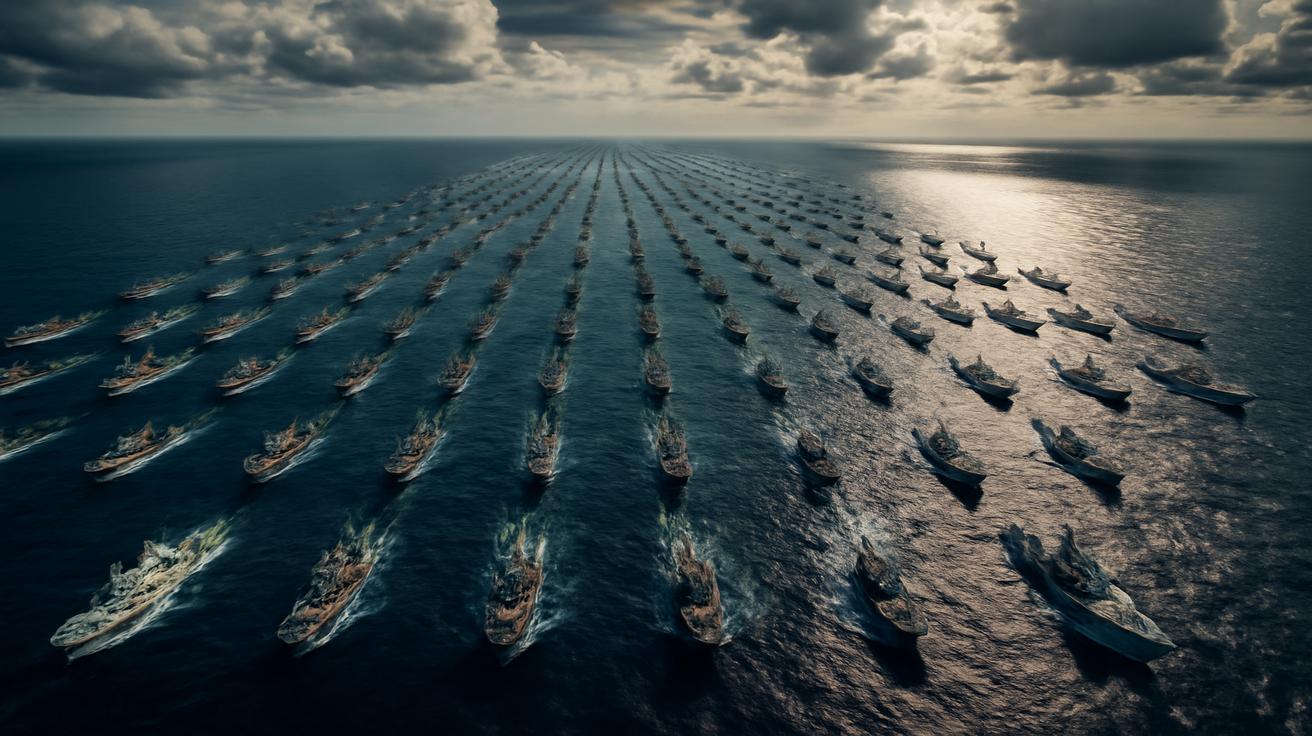
The first reports came in like rumors carried on a stiff winter wind—half-whispered notes from satellite operators, scratchy radio calls from small crews out in cold gray water. Somewhere along a disputed line on the sea, where the maps blur and tempers sharpen, China was mobilizing fishing boats. Not a few dozen. Not even a few hundred. More than 1,400 vessels, moving not as a scattered fleet but as if choreographed, fanning out across roughly 200 miles of troubled ocean. Nobody had predicted it, and yet there they were, steel and fiberglass and diesel engines forming something that looked less like a fishing expedition and more like an improvised wall.
The January Quiet That Wasn’t Quiet at All
January on the open water usually feels like a pause button—cold currents, fewer storms than autumn’s chaos, and long, low days when even the sun seems tired. But this January was different. On satellite images, the sea lit up at night like a slow-moving constellation, pinpricks of light strung together in an uneasy arc. Each light was a boat; together they formed an artificial barrier, a human-made reef of intention and steel.
At sea level, it felt different still. Imagine standing on the deck of a modest wooden boat, your breath turning to vapor as the wind knifes across the bow. On the horizon, instead of the clean emptiness of open ocean, you see silhouettes stacking up like a distant city skyline. Trawlers, longliners, purse seiners—some flying clear flags, some not at all—drift in rough formation, engines idling, nets rolled and ready but not always deployed. Lights dangle from masts like floating streetlamps. The air smells of fuel and fish and something else: tension.
No one saw it coming this quickly. Analysts had spent years warning about “gray zone” tactics—operations that fall just short of open conflict, using civilian or civilian-looking tools to achieve military and political goals. But even seasoned observers were taken aback by the sheer scale of this sudden mobilization. A normal fishing fleet seeks fish. This one seemed to be seeking presence. Occupation. A statement written on saltwater.
The Sea Turned into a Negotiation Table
Maps, in this part of the world, are not neutral. They are arguments drawn in ink. China’s nine-dash line—an arc reaching far into contested waters—has long clashed with the claims of other coastal nations whose fishers have worked these grounds for generations. But maps are abstractions. The sea itself is stubbornly real: waves, reefs, migrating fish, and the livelihoods of people who depend on them.
In January, it was as if someone tipped the negotiation table and let all the pieces slide into the water. Instead of diplomats in conference halls, there were captains in wheelhouses. Instead of speeches, there were ship wakes and track lines on marine radar. The 1,400 Chinese vessels didn’t simply wander into place; they were directed. Their positions knit together into a broad band across roughly 200 nautical miles, a semi-permeable curtain of hulls and hull numbers.
Other nations’ coast guards, already stretched, found their patrol routes suddenly clogged. A routine inspection cruise veered into something closer to crowd control. A single cutter or patrol craft could no longer shadow “the Chinese boats”; there were simply too many. When one vessel moved aside, another slid silently into its place, as if the ocean itself were conspiring to keep the line unbroken.
Out on the water, radio chatter grew crowded and brittle. In heavily accented English and clipped local tongues, voices called out position warnings and territorial claims. “You are entering our fishing grounds.” “You are in our exclusive economic zone.” “For safety, alter course immediately.” The sea has always been noisy—wind, waves, engines—but now it pulsed with layered human insistence.
The Hidden Engine: A Maritime Militia
To call these “just fishing boats” misses the point. For years, researchers and governments have documented what is often called a maritime militia—a civilian fleet that can be activated to advance state interests. Crews may be given fuel subsidies, extra equipment, or quiet instructions on where to go and when. In peacetime, they chase fish. In moments of tension, they can be repositioned to chase something less tangible: leverage.
In January, the pattern was hard to ignore. Boats with similar home ports moved together. Their transponders—those small devices that broadcast a vessel’s identity and location—blinked in synchronized arcs, sometimes going silent in suspiciously coordinated blackouts. All the while, Chinese coast guard vessels hovered at the edges of the swarm like shepherd dogs flanking a vast, restless flock.
From space, the whole thing looked like a rough sketch of a border where no natural border exists. A barrier made not of fences, but of people whose job descriptions suddenly expanded beyond fishing. They were, in effect, a human buffer between Beijing’s claims and everyone else’s objections.
When Fish Become Pawns
If you strip away the politics for a moment and just listen, the sea tells a quieter story: the story of fishers from many countries who woke up in January expecting a normal season and instead found themselves pressed against a moving wall of foreign steel.
In small coastal towns, the change was felt first as an absence. Boats that would typically leave before dawn began returning early, holds half-empty. A captain from one neighboring country described it as “chasing shadows”—every time his crew approached a familiar fishing ground, a string of Chinese vessels already loomed there, engines humming, nets in or ready. The message didn’t need to be spoken: this space is taken.
For local fishers who operate smaller boats with limited fuel, detouring hundreds of miles was not an option. The sea that had once seemed boundless now felt suddenly compressed, pushed back by a wall that did not officially exist but was very much there, hull by hull. Catches dwindled. Fuel bills rose. Tempers onshore grew shorter.
The fish, of course, had no say in any of it. They continued their migrations along currents and temperature gradients, unaware that with every school that slipped beneath the artificial barrier, they were crossing an invisible front line. Yet their very abundance—or lack of it—would help decide which nation’s narrative gained traction. “Overfished by others” is a powerful rallying cry. So is “protecting our traditional grounds.” Each side told its version. The fish remained mute.
Ecology Under Pressure
Beyond politics and daily livelihoods, there is a subtler cost. A massive fleet, concentrated over a 200‑mile span, exerts enormous pressure on marine ecosystems. Bottom trawlers scrape the seafloor, tearing at coral and sponge gardens that may have taken centuries to grow. Longlines baited for tuna or swordfish can hook turtles, sharks, and seabirds as collateral damage.
Scientists watching the January mobilization were not just counting hulls; they were quietly tallying risk. How many spawning grounds lay in the path of this living barrier? How many migratory routes crossed it? In a warming ocean where species are already stressed and shifting, a sudden surge of industrial fishing is like a heavy foot pressing down on an already thin ice sheet.
Some vessels may have been there more for presence than for actual harvest, but even idling fleets cast floating shadows. Anchor chains can scar seagrass beds. Constant noise from engines masks the subtle sounds many marine species use to navigate and communicate. The ocean does not differentiate between military gesture and economic enterprise; it only feels the sum of our actions on its surface and below.
Lives at the Edge of a Moving Wall
It is easy, from far away, to see this story in terms of lines on maps and fleets on screens. Up close, it is made of people and weather and the small daily calculations of risk. Out on a winter-gray sea, a single decision—hold course or turn away—can feel like the weight of national policy pressed into a captain’s palm.
On one side of the artificial barrier, Chinese crews worked in tight formation. Some had likely never been this far from their home ports before, yet here they were, part of something bigger than any single catch. Their days blurred into a routine of engine checks, net maintenance, and watch rotations, all under the quiet understanding that they were also, in a sense, on the front line of their country’s maritime ambition.
On the other side, local fishers from smaller nations tried to read intentions in the angle of another boat’s bow, the speed of its approach, the crackle of its radio calls. A misjudged maneuver could mean a collision, an injury, or an international incident. More than one captain chose to cut short a trip rather than risk threading through the densest parts of the living barrier. A storm front on the horizon was no longer the only danger; now there was also the slow-motion potential of being hemmed in, squeezed between weather and will.
At night, the sea glowed with working lights. Sodium lamps cast hard-edged halos over decks slick with seawater. Diesel generators throbbed through the hull. In the distance, other boats were only clusters of white and yellow stars, moving with the waves. The barrier did not sleep; it pulsed and drifted, holding its shape more by intention than by any physical tether.
Table: A Glimpse of the January Barrier
Below is a simple snapshot of what this floating frontier looked like in broad strokes:
| Aspect | Details |
|---|---|
| Number of vessels | Approx. 1,400 Chinese fishing boats |
| Extent of barrier | Roughly 200 nautical miles across contested waters |
| Primary function | Hybrid of fishing activity, territorial presence, and political signaling |
| Key actors nearby | Chinese coast guard, regional navies and coast guards, local fishing fleets |
| Main impacts | Restricted access for neighboring fishers, heightened tensions, increased ecological pressure |
On a small smartphone screen, those rows compress into a compact ledger of power: one column for what was seen, another for what it meant. Behind each cell lies a web of individual stories—families depending on a good season, officers juggling rules of engagement, scientists re-running impact models late into the night.
What Happens When the Boats Go Home?
Barriers built of steel and will are, by nature, temporary. Storms roll through. Fuel runs low. Orders change. At some point, the 1,400 boats will disperse, thinning back into ordinary shipping lanes and commercial routes, returning to their home ports. The constellation will dim on satellite feeds, and the sea will look, to distant eyes, empty again.
But absence can be deceptive. Once a tactic like this is used at scale, it becomes part of the region’s mental seascape. Every captain, every admiral, every coastal community now knows that such a barrier is possible—and that it can appear faster than most diplomats can book a flight. The memory of January will linger like a faint watermark beneath every future chart.
For local fishers, the aftertaste is bitter and pragmatic. Some will push for greater government support: fuel subsidies, larger patrol fleets, better legal backing in disputes at sea. Others will simply adapt, shifting their fishing grounds where they can, or leaving the water altogether if it no longer supports them. Communities built around harbors and tide rhythms may find themselves negotiating not just with nature’s variability, but with the timing of geopolitical maneuvers.
Ecologically, the wake of such a mobilization is harder to read. Damage to seafloor habitats may only become clear years later, as certain species fail to return in their usual numbers. Overfishing in one season can echo down food chains, reducing the resilience of the entire system just as climate change pushes temperature and acidity into unfamiliar ranges. A barrier of boats may dissolve, but its imprint on the living ocean can endure.
The Sea Remembers
There is a tendency, in stories like this, to cast the ocean as a passive stage on which human dramas unfold. Yet the sea is an active character, with its own memory and momentum. It stores heat, absorbs carbon, and carries the signatures of our actions across generations.
In January, when China mobilized 1,400 fishing boats into a 200‑mile barrier, the sea registered more than just propeller churn. It felt the drag of nets, the pulse of sonar, the shadow of hulls blocking light from the plankton-rich upper layers. It absorbed the extra fuel burned, the plastics shed, the noise added to its already crowded soundscape.
And it will respond, in its own slow, unsentimental way. Maybe in the altered routes of tuna schools, veering ever so slightly away from a place that has become too busy, too loud. Maybe in reefs that don’t quite recover after repeated scouring. Maybe in the quiet frustration of future generations, looking out at a sea that no longer holds the abundance their grandparents took for granted.
Standing on any shore today, it is possible to feel both the immensity of the ocean and the shrinking of its possibilities. We are filling it—with our boats, our politics, our urgency—faster than we are learning how to share it. The January barrier was a bold gesture in a high-stakes game, but it was also a mirror held up to our collective relationship with the sea: confrontational, extractive, impatient.
No one saw it coming, not like this. Yet in retrospect, it feels almost inevitable, the latest chapter in a longer story of crowded waters and shifting power. The question now is not whether such barriers will appear again, but whether we can find a way to let the ocean be more than a battlefield or a buffet line—whether we can remember that beneath every flag and hull number lies a living world that does not recognize any of our lines at all.
Frequently Asked Questions
Why did China mobilize so many fishing boats at once?
The mobilization served multiple purposes: asserting territorial claims in disputed waters, reinforcing political messages without direct military confrontation, and maintaining or increasing fishing activity. Using a large fishing fleet allows China to project presence and influence while operating in a gray zone between civilian and military action.
Is this barrier considered legal under international law?
Legality is contested. Coastal states have rights within their exclusive economic zones under international law, but overlapping claims create ambiguities. While fishing itself is not illegal, coordinated use of large fleets to restrict access or intimidate others can challenge the spirit of maritime law and is often protested diplomatically by neighboring countries.
How does this affect local fishing communities in the region?
Local communities often face reduced access to traditional fishing grounds, increased operational risks, and higher costs as they are forced to travel farther. Smaller vessels may be effectively pushed out of contested areas, leading to lower catches, economic stress, and social tensions in coastal towns.
What are the environmental consequences of such a large fleet in one area?
Concentrated industrial fishing can lead to overharvesting of key species, damage to seafloor habitats from trawling and anchoring, and increased bycatch of non-target species. Noise pollution and physical disturbance can affect marine life behavior, and the cumulative impact can weaken already stressed ecosystems.
Could other countries use similar tactics in the future?
Yes. Once a tactic is demonstrated at scale, it becomes part of the informal playbook. Other nations with large fishing fleets or state-supported maritime sectors may be tempted to deploy similar strategies to assert claims or counter rivals, further crowding contested waters and complicating efforts to manage them sustainably.






Leave a Comment