
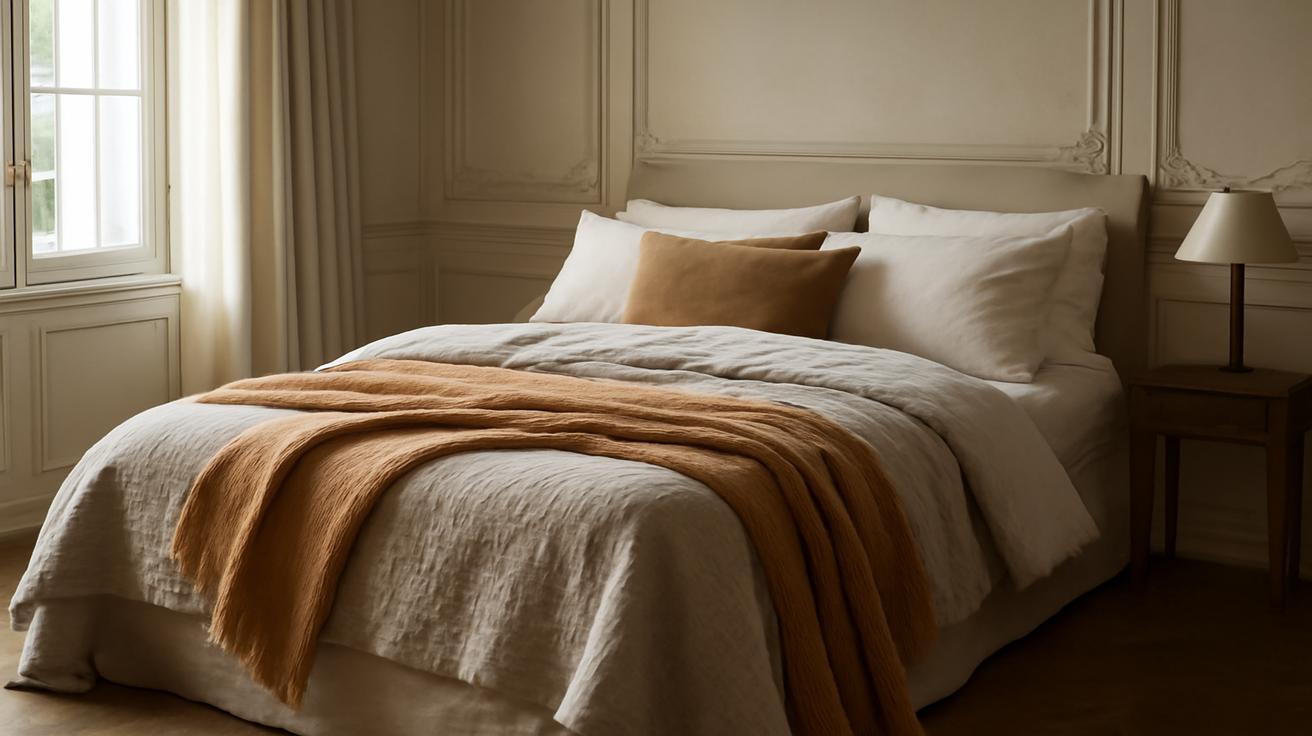
On a clear January morning in Lyon, the kind where the Saône wears a delicate veil of mist and the city feels half-awake, Sophie stands in her bedroom and stares at the empty space where her duvet used to be. The bed looks strangely naked, made up with a crisply tucked sheet and a textured cotton coverlet folded at the foot like a shy smile. Beside it, in a woven basket, a neatly rolled wool blanket waits like a promise. She hesitates, fingers grazing the quilted fabric. No more wrestling an enormous duvet into a cover. No more waking up in a sweat at 3 a.m. No more “one-tog-fits-nobody” arguments with her partner. It feels like the end of an era.
Across France, that small, private scene is repeating itself in thousands of bedrooms. By 2026, the duvet—the puffy symbol of cozy modern living—is quietly being retired, replaced by something quieter, smarter, more modular, and strangely… chicer. It’s not a single product or gadget, but a whole new way of dressing the bed, merging the sensibility of Mediterranean summers, Japanese minimalism, and good old French practicality. Walk through Parisian design fairs, browse Bordeaux concept stores, or scroll through French interior Instagram accounts, and you’ll see it: layered beds, light and breathable, made up of flat sheets, bed covers, and thin quilts, like well-curated outfits rather than padded uniforms.
The Day the Duvet Started to Feel Wrong
In many French homes, the love affair with the duvet lasted decades. Thick, fluffy, promising instant cocooning—what wasn’t to like? But somewhere between hotter summers, rising energy prices, and the pandemic spending-spree on home decor, something snapped. People started to notice that the very thing meant to bring comfort was… not always that comfortable.
It began, quietly, with heat. Winters were milder; radiators stayed on a bit too long; nights felt stuffy. Couples woke up sweaty, each clinging to the edge of a shared duvet too heavy for one and too hot for two. Parents found their teenagers half-uncovered, duvet kicked to the floor. Guests in tiny Parisian studios folded and refolded duvets just to sit on the bed with a cup of coffee. What once felt luxurious began to feel bulky, almost intrusive.
At the same time, the average French person was becoming more attentive to materials, energy, and space. Dryers were used more sparingly. People noticed how long duvets took to wash, how they never quite fit the machine, how they hogged the drying rack like an overgrown housemate. Designers noticed something else: duvets made every bed look, more or less, the same—one big puff of white or beige, disguising the textures beneath.
So the question started to simmer: what if the problem wasn’t the bed, or the season, or the partner stealing the covers… but the duvet itself?
The New French Bed: Layers, Not Lump
Step into a Parisian apartment in 2026, and you’re likely to find a bed that looks quietly composed rather than overstuffed. The new alternative is not a single product but a system: a combination of breathable flat sheets, mid-weight bed covers, lightweight quilts, and targeted throws. It’s a dressing philosophy—layering for temperature, texture, and mood—rather than a one-size-fits-all padded blob.
The base layer is almost always a high-quality flat sheet. Not an afterthought, but the anchor. In France, cotton percale and washed linen reign: fabrics that feel cool in summer, cozy in winter, and improve with every wash. Over that comes a bed cover or boutis—thin, quilted, often with subtle patterns, designed to be seen and touched, not hidden under a cover. Then, depending on the season, a light quilt or wool blanket is folded at the foot, waiting to be pulled up in the small hours when the temperature drops.
It’s the logic of dressing in layers, applied to sleeping. Instead of a single thick layer trying to satisfy every body at every temperature, the bed becomes adaptable. Warm sleeper? Sleep under just the sheet and cover. Cold sleeper? Add the quilt. Heatwave in Marseille? Strip it back to a linen sheet and nothing more, and the bed still looks intentionally made, not half-abandoned.
The look is unmistakable: beds that recall sun-washed Mediterranean houses, ryokans in Kyoto, and Scandinavian cabins all at once. Low-profile, textural, with the kind of rumpled elegance that says, “someone slept well here,” rather than “someone fought a duvet here.”
The Quiet Chic of Imperfect Textures
French interiors in 2026 have embraced a softer, tactile minimalism. The new bed aesthetic leans less on showy throws and decorative pillows, and more on natural fibers and subtle color palettes. Ecru linen, sand-colored cotton, a muted olive quilt, a thin charcoal wool blanket folded just-so. The goal is not hotel perfection, but lived-in, breathable harmony.
The absence of a duvet also means the structure of the bed itself becomes visible again. The mattress, the framing, the sheet—everything counts. No more hiding sagging mattresses under a giant puffy comforter. People are investing in better basics and celebrating the simplicity of a well-made flat sheet, corners tucked with almost military precision or left languidly loose, depending on personality.
The Numbers Behind the Comfort
For all the romance of layered textiles and gentle mornings, there’s also a practical, almost mathematical side to this shift. French households, especially urban ones, have become strategic: less storage, less laundry, less waste.
Ask anyone who’s hauled a king-size duvet up six flights of narrow Haussmann stairs to the laundromat: it’s not exactly a charming Parisian fantasy. Duvets take up space—on beds, in closets, in washing machines. And unlike flat sheets and covers, they’re awkward to care for, delicate to dry, and quick to lose their freshness.
The new system solves that through flexibility. Instead of one bulky item, you have two or three lighter ones that all fit comfortably in a standard washer, can be rotated, mixed, and matched, and often last longer because each piece is under less strain. The result: more control over hygiene, fabric quality, and even monthly expenses.
| Aspect | Traditional Duvet | Layered Alternative |
|---|---|---|
| Laundry | Bulky, needs large machine or laundromat | Sheets & light covers fit any washer |
| Temperature control | One fixed level of warmth | Modular: add or remove layers easily |
| Storage | Takes significant closet space | Folds flat; works year-round |
| Style options | Cover swaps only | Mix fabrics, colors, & textures |
| Longevity | Fill can flatten over time | Pieces replaced individually as needed |
Environmental concerns add an extra layer. As France pushes harder on sustainability, people are looking more critically at synthetic fillings and fast-home-textiles. Thin wool blankets, organic cotton covers, linen sheets that last for years—these feel both ethically and emotionally right. There is something deeply reassuring about owning fewer, better pieces that can be repaired, aired on a balcony, and passed along instead of dumped.
How French Homes Actually Sleep Now
It’s one thing to admire a perfectly styled bed in a boutique hotel in Biarritz; it’s another to navigate kids, pets, odd heating systems, and real-life budgets. Yet the layered alternative has slipped into everyday French life with surprising ease, adapting to different regions, generations, and even personalities.
In a small apartment in Toulouse, a young couple working hybrid jobs has simplified their setup to three main layers: a cotton percale sheet, a light piqué bedspread, and a soft, machine-washable wool throw. Winter nights, the throw comes up to their shoulders; summer nights, it stays folded at the foot, a decorative gesture more than a functional one. They’ve kept one mid-season quilt in storage, but the duvet is gone.
In Brittany, where damp chills creep into old stone houses, families layer heavier. A linen sheet, then a quilted cotton cover, then a dense wool blanket that smells faintly of lanolin and sea air after being aired outside. Grandparents smile, recognizing the beds of their childhood—before duvets swept across Europe—updated with modern colors and weaves.
Even in student flats, where money is tight and space is tighter, the shift is visible. One breathable cover and a blanket are easier to wash in a shared machine than a bulky duvet. When friends crash after a late night of cheap wine and playlists, an extra blanket appears from a shelf like a magician’s scarf, not a heavy, musty spare duvet rescued from under a bed.
Couples, Compromise, and the End of the Tug-of-War
Perhaps the most quietly revolutionary consequence of the no-duvet movement is the peace it’s bringing to couples with wildly different temperature needs. Instead of battling over the thickness of a shared duvet or experimenting with dual-tog mashups, many French couples are embracing a more radical idea: separate layers on the same bed.
Picture this: one large shared flat sheet, generous and cool. On one side, a light cotton cover only. On the other, the same cover plus a folded quilt. The bed still looks cohesive—a single, unified whole—but the experience is personalized. In some homes, partners have their own single-size coverlets atop a common sheet, a quiet acknowledgment that loving someone doesn’t mean sharing exactly the same degree of warmth at 2 a.m.
It’s a subtle cultural shift toward self-knowledge and gentler coexistence. Instead of feeling guilty for being “the cold one” or “the one who always opens the window,” each person has tools—layers, fabrics, thicknesses—to fine-tune their comfort. Domestic harmony sometimes starts with a well-chosen blanket.
Morning Rituals, Rewritten
The end of the duvet has also rewritten one of the most mundane but symbolic acts of the day: making the bed. With duvets, it’s often a single, annoyed gesture—yank, shake, flatten. With layered covers, the ritual becomes quieter, slower, and, strangely, more satisfying.
Sophie, that January morning in Lyon, notices the difference immediately. Instead of fighting gravity and trapped air, she smooths a sheet with the flat of her palm. She straightens the cover, tucks a corner, aligns the folded quilt until it forms a neat, soft line across the bed’s foot. The whole thing takes barely a minute, but it feels… intentional.
There’s no wrestling a duvet back into its cover after washing, no disappearing into a cotton tunnel and emerging irritated and half-suffocated. Every element is visible as it goes back on the bed. If one piece is stained, only that piece is stripped. If the cat claims the wool blanket as its throne, the rest of the bed remains undisturbed.
And visually, the room changes. Without a swollen mass dominating the center, the bed rests lower, calmer, inviting rather than imposing. Colors are layered softly, like watercolors rather than blocks of paint. Morning light brushes the textures—matte linen, slightly shiny cotton, the faint geometric ripple of quilting—and the bedroom feels less like a hotel and more like a personal landscape.
From Trend to New Normal
What began as an aesthetic whisper in design magazines has, by 2026, become almost an unspoken standard in French interiors. New collections from bedding brands emphasize “ensembles de couches” instead of “winter duvets.” Showrooms teach customers how to combine a summer sheet with a mid-season cover, a winter blanket, and a year-round quilt. Even big-box stores stock more bedspreads and thinner quilts than traditional duvets.
There will always be exceptions, of course. Mountain chalets still love their giant down cocoons; some people simply adore the weight and cloud-like feel of a thick duvet. But in the quiet majority of urban and suburban homes, the trend line is clear: more modular, more breathable, more versatile.
It aligns seamlessly with the broader French direction in 2026: smaller spaces made smarter, fewer objects chosen with more care, a desire to feel connected to the seasons rather than insulated from them. The bed, that most intimate of domestic spaces, follows suit.
Designing Your Own No-Duvet Bed
If you’re tempted to banish the duvet but unsure where to begin, the French approach offers a simple rule: start light, then add. Don’t overbuy; observe how your body actually sleeps across a week or two.
A good basic setup often looks like this:
- One high-quality flat sheet in cotton percale or linen
- One mid-weight bed cover or quilted boutis that stays on year-round
- One additional layer—for most, a light quilt or wool blanket—to add or remove seasonally
Then, play with texture and tone. Choose a neutral base—white or ecru sheet, soft beige cover—then add a single accent layer: a terracotta quilt in autumn, a deep blue cover for winter, a sage green throw in spring. The effect is subtle but powerful; the bed changes mood without changing identity.
Think also about touch. How does your skin react to linen’s crispness, cotton’s smoothness, wool’s slight scratchiness? The French trend is less about the picture-perfect Instagram bed and more about the quietly perfect feel of sliding between layers that match your senses and your climate.
And when in doubt, remember the new golden rule: it’s easier to add a blanket at 3 a.m. than to crawl out of a too-hot duvet you regretted the moment you bought it.
Why This Change Feels So Strangely Emotional
On the surface, it’s just bedding. But anyone who has carried a childhood duvet from apartment to apartment knows how loaded these everyday objects can be. Letting go of the duvet feels, for some, like letting go of a certain image of comfort—a TV-show version of coziness, all marshmallow puff and overstuffed ease.
What’s replacing it in French homes is more grown-up, more nuanced, and perhaps more honest. Comfort becomes something you build and adjust, not a single purchase. Warmth becomes a choice rather than an assumption. The bed becomes less a prop and more a quiet ally in the daily negotiation between body, season, space, and self.
On that January morning in Lyon, when night finally returns and the city lights blur against the river, Sophie slides into bed under her cool sheet and textured coverlet. At 4 a.m., when the cold sneaks under the window, she reaches down, half-asleep, and pulls the wool blanket over her shoulders. No zips, no snaps, no wrestling. Just a soft, deliberate second skin. The duvet is gone. She doesn’t miss it at all.
FAQ: No More Duvets in 2026
Is this really practical in winter, or is it just a design trend?
It’s practical. In colder months, French homes use layered systems: sheet + mid-weight cover + wool blanket or light quilt. This combination can be as warm as a thick duvet, but with better ventilation and the option to remove or add layers easily if you overheat or feel chilly.
Won’t it be more work to make the bed with several layers?
Surprisingly, no. Without a bulky duvet to wrestle, making the bed is often faster: smooth the sheet, pull up the cover, straighten or fold the extra layer at the foot. Many people find the process more pleasant and less physically awkward.
What if I really like the “weight” of a duvet?
You can recreate that grounded feeling by combining a lighter quilt with a denser wool or cotton blanket. This gives you that comforting weight while still allowing air to circulate and letting you adjust easily on warmer nights.
Do I need to buy everything new to switch away from duvets?
No. You can repurpose what you have. Start by using your duvet cover as a lightweight bedspread with a flat sheet underneath. Then, gradually add one good blanket or quilt. Over time, you can phase out the actual duvet insert if you find you no longer need it.
Is this style only suited to minimalist or “design” interiors?
Not at all. The layered approach works with rustic, bohemian, classic, and contemporary styles. Because you can mix colors and textures—linen, cotton, wool—it adapts easily to different aesthetics, from country houses to tiny city studios.
How often do I need to wash all these layers?
The flat sheet, as the direct skin contact layer, is washed most frequently. The mid-weight cover and blankets are washed less often, like duvet covers used to be—every few weeks or months, depending on use. Because each piece is lighter than a duvet, laundry is easier and can be split over time.
What materials are French homes favoring for this new setup?
Most popular are cotton percale and washed linen for sheets, quilted cotton for covers, and wool or cotton blend blankets. These materials breathe well, age gracefully, and fit standard washing machines—making the no-duvet bed both chic and deeply practical.








Leave a Comment