
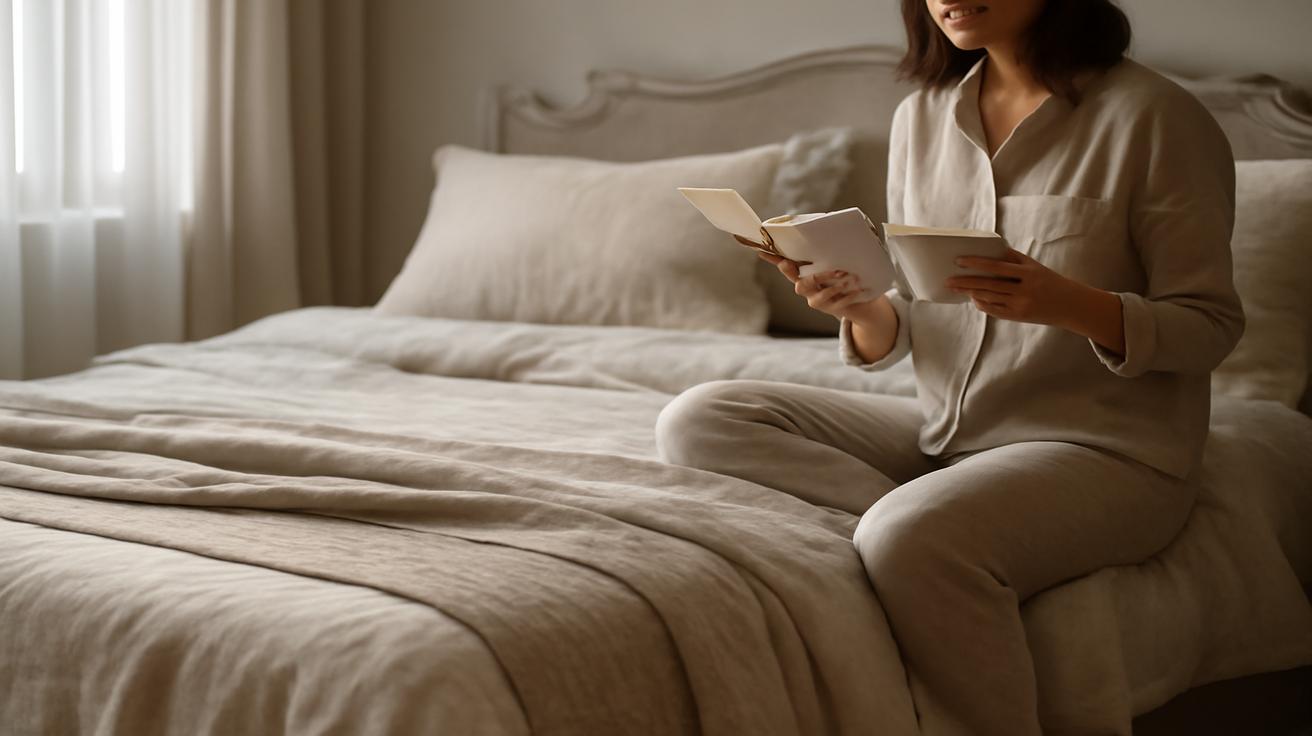
On a misty January morning in Lyon, the city was still half-asleep when Claire decided she’d had enough of her duvet. It sounds dramatic, but there she was: wrestling a deflated white mass into a cover that twisted, bunched, and swallowed her arms whole. One corner escaped, then another. She broke a sweat before she’d even had her coffee. Somewhere between the second curse word and the third attempt, she stopped, sat on the edge of the bed, and said out loud, “There has to be a better way.”
The Quiet Revolution at the Foot of the Bed
Across France, that same muttered sentence has been echoing in bedrooms, laundry rooms, and Airbnbs. A quiet revolution is underway, and it doesn’t roar with marketing slogans or tech buzz. It rustles, softly, in the form of a simple, beautifully made top sheet and a layered blanket — the elegant alternative creeping into French homes and calling into question a sacred object of modern comfort: the duvet.
If you’ve visited older French homes, you may have seen hints of this before — a crisp flat sheet, a wool blanket, perhaps a light quilt folded at the foot of the bed. For years, the duvet reigned as a symbol of modern ease: fluff it, shake it, throw on a cover and you’re done. But real life turned that promise of ease into a paradox. Duvet covers were hard to put on, the filling shifted, laundering was a hassle, and you either roasted at 3 a.m. or shivered under a too-thin “summer” version stored in the closet.
So, French homes are rediscovering — and reinventing — a more flexible approach: layered bedding that’s chic, comfy, and surprisingly practical. A return not to the past, exactly, but to the simple logic of layers that can adapt to bodies, seasons, and the small rituals of everyday life.
The Rise of the Layered Bed: Sheets, Blankets & Boutis
Walk into a new Parisian rental or a renovated farmhouse in Provence in 2026, and chances are the bed tells a slightly different story than it did a decade earlier. The bulky duvet mound has flattened into something calmer, thinner, more composed. You’ll see:
- A generously sized top sheet, often in washed linen or cotton percale, turned down over a blanket like a folded collar.
- One or two light blankets — sometimes wool, sometimes cotton honeycomb — stacked depending on the season.
- A quilted coverlet or boutis neatly draped, adding texture more than thickness.
At first glance, it looks almost too simple. But when you slide under it, there’s a deliberate pleasure: the cool slickness of the sheet against your skin, the gentle pressure of a blanket, the feeling that you’re in control of your own warmth, layer by layer.
French households, long seen as duvet devotees, are embracing this layered bed not just for aesthetics, but for deeply practical reasons. They’ve discovered what hotels in southern Europe have quietly known for years: separate layers breathe better, wash easier, and let couples negotiate the nightly war of “I’m hot” versus “I’m freezing” without starting a minor domestic conflict.
From Monolithic Duvet to Tailored Comfort
With a duvet, you commit: one filling, one warmth level, one bulky piece to take care of. With layers, comfort becomes tailored. On a damp spring night in Bordeaux, you might keep the top sheet and a single cotton blanket. In the crisp bite of a January in Alsace, you add a wool blanket and a quilted throw. Nothing more dramatic than a quick fold and unfold, yet the experience of sleep changes completely.
It’s a kind of quiet luxury that doesn’t shout. Your bed becomes a living object, responsive to the wind rattling the shutters, the heatwave rolling in from the south, the unexpected 23°C day in October when you thought autumn had finally arrived.
Why French Homes Are Saying “Au Revoir” to the Duvet
Underneath this shift is a curious mix of influences: sustainability, health, design, and the simple desire for things to be easier, not harder. The duvet, for all its fluffy promise, has become the symbol of unnecessary complication.
Laundry Day: The Breaking Point
Ask a family of four living in a typical apartment in Toulouse what triggered the change, and they will almost always point to the washing machine. Duvets eat space. They don’t fit easily in standard machines. Professional cleaning is expensive and time-consuming. In contrast, a top sheet and blanket slide in, spin, and dry with no drama.
Parents have started to do the math. One big duvet washed twice a year versus a sheet washed weekly and blankets refreshed seasonally. Easier hygiene, less smell trapped in the stuffing, no more hoping the laundromat dryer isn’t already full when the weather is damp.
Sweaty Nights & Sticky Mornings
The other culprit? Heat waves. French summers are not what they used to be. More nights over 25°C, more restless sleep. Under a duvet — even a “light” one — many people wake up stuck to their covers, half-kicking them off, half-dragging them back on at 5 a.m. Layers solve this with almost childlike simplicity: just peel one away.
Skin breathes better under a top sheet and blanket. The air trapped between layers circulates more freely than inside a thick duvet casing. Those who run hot at night report fewer wakeups, and the morning feels less like emerging from a sauna and more like slipping from a cocoon.
Aesthetics & the New “French Bed” Look
The layered bed has also become surprisingly fashionable. Interior designers working in Paris, Lille, and Marseille are recommending it for small apartments where visual calm is precious. Duvets tend to create a puffed, rounded silhouette. Layers lie flatter, sharper, more hotel-like — allowing for a bed that looks made even when you haven’t tried that hard.
A neatly folded quilt at the foot of the bed, a linen sheet casually creased, a light blanket peeking out in a muted color — it’s the kind of lived-in chic that French decor magazines love. And it photographs beautifully: texture, depth, a sense of invitation rather than overload.
How the New Bedding Works in Daily Life
This isn’t just an aesthetic philosophy; it’s a way of living with your bed more actively. Imagine a small apartment in Nantes. Two people, one bed, different body temperatures.
- He keeps the top sheet and a cotton blanket.
- She keeps the sheet, the blanket, and adds a thin quilt on her side only, folded lengthwise.
No negotiation, no “stop stealing the covers,” just a quiet coexistence under customized layers. Over time, this adaptability becomes part of the ritual of going to bed. You listen to your body: Do I need one blanket tonight, or two? Do I want the heavy one or the light one? You respond in minutes, no seasonal duvet swap required.
Parents especially are discovering the practicality. Children who get night sweats? Top sheet only, blanket half-pulled. Teenagers who never make their beds? A simple throw over a sheet looks decent enough. Elderly relatives visiting from a colder part of the country? Add a wool blanket from the cupboard, no new duvet to buy, no guest-room drama.
The Simple Logic of Layers: A Comparison
Here’s how the shift often feels when you break it down practically:
| Aspect | Traditional Duvet | Layered Sheets & Blankets |
|---|---|---|
| Temperature control | Fixed warmth; tricky in heat waves | Adjustable night by night, layer by layer |
| Laundry & care | Bulky to wash, often needs laundromat | Sheets wash weekly at home, blankets occasionally |
| Couple comfort | One warmth level for both people | Each side can have different layers |
| Look & style | Puffy, casual, often bulky | Sleek, hotel-like, more textured |
| Seasonal changes | Requires swapping duvets or fillings | Add or remove a blanket; same base all year |
The Sensory Shift: How It Actually Feels
What keeps this trend growing isn’t only rational. It’s deeply sensory. The first night you sleep under a top sheet instead of wrapped in a duvet burrito, it can feel almost too light, too exposed. Then something subtle happens: you become aware of textures again.
The sheet has its own personality. Washed linen feels thick yet breathable, with a pleasant weight and tiny irregularities under your fingertips. Cotton percale feels cool and smooth, almost like sleeping inside a freshly ironed shirt. A wool blanket’s gentle scratch reminds you of old mountain hotels and childhood naps at your grandparents’ house.
The sound changes too. Instead of the dull whoosh of fluff, you hear the whisper of layers folding over each other. When you turn, nothing suffocates you. The air around you feels less compressed. There’s more space between you and the covers, but paradoxically, you feel held — cradled by layers instead of engulfed by one giant cushion.
Morning Rituals, Rewritten
Making the bed also becomes less of a chore and more of a small, daily choreography. Flick the sheet up, smooth the blanket, straighten the quilt. Each layer has its place and returns to it quickly. No wrestling, no shaking, no crawling inside a duvet cover like a frustrated ghost.
In a small Paris studio, a layered bed is often the difference between chaos and calm. When the sofa is the bed and the bed is the office and the office is the dining room, having a bed that can be reset in under a minute with a few folds changes how the whole space feels. By 9 a.m., the same structure that sheltered your sleep becomes a clean, ordered plane — almost like a stage being reset between acts.
Eco, Health & Heritage: The Deeper Layers
Beneath the comfort and style, there’s another layer to this story: conscience. Duvets, particularly synthetic-filled ones, have come under increased scrutiny in France. How much polyester are we sleeping under? How often do we actually wash them? What happens to them when they’re discarded?
Less Bulk, More Longevity
Choosing separate layers often allows people to invest in fewer, better pieces. A good wool blanket might last decades. A quality cotton or linen sheet will soften rather than sag with time. Instead of replacing a whole duvet when it flattens or yellows, you simply refresh one layer at a time.
This longer life means less waste and fewer impulse buys. And because sheets are easier to wash, they tend to be cleaned more frequently, which quietly improves skin health and home hygiene. Those prone to allergies or asthma often report fewer issues when dust and mites aren’t lurking in hard-to-clean duvet stuffing.
A Modern Take on Old Traditions
There’s also a cultural echo. Before the duvet conquered French homes in the late 20th century, layered bedding was the norm: sheets, blankets, quilts carefully folded and aired out at the window. In 2026, young adults aren’t simply returning to their grandparents’ habits; they’re remixing them.
A boutis may now come in muted clay or eucalyptus green instead of traditional florals. Blankets might be sourced from small French or European makers, made from recycled wool or organic cotton. The aesthetic is minimal but warm, rooted in heritage yet unmistakably contemporary. It feels less like nostalgia and more like a homecoming: “We did this before. It worked. Why did we stop?”
Will 2026 Really Be the End of the Duvet?
So, does “no more duvets in 2026” mean France will suddenly banish them to the attic, like fondue sets and CD towers? Not quite. Duvets will survive, of course — in mountain chalets, in student flats, in the spare room where change arrives slowly. But their monopoly is crumbling, replaced by something more thoughtful, more adjustable, and frankly, more French in spirit.
The trend isn’t anti-duvet so much as pro-choice. It whispers: your bed doesn’t have to be a big, puffy default. It can be a composition — tuned to your body, your climate, your sense of beauty. Duvets, once seen as the “easy” option, are starting to look oddly rigid, a one-size-for-all relic in a world that’s rediscovering nuance.
Back in Lyon on that misty morning, Claire ended up doing something small but decisive. She folded the duvet, carried it to the storage cupboard, and pulled out an old cotton blanket she’d almost forgotten. She ordered two big linen top sheets that afternoon. That night, her bed looked strangely flat, almost shy. But when she slid under the covers, the sheet cool on her skin, the blanket just heavy enough, she felt something she hadn’t in a while.
She felt like the bed had been made for her — not for some catalog idea of comfort.
That’s the quiet revolution spreading across French homes in 2026. Not a war on duvets, but a return to listening: to bodies, to seasons, to the small sounds of fabric and breath and night air. Layer by layer, an uncomplicated kind of comfort is taking back the bed.
FAQ
Are duvets really disappearing in France by 2026?
No, duvets aren’t disappearing entirely, but their dominance is fading. More French households are choosing layered bedding — top sheets, blankets, and light quilts — because it’s easier to wash, more adaptable to temperature, and visually calmer in small spaces.
Is a layered bed actually warm enough in winter?
Yes. Several thinner layers can be just as warm, or warmer, than a single duvet. For cold winters, many people combine a top sheet with a wool blanket and a quilt or coverlet. The air trapped between layers adds insulation, and you can increase or reduce layers as needed.
Doesn’t a top sheet just add more work when making the bed?
Surprisingly, it often reduces effort. A top sheet is quick to straighten, and blankets rarely shift as dramatically as a whole duvet. For many, it’s easier to flick a sheet and smooth a blanket than to shake and fluff a bulky duvet every morning.
What fabrics work best for this no-duvet style?
Cotton percale or linen are popular for top sheets because they breathe well and feel good against the skin. For blankets, cotton honeycomb, light wool, or blends with a bit of weight are common. A thin quilted coverlet or boutis adds texture and extra warmth when needed.
Can couples with different temperature needs share a layered bed?
That’s one of the big advantages. Each person can customize their side with more or fewer layers. Some couples even use a shared top sheet but separate blankets or quilts on each side, balancing togetherness with personal comfort.







Leave a Comment