
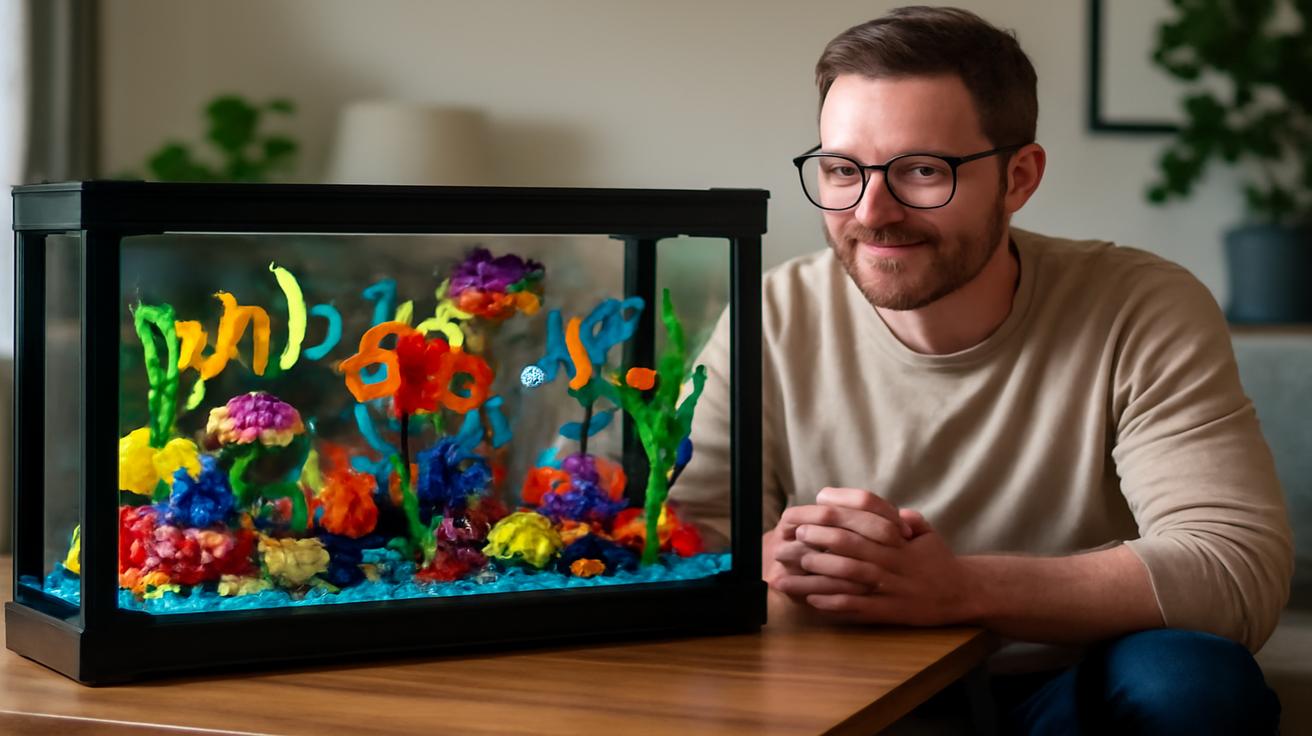
You notice it first in the silence. No gentle thrum of filters. No chorus of bubbling air stones. Just the soft clack of plastic as you snap one more translucent blue tile into place and watch light shimmer across hundreds of tiny, brick-built scales. The fish don’t flinch. They never do. Their world is perfectly still, a reef frozen in full color—yet somehow, entirely alive.
There’s no bucket of water waiting in the corner. No tub of pellets, no list of feeding times magneted to the fridge. Instead, spread across your table, there’s a sea of LEGO elements in dazzling colors and unusual shapes. Some look like coral. Some like sea grass. Some, frankly, look like someone in Denmark got very excited about neon pink. You run your fingers through the pieces and they whisper against each other like seashells in a tidal pool.
This is the new 4,154-piece LEGO aquarium set made for adults—an underwater world that will never need a water change, never cloud with algae, never lose a fish to a mysterious overnight illness. It’s not a substitute for the ocean; it’s a small, meticulous love letter to it. One that snaps together, brick by brick, until your living room suddenly feels a bit more like a tide-washed cove.
A Reef You Build, Not Maintain
For anyone who has ever dreamed of owning a saltwater aquarium—then recoiled at the cost, the complexity, or the heartbreak—the appeal is immediate. A “tank” with no pumps, no math, no mess. Just time, focus, and the gentle pleasure of making something intricate with your hands.
This particular set is unapologetically ambitious. Over four thousand pieces means you’re not just building a pretty box with a couple of fish. You’re composing an ecosystem in miniature: layered rockwork, branching coral, drifting fronds of brick-built kelp, schools of fish weaving between them, perhaps a shy little crustacean lurking down where the “substrate” meets the glass.
You begin with the base—the aquarium’s “glass.” Transparent panels lock into a rectangular frame, the structure deceptively simple but solid, designed to hold an improbable amount of ornamentation. As you build up the stand, you can almost feel the phantom weight of water that will never actually be there. This is the fantasy of an aquarium without the gravity, a container that will never bow, never leak, never ask you to test its nitrate levels.
The more you progress, the more your brain shifts into a different pace. Time stretches. You start noticing piece shapes by touch alone: the familiar two-by-four bricks, the slender curve of a SNOT bracket, the cool, sharp edges of transparent tiles. You fall into a quiet rhythm—click, press, align, adjust—until the rest of the world thins to a murmur beyond your focused little tidepool of a workspace.
| Feature | Details |
|---|---|
| Piece Count | 4,154 LEGO elements |
| Recommended Age | 18+ (designed for adult builders) |
| Type | Display aquarium (no water, no real fish) |
| Key Elements | Coral, rockwork, plants, brick-built fish, tank structure |
| Maintenance | Dusting only—no feeding or water changes required |
The Quiet Pleasure of a Brick-Built Tidepool
Nature-themed builds have always had a special pull. There’s a certain irony in using strict, geometric bricks to imitate the softness and chaos of wild spaces: a bonsai tree made from angular leaves, an orchid built from curved plates, a wave sculpted from tightly stacked slopes. This aquarium takes that familiar tension and dives far deeper with it.
The corals come together in impossible colors, just like their real-world counterparts. Lime-green tubes and branching red pieces form a riotous cluster of “polyps.” A gently twisting trail of orange and yellow slopes suggests a sponge-encrusted rock. Tiny neon pieces wink like the bright dots of a Christmas tree worm. Every finished patch of reef starts with abstraction—a mess of parts—and then, suddenly, resolves into something instantly recognizable.
The fish are where personality creeps in. Their shapes are simplified, stylized even, but the posture of each one feels intentional, almost narrative. A long, slender fish arcs around a coral column, mid-turn. A plumper, rounder one hovers near the bottom as if grazing on imaginary algae. Though the bricks are rigid, there’s movement implied in their placement—an echo of the endless, gentle drift you find in real aquariums.
Building them, you start thinking about the real animals these bricks are quietly celebrating. Reef fish: dazzling, delicate, dependent on specific temperatures and water chemistries and long, complicated relationships with their habitats. Here, they are safe from all of that—yet your hands, setting one bright tile next to another, can’t quite forget that somewhere in the real ocean, the living inspiration for this plastic fish is navigating a far more precarious world.
From Stress Relief to Flow State
This is where the appeal of an adult-targeted LEGO set becomes more than nostalgia. It’s not just about building what you loved as a kid; it’s about finding a slow, tactile antidote to screen-saturated days. With over 4,000 pieces to sort, organize, and snap together, this aquarium practically demands that your thoughts quiet down.
You sit at the table after work, phone face-down, and let the instructions guide you step by measured step. Each bag of parts is a small, contained challenge. Each completed module is a little piece of satisfaction. There’s no score, no deadline, no “productivity” metric attached—only the gentle, incremental progress of turning chaos into coherence.
By the time you realize how much time has passed, the outlines of your reef are already visible. Towers of coral rise from the base. Shelves of rock reach outward. You test how each segment slots into the larger structure, the way real reef outcrops stack and interlock on the sea floor. The room around you might be cluttered or loud, but the world inside the tank is coming together in pristine, ordered vibrancy.
When Design Meets Daydreaming
Part of the magic of this build is how unapologetically it leans into display. This is not a model you finish and then tuck away on a shelf to gather dust in anonymity. It wants to be seen. It wants to glow faintly in the corner of your home office or living room, throwing shards of colored light as the sun moves past the window.
The tank’s clean rectangular silhouette has that mid-century, almost gallery-like quality: a frame around something wild. Inside, the chaos of color and shape is carefully staged. You can approach it like a photographer, considering angles and lines of sight. Where will the focus fall when you look straight on? Which fish will be half-hidden, a little visual reward for anyone who bothers to peer more closely?
This is where the adult design sensibility really clicks. Everything is modular enough that you can play curator. Don’t like where that purple coral sits? Shift it. Want a more open “swim-through” in the center? Rebuild the rock arch with a bit more height. The build isn’t a fixed diorama; it’s a starting layout, a pointer toward all the possible reefs that could exist inside the same clear rectangle.
A Living Room Conversation Piece
Once assembled, the tank becomes a quiet magnet for attention. Guests notice it almost instantly, usually with the same half-laughing double-take: “Wait, is that LEGO?” It invites closer inspection in a way few mass-produced decorative objects do.
You watch people lean in, pointing at details that snag their attention: the tiny anemone-like cluster in one corner, a quirky fish expression, a subtle gradient in the “sand” at the bottom. Unlike a TV screen or a piece of wall art, this is something that feels both complete and still somewhat alive—not in a biological sense, but in how openly human it is. Someone, somewhere, designed this. And you, piece by piece, brought that design to life.
The conversations that spin off are rarely about plastic. They’re about childhood sets and first experiences with the ocean; about that one ill-fated betta fish; about coral bleaching on the news; about the way aquariums and terrariums and houseplants are all little attempts to keep some small corner of the wild within arm’s reach.
Where Aquariums and Ethics Intersect
Real aquariums are complicated things. Ethically, emotionally, logistically. There’s an intimacy in tending to living animals in a glass box: measuring drops of dechlorinator, thawing frozen food, hovering anxiously over a fish that isn’t eating. There’s joy in watching them explore, rest, interact, grow. There’s also, inevitably, loss.
This LEGO aquarium glides past all those complications. No one lives here. No one can be hurt by a forgotten water change or a power outage or an uncycled filter. And yet, as your fingers move through the build, you might find yourself thinking, just a bit more deeply, about the real aquariums and ecosystems that inspired it.
There’s something quietly subversive about the premise: an aquarium that isn’t an aquarium, celebrating marine life without trapping any of it behind real glass. It slots neatly into a growing desire to appreciate animals without always needing to own or confine them. The wild, rendered in plastic, safely and playfully, but also with a sort of reverent detail that speaks of hours spent studying the way coral branches, the way fish stripes align, the way a reef feels crowded and yet holds space for everything.
A Gateway to Learning, Not Possession
For some, this set will be a stepping stone: a way to test if their love of reef imagery could translate into the discipline of a real saltwater tank. For others, it may be the final stop—a way to live with the aesthetic of an aquarium without ever going near test kits or live rock.
Either way, it opens doors to curiosity. You might find yourself googling the species that seem hinted at in the designs. That one fish looks suspiciously like a clownfish; that branching structure whispers of staghorn coral. The set nudges you, gently, toward learning by making you care first about the beauty, then about the biology.
And unlike a real tank, you can take this reef apart. Explore how it works. Rearrange ecosystems with no consequences beyond a few satisfying hours of rebuilding. It’s an ocean you can deconstruct and put back together whenever you like—a creative sandbox with the sea as its theme.
No Buckets, No Filters, Just Dusting
Ask any aquarist what they spend the most time on, and “maintenance” will be near the top of the list. Water changes that leave the house smelling faintly of lakes. Filter cleanings that reveal mysterious gunk you’d rather not identify. The eternal war with algae, which seems to spring eternal from even the most careful setups.
Here, maintenance shrinks to something almost laughably simple: every so often, gently swipe a cloth over the clear panels and the coral tops. That’s it. No schedule of water tests. No tracing of odd behavior in a fish. No measuring decaying plant leaves or calcium levels. The reef remains in perfect suspended animation, forever at its visual peak.
You might miss the ritual, if you’ve owned tanks before. The way refilling a tank feels like topping off a tiny world. The quiet satisfaction of clearing a patch of algae and revealing bright rock beneath. But there’s also relief in this frozen reef. It doesn’t need you in the same way. Its existence isn’t tied to your vigilance; only its dust levels are.
And yet, the set does reward attention. The more time you spend with it, the more little compositions emerge. A cluster of fish looks different in morning light than under the soft warm glow of a lamp at night. Shadows from the coral branches stretch long and surprising. The tank doesn’t change, but your perception of it does, shifting with seasons, with moods, with the light through your windows.
Rebuilding as a Form of Return
Life changes. Apartments are packed up, shelves rearranged, tables repurposed. What’s quietly comforting about a big LEGO set is its built-in resilience. When it’s time to move, the reef can be carefully lifted out in sections, bubble-wrapped like any fragile sculpture. Or it can be disassembled entirely, coral turned back into sorted pieces, fish into a handful of small, bright parts.
That disassembly is not a loss. It’s a promise. Another quiet winter afternoon, months or years from now, you’ll slit open the tape on a familiar box. Out will spill the same shapes and colors, a tide of memory as much as plastic. You’ll start again: the base, the glass, the rock, the coral. Perhaps this time you’ll rearrange more boldly. Perhaps you’ll follow the instructions precisely, letting your hands remember the motions they once learned.
An aquarium, even a plastic one, becomes a kind of anchor in time. You remember what was happening in your life when you built it: the music you played in the background, the worries you were trying to set aside, the person you talked to on the phone while hunting for that one infuriatingly tiny tile. Rebuilding lets you visit that version of yourself again, from a calmer shoreline.
FAQ: Everything You’re Wondering About the LEGO Aquarium Set
Is this a real, functioning aquarium with water and live fish?
No. This is a display-only LEGO set designed to look like a detailed aquarium, but it is completely dry. It’s not meant to hold water or live animals—only bricks.
How challenging is the 4,154-piece build for someone new to LEGO?
It’s substantial, but approachable. The instructions are step-by-step and clearly illustrated. If you’re patient and comfortable following visual guides, you can handle it—even without previous large-set experience. Expect to build over multiple sessions.
How long does it typically take to complete?
Build time varies, but many adult builders will likely spend 10–20 hours from start to finish, depending on pace, breaks, and how often you pause to rearrange or admire the details.
Can I customize the layout of the coral and fish?
Yes. While the instructions provide a specific arrangement, many sections are modular. You can swap positions, alter colors, rearrange rockwork, or even design your own fish and coral variations using spare pieces.
What kind of maintenance does the finished model need?
Only gentle dusting from time to time. A soft, dry cloth or a small, clean brush works well for both the transparent “glass” and the more intricate coral structures.
Is this suitable as a gift for someone who loves the ocean but not necessarily LEGO?
Very much so. The finished model functions as a striking decorative piece and a conversation starter. Even non-LEGO fans often appreciate its sculptural, colorful presence—especially if they love aquariums or marine life.
Can children help build it, even though it’s marked for adults?
They can, with supervision. The 18+ recommendation reflects complexity and display intent, not content. Shared building with kids can be a great experience, but some sections are delicate and require careful handling.
Does it light up, or can I add lighting?
The standard set does not include built-in lights, but many builders choose to place small external lights behind or above the model to create a soft, underwater glow. Any modifications should stay outside the tank to avoid stressing the structure.
What makes this different from smaller LEGO fish or ocean sets?
Scale, detail, and focus. With over 4,000 pieces, this set offers layered rockwork, dense coral, multiple fish, and a substantial display presence. It’s designed as a centerpiece for adult builders rather than a quick play set.
Will the colors fade over time?
LEGO bricks are color-stable under normal indoor conditions. To keep them looking their best, avoid prolonged direct sunlight, which can fade any plastic over many years, and dust the model occasionally.








Leave a Comment