
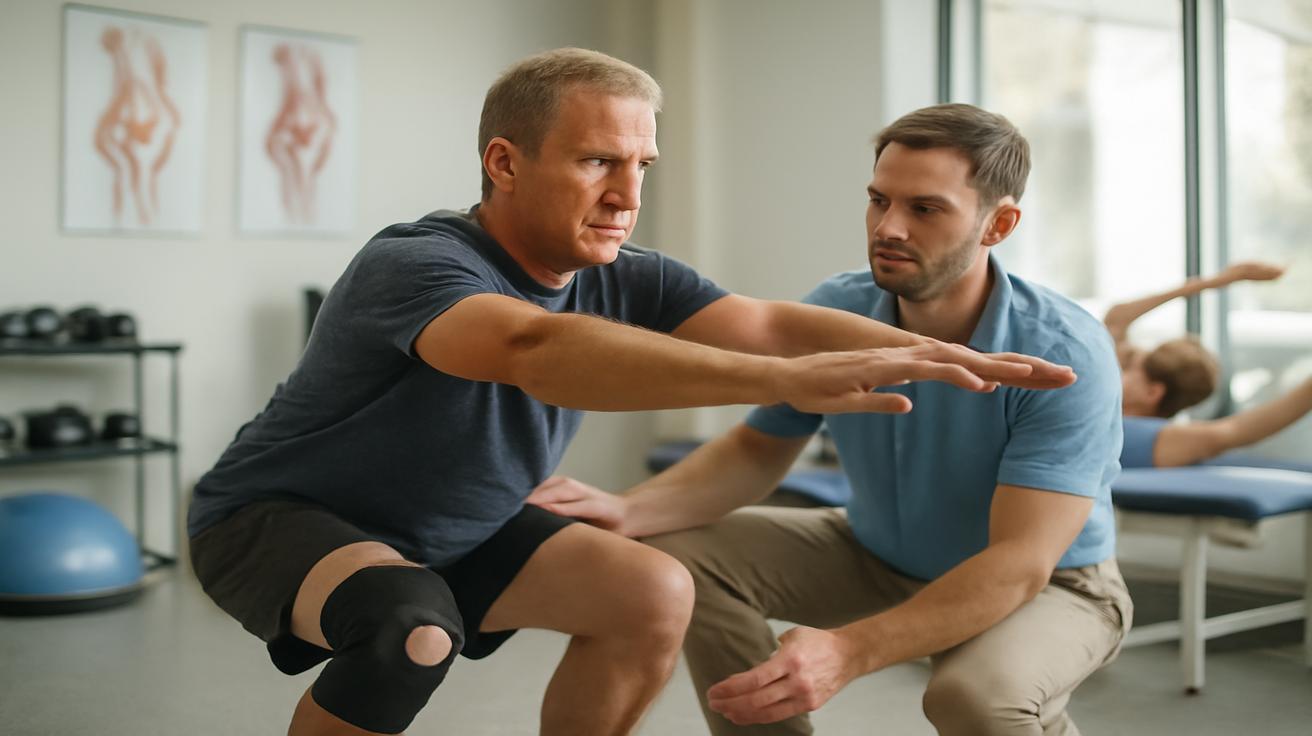
The woman in the cherry-red windbreaker hesitates at the edge of the park path, one sneaker half a step ahead of the other. Joggers pass her in a blur, breath clouding in the cool morning air. A dog barks, a cyclist rings a bell. She inhales, plants her feet hip-width apart, and drops—slowly—into a squat. Her hands glide forward for balance. Her knees track over her toes. Her face is pinched with concentration, and something else too: fear.
At the bottom of the movement she pauses. You can almost hear the silent conversation happening behind her eyes: What if this hurts? What if this makes it worse? What if the internet is wrong?
Once, this woman was told by her doctor never to squat again. “Bad knees,” he’d said with the finality of a slammed book. And for years, she obeyed. No deep chairs, no crouching to play with her niece, a strained apology every time she stayed standing while others folded themselves down to the floor. Squats were the enemy. Squats were danger.
Now she is here because another voice—a younger physical therapist with soft-soled sneakers and a harder insistence on nuance—has told her the opposite: “If you do them right, squats might actually save your knees, not ruin them.”
That idea, that a move long demonized by doctors and dreaded by patients might be medicine instead of poison, is rippling through clinics, gyms, and research conferences. It’s stirring up arguments in hospital hallways and online forums. And it is quietly rewriting what many of us think we know about knee pain, aging, and the line between harm and healing.
How squats went from villain to maybe-hero
To understand why squats are suddenly being defended in hushed, almost conspiratorial tones, you have to rewind a few decades. In the 1980s and 1990s, as recreational running boomed and office chairs grew ever more padded, knee pain became a kind of background soundtrack to modern life. An MRI here, an X-ray there, and a story began to crystallize:
Your knees are fragile. Your cartilage is wearing out. Bending deeply is dangerous. Don’t squat. Don’t kneel. Don’t let your knees go past your toes. Protect, avoid, guard.
It was a story that made intuitive sense. When knees hurt, they often hurt with movement, especially bending or going down stairs. If something is painful when it moves, the solution must be to move it less, right?
Only, behind the scenes, quiet research projects were uncovering an inconvenient truth: joints are not like fine china. They are more like living forests—systems that change, adapt, strengthen, and sometimes recover when stressed in the right way. The cartilage that cushions your knees, once thought to be inert and doomed to wear away like a brake pad, turns out to be more dynamic than we gave it credit for. The muscles around the knee are not backup players but lead actors in the story of pain and function.
And squats—especially slow, controlled, well-coached squats—are one of the simplest ways to challenge that entire ecosystem at once. Hips, knees, ankles, core, balance, coordination, confidence: it all shows up in a single, deceptively ordinary human movement the body has known since before there were chairs.
So why, if the science is nudging us toward squats as medicine, is the medical community so stubbornly split?
The fracture line in the medical world
In a fluorescent-lit hospital corridor, two professionals stand facing each other, each holding a piece of the truth.
On one side, an orthopedic surgeon who has spent three decades peering inside damaged knees. He has seen shredded menisci, crumbling cartilage, angry, inflamed joint linings. In his mind, the prescription is almost reflexive: “Avoid load. No squats. No deep bending. We have to preserve what’s left.” When he says this, he is not being careless. He is being protective. He has seen too much.
On the other side, a young sports medicine physio with a tablet full of studies. She flips through graphs showing patients who squatted—gently, gradually, within their capacity—and watched their pain decrease and strength rise. She gestures at images of older adults in their seventies resting effortlessly in deep squats in cultures where chairs are rare and bending is normal. “If we keep telling people to avoid movement,” she counters, “their muscles melt away. Their confidence shrinks. The pain doesn’t magically vanish; it just has less support to carry it.”
They’re not really arguing about squats. They’re arguing about the central paradox of pain care: when something hurts, is the answer to shield it from the world, or is it to reintroduce it to the world, gently, carefully, in doses?
Swimming and Pilates have long been the diplomatic middle ground in these debates: low impact, graceful, and non-threatening. You float through water. You lie on a mat. You’re supported, guided, cushioned. For many, these are wonderful ways to move—and they absolutely have their place. But they also dodge one uncomfortable reality of daily life: the world is not padded. The ground is not buoyant. Toilets are low, stairs are high, grocery bags are heavy, children are squirmy. At some point, you have to bend your knees against real gravity.
That is what makes this new wave of squat advocacy feel so controversial. It is asking us, and our doctors, to admit that no amount of careful avoidance can replace learning to move well under real-world load.
Why squats are uniquely “everyday” medicine
Picture your day without calling it exercise. Getting out of bed. Sitting on the toilet. Lowering yourself into a chair. Getting off the ground after reaching under the couch for a lost sock. All of these are, in pure biomechanical terms, forms of squatting.
To pretend we can simply edit squats out of the repertoire of a human body is a little like trying to give up blinking. You might avoid the gym, but you cannot avoid gravity.
What experts who now praise squats are really saying is this: if you are going to do this movement anyway, let’s teach your body how to do it in a way that builds it up instead of scaring it into stiffness.
That doesn’t mean dropping a barbell on someone’s back on day one. It rarely looks like a gym advertisement. In clinics and small studios around the world, it often starts with a movement that barely looks like a squat at all: a tiny bend, a gentle shift back into the heels, hands on a countertop, a chair behind you just in case. A breath. A pause. Standing again.
Over time, this humble bend becomes a kind of nervous system conversation. With each repetition, your brain collects data: That didn’t break me. That wasn’t as bad as I feared. That part of my knee felt supported. Those muscles woke up. This is not just strength training. It is fear training, in the best sense—teaching fear that it no longer needs to call all the shots.
What the science actually says (and doesn’t)
When experts cite research to defend squats for knee pain, they’re not claiming that every person with every knee condition will be cured by bending deeply. That would be as simplistic as the old “never squat” rule.
Instead, the data is more nuanced:
- Strengthening the muscles around the knee—especially the quadriceps, glutes, and hamstrings—is consistently linked to improved function and reduced pain in many kinds of knee issues, including osteoarthritis.
- Controlled loading of joints, including through bending and weight-bearing, can help maintain cartilage health, joint nutrition, and resilience over time.
- People who are guided through gradual, tailored strengthening programs often regain confidence in their knees and report better quality of life than those told only to “rest” or “avoid.”
Squats, properly adjusted, happen to be one of the most efficient ways to deliver all of that at once. But here’s the part that sometimes gets lost when headlines shout about “controversial squats curing knee pain”:
Form matters. Progression matters. Context matters.
A deep, weighted barbell squat with rounded back and collapsing knees done by someone who hasn’t moved much in ten years is not the same as a shallow, supported bodyweight squat with good alignment done under the watchful eye of an experienced therapist.
And this is where the split in the medical community becomes understandable. If the word “squat” conjures images of reckless gym culture, Instagram challenges, and weekend warriors loading plates onto bars without guidance, it makes sense to want to slam on the brakes. If the word “squat” conjures a careful, stepwise rehabilitation program, it starts to look less like a threat and more like a tool.
From fear to familiarity: how squats can be “dosed” like medicine
Think of squats not as a yes-or-no question, but as something with a dosage and formulation, like a prescription.
There’s the form of the squat: shallow or deep, feet narrow or wide, heels elevated or flat, supported or free-standing. There’s the load: your own bodyweight, a light weight held in front, or no load at all beyond gravity. And there’s the frequency and volume: how many times, how often.
For many people with knee pain, a starting “dose” might look like a few very shallow squats, holding onto a counter or doorframe, once a day. As the body adapts, the dosage can be adjusted—perhaps a little deeper, perhaps a few more repetitions, perhaps with less support from the hands.
Done in this way, squats become a kind of physical conversation: you ask your knee for a little more, it gives you feedback the next day, and you respond. If it flares, you back off the depth or the number. If it tolerates, you maintain or gently progress. The key is that you are no longer obeying a blanket rule (“never squat”) but negotiating with your own body.
To make this more concrete, here is a simple example of how a cautious progression might look over time. This is not a universal prescription, but an illustration of the principle of gradual change:
| Phase | Movement Focus | Support & Depth | Typical Frequency |
|---|---|---|---|
| Phase 1: Introduction | Mini squats | Hands on counter, very shallow bend | 1–2 sets of 5–8 reps, 3–4 days/week |
| Phase 2: Confidence | Chair squats | Light touch on chair, sit and stand | 2 sets of 6–10 reps, 3–4 days/week |
| Phase 3: Control | Bodyweight squats | No support, comfortable depth | 2–3 sets of 8–12 reps, 2–3 days/week |
| Phase 4: Strength | Loaded squats (optional) | Light weight held in front, controlled | 2–3 sets of 6–10 reps, 2 days/week |
Again, this is a sketch, not a rulebook. Your history, your pain pattern, your fears and your goals all matter. But this way of thinking—of squats as adaptable, flexible, adjustable—is at the heart of why some experts are so passionate about them, even as others recoil.
What about “bad knees,” arthritis, or past injuries?
If you’ve ever been told you have “bone-on-bone” arthritis or a “degenerative” knee, this is probably where your skepticism spikes. It’s one thing to ask a slightly achey knee to practice squatting. It’s another to ask a joint you’ve been told is damaged to do the very thing you were warned against.
Here is where language matters. Terms like “bone-on-bone” can sound catastrophic, but often they’re shorthand for advanced joint changes, not literal grinding of bare bone with every move. Many people with scary imaging results have surprisingly manageable pain. Others with mild imaging findings can hurt a lot.
For those with osteoarthritis or old injuries, the emerging consensus among rehab specialists is not that squats are universally forbidden or universally required, but that they are a tool to be considered—and often modified.
Maybe your version of a squat never dips past a certain depth. Maybe you keep your heels slightly elevated or use a rail for balance. Maybe you pair squats with other exercises that build hip and core strength so the knee isn’t carrying the whole burden alone. Maybe some days you don’t squat at all, and that’s fine too.
The controversy in clinics is less about whether movement helps and more about which movements, at which stages, and how to communicate risk without accidentally imprisoning people in a story of fragility.
Some surgeons, wary of lawsuits and worst-case scenarios, still default to “avoid.” Some physiotherapists, frustrated by the fallout of years of fear-based messaging, push strongly toward “load and strengthen.” In between are the patients, caught in the crossfire of professional caution and professional confidence, trying to decide which story to believe.
Listening to your knees—and to the right kind of pain
One reason squats are so divisive is that they force us to confront an uncomfortable fact: not all pain is a stop sign. Sometimes, in rehabilitation, a small amount of discomfort is more like the soreness of a long walk after a sedentary month—a signal of change, not damage.
Distinguishing between helpful and harmful sensations can feel like learning a new language. Helpful discomfort tends to be mild, often described as pressure, effort, or “working hard.” It usually eases within a day or two. Harmful pain is sharp, stabbing, or swelling; it lingers or escalates, and it can change how you move even when you’re not exercising.
When experts guide people through squats for knee pain, they’re not ignoring pain. They’re teaching how to stay within a “green” or “yellow” zone of tolerable sensation, where the joint is being asked to adapt but not overwhelmed. This requires attention, practice, and often the calm presence of someone who can say, “Yes, that kind of ache is okay. That other feeling, let’s adjust for.”
In this sense, squats become more than an exercise; they become an education in body literacy. For many who’ve spent years treating their knees like ticking time bombs, that education is both unnerving and exhilarating.
So, should you squat if your knees hurt?
Somewhere between the wariness of the veteran surgeon and the optimism of the young physio is a middle path that respects both experience and evidence, both vulnerability and resilience.
On that path, the answer to “Should I squat?” is not a default yes or no, but a set of more nuanced questions:
- What exactly is going on with your knees? A clear diagnosis—ideally from someone who sees a lot of knee cases—can help guide the form and depth of your squats.
- How much are you moving now? If your current activity is mostly sitting and short walks, your starting point will be very different than that of a recreational athlete.
- What do you actually want to do in daily life? Play with grandkids on the floor? Garden? Hike? Climb stairs without gripping the railing? Your goals matter.
- Do you have access to someone who can coach your movement—an experienced physical therapist or trainer who understands pain science and joint health?
For many people, the most honest answer might be: “Yes, but gently, and not alone at first.” Or: “Yes, eventually, but let’s get some basics in place first.” Or occasionally: “Not right now; let’s calm this flare and build some capacity in other ways, then revisit.”
The controversy will likely continue for a while. Medicine, like the human body, changes slowly. Old dogmas linger. New ideas are tested, refined, sometimes overturned. But the fact that squats—once exiled from the world of knee pain—are even on the table again says something important about where we’re heading.
We are moving away from the idea that hurting joints must be wrapped in metaphorical bubble wrap, and toward an understanding that careful, respectful loading can be part of healing. We are acknowledging that fear can be as disabling as weakness. And we are rediscovering an old truth our ancestors never really forgot: the body was built to bend.
Back in the park, the woman in the red windbreaker stands up from her first hesitant squat. She tests her knee with a small, surprised twist. The world has not ended. Nothing snapped. The pain—still there—is no worse. On her therapist’s advice, she does four more, each one a little smoother, her arms a little less frantic for balance.
Is this a miracle cure? No. Her knee will still ache some days. Some evenings she will still ice it, still mutter under her breath going down stairs. But weeks from now, when she sits on the floor with her niece, when she rises from a low restaurant booth without planning it like a military operation, she will remember this chilly morning.
Not as the day her pain vanished, but as the day her story about her knees began to change—from fragile and forbidden, to capable of learning again.
Frequently Asked Questions
Are squats safe if I have knee osteoarthritis?
For many people with knee osteoarthritis, carefully modified squats can be safe and even beneficial. The key is to start with a small range of motion, use support if needed, and progress gradually under professional guidance. Always discuss your specific situation with a healthcare provider who understands both your imaging findings and your daily function.
Won’t squats just wear out my cartilage faster?
Current research suggests that controlled, moderate loading—like well-performed squats—can help maintain joint health rather than accelerate damage. Cartilage responds to movement and load; complete avoidance can actually contribute to weakness and stiffness. Problems arise more from excessive, poorly controlled loading than from thoughtful, gradual strength work.
What if my doctor told me never to squat?
Doctors often give blanket precautions to keep patients safe, especially when they don’t have time to assess your movement in detail. It’s reasonable to go back and ask for more specifics or to seek a second opinion from a physical therapist or sports medicine specialist. Bring up your goals and ask whether a supervised, modified squat program could be appropriate for you.
Is swimming or Pilates a better choice than squats for knee pain?
Swimming and Pilates can be excellent for overall fitness and pain management, especially when joints are very irritated. However, they don’t fully replicate the loaded bending and standing you need for everyday tasks like getting out of chairs or climbing stairs. Many people benefit from a combination: low-impact activities plus progressive strength work, which may include squats.
How do I know if my squat is “good” for my knees?
In general, aim for your knees to track in line with your toes, your heels to stay grounded (or supported if needed), and your weight balanced through your midfoot and heels rather than shifting entirely to your toes. Pain during or after should be mild and short-lived, not sharp or worsening over days. If you’re unsure, investing in a session or two with a qualified professional to assess and coach your form is often worthwhile.







Leave a Comment