
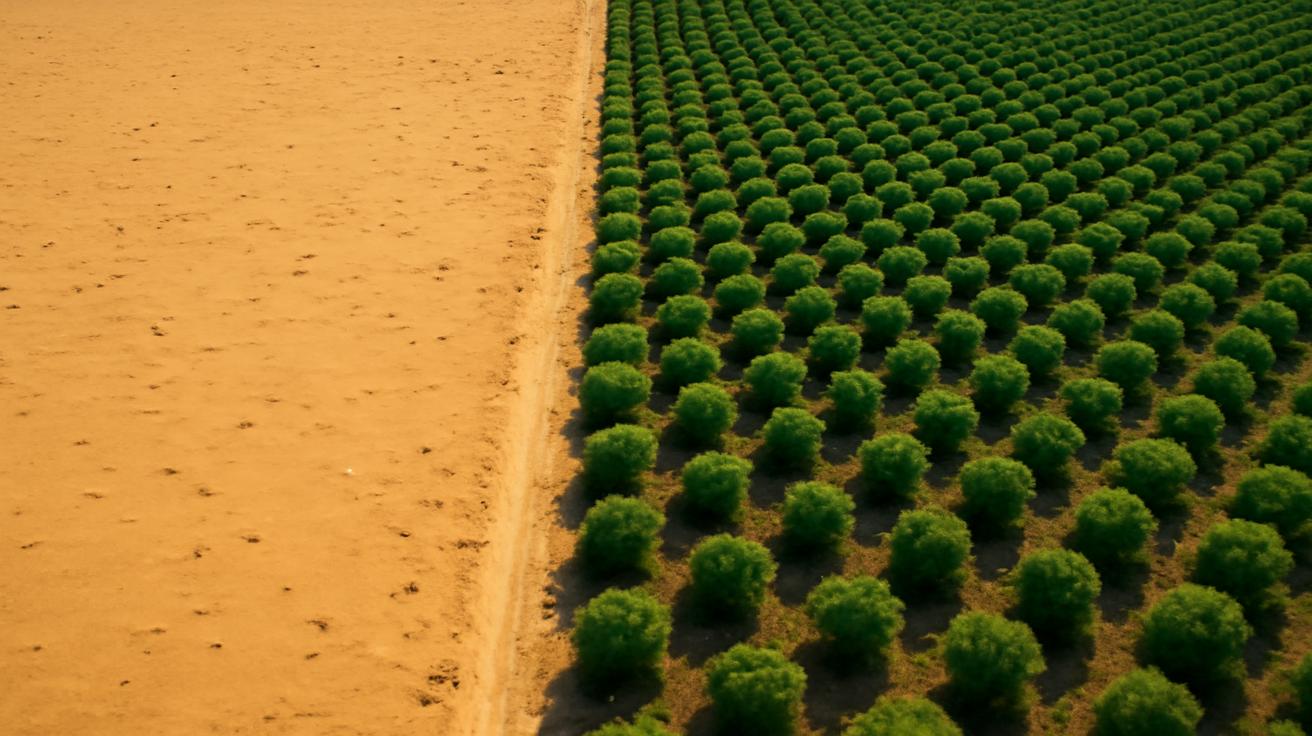
The first thing you notice is the color. From the window of a satellite as it sweeps over northern China, the land once read like a parchment of dust and stone—beige, brittle, tired. Now, there are ribbons of deepening green stitched across the surface, scattering like ink strokes from an invisible brush. To the human eye, these might look like regular woodlands or croplands. To NASA’s satellites, tuned to read subtle signals of chlorophyll and moisture, they are evidence of something much larger: desert slowed, dunes held back, and an entire human-made forest quietly altering the story of a continent.
The View From Space: How NASA Saw the Green Wall
For decades, the north of China was known more for dust storms than for trees. The Gobi Desert, a vast expanse of rock, gravel, and sand, pushed steadily south and east, spilling into farmlands, climbing toward cities, and periodically sending veils of yellow dust across Beijing, Seoul, and even as far as Japan and the west coast of North America.
When the Chinese government first proposed the “Three-North Shelter Forest Program” in 1978—better known outside the country as the Great Green Wall—it sounded wildly ambitious, even impossible. The idea was to grow a giant ecological barrier, a patchwork of forests, shrubs, and grasslands stretching thousands of kilometers along the desert’s advancing edge. For years, news about it came mainly from the ground: newly planted saplings, farmers digging contour trenches, local officials boasting about tree counts.
But stories told from the ground can be slippery. Trees planted aren’t always trees surviving. Deserts don’t pause just because we decide they should. So scientists turned to the one witness that could see everything at once: Earth-orbiting satellites.
NASA’s MODIS and Landsat instruments, which have been quietly scanning the planet for decades, can detect tiny variations in the color and reflectivity of the land surface. By analyzing something known as “vegetation indices”—essentially, how “green” an area is by scientific standards—researchers began to build a timeline of northern China’s changing skin.
When they overlaid two decades of data, a pattern emerged. The browns were retreating. The greens were advancing. In the places where the Great Green Wall was planned, the satellite record was clear: vegetation density was increasing, and the expansion of bare, desert-like land was slowing down, even reversing in some regions.
What It Means to Slow a Desert
Deserts don’t move like armies, marching in clear lines. They creep. They nibble at the edges of grasslands and fields, wearing them down with wind, drought, and the constant grinding of exposed soil. For a long time, the story along China’s northern frontier was one of steady loss: degraded pasture, exhausted cropland, villages swallowed by dust.
NASA’s satellite data flipped that narrative in key places. Where the Great Green Wall planting zones were most intense—particularly in parts of Inner Mongolia, Gansu, and Ningxia—there was a distinct shift in the spectral signature of the land. Less exposed soil. More vegetative cover. A once expanding patchwork of deserts and desertified land had begun to stabilize.
On the ground, this change is more than just lines on a graph. It is the difference between waking up to a landscape washed in grit and waking to a softer horizon. Families in former “dust bowl” villages report fewer spring sandstorms; some towns that once battled to keep sand off their doorsteps now see the slow return of grasses and shrubs.
Slowing desert expansion is not the same as erasing it. The Gobi is still there, immense and unbothered. But in places where dunes once threatened to move, the forward pulse has weakened. Sand has been caught and held by roots, fenced by forest belts, stitched into place by hardy shrubs.
| Indicator | Before Large-Scale Planting | After Decades of the Great Green Wall |
|---|---|---|
| Vegetation cover in target regions | Sparse, declining in many dryland zones | Noticeable increase detected by NASA satellites |
| Desertified land trend | Expanding toward cropland and settlements | Expansion slowed, locally reversed in some areas |
| Dust storm frequency in key provinces | Frequent, severe in spring months | General decline in many downwind regions |
| Land surface temperature patterns | High temperatures over bare, dry soils | Localized cooling where vegetation has increased |
Inside the Great Green Wall: More Than Just Trees
From the air, the Great Green Wall looks like mottled patches and bands of darker tones. Up close, it is messy, imperfect, and deeply human. There are rows of poplars lining dusty roads. There are shelterbelts planted like giant stitches across farmland. There are dunes pinned down by checkerboards of straw, each square hand-laid by workers trudging up loose slopes in biting wind.
The word “wall” is misleading. No single, uninterrupted forest divides desert from city. Instead, the project is a mosaic: plantations, natural regrowth, grassland restoration, and farmer-managed groves that stretch across a zone roughly the size of many countries combined. In some places, it feels like a forest. In others, like scattered islands of trees in an ocean of dryland.
NASA’s confirmations give a kind of quiet evidence to the work of tens of millions of hands. Every green pixel the satellites see represents something tactile: an acacia seed pressed into a furrow, a young elm shielded from goats, a sapling that survived its first year of scorching wind. The satellites do not distinguish between a single wild shrub and a regimented plantation, yet both matter. Both increase ground cover, catch drifting sand, shade the soil, and slow the wind at the surface.
How Satellites Detect a Forest That’s Still Growing
Modern environmental storytelling often leans on metaphor, but the way satellites see Earth is almost brutally literal. They capture reflected sunlight across different wavelengths: visible light, near-infrared, shortwave infrared. Healthy plants absorb a lot of red light for photosynthesis and reflect more near-infrared light. By comparing those bands, scientists build an index of “greenness,” a number that grows as vegetation thickens.
In northern China, these indices climbed noticeably between the early 2000s and the 2020s. Patches that once behaved like bare, high-reflectance soil began acting more like woodland or dense shrubland. Seasonal patterns shifted—it took longer for the land to revert to its most exposed state, suggesting more permanent cover.
This doesn’t just tell scientists that trees are present; it tells them that these trees and shrubs are actively functioning, pulling carbon from the air, moving water through their stems, and altering the local microclimate. The signal is strong enough that when NASA researchers map global “greening trends,” northern China now shows up as one of the most prominent bright spots on the planet.
Lives Lived in the Shadow of a Slower Desert
Imagine standing in a village on the frontier of the Gobi in the 1990s. The wind carries sand that stings your eyes. Fields at the edge of town are half-buried; each spring you shovel dunes away from doors and irrigation ditches. Younger people leave for cities; older ones stay, watching as the landscape grows harsher.
Now imagine the same village today. It’s not suddenly lush; this isn’t a fairy-tale transformation. The air still dries your lips, and winters bite. But along the horizon, there are bands of trees where there used to be nothing. Older plantations have thickened, branches knitting together to form scruffy, resilient forests. Between them, grasses have taken hold, catching more dust. After a hard rain, water lingers a bit longer in the soil.
Local herders talk about new pasture where they once saw only barren crust. Farmers notice less topsoil lost to storms. Some communities have begun harvesting modest amounts of non-timber products—nuts, fruit, medicinal plants—from restored areas. Children grow up with a different baseline of normal: the sound of leaves in the wind where their grandparents heard only the hiss of dust.
NASA’s data can’t capture these stories of return and adaptation, but they depend on the same root systems, the same expanding patches of green that appear in satellite imagery. When we say that the Great Green Wall is “reshaping entire regions,” it’s not only about maps or climate models; it’s about the daily relationship between people and their land quietly shifting toward something more stable.
Not a Perfect Forest, But a Real One
The story of the Great Green Wall is not one of unbroken success. Some early plantations relied heavily on a few fast-growing, water-hungry species, like certain poplars, that struggled when droughts deepened. Monocultures—vast stretches of the same tree—fell victim to pests and disease. In some areas, heavy planting even strained scarce groundwater supplies, forcing project managers to rethink their approach.
NASA’s satellites, too, offer a blunt picture. They can tell us where there is more vegetation, but not always whether that vegetation is ecologically healthy or diverse. A dense, uniform plantation and a mixed, natural woodland can both look similarly green from space.
This is where ground truthing comes in: teams of Chinese and international scientists, ecologists, and local farmers walking through those planted belts, measuring soil, tracking survival rates, experimenting with native species that can handle salinity, cold, and drought. Over time, policies have shifted: more emphasis on mixed-species planting, natural regeneration, grassland protection, and reducing overgrazing rather than simply counting new trees.
Yet even with its imperfections, the macro pattern that NASA confirms is remarkable: more green where, without intervention, there almost certainly would have been less. The Great Green Wall’s very flaws have forced improvements, pushing the project away from simple “tree quotas” toward longer-term ecosystem thinking.
Climate, Cooling, and the Breath of a New Forest
As vegetation takes root across northern China, the impact ripples beyond just halting sand. Plants change how energy moves between land and atmosphere. They shade the surface, evaporate water, and roughen the ground so that wind loses some of its bite.
Satellite-derived land surface temperature datasets show small but telling pockets of cooling where restoration has been strongest. These changes are local, not a cure for global warming, but they matter for communities on the ground: slightly cooler summer afternoons, more comfortable microclimates for crops and livestock, and a hint of resilience in the face of intensifying heat waves.
Then there is carbon. Every new trunk and branch and root that shows up in satellite data represents carbon drawn out of the atmosphere and locked into biomass. While estimates vary, China’s large-scale tree and shrub planting programs, including the Great Green Wall, are now recognized as one of the contributors to the global increase in terrestrial carbon sinks over recent decades.
In other words, when the satellites register more green in these dry northern lands, they are also quietly logging more stored carbon—an unplanned but vital ally in the struggle to stabilize the climate.
Lessons for a World Facing Growing Deserts
From the Sahel in Africa to the drylands of Central Asia and the American Southwest, many regions confront the same forces that once drove the Gobi toward Chinese towns: overgrazing, deforestation, drought, shifting rainfall, and the long shadow of climate change. China’s Great Green Wall isn’t a template to be copied exactly—its political, social, and ecological context is unique—but it is a powerful case study in scale, persistence, and learning by doing.
NASA’s confirmation that this project has measurably slowed desert expansion gives weight to the idea that human-driven landscape restoration can work, even in harsh places and under pressure. It shows that with time measured not in years but in decades, and with constant adjustment, it’s possible to bend the trajectory of degraded land.
It also underlines a crucial nuance: success is not binary. The Gobi has not been “stopped.” Dust storms still happen. Some plantations fail. But the balance has shifted. In a world that tends to look for simple heroes and villains, the Great Green Wall stands as a more complicated, more realistic kind of hope: a messy, evolving experiment that is nonetheless tilting the region toward more stability than it might otherwise have known.
The Story Still Being Written
Back in orbit, the satellites keep collecting their quiet proof. Each year adds another layer to the archive—a living time-lapse of a continent’s northern rim. When scientists replay that film, the transformation is striking: expanding smudges of green, interrupted by drought years, by policy changes, by the limits of what any one country can do. Yet the direction, overall, holds.
On the ground, farmers still argue about which species survive best. Ecologists still debate how to balance trees with grasslands and traditional grazing. Policymakers still grapple with how to support communities while protecting fragile new ecosystems. The Great Green Wall is not a fixed structure but a conversation between people, plants, soil, and climate—a conversation that will continue for decades.
What NASA has given this story is a kind of objective chorus line: a record that says, clearly, that these millions of acts of planting and protecting have added up to something visible from space. They have slowed a desert. They have reshaped the heat and color of whole provinces. They have turned what could have been a one-way slide into sand into something more complex, more hopeful.
And perhaps that is the most quietly radical part of all this: the idea that, in a century defined by environmental loss, an entire region can move in the other direction—not toward untouched wilderness, not toward some pristine past, but toward a new, human-shaped landscape that is greener, more stable, and a little more forgiving than it used to be.
FAQ
Is the Great Green Wall in China really visible from space?
Yes, though not as a single clear line. Satellites don’t see a “wall” like a building; instead, they detect large-scale changes in vegetation. NASA’s instruments can clearly see that areas targeted by the Great Green Wall have become greener over the past few decades.
Has the project completely stopped the Gobi Desert from expanding?
No. The Gobi Desert still exists and continues to change with climate and land use. However, in many zones along its edge, NASA data and field studies show that desertification has slowed and, in some areas, partially reversed compared with earlier decades.
Does planting trees in dry regions waste water?
It can, if done poorly. Some early phases of the project used water-intensive species that struggled in arid conditions. Over time, managers have shifted toward more drought-tolerant, native species and a greater focus on grasslands and shrubs, which use less water and are better adapted to local conditions.
How do satellites know if land is becoming greener?
Satellites measure reflected light at different wavelengths. Healthy plants absorb certain wavelengths and reflect others, especially in the near-infrared band. By comparing these, scientists calculate vegetation indices that show how dense and active plant cover is over time.
Can other countries copy China’s Great Green Wall model?
They can learn from it, but not simply copy it. Each region has unique climates, soils, and social systems. The key lessons are long-term commitment, integration of local communities, adaptability, and the importance of combining trees with broader land restoration, not just mass planting.
Is the Great Green Wall helping with climate change?
It contributes in two ways: by storing carbon in new vegetation and soils, and by slightly cooling local land surfaces through shading and evapotranspiration. It is not a solution to climate change on its own, but it is a meaningful piece of a much larger puzzle.
Will the Great Green Wall need to be maintained forever?
Yes, in the sense that any managed landscape needs ongoing care. Once ecosystems mature and become more self-sustaining, the effort may shift from intensive planting to protection, sustainable use, and adaptation to changing climate, but human stewardship will remain essential.








Leave a Comment