
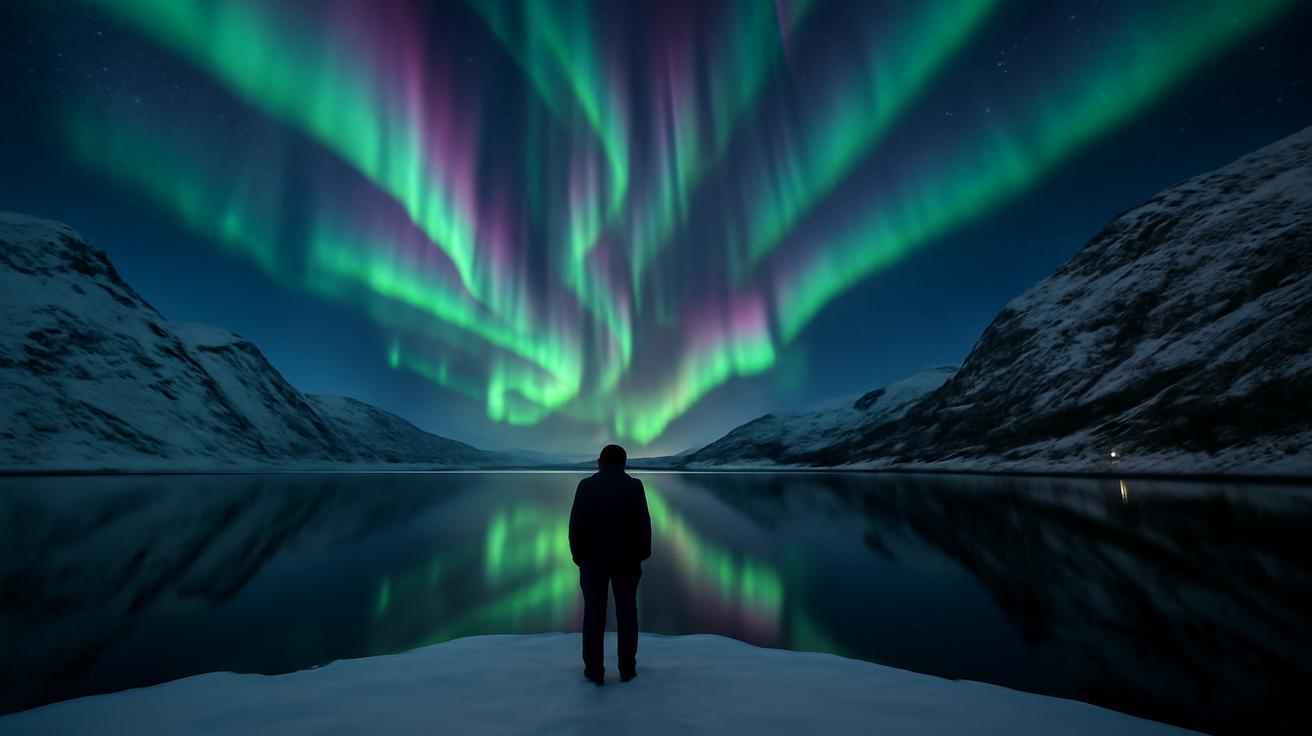
The first time you notice it, you might think you’re imagining things. A subtle glow low on the horizon, like the sky is quietly breathing. Not the sharp white of city lights, not the orange smear of distant highways—something softer, stranger. Green, maybe. Or is it purple? You stand there, breath curling into the cold night air, while the world above you starts to move. Curtains of color ripple soundlessly, like someone has draped silk across the stars and then set it gently swaying. For a second you forget to breathe. This, you think, should not be happening here.
The Year the Lights Came South
In the last few months, photos have started trickling across social media: auroras over London bridges, over the cornfields of Iowa, over suburbs that rarely see more than a handful of stars. A fisherman on the coast of Maine stands on his dock, phone held shakily in gloved hands. A teacher in Germany hurries her kids out of bed at midnight. A couple in northern France pulls off the highway, headlights off, watching streaks of emerald bend and twist over a familiar landscape made suddenly alien.
NASA says this is no coincidence. The Sun, in its own slow, fiery rhythm, has turned the volume up.
Solar winds—those constant streams of charged particles flowing off the Sun—are stronger this year, more energetic, more insistent. They’re pushing and tugging at Earth’s magnetic cocoon in ways we haven’t seen in over a decade. And the result is playing out across the Northern Hemisphere: auroras blooming farther south, brighter, more frequent, and in some places, utterly unexpected.
It isn’t just a pretty sky show. It’s a story written in invisible fields and charged particles, in the quiet hum of satellites and the flicker of polar skies. It’s also, unexpectedly, a story about us—about what we choose to notice when the universe literally lights up our backyard.
What the Sun Is Whispering (Loudly) This Year
Every eleven years or so, our Sun moves through a cycle—like a heartbeat made of plasma and magnetism. At solar minimum, it sits quieter, blemish-free, a smooth golden face with few sunspots or eruptions. As it climbs toward solar maximum, it becomes restless. Dark sunspots pepper its surface, magnetic fields twist and snap, flares and outbursts burst into space.
We are now standing near that crest: the current solar cycle, known as Solar Cycle 25, is ramping up faster and stronger than many scientists initially predicted. NASA and other space agencies have been watching this carefully. Their instruments, tucked into spacecraft orbiting far above the Earth, record the stream of particles constantly rushing off the Sun—the solar wind.
This year, those readings have been louder. Stronger. More frequent gusts and surges in the solar wind are sweeping past Earth, sometimes accompanied by explosive eruptions of solar material called coronal mass ejections. Together, they slam into our planet’s magnetic field, compressing it, rattling it, pouring energy into it like a storm wind into a sail.
Normally, this space weather is something most of us never think about. It hums and crackles in radio signals, in satellite orbits, in the delicate lines of the power grid. But when it crosses a certain threshold, it becomes visible. Not as a graph or a data point—but as light.
How Solar Winds Turn into Dancing Skyfire
Imagine Earth wrapped in an invisible bubble—a magnetic shield stretching tens of thousands of kilometers into space. When the solar wind rushes toward us, that magnetic bubble bends and flexes, deflecting most of the charged particles like rain sliding off an umbrella. But near the poles, the field lines curve downward into the atmosphere. The door, there, is slightly ajar.
When the solar wind grows stronger, more particles sneak through this high-latitude gateway. They plunge along those magnetic field lines, streaming toward Earth’s upper atmosphere. At altitudes of 100 to 300 kilometers, they collide with thin, ghostly layers of gas—oxygen, nitrogen—energizing them, jostling their electrons, turning our sky into a kind of colossal neon sign.
As the excited atoms relax and release that energy, they glow. Oxygen paints the sky green and, higher up, red. Nitrogen adds purples and blues. The result is an aurora—a shimmering drapery of light that can pulse like a heartbeat, curl into arcs, or explode into pillars and rays. For centuries, people have told stories about those lights: dancing spirits, celestial battles, pathways of souls.
In typical years, this spectacle stays wrapped snugly around the Arctic and Antarctic Circles, a private show for the high latitudes. But this isn’t a typical year.
When the Polar Lights Visit New Places
Because the solar wind is stronger, the auroral oval—the ring around each pole where auroras most commonly appear—has swollen and stretched. It’s as if someone has tugged the lights downward, nudging them into territory they rarely reach.
Across the Northern Hemisphere, people who have never thought of themselves as “aurora people” are suddenly looking at aurora forecasts the way others check the surf report or the chance of rain. In Canada and Scandinavia, where auroras are a familiar winter companion, the displays have grown richer, more frequent, sometimes more chaotic. But the real surprise is how often the lights have reached deeper into Europe, Asia, and North America.
In March and again in late autumn, geomagnetic storms triggered by bursts in the solar wind shoved the auroral oval drastically southward. In the United States, states like Montana, Minnesota, and Maine hosted sprawling curtains of green that climbed straight overhead. On particularly strong nights, faint arcs even brushed the skies over Colorado, Missouri, and farther east. In the UK, the northern lights bled south from the Scottish Highlands into northern England and even Wales, glowing over cathedral spires and seaside cliffs that rarely know such color.
One of the small, quiet wonders of this year has been the shared sense of discovery. People step out into their backyards—still in slippers, phone in hand—and find themselves whispering to no one in particular: “Is that it? Am I really seeing this?” Kids rub sleep from their eyes on the shoulders of parents who’d only ever seen auroras on screens. For a moment, familiar towns feel like outposts on some high-latitude frontier.
| Region | Typical Aurora Visibility | This Year’s Increased Chance | Skywatcher Tip |
|---|---|---|---|
| Northern Scandinavia, Iceland, Arctic Canada | Frequent in winter, often overhead | More intense, longer-lasting storms | Look up, not just north; activity may fill the whole sky. |
| Scotland, Southern Canada, Alaska’s southern coast | Occasional arcs on clear nights | Regular shows during strong solar wind periods | Watch the northern horizon between 10 p.m. and 2 a.m. |
| Northern U.S., Northern Europe (Germany, Denmark, Poland) | Rare, usually during major storms | Noticeably higher chances a few times each season | Seek dark rural skies; faint auroras may appear as grayish arcs to the naked eye. |
| Central Europe, Central U.S. | Very rare | Possible during the strongest geomagnetic storms | Use a tripod and long exposures; the camera often sees color before your eyes do. |
Behind the Beauty: A Planet Under Pressure
There’s a temptation to think of this simply as a gift from the cosmos—an unexpected free show. In a way, it is. But underneath the swirling ribbons of color lies a more complex truth: what dazzles our eyes is also a sign that Earth’s magnetic environment is being heavily disturbed.
When solar winds intensify, they don’t just produce auroras. They can induce electrical currents in long power lines and pipelines. They can interfere with radio communications used by aircraft and ships. They can buffet satellites in orbit, subtly altering their trajectories, disrupting GPS accuracy, or, in extreme cases, knocking systems offline. The same storm that paints the sky with luminous veils is also tugging at the weft and warp of our technological fabric.
This year, space-weather monitoring centers have been busy. NASA’s spacecraft, along with observatories from other agencies, are constantly tracking the Sun’s mood swings. When a powerful solar flare erupts or a coronal mass ejection barrels toward Earth, alerts ripple through control rooms. Power grid operators brace for induced currents. Satellite controllers tweak orbits. Airlines may adjust routes to avoid the most radiation-prone polar paths.
Strangely, this blend of risk and reward—of ethereal beauty and practical concern—gives the aurora a kind of double life. The same solar gust that has engineers studying dashboards late into the night also has teenagers sneaking out to lie on frost-hardened fields, watching columns of green roll overhead. Up there, in the thin air where atmosphere and space mingle, our vulnerabilities and our awe occupy the same stage.
Listening to the Sun in Real Time
One of the quietly remarkable things about this moment in solar history is how intimately we can listen to our star. NASA’s observatories—like the Solar Dynamics Observatory and the fleet of spacecraft positioned around the Sun—capture images and measurements nearly continuously. We can see sunspots blossom, flares erupt, and vast arcs of plasma rise and fall.
This data doesn’t exist in some distant, abstract realm. It filters down into the phones of amateur skywatchers who now talk casually about “KP indices” and “geomagnetic storms.” It informs the choices of cabin crew crossing the Atlantic at night. It controls the dance of rovers on Mars, space stations in low Earth orbit, and communications antennas on remote islands.
In a sense, the stronger solar winds of this year have tightened the conversation between our planet and its parent star. Each surge is a message. Sometimes it’s a whisper, sometimes a shove. We translate those messages into colors in the sky, into warnings on screens, into decisions made in dimly lit control centers and on dark rural lanes where someone is standing with a camera pointed north.
How to Chase the Lights Without Moving North
If the idea of seeing the aurora has always felt like a distant, bucket-list fantasy involving long-haul flights and frozen eyelashes, this year offers a simpler invitation: step outside, look up, and be ready. You may not get the cathedral-like columns of the high Arctic, but your odds of catching some version of the lights—especially if you live in the northern half of the Northern Hemisphere—are higher now than they’ve been in years.
Start with darkness. The aurora is a subtle creature until it isn’t, and urban skies drown its first shy attempts in sodium-orange haze. Find a place where the horizon to the north is as clear and unlit as possible—a field, a beach, a hillside, a quiet country road. Let your eyes adjust. At first, you might see nothing. Or you might mistake an arc of aurora for a low cloud: a pale, grayish smear, stretching east to west.
Patience is part of the experience. The lights can flare suddenly or build slowly, almost imperceptibly, from a dim band to a rippling curtain. On camera, the transformation is even more dramatic. A simple tripod and a long exposure—10 or 20 seconds—can reveal colors your eyes barely register. Greens blossom, purples wink in and out at the edges of arcs, faint pillars become sharp, glowing spears.
The other part is timing. Strong auroral activity often peaks around local midnight, but it can surge and fade several times in a night. This is where our wired age becomes a surprising ally. Space-weather alerts, driven by data from NASA and other agencies, now ping across phones in near real-time. A spike in the KP index—a measure of global geomagnetic disturbance—can send people scrambling for coats and keys.
What to Watch For in a Strong Solar Wind Year
In a year like this, several telltale signs suggest the sky might be gearing up for a show:
- Recent news of a strong solar flare or coronal mass ejection directed toward Earth.
- Forecasts mentioning “geomagnetic storms” or elevated solar wind speeds.
- Reports of auroras from locations slightly north of you earlier in the evening.
Even so, auroras keep their own counsel. They can appear on nights when forecasts are modest, or stay stubbornly faint when all the ingredients seem perfect. That unpredictability is oddly part of their charm. You don’t go out under a strong solar wind sky with a guarantee—you go with a possibility, a quiet question whispered to the dark: “Will it happen tonight?”
Why This Matters More Than Just Pretty Pictures
On one level, the story of stronger solar winds this year is technical: cycles, indices, high-energy particles, data streams. On another, it is profoundly human. The aurora asks something simple of us: to slow down and look at our own sky with the same attention we give to our screens.
In a world thick with noise, where the night is often simply what happens between work and the next morning’s alarm, these lights interrupt the script. They pull people out of warm houses and busy thoughts, barefoot on cold porches, faces turned upward in silence. Neighbors who rarely speak share whispered comments at the edge of a driveway, pointing at glowing streaks. For an hour, the main story is not a headline, not a notification, but a shifting curtain of charged particles 200 kilometers above a turning world.
NASA’s confirmation that the solar wind is stronger this year, that auroras will be more visible across the Northern Hemisphere, is both a scientific statement and an invitation. The science explains the why: the Sun’s cycle, the geometry of magnetic fields, the chain of events from solar surface to terrestrial sky. The invitation is quieter: you live on a planet inside a magnetic cocoon, orbiting a star that occasionally sends you visible reminders of your connection.
Stand under a strong aurora and you feel, on some level, that connection. The light above you did not come from city bulbs or digital screens. It began in a tangle of magnetic lines on the face of a star 150 million kilometers away, traveled through the vacuum of space as a rushing wind of particles, then met our atmosphere in a series of collisions so delicate they could fit inside a lab experiment, yet so vast they paint a continent-wide sky.
This year, that meeting is happening more often, farther south, in more familiar places. Maybe on the street where you live.
Frequently Asked Questions
Why are auroras more common this year?
Auroras are more common this year because the Sun is approaching the peak of its 11-year solar cycle, known as solar maximum. During this phase, solar activity increases—there are more sunspots, flares, and bursts of solar wind. These stronger, more frequent streams of charged particles interact with Earth’s magnetic field, triggering more auroral displays.
Do stronger solar winds make auroras brighter or just more frequent?
Both. Stronger solar winds can increase the intensity of geomagnetic storms, which in turn can make auroras brighter and more dynamic. They also expand the auroral oval, allowing auroras to be seen in locations farther from the poles, so more people have a chance to witness them.
Is it safe when auroras are especially strong?
For people on the ground, auroras themselves are safe to watch. The main concerns relate to technology: strong geomagnetic storms can affect power grids, satellites, GPS systems, and radio communications. Space agencies and power companies monitor space weather carefully so they can take protective steps when needed.
Can I see the aurora from a city?
It’s possible, but difficult. Light pollution from streetlights and buildings washes out faint auroral displays. In very strong storms, bright auroras can still be visible from cities, but your best chance is to travel to a darker location with a clear view of the northern horizon.
What time of night is best for seeing the aurora?
Auroras can occur anytime it’s dark, but they are often most active around local midnight, between about 10 p.m. and 2 a.m. However, strong events can start earlier or continue later, so staying flexible and checking the sky periodically through the night helps.
Do I need special equipment to photograph the northern lights?
You don’t need professional gear, but a few basics help: a camera that allows manual settings, a tripod, and the ability to take long exposures (around 5–20 seconds). Many modern smartphones in “night” or “pro” mode, combined with a steady surface or small tripod, can capture surprising detail and color.
Will aurora visibility stay this high every year?
No. Aurora activity follows the Sun’s 11-year cycle. We’re currently in a period of heightened activity near solar maximum, which will last for a few years. After that, the Sun will gradually quiet down, and auroras will become less frequent and retreat closer to the polar regions again.







Leave a Comment